
Account-Based Marketing (ABM) for B2B: A Practical Guide to Targeting Big Fish

This material was prepared in collaboration with Kateryna Gusachenko, ABM Manager at Netpeak.
If your B2B wants to focus your marketing efforts on specific big companies (target accounts) rather than chasing a massive pool of leads, account-based marketing (ABM) is exactly what you need.
In practice, ABM is all about working with carefully selected accounts. Imagine fishing: rather than casting a huge net and hoping to catch anything, you target a few big ones that would feed your family for a long time.
It works best for companies with long sales cycles, high-value deals, and complex decision-making processes.
In this guide, we will talk about what ABM is and how to implement it step by step. You’ll learn how to select target accounts, build your ABM strategy, launch the right channels, and track the KPIs that actually matter.
This is not a theoretical article or a tool review. It’s a practical playbook for B2B companies that want to launch ABM quickly and efficiently and achieve controlled growth.
Here’s what you’ll find inside:
-
5 core components of a successful ABM system
-
5 stages of ABM implementation — from analysis to scaling
-
171 specific tasks to build your ABM program step by step
-
Clear milestones and KPIs for every stage
At the end of the guide, you can download a detailed Gantt chart to help plan and launch your ABM system. Let’s go!
Is This Guide for You? Let’s Find Out
This guide is for owners or managers of B2B businesses, CMOs, and sales managers who:
-
Sell complex or expensive B2B solutions
-
Tired of “quantity” over “quality” and want to see strategic accounts in the pipeline instead of burdening the sales department with processing “cold noise.”
-
Work with a limited market of potential customers
-
Looking for a way out of the trap of “non-targeted leads” and want to invest their budget in the 20% of customers who bring in 80% of the profit
-
Want to scale without inflating operations and earn more by working with fewer large customers, where each contract is of strategic importance
-
Ready to play in the “big leagues” and plan to systematically enter the TOP-accounts and the Enterprise-market
ABM in Simple Terms: How It Actually Works
In traditional B2B marketing, you try to generate more leads, while sales aims to convert those leads into deals.
For a while, this does work. But as companies grow, the system often stops scaling. Costs grow faster than the pipeline can keep pace, and the team's focus blurs.
ABM changes the focus. Instead of centering everything around leads, it focuses on specific companies, with their decision-makers, processes, and real business needs.
In practice, this means:
-
Clear prioritization of customers
-
A joint marketing and sales strategy
-
Synchronization of channels around the account list
-
Measuring account progress in the funnel rather than clicks
ABM is not a channel or a campaign. It is a growth management model for complex B2B sales.
When ABM Makes the Most Sense for B2B Business?
B2B teams most often implement ABM when they need to:
-
Increase the average deal size
-
Reduce CAC by focusing on relevant accounts
-
Increase ROMI
-
Enter the enterprise segment or strategic accounts
-
Shorten the deal cycle
-
Focus sales and marketing teams on the most promising companies
-
Increase sales conversion
Who Is ABM Suitable For?
It is essential for your B2B business growth if your:
-
Customer LTV is high ($10,000 or more)
-
The deal cycle is long (three months or more) and involves several stakeholders
-
The number of potential customers in the niche is limited (up to 5,000)
-
You have a sales team and a complex sales process
-
It is important for you to manage the quality of the pipeline as well as increase traffic
If your business runs on quick, high-volume transactions, ABM is probably not the tool you need.
What Launching ABM Looks Like in Practice
One important thing to understand: ABM doesn’t launch in a linear fashion, "step by step, one after another."
Many activities run in parallel:
-
While you're building the account list, B2B content is already in production.
-
While you launch advertising campaigns, outreach, and sales activation are underway.
-
As soon as the first market signals appear, optimization begins.
That’s why a Gantt chart is especially useful for ABM planning: it shows what to do and how to synchronize the work of different roles over time, from strategy and research to advertising, sales, and analytics.
This guide is designed as an instructional manual for using the Gantt chart.
-
We’ll break down the key components of a B2B ABM strategy — from the strategic foundation to the tools used during active campaigns.
-
You’ll see how these elements synchronize, layer, and run in parallel over time.
In other words, how an ABM program moves from high-level planning to weekly tactical execution is reflected in a detailed timeline.
To make things easier to understand, this guide divides ABM into two concepts: blocks and stages.
|
Blocks |
These are the core components of the ABM system: strategy, data, content, channels, sales activation, and analytics. Think of them as the engine parts. |
|
Stages |
They describe how the system is launched, tested, optimized, and eventually scaled. This is the roadmap. |
In practice, blocks run in parallel, while stages help organize priorities, resources, and risks over time.
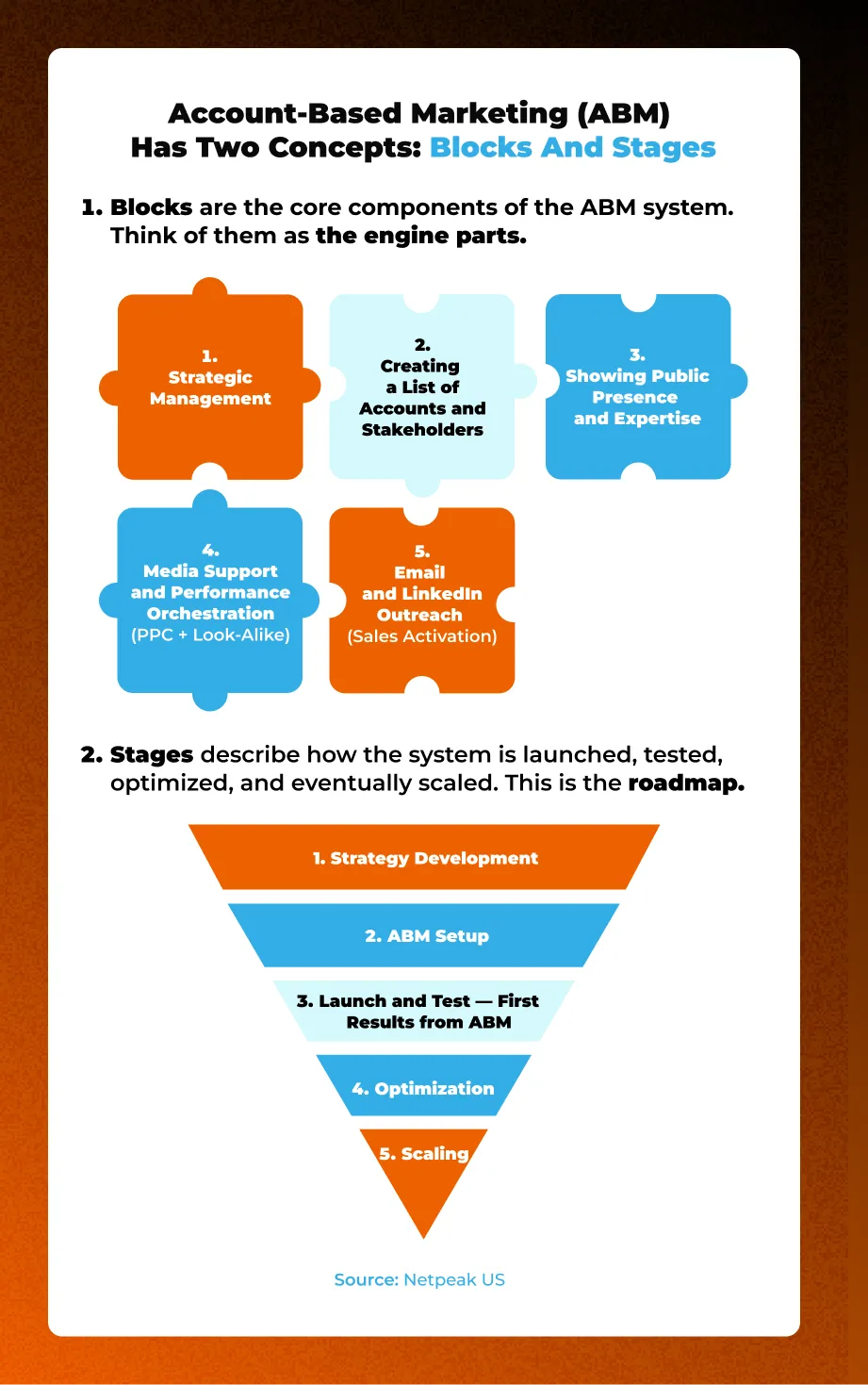
This logic is reflected in the Gantt chart you can download below.
ABM Implementation: Blocks
Here are five blocks your B2B business needs to go through. “The engine parts,” remember?
Block 1: Strategic Management
This section will help you to answer the following questions:
-
How will we generate revenue through ABM?
-
How will we determine if the system is functioning properly?
-
How will we manage it?
Task: Provide a clear step-by-step framework for launching an ABM system that aligns strategy, technical setup, and sales activity in one coordinated cycle.
In practice, this includes:
|
Developing an ABM Strategy |
|
|
Developed Strategy Implementation |
|
The result:
- Approved ABM strategy (goals, focus, and expected results)
- Clearly defined ICP
- Fixed business case: why ABM and what are the metrics of success
- Marketing funnel architecture
- Agreed-upon measurement model (what we count: accounts, stages, pipeline, and revenue)
- Defined roles and responsibilities between marketing and sales
- Agreed-upon timeline, scope of work, and budget
If there is no strategy, common goals, or measurement model, you will scale activity rather than results.
Block 2: Creating a List of Accounts and Stakeholders
This block helps you to understand: Who are we working with, and where does the future income lie?
Task: Create a database of potential customers that matches the ICP requirements. It should include information about companies, stakeholders, and contact details, along with unique attributes that help personalize communication and target similar audiences.
In practice:
-
Determine how to search for and verify the ICP parameters, and prioritize ICP segments.
-
Find accounts (companies) that fully match the ICP, as well as key stakeholders in these companies.
-
Enrich the database with additional data about companies and stakeholders for personalized communication.
-
Validate stakeholder contact details - clean up the database.
The result:
- A minimum target account list (TAL) of 50–200 ICP companies, as well as clear search and qualification criteria for further database collection.
- You validated the contact details of key stakeholders in target accounts.
- Additional data on companies, stakeholders, and their characteristics are collected to enable further personalized communication.
- The database is enriched with historical sales team data on previous interactions.
If there is no agreed-upon TAL or data for each stakeholder, further activities will simply be expensive targeting, not an ABM system.
Block 3: Showing Public Presence and Expertise
This section addresses the question: Why should these accounts trust us before we even make contact?
Task: Build a professional reputation, trust, and recognition among ICPs before making personal contact with future clients.
In practice:
-
Present your company and ambassador profiles on LinkedIn in a way that inspires trust and reliability.
-
Add the stakeholders collected in the database to your connections.
-
Build an expert presence through relevant comments, discussions, and reactions to stakeholder publications.
-
Useful posts appear in stakeholders' news feeds to prepare them for personal contact (these posts are seen by target accounts due to prior connections, likes, and comments rather than by the entire LinkedIn network).
The result:
- Packaged profiles of the company and its ambassadors (LinkedIn/website)
- Stakeholders added to connections
- Content created for working with ICP (positioning, cases, and expertise)
- Basic content presence launched in relevant channels
- First signs of recognition and interaction from stakeholders in key accounts
If the brand ambassadors do not inspire trust in target accounts, outbound and advertising will be less effective and more expensive.
Block 4: Media Support and Performance Orchestration (PPC + Look-Alike)
This block is about the following questions:
-
How to create a systematic media presence around target accounts?
-
How to warm up the buying committee and prepare them for direct contact with a sales representative?
Task: Create a targeted advertising ecosystem around the TAL to raise awareness, strengthen trust, and encourage meeting bookings.
In practice, this includes:
1. Analytical preparation:
-
Setting up landing page tracking
-
Defining KPIs (account engagement, cost per lead, marketing qualified lead, sales qualified lead, and meetings)
-
Preparing dashboards to monitor results
-
Developing a media plan and agreeing on budgets
2. Precise targeting of target accounts:
-
Launching campaigns to owners of collected email addresses of target companies
-
Targeting Google, LinkedIn, Meta, and TikTok
-
Segmenting audiences by role (buying committee)
3. Scaling through Look-alike:
-
Creating similar audiences based on TAL
-
Attracting new, relevant accounts with similar profiles
-
Expanding reach without losing quality
4. Creative and offer:
-
Development of advertising creatives that address specific ICP pain points
-
Testing of formats (videos, case studies, expert content)
-
Adaptation of messages to roles in the buying committee
5. Continuous Optimization:
-
Monitoring the cost of target actions
-
A/B testing of ads and segments
-
Budget adjustments based on actual performance
The result:
- Established media presence in the field of view of target accounts
- First signs of brand recognition among the buying committee
- Increased conversion in outreach and meetings
- A customized system for measuring advertising effectiveness
- A clear understanding of which segments and creatives are actually driving the pipeline
Synchronize presence across channels to create stable demand. This is more about the availability of information across different channels than the system itself.
Block 5: Email and LinkedIn Outreach (Sales Activation)
This block addresses the question: How to convert awareness and interest into direct dialogue, meetings, and specific pipeline opportunities?
Task: Build a semi-automated system for personalized communication with stakeholders from target accounts to schedule meetings and move deals through the sales funnel.
In practice, this includes:
1. Technical preparation:
-
Warming up domains and email addresses
-
Setting up signatures and postmasters
-
Completing the ambassador LinkedIn profile preparation
2. Develop communication logic by:
-
Creating chains of personalized messages
-
Writing scripts for different roles in the buying committee
-
Forming trigger scenarios
-
Adapting messages to the industry and pain points
3. Launching and managing mailings:
-
Launching outreach campaigns to the collected database
-
Manual communication with stakeholders
-
Handling objections
-
Qualifying leads and scheduling meetings
The result:
- Scheduled meetings with target accounts
- Qualified opportunities in the pipeline
- A systematic personalization model based on ICP
- Synchronized movement between marketing and sales
- A predicted volume of sales activations per month
If outreach is not personalized and synchronized with media support, you create "cold pressure" rather than systematic account progress.
ABM Implementation: Stages
Here are the stages your B2B business needs to go through. It’s the roadmap we talked about earlier.
Stage 1: Strategy Development
Goal: Develop an ABM strategy and a detailed six-month implementation roadmap.
At this stage, it is important to:
-
Conduct an analysis of the market, demand, competitors, product, customers, and sales.
-
Set SMART goals.
-
Develop a strategy: ICP, communication, focus markets, product packaging, and positioning.
-
Choose tactics: tools, methods, and standards.
-
Plan implementation: Gantt chart, team, resource calculation.
-
Ensure analytics and control: KPIs and a dashboard.
Without a clear strategy, KPIs, and coordination with sales, ABM will turn into a set of activities with no predictable impact on revenue.
Stage 2: ABM Setup
Goal: Prepare the necessary infrastructure to launch an ABM campaign: build a database of accounts and contacts, set up advertising and outreach, optimize profiles, and create message distribution systems.
At this stage, it is important to:
-
Start collecting and enriching the database by finding and verifying stakeholder contacts for the selected ICP.
-
Optimize the LinkedIn infrastructure by preparing ambassador profiles, connecting premium packages, and manually warming up accounts for secure automation.
-
Ensure email "digital hygiene" by creating signatures, connecting postmasters, and warming up addresses before focused communication.
-
Form a content arsenal by preparing publication templates, visuals, and automation scripts (personalized templates).
-
Set up PPC with email and look-alike targeting by preparing an advertising account, analytics, audiences, and creatives for media support.
-
Launch engagement mechanics by starting to comment on stakeholder content to build "recognition" before direct contact.
-
Prepare outreach by writing scripts, personalizations, and creating outreach campaign templates.
If channels are not synchronized and combined into a common campaign, you simply launch separate activities and lose the synergy effect.
Stage 3: Launch and Test — First Results from ABM
Goal: Launch all communication channels in line with the strategy to obtain initial feedback and results. Measure the actual effectiveness of the chosen tactics and test the ABM strategy's hypotheses.
At this stage, it is important to:
-
Continue searching for and enriching the database of accounts and stakeholders.
-
Regularly publish high-quality content on the company's and ambassadors' profiles.
-
Interact with stakeholders in discussions of publications.
-
Launch PPC campaigns and test creatives.
-
Prepare personalizations and launch outreach chains.
-
Qualify, score, and prepare leads for meetings.
-
Analyze the operational KPIs of each tool weekly.
-
Plan next steps based on the results, and prepare new materials.
If there are no initial signs of demand or meetings, it is too early to scale up. First, correct your messages, channels, or ICP.
Stage 4: Optimization
Goal: Convert accumulated interest into closed deals and payments. Increase the profitability of the ABM system by scaling effective tactics and eliminating ineffective ones.
At this stage, it is important to:
-
Iteratively update the ICP by continuing to search and enrich the database using profiles of accounts that have already shown interest or become customers.
-
Scale media pressure by optimizing current campaigns on LinkedIn and Google Ads and connecting Meta Ads to "push" stakeholders through retargeting.
-
Improve the content strategy by highlighting content formats with the highest engagement rate and implementing new tests (video cases and industry reports).
-
Refine outreach chains by conducting A/B testing of personalization and message structure to increase conversion to scheduled meetings.
-
Systematize lead management to ensure smooth qualification and scoring of leads and prepare the sales team for the final stages of negotiations.
-
Identify "profitable connections" by finding combinations of channels and messages that provide the fastest path from contact to contract.
If you can't identify which tactics are driving deals, you're scaling chaos, not a system.
Stage 5: Scaling
Goal: Convert accumulated potential into the final stages of the funnel: meetings, substantive negotiations, and signed contracts. Fully use the channels that already work and add tools to strengthen their performance.
At this stage, it is important to:
-
Finalize work on the database by completing the account collection and applying alternative methods to identify "hard-to-reach" stakeholders.
-
Maximize media coverage by scaling PPC campaigns on LinkedIn, Google, and Meta Ads, focusing on the most conversion-friendly segments.
-
Use Outreach to drive interest by implementing a follow-up and personalized reminder strategy to move "warm" stakeholders into the appointment phase.
-
Strengthen social selling by activating interaction in discussions and continuing to publish effective content.
-
Implement direct tools by launching auxiliary mechanisms, such as narrowly targeted landing pages for specific segments, offline events, and gifts, for personal contact with top accounts.
-
Synchronize the deal path by ensuring the fastest possible transfer to the sales team through smooth lead qualification and scoring.
If there is no stable economy and predictable results, scaling will only increase costs, not revenue.
Project Team: Building ABM
Strategy is only the starting point. In real business, none of it works without a well-coordinated team behind it. People turn Gantt charts, roadmaps, and tactical plans into meetings, deals, and revenue.
At its core, ABM is a collaboration between marketing and sales. Each role supports a specific stage of the account’s journey through the funnel — from the first touch to the signed contract.
That’s why, before thinking about scaling, it’s important to clearly define who is responsible for what in your ABM system.
|
Role |
Area of Responsibility |
|
CMO & Head of Sales |
Strategic oversight, synchronization of marketing with sales, and ROI control. |
|
ABM Strategist |
Campaign architecture, ICP development, positioning, and offers. |
|
PM (Project Manager) |
Team coordination, deadline compliance, and weekly reporting. |
|
Researcher |
Search, verification, and deep enrichment of the target account database. |
|
SDR |
Direct communication, outreach, email/LinkedIn warming, qualification, and scheduling meetings. |
|
PPC Specialist |
Advertising setup and optimization (Google, LinkedIn, Meta, TikTok). |
|
Technical / Developer |
Technical setup: CRM integration, landing page configuration. |
|
Analyst |
Tracking stakeholder micro-conversions, dashboards, and automation of readiness signals. |
|
LSM |
Developing ambassador profiles. |
|
Creative Team |
Content creation, copywriting, and design. |
Instead of a Conclusion: Two Ways to Attract Key Accounts
There are two main ways to launch ABM.
#1: To Build It In-House
This means creating a strategy, assembling a team, building processes, testing ideas, fixing what doesn’t work, and testing again. With time and persistence, this approach can lead to a stable ABM model within a few quarters.
To make this process easier, we’ve prepared a Gantt chart for launching ABM from scratch. It’s a practical project plan your team can follow at every stage — from defining the strategy and building an account list to launching channels, activating sales, and optimizing performance.
#2: To Launch ABM with the Help of an Experienced Team
A specialized ABM partner can help you avoid common pitfalls, test strategies faster, and protect your reputation. After all, key accounts are limited — and you rarely get a second chance to make a first impression.
At Netpeak, we treat ABM not as a theory but as a managed growth system. We help companies build the entire process and measure real business results.
This practical experience allows us to break the launch into clear stages, identify bottlenecks early, and build a realistic roadmap for growth.
If you’d like to discuss how ABM could work for your business, book a meeting with the author of this guide via Calendly.
Guide Authors
Maksym Sokolyuk
Chief Business Development Officer at Netpeak with over 10 years of experience in B2B marketing and business development. Over 10 years of experience in B2B marketing and business development.
He specializes in building growth systems for B2B companies, developing go-to-market strategies, implementing account-based marketing, and synchronizing marketing and sales. He has worked with SaaS, IT, and service companies, helping them enter the enterprise segment and scale revenue through strategic accounts.
Kateryna Gusachenko
An ABM manager at Netpeak and an expert in B2B marketing and ABM strategy implementation. With over 12 years of strategic marketing experience, she specializes in strategy development, identifying the ideal customer profile (ICP), account research, channel orchestration, and analytics.
She helps launch and scale ABM projects for B2B companies across various niches.
FAQ
What is ABM in simple terms?
ABM is a B2B marketing approach in which a company works with specific target accounts rather than with mass leads. Marketing and sales are personalized to the tasks and roles of the buying committee.
Who is ABM suitable for?
ABM is best suited for B2B companies with a high average order value, a long sales cycle, a complex decision-making process, and a limited number of potential customers. Examples include SaaS, B2B services, enterprise solutions, IT, and consulting companies.
How should you implement ABM, and where should you start?
Start by forming an ABM strategy, which includes defining your ideal customer profile (ICP), selecting target accounts, setting goals with the sales team, and building a KPI measurement model.
How long does it take to launch ABM?
You will see the first results in 3-4 months, but it takes 5-6 months to fully implement an ABM system. This is why using a step-by-step plan and a Gantt chart is important.
How do you measure ABM effectiveness?
ABM effectiveness is measured by account-level KPIs, including engagement, meetings, opportunities, pipeline impact, and revenue. The most important indicator is ABM ROI, not just cost per click or lead.

 0
0
 0
0
 0
0
 0
0
Related Articles
Why Your Amazon Pet Ads Are Getting More Expensive Every Quarter Since 2025 (and How Smart Brands Manage It)
What happened to the auction prices? Where is the margin going, and what should be done next quarter?
How to Track Brand Mentions in AI Search? Find Out Whether You Are in the Answer
Being mentioned in an AI search boosts visibility. Discover how to monitor your brand mentions in ChatGPT, Perplexity, or Gemini and follow our approach to higher mention frequency.
5 Questions to Expose an Amazon Agency That Can’t Handle Pet Brands
A field guide for CMOs who are tired of getting sold smoke and mirrors — and want an agency that actually understands the difference between a kibble and a kernel.