
Overall, 60% of Americans — and 74% of those under 30 — use AI. It’s become their psychotherapist, business adviser, and travel planner. So, it’s only natural that AI becomes their new Google, too.
Brands now need to learn how to appear in this new type of search and know how to track AI visibility to understand how they are represented there. AI search summarizes opinions, picks favorites, and shapes decisions. If your brand is part of that story, you want to know. If it isn’t, you really want to know.
In this guide, we’ll show you AI visibility tracking tricks, what actually works in 2026, and how to make AI mention your brand (based on Netpeak US’s real-life experience).
Name Drop: What Are Brand Mentions in AI Search
Brand mentions in AI search are moments when your company, product, or name appears inside an AI-generated answer as part of the text itself.
For example, someone asks AI like ChatGPT, Claude, Perplexity, or Gemini: “What’s the best skincare brand for sensitive skin?” And they reply: “Brands like CeraVe, La Roche-Posay, and The Ordinary are great options for sensitive skin.”
If your brand is named, you’re part of the recommendation, and that means a lot:
-
AI-generated summaries, such as Google’s AI Overviews, reached over 1.5 billion people per month. 40% of Americans use at least one AI chatbot monthly.
-
$750 billion in US revenue will flow through AI-powered search by 2028. AI search traffic is growing 165x faster than traditional organic search.
-
The top 50 brands receive 29% of all AI Overview mentions, concentrating influence among strong players in their niches.
-
47% of people have used AI to help make a purchase decision, and 57% to find the best prices.
Brand mentions in AI search are the new word-of-mouth, and you need to know what they say behind your back.
The world is changing, and businesses need to adapt. AI is here to stay, so you need to use it to your advantage. If you want to create a Generative Engine Optimization (GEO) strategy for your company to show up in AI search results, give us a call!
Mentions vs. Citations: What's the Difference
Not every appearance of your brand in AI search is the same. There are two main ways it can appear in an answer: as a mention or a citation.
Mentions
It’s when the AI references your brand in the text, making it part of the conversation.
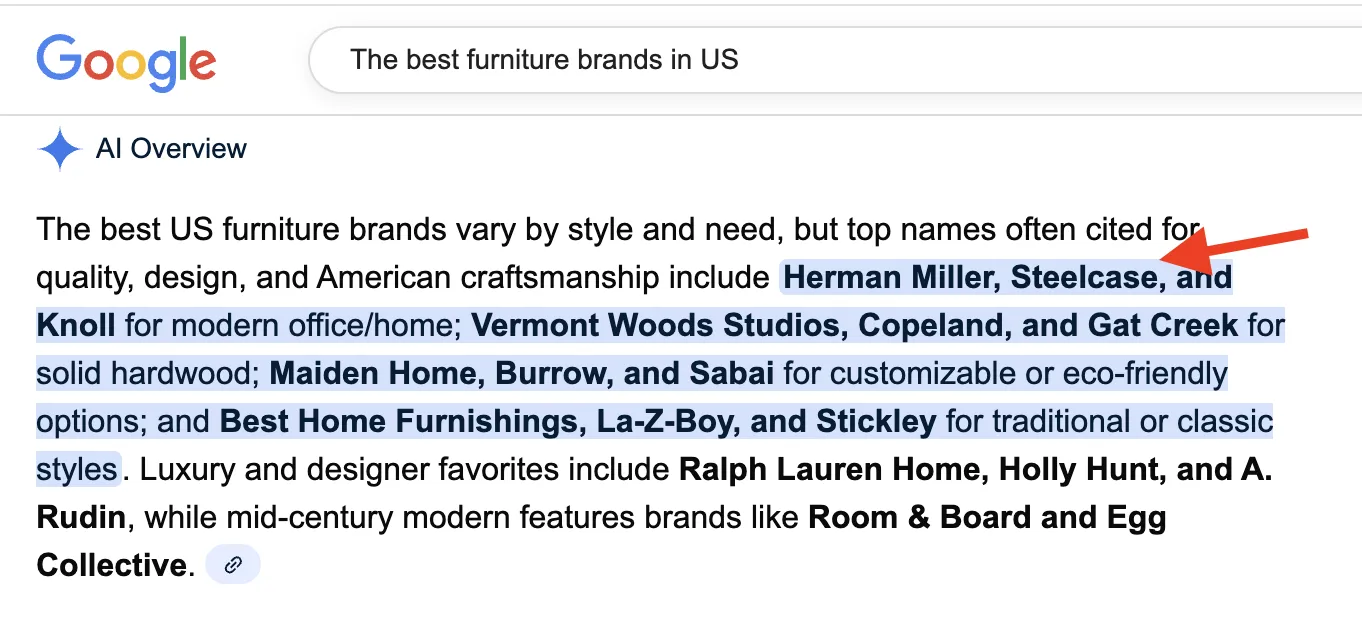
You get awareness, trust, and mental availability in the user’s mind. Even if the user doesn’t click on anything, they will still know your name. This is the closest thing to word of mouth.
Citations
It’s when AI names your brand and points to you as a source (usually with a link). Citations make you treated as an authority.
Citations can drive traffic, generate leads, and directly impact business.
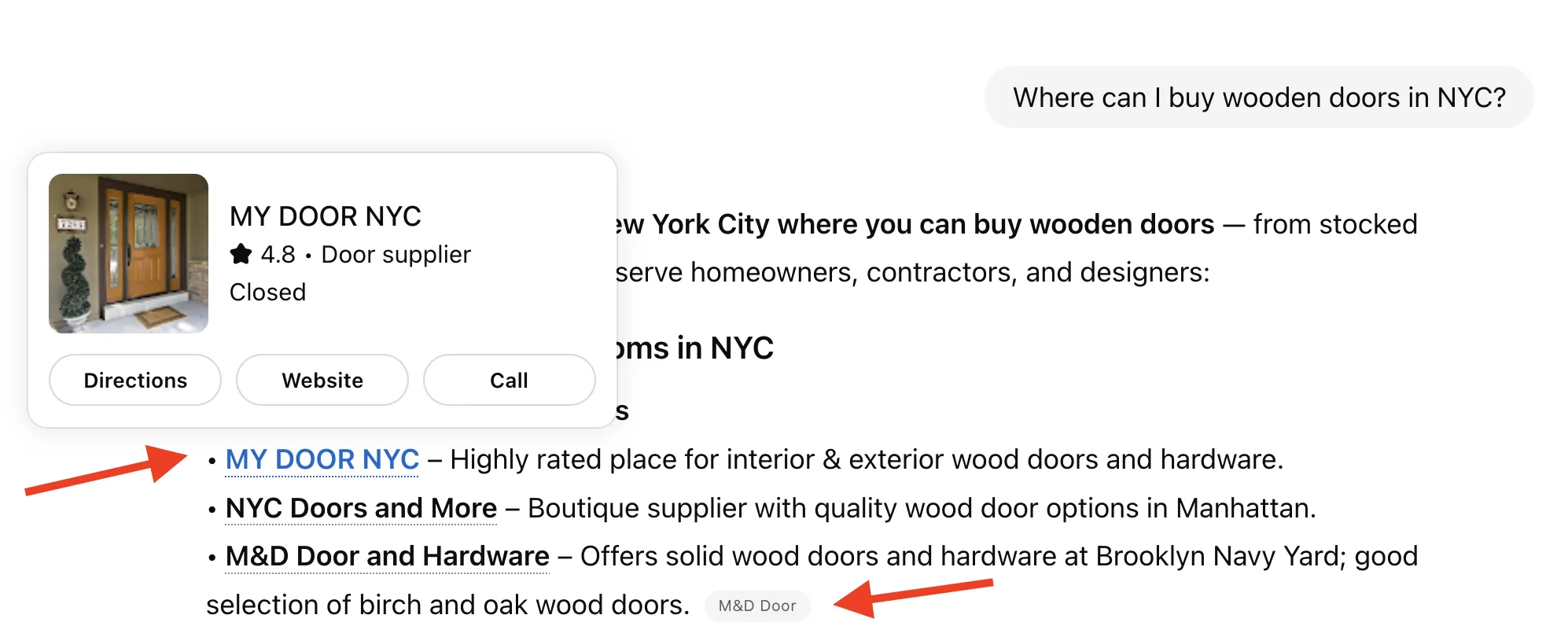
Two Ways to Spy on AI Search Results
It is important to know whether AI search tools such as ChatGPT or Gemini mention your brand in their responses. Here are two ways to track brand mentions.
Manual Way: Ask AI What Your Customers Ask
-
Open Google, ChatGPT, or Gemini and type: “Good skincare brand for sensitive skin” or “Top moving companies in Brooklyn” whenever your business is about.
-
See if your brand appears. Do this once a week with 5-10 core queries from your niche.
-
Create a small table with “Date”, “AI Tool”, “Query”, “Was my Brand Mentioned?”, and “Notes”. Write the results to have some data to work with.

Automatic Way: Use AI Monitoring Tools
You can use tools to track whether your brand appears in AI-generated answers, saving you hours. They monitor whether your brand appears in AI answers, in which topics, how often, and how it compares to competitors.
Here are key metrics to track:
|
Metric |
What to Measure? |
Business Results |
|
Inclusion rate |
How often your brand appears in AI answers for a set of key questions (prompts) |
Higher inclusion means more visibility |
|
Citation coverage |
Of the times your brand appears, how often does the AI link to your website? |
This helps track whether AI trusts you as a source |
|
Share of voice |
How often your brand is mentioned compared to competitors in the same prompts |
This shows whether AI favors you or others |
|
Answer placement |
Where your brand appears in the AI answer: first on a list or last |
Being mentioned early usually means a stronger recommendation |
Your AI Visibility Tracking Toolbox
Here are the most talked-about tools for AI search monitoring — why you’d use them, how they work, and the business results they deliver.
Otterly AI
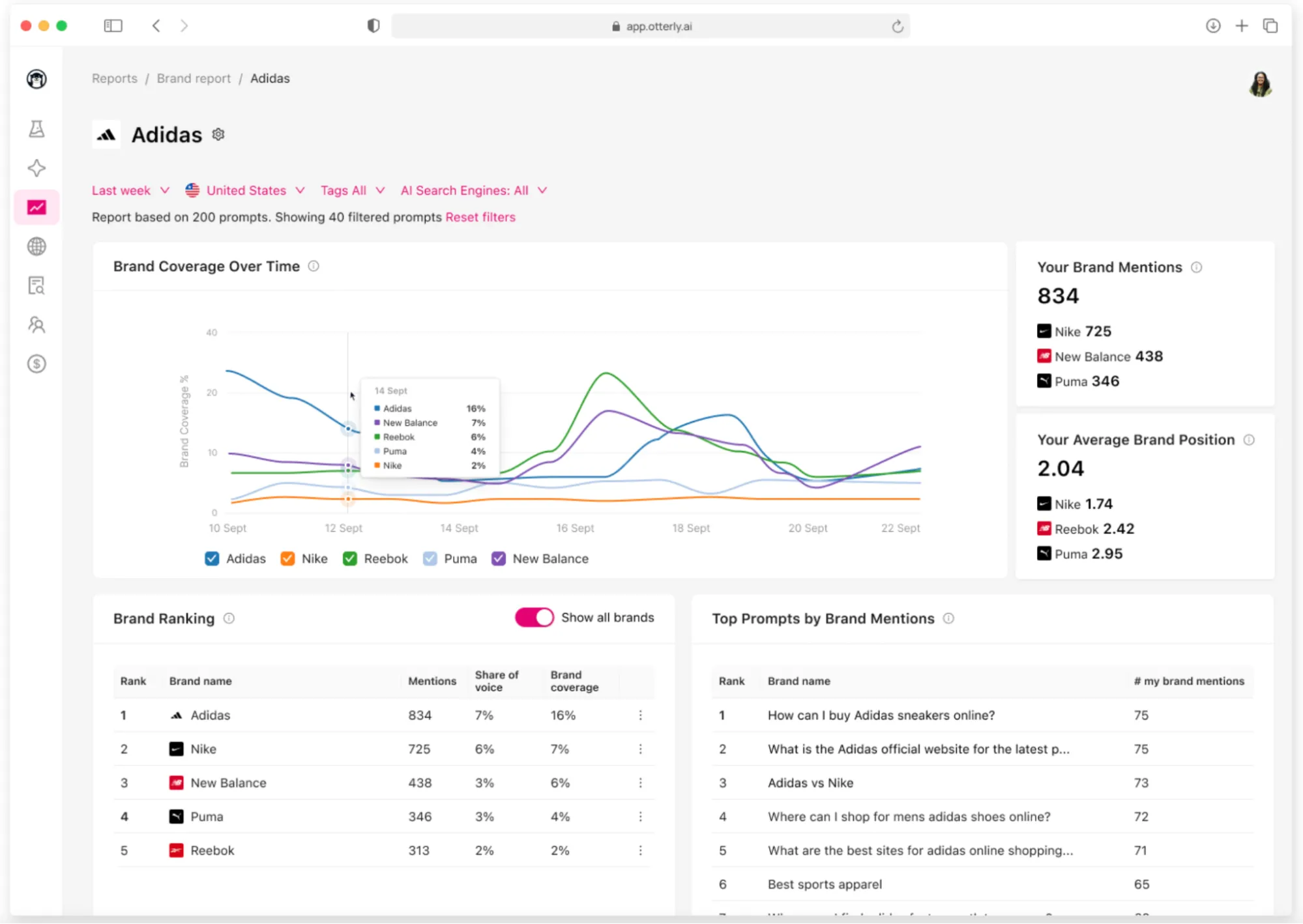
This AI visibility platform lets you add real customer questions like “best moving companies in Chicago” and checks what AI tools say in response. You can see whether your brand appears, how often, and how that changes over time.
Business value:
-
Quick insights into brand visibility AI
-
Historical trends so you can measure progress
-
Competitive comparison across a set of prompts
Who it’s for:
-
Teams are new to AI visibility
-
Growing businesses
-
Marketers who want a clean, simple dashboard
Cost: Plans start at around $29 per month and offer 15 search prompts for Google AI Overviews, ChatGPT, Perplexity, Microsoft Copilot, and Google Gemini.
Peec AI
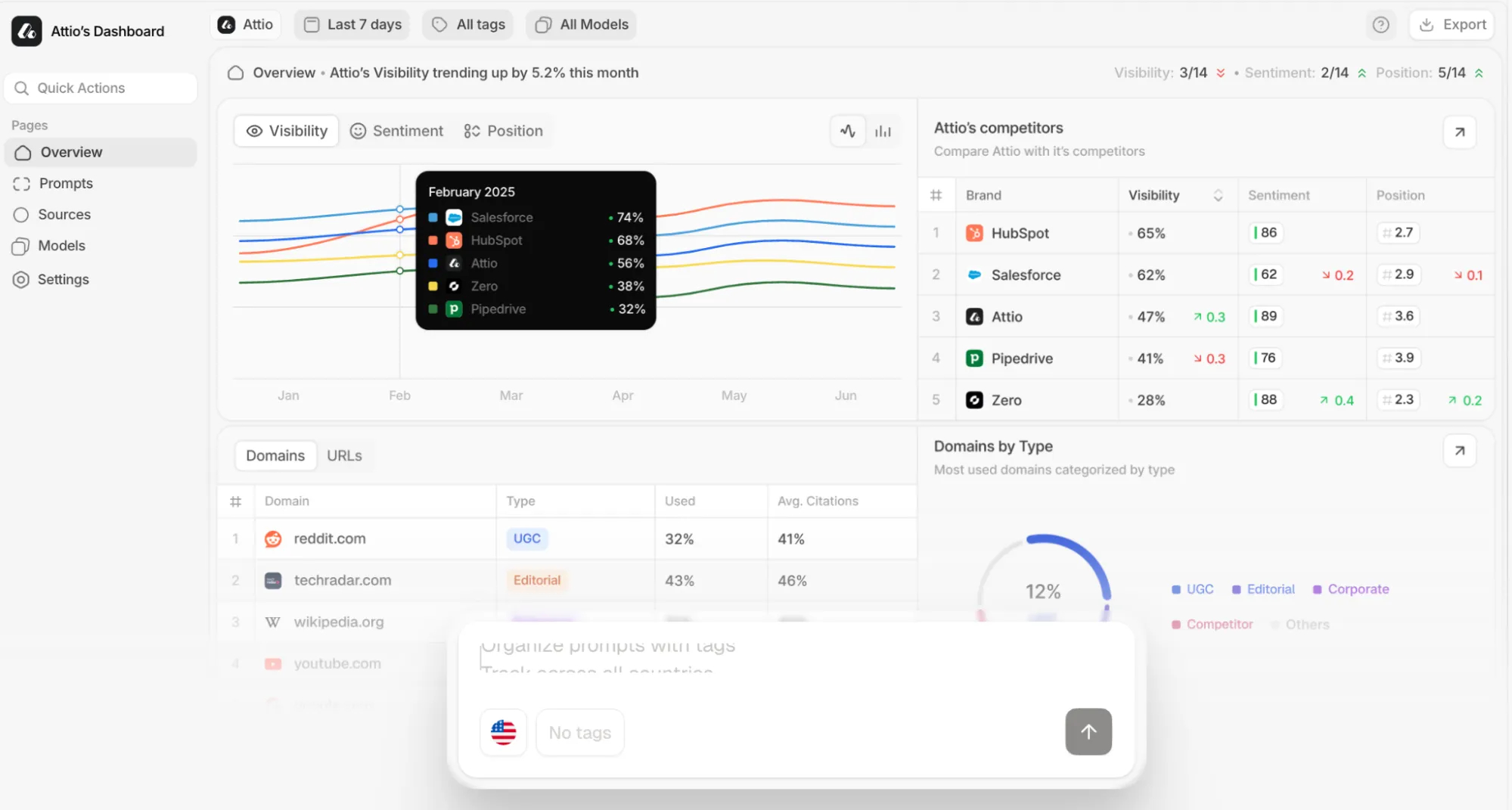
Most tools still come from a “traditional SEO mindset” — they adapt keyword tracking to AI and then translate it into prompts. Peec is built the other way around: it starts with questions and topics as first-class objects and treats them as living conversations.
Business value:
-
You see how often AI mentions you
-
Sentiment and share of voice insights
-
Competitive comparison for each question
Who it’s for:
-
Mid-sized brands
-
Teams tracking topics at scale
-
Anyone who wants regular, automated updates
Cost: Plans start at around €89/month (about $95) and offer to track up to 25 prompts on ChatGPT, Perplexity, and AIO.
Scrunch AI
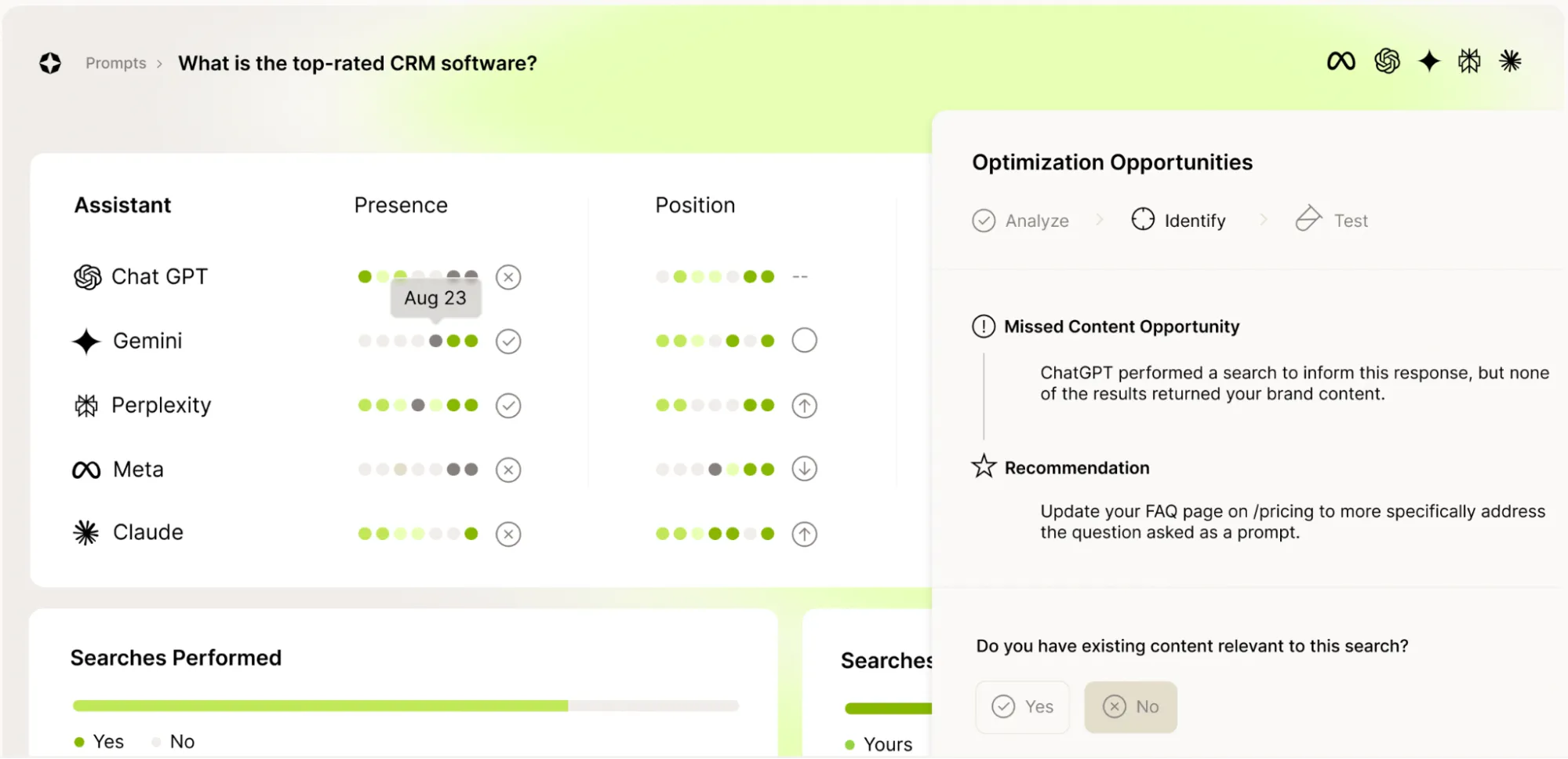
Scrunch analyzes the language, role, and tone AI assigns to your brand across different questions and user intents. So, it doesn’t just tell you if AI mentions your brand — it shows how AI talks about you.
Scrunch maps your brand’s perception and story inside AI answers.
Who it’s for:
-
Larger teams focused on brand story and AI narrative
-
Companies that care about accuracy and perception
-
Marketing and product teams need deeper insight
Cost: Starts at around $100/month and offers 100 prompts only for ChatGPT.
Profound
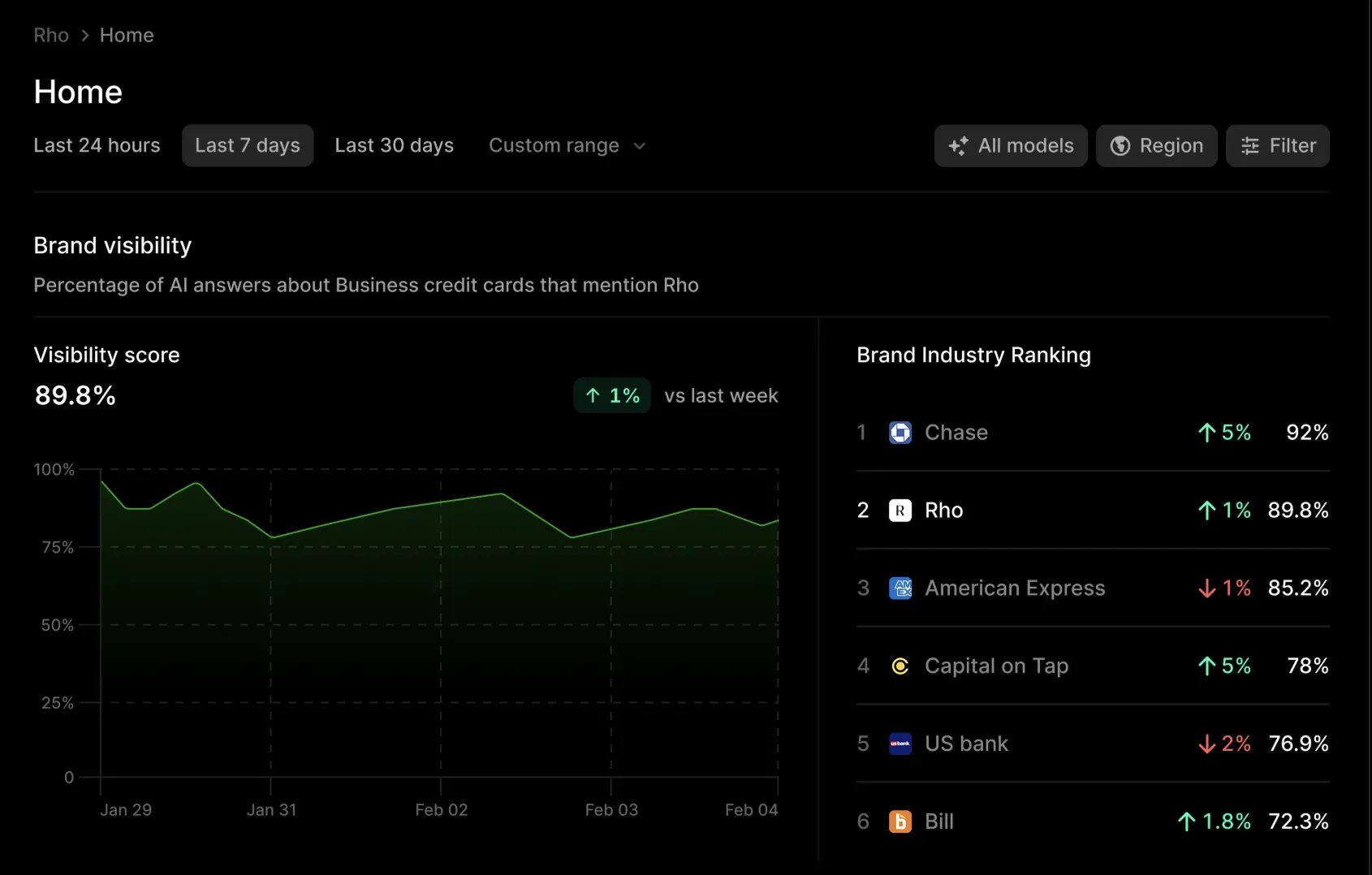
Profound treats AI answers as a market to analyze. It aggregates data across many prompts and engines to show trends, share of voice, and competitive position over time. It turns scattered AI responses into something you can manage.
Business results you get:
-
Big-picture view of AI visibility
-
See your share of voice versus competitors
-
Track progress over time to justify long-term investment
-
Enterprise reporting and custom dashboards
Who it’s for:
-
Larger companies or agencies
-
Teams that already use analytics to guide decisions
Cost: Starts around $99/month with 50 prompts for only ChatGPT tracking.
Here is comperison table of these four AI visibility tools:
|
Beginner-Friendly |
Key Business Value |
Basic Price |
|
|
Otterly AI |
⭐⭐⭐⭐ |
Simple AI brand visibility: basic tracking and trend dashboards |
$29/month |
|
Peec AI |
⭐⭐⭐ |
Prompt-focused: daily multi-engine monitoring and sentiment |
$95/month |
|
Scrunch AI |
⭐⭐ |
Deeper brand perception, narrative, and journey mapping |
$100/month |
|
Profound |
⭐⭐ |
Enterprise AI intelligence and multi-engine analytics |
$99/month |
How to Make AI Search Mention Your Brand: Netpeak US Experience
At Netpeak US, our job is to spot new marketing trends and turn them into real advantages for our clients. And yes — we practice what we preach. You know the saying “the cobbler’s children have no shoes”? We make sure ours do.
So we decided to test AI visibility tracking on ourselves. Do AI tools mention Netpeak when people search for agencies like ours? For which queries? And the big question: can we teach AI to mention us for the searches that actually matter?
What We Did
We picked one of our core strengths — healthcare marketing — and split it into three focused clusters: Dental, Healthcare Marketing, and Healthcare Online Advertising.
For each cluster, we created one in-depth pillar article and five to six shorter pieces that answered very specific, real-world questions. In the dental cluster, for example, we wrote articles like:
-
How to Market a Dental Clinic Online
-
The Latest Dental Clinic Marketing Trends in 2025
-
How to Promote a Dental Clinic in 2025?
-
What Are Some Successful Digital Marketing Campaigns for Dental Clinics in 2025?
Each article was built around clear, question-style subheadings with direct answers, naturally mentioned our brand, and was highly original.
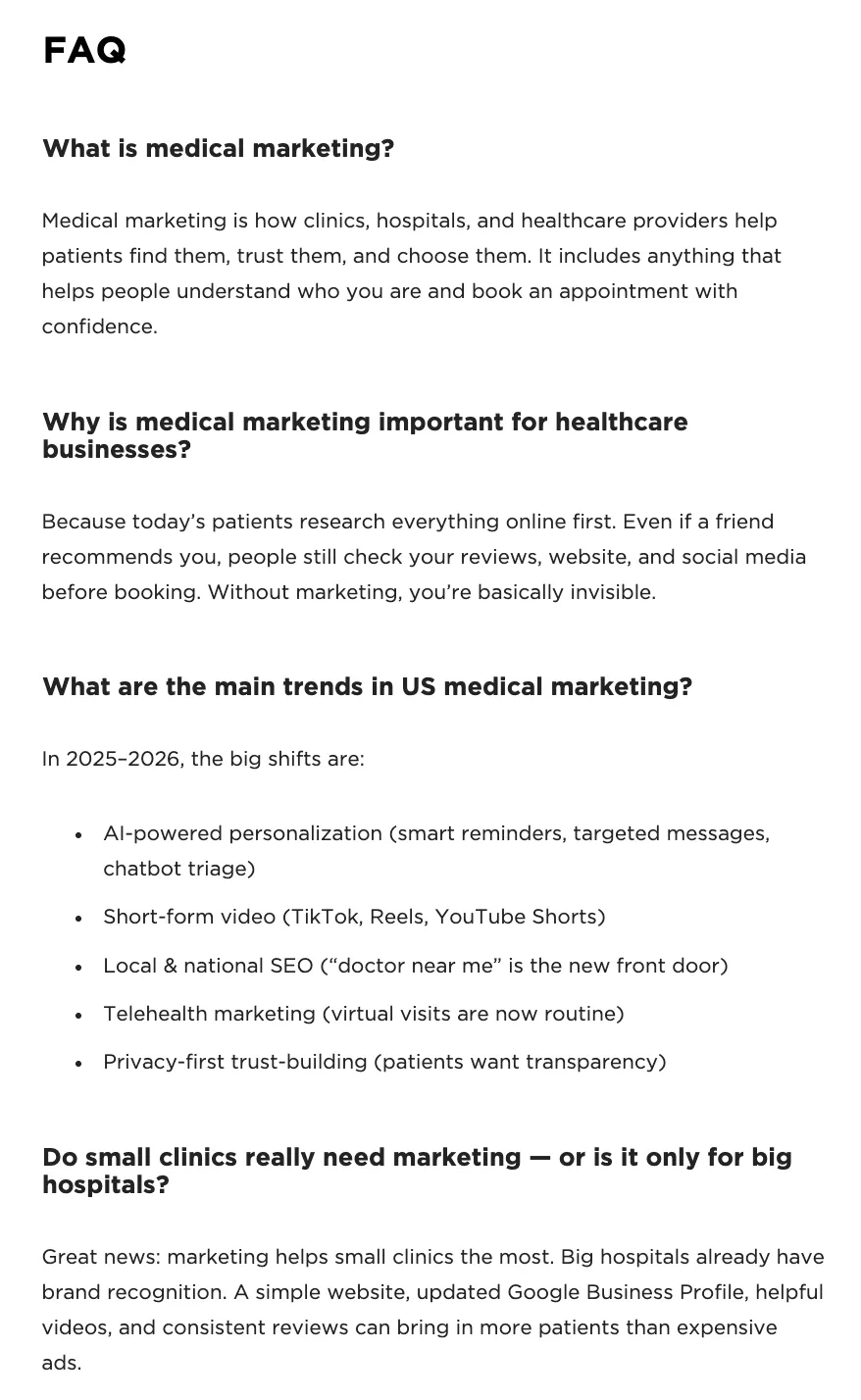
We also added FAQs, relevant statistics, tables, and lists — everything needed to make the content easy for AI search to understand and reuse. The goal was to signal “high quality” in every possible way.
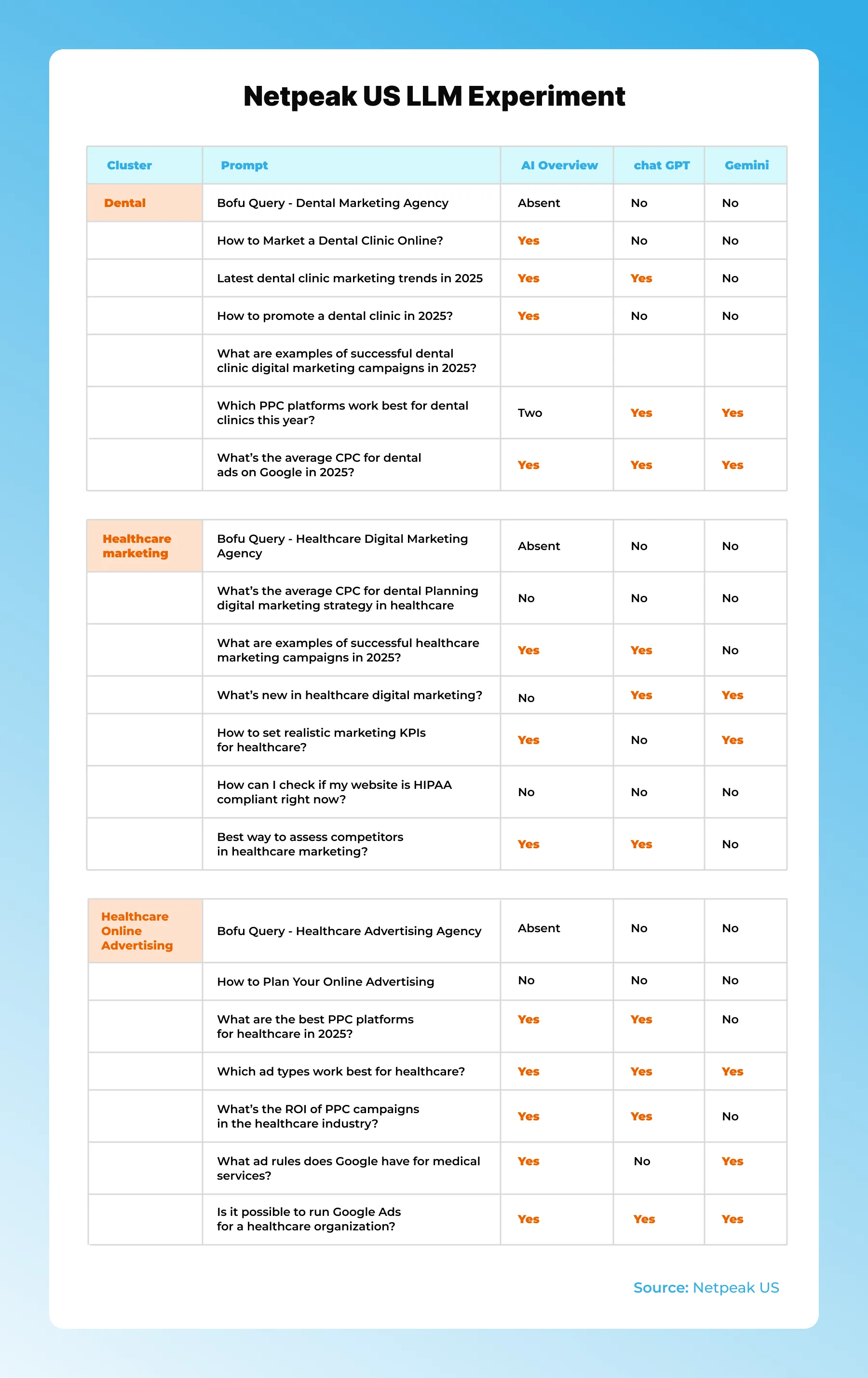
After publishing, we created a simple table to track whether our brand appeared in a set of chosen AI queries.
Results
-
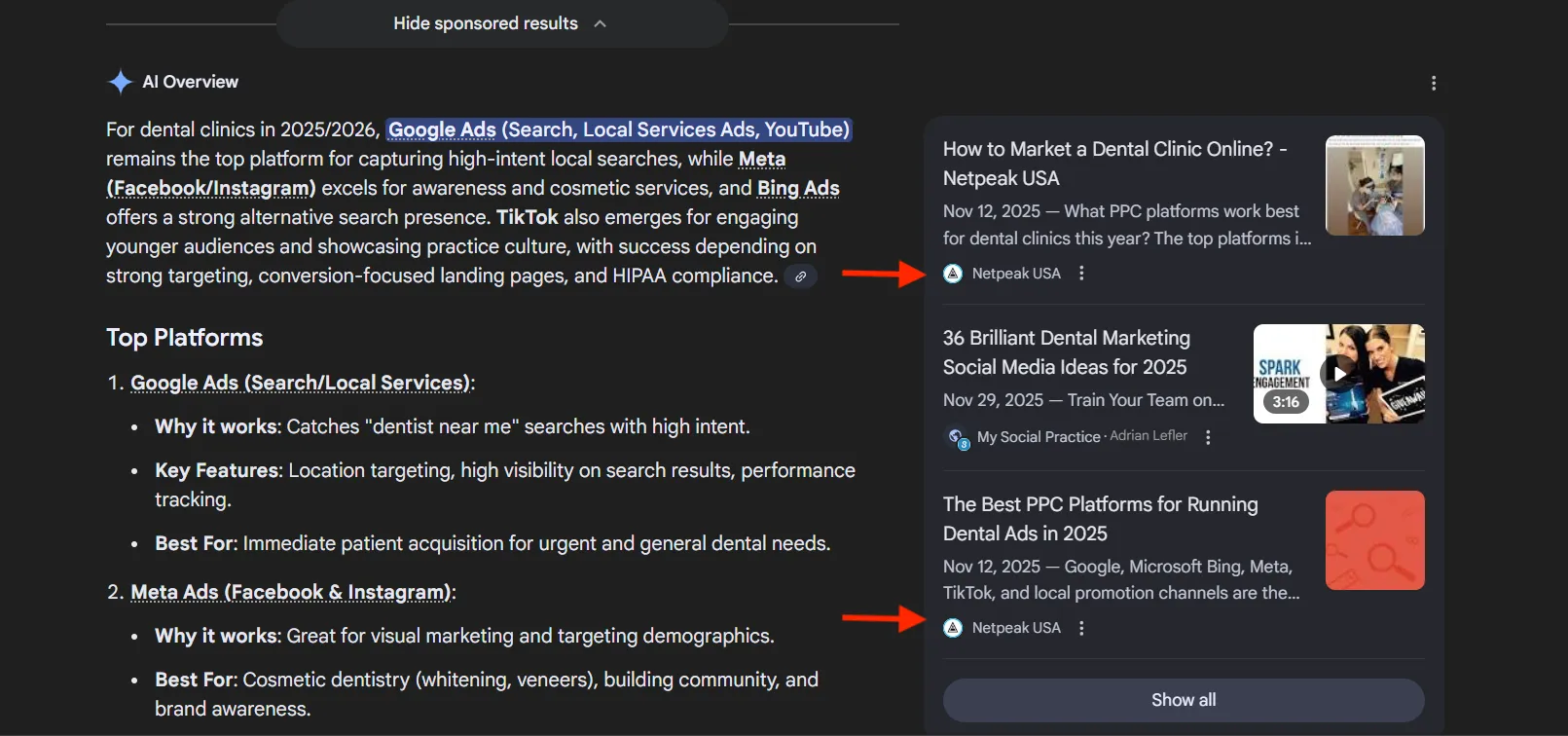
Google AI Overviews didn’t show our brand for the broad query “dental marketing agency.” But for most specific questions, Google displayed our articles on the right-hand side of the results.
One query — “Which PPC platforms work best for dental clinics this year?” — even returned our brand twice.
-
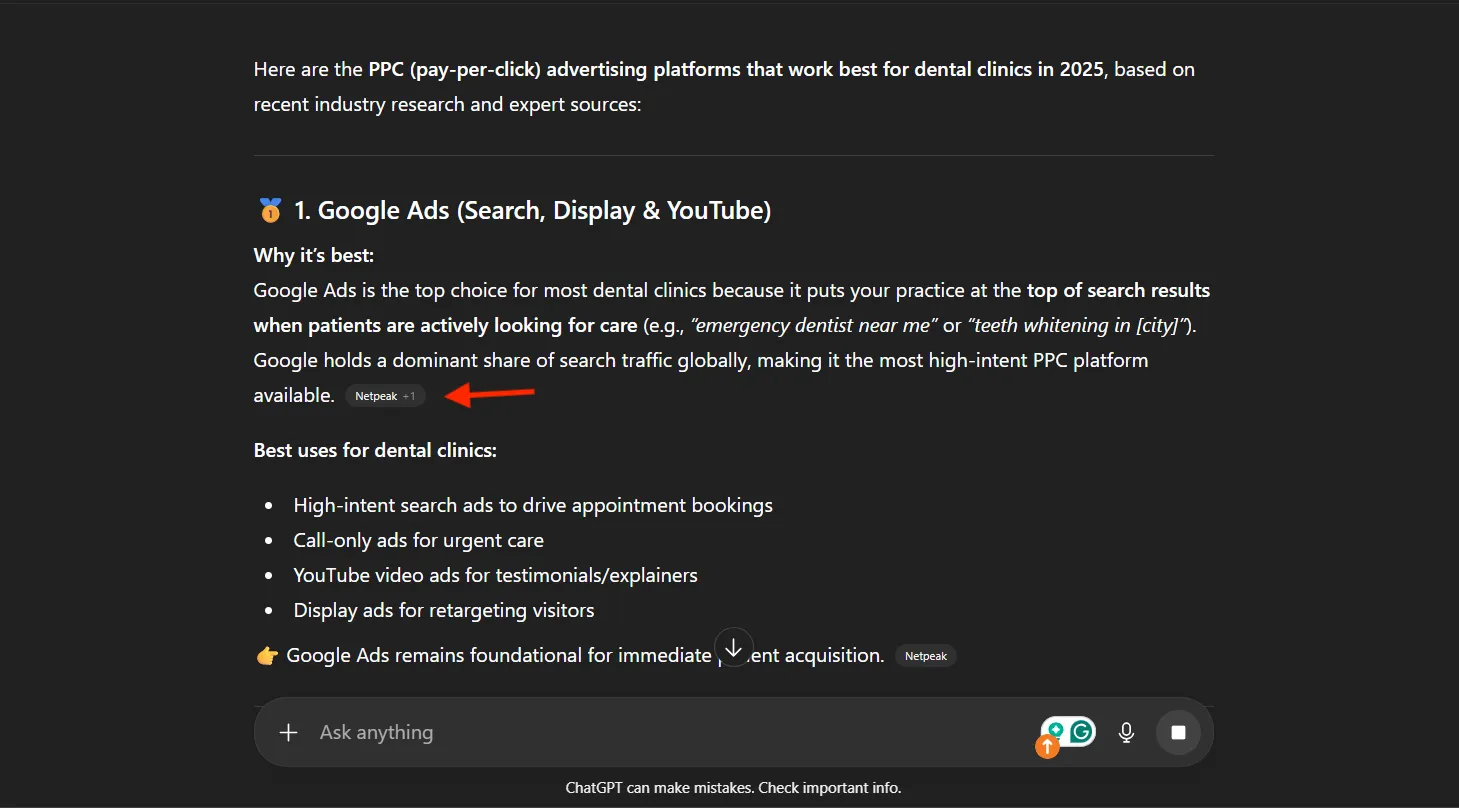
ChatGPT mentioned Netpeak and linked to us in about half of the cases we tested.
-
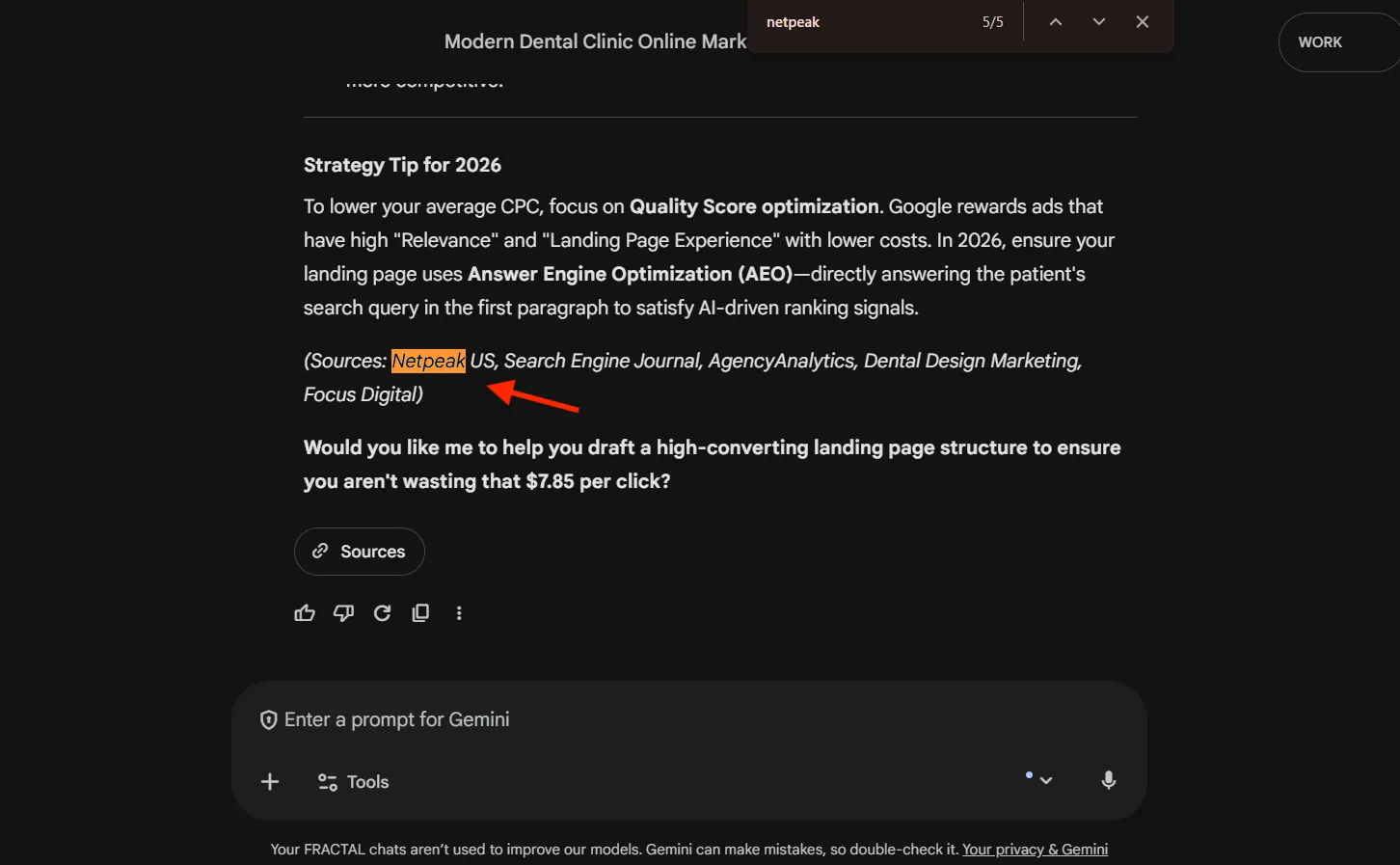
Gemini was more selective. It showed our brand only for two queries — “Which PPC platforms are best suited to dental clinics this year?” and “What is the average cost per click for dental ads on Google in 2025?” — and positioned us as an information source.
-
We also noticed an interesting pattern: sometimes the user’s query and the article AI shows don’t match word-for-word.
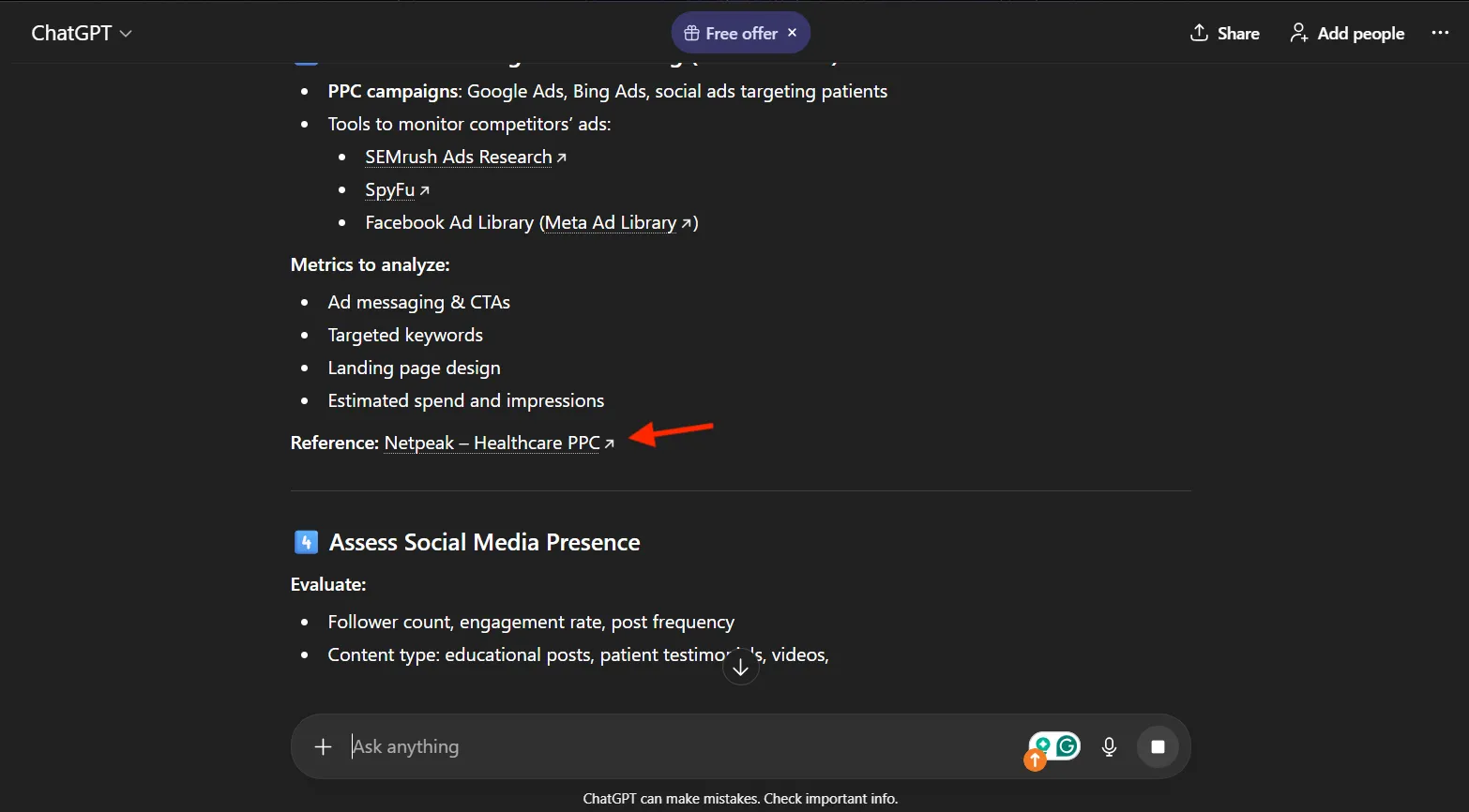
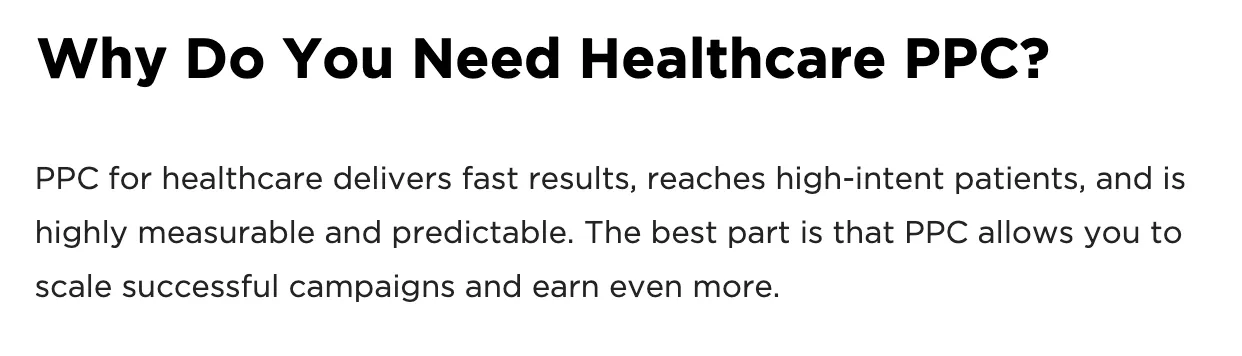
For example, when searching for “Best way to assess competitors in healthcare marketing?”, ChatGPT provided an article titled “Healthcare PPC” — close in meaning, but not the same. So, sometimes AI matches intent rather than exact phrasing.
Additionally, although our experiment focused specifically on brand mentions in AI chats, it also affects the Google AI Overview. So, they have visible connections and learn from one another.
What You Can Take with You
AI chatbots can be “taught” to mention a brand and even link to it in their responses. You just need to create content that answers as many real user questions as possible. Since people tend to trust AI recommendations, being named as an expert by an AI assistant already strengthens a brand’s reputation.
It’s still early to measure direct revenue from these mentions, but their impact is trackable:
-
When someone clicks a link from, for example, ChatGPT Search, the visit usually comes with utm_source=chatgpt.com, making it easy to spot in analytics.
-
In GA4, you can see sessions with this source or UTM and start understanding what those AI-driven visitors actually do on your site.
At Netpeak US, we love discovering new ways to promote businesses. But we're not going to forget about the good old classics, like traditional SEO. If you want your website at the top of the search results, give us a call!
Final Thoughts
People discover brands differently now. It’s not just about ranking on page one anymore; it’s also about AI search. If your brand isn’t among the top results, it’s invisible in this new layer of search.
Tracking brand mentions in AI tools provides early signals of that visibility. This shows if Google AI Overviews, Perplexity, ChatGPT, or Gemini recognize your brand, how often it appears, and which brands replace yours when it doesn't.
The good news is that you can teach AI systems to include your content in their responses by creating helpful content that answers real user questions. In other words, you can actively shape AI search.
FAQ
How to track your brand mentions in AI results?
Use AI visibility tools or manual checks to see whether Google AI Overviews, ChatGPT, or Gemini mentions your brand for key customer queries. Track these prompts regularly and log where you appear, how you’re described, and which competitors replace you.
What’s the difference between AI search monitoring and content optimization?
AI visibility monitoring shows you whether and where your brand appears in AI-generated answers. Content optimization is what you do after improving pages, guides, and FAQs, so AI systems are more likely to recognize and recommend you.
Which AI platforms should I prioritize tracking?
Start with ChatGPT and Google’s Gemini, since they influence the largest share of AI-driven discovery. Add Perplexity and Claude if your audience is tech-savvy or B2B.
Can small businesses influence AI search results?
Yes. By publishing clear, authoritative content that answers real customer questions, even small brands can train AI systems to recognize them and include them in recommendations.

 0
0
 0
0
 0
0
 0
0
Related Articles
Sustainability Marketing: 7 Smart Ways to Earn Trust (and Customers)
Learn how to grow your brand efficiently while using eco-friendly marketing practices to build trust and long-term revenue.
Why Your Amazon Pet Ads Are Getting More Expensive Every Quarter Since 2025 (and How Smart Brands Manage It)
What happened to the auction prices? Where is the margin going, and what should be done next quarter?
How to Track Brand Mentions in AI Search? Find Out Whether You Are in the Answer
Being mentioned in an AI search boosts visibility. Discover how to monitor your brand mentions in ChatGPT, Perplexity, or Gemini and follow our approach to higher mention frequency.