
Your online reputation today is a bit like a dressing room mirror — brutally honest and often unflattering. Customers post reviews, opinions, memes and the occasional rage-fueled comment on social media. Still managing reviews by hand? Are you also still using the old fax machine?
AI reputation management has become a must. Using AI in reputation management lets you monitor brand mentions automatically, detect sentiment shifts and get actionable insights before a small issue sparks a reputation wildfire.
The impact of generative artificial intelligence — from Google AI to OpenAI and beyond — has fundamentally changed the business landscape, including AI-powered reputation monitoring. The reality is that AI can now track your brand’s good, bad and ugly moments faster than you can think “Please don't screenshot that.”
How Does AI Affect Reputation Management?
AI affects reputation management the way power steering affects driving — you can technically do it without it, but why would you suffer?
According to Forbes, 98% of consumers read online reviews before buying, and 89% expect businesses to respond to all reviews. Not just the ones you want to call your mom about.
AI systems monitor brand mentions, customer feedback and online reputation signals across platforms like Google, Reddit and review sites. Instead of manually checking everything, an AI reputation management agent analyzes language, detects sentiment, spots trends and can even detect future shifts in how customers (and potential customers) feel about your brand. Because sometimes, you don’t want to be Amazon.
Some examples of how AI affects online reputation management (ORM):
-
Real-time monitoring of social media
-
Sentiment analysis that detects tone changes instantly
-
Machine learning models that identify recurring pain points
-
Automated flagging of negative content before it surfaces in search
-
Predictive analytics to forecast damage before it hits your results pages
The Benefits of Implementing AI in Reputation Management for Your Business
Using AI for reputation management gives you a competitive edge that mere mortals alone can’t match.
1. Real-time monitoring across every platform
AI checks reviews, social posts, forums and SERP changes faster than you can type “We apologize for the inconvenience.” Manual monitoring means checking platforms individually — Google Reviews in the morning, Yelp at lunch and social media when you think of it. Meanwhile, someone has already complained, shared a screenshot and turned into a viral meme.
AI-powered tools scan hundreds of sources simultaneously, tracking brand mentions on Reddit threads, niche review sites, TikTok comments and even obscure forums where your customers actually hang out. When a disgruntled customer posts at 11 p.m., your system knows by 11:01 p.m., which is long before you check your phone the next morning and have a panic attack.
According to Sprout Social’s 2025 data, nearly three-quarters of consumers expect a response within 24 hours if not sooner. Without AI monitoring working around the clock, meeting these expectations at scale is basically impossible.
2. Better understanding of the customer experience
Sentiment analysis shows what customers actually feel, not what you think they feel. Here’s the difference: A review says “The product works fine, I guess.” Manual reading? Sounds neutral, maybe positive. AI sentiment analysis? It can detect hesitation, lukewarm satisfaction and potential churn risk.
Natural language processing identifies emotion, intensity and even sarcasm in customer feedback — though let’s be honest, sarcasm detection is currently AI’s Kryptonite. Still, AI spots patterns across hundreds of reviews that a human would miss while drowning in spreadsheets. It connects the dots when 50 customers complain about your product in 50 different ways: “hard to open,” “required an engineering degree to assemble.” These insights transform scattered feedback into a prioritized road map of what actually needs fixing, not just what made it into the angriest ALL-CAPS review.
3. Automated issue detection
If 70 people complain about slow shipping, AI highlights the pattern instantly. Humans see individual complaints. AI sees the forest and the trees.
Machine learning algorithms identify recurring themes that might seem unrelated at first glance. Different customers might mention “texture,” “application” and “formula change” across different platforms over two weeks. AI connects these dots and flags a potential product quality issue before it becomes a full-blown crisis. PwC research reported that 32% of customers will stop doing business with a brand after a single bad experience. Catching patterns early means you can fix problems before they cause your customers to jump ship.
4. Improved customer engagement and satisfaction
Businesses can respond faster when they know exactly when and where problems arise. Speed matters more than most brands realize. HubSpot research found that 90% of customers rate an “immediate” response as important or very important when they have a customer service question, and 60% of those customers define “immediate” as 10 minutes or less.
AI-powered reputation management systems trigger alerts the second that negative feedback appears, route issues to the right team member and can even draft response templates based on the type of complaint. This level of responsiveness shows customers that their concerns matter — and they take note. Fast responses often get mentioned in follow-up reviews, creating a positive feedback loop that improves your overall rating.
5. Protecting your brand perception in search
AI helps spot harmful articles or negative results early — then you can fix them with search optimization. When someone Googles your brand name, the first page of results essentially becomes your digital storefront. One negative article ranking in position 3 can tank conversion rates.
AI-powered SERP monitoring tracks your brand’s search visibility daily, alerts you when negative content climbs the rankings and identifies opportunities to push it down with positive content. BrightLocal research shows that 87% of consumers read online reviews for local businesses. If those top search results tell a negative story, you’re losing customers before they ever reach your website. AI doesn’t just alert you to the problem — it helps you understand which content is gaining traction and why, so you can build a counter-strategy.
6. Actionable insights for product and service improvements
It’s like getting a focus group without having to entice people with snacks. Traditional market research is slow, expensive and often reflects what people think they’ll say in a focus group rather than what they actually post on Reddit. Focus group participants say things like “I value quality and craftsmanship.” Real customers say “Why does this thing beep so much?”
AI analyzes thousands of real customer comments to surface real pain points and wants. Instead of waiting for quarterly surveys, you get real-time feedback on what’s actually frustrating customers or delighting them. This transforms your reputation management from a defensive tool into an offensive strategy for product development and customer experience improvement.
Best Practices for Implementation
To build a reliable reputation management solution, follow these practical steps:
1. Centralize monitoring
Bring all platforms into one dashboard. Scattered monitoring creates blind spots. When your team checks Google Reviews on one platform, Yelp on another, social media on a third and your website feedback somewhere else entirely, critical mentions can fall through the cracks. It’s reputation management by treasure hunt, except the treasure is someone threatening to “NEVER order from you again” on a forum you didn’t even know existed.
A unified dashboard means your team sees every brand mention in one place — whether it’s a five-star review on Google, a rant on Reddit or a tagged photo on Instagram where you’re the villain.
This centralization makes it easier to spot cross-platform patterns. If customers are praising your product on Amazon but complaining about shipping times on Facebook, you need to see both of those simultaneously. Otherwise you’re celebrating great reviews while your logistics nightmare trends on Threads.
Most modern reputation management tools integrate with major review sites, social platforms and search engines to provide this single source of truth.
2. Train your AI models on industry terms
AI doesn’t excel at context. Generic AI models might misread industry-specific language. The financial services industry uses terms like “bearish” and “bullish” that confuse untrained models.
Industry-trained models perform significantly better. The investment in training your AI on your industry’s vocabulary pays off in fewer false positives and more actionable insights. Feed your AI system past reviews, customer service transcripts and industry-specific feedback to teach it the ins and outs of your business language.
3. Combine automated alerts with human review
Never let a bot be solely responsible for replying to angry customers. AI excels at speed and pattern recognition. Humans excel at judgment, empathy and understanding when rules need to be broken.
Set up your system so AI flags urgent issues immediately, but humans make the final call on responses — especially for high-stakes situations. A customer threatening legal action or posting about a safety issue needs human judgment, not an automated template. According to Sprout Social, 73% of consumers will buy from a competitor if you don't respond on social media. But answering with tone-deaf automated messaging might be worse than not responding at all.
The best approach: AI handles monitoring and categorization, humans handle strategy and communication. AI can draft suggested responses, but a person reviews and personalizes before hitting send.
4. Use AI-powered reports weekly
Track changes in sentiment, recurring complaints and emerging topics. Weekly reporting creates a rhythm that catches problems before they become dumpster fires while avoiding the psychological warfare of daily fluctuations.
Checking sentiment every single day is like reading WebMD when you have a headache — you’ll convince yourself everything is a disaster when really Karen just had a bad day and took it out on your Yelp page.
AI-powered reports should highlight:
-
Sentiment trend lines — Are things getting better or worse, and is it a trend or just Mercury in retrograde?
-
Volume spikes — Sudden increases in mentions often signal problems, viral moments or someone famous mentioned your brand name.
-
Recurring complaint themes — This is the top 5 issues actual customers mention, not the thing your CEO’s college roommate complained about once.
-
Competitor comparison — This shows how your sentiment compares to similar brands who are also probably having a rough week.
-
Platform-specific insights — They show which channels are actively hosting your public roasting versus which ones still like you.
These reports transform raw data into strategic intelligence. If AI shows a 15% drop in positive sentiment around product quality over three weeks, you know something changed — maybe a supplier, a formula adjustment or shipping issues. Without weekly tracking, you’d only notice when disaster strikes.
5. Integrate with your CRM
Reputation data should flow directly into your customer service system. When a customer who left a negative review calls your support line, your team should already know about it. When someone praises you on social media then visits your website, your sales team should see that context.
CRM integration creates a complete picture of each customer’s journey. It prevents catastrophically tone-deaf situations like sending a “We’d love your feedback!” email to someone who just left a one-star review titled “WORST EXPERIENCE OF MY LIFE.” Nothing screams “we don’t care” quite like auto-blasting promotional emails to people actively mad at you.
It also enables proactive outreach — if AI detects a longtime customer’s sentiment shifting negative, your account manager can reach out before they cancel their subscription and write a nasty review.
6. Create playbooks
Think of playbooks as your crisis management cheat sheets. When a customer posts “This arrived broken, and now my cat hates me,” you don’t want your team frantically messaging each other asking “What do we say?!”
Map out your game plan for the usual suspects: shipping nightmares, defective products and packaging problems that cause cat resentment.
What goes in a playbook?
-
When to use it: Does a single bad review need this response, or just when three customers report the same issue?
-
Response speed: Within 2 hours? Same day? (faster is almost always better)
-
Tone guardrails: Stay empathetic and solution-focused, not defensive or robotic
-
Escalation triggers: When do you loop in legal, PR, or the CEO?
-
Sample responses: Templates you can actually personalize (not copy-paste word for word)
Real talk example: Your “defective product” playbook might look like:
-
Respond within 2 hours (even if it’s only “We see you”)
-
Lead with a genuine apology that doesn’t sound like it came from a lawyer
-
Offer immediate replacement + rush shipping (make it stupidly easy for them)
-
Flag it for your product team — one defect is bad luck, five is a pattern
-
Follow up within 48 hours to make sure they'\’re happy (not just to close the ticket)
Having this dialed in means your team can handle crises confidently instead of panicking and making things worse.
7. Measure improvement
Track review scores, NPS and brand sentiment before versus after implementing AI. You know that saying “what gets measured gets managed”? It’s annoyingly true. Without actual numbers, you’re just vibing your way through reputation management and hoping for the best. Good luck explaining that to your boss when they ask for ROI.
What you should actually be tracking:
-
Average star rating: Track it across all platforms, not just the ones where you’re doing well (yes, even Yelp).
-
Review volume: More reviews usually means better visibility in search results. It’s like social proof that snowballs.
-
Response rate and speed: Are you answering reviews? How fast? Customers notice when you ghost them.
-
Sentiment breakdown: What percentage of reviews are positive vs. neutral vs. “I want a refund AND an apology.”
-
Net Promoter Score (NPS): Are customers actually recommending you, or just... not actively hating you? Track the trend over time.
Think of these metrics as your reputation report card. They’ll show you what’s working, what’s tanking and where to focus your energy. Plus, when leadership asks “Is this reputation management thing even worth it?” you’ll have the receipts.
How Netpeak Services Help
We don't just write about AI in reputation management — we actually build and run the solutions.
-
AI-driven monitoring of reviews and mentions
-
Sentiment analysis for every channel
-
Search reputation cleanup
-
Removal or suppression of harmful results
-
Customer feedback analysis
-
Content strategy based on what customers really think
You can see this in practice through our published case studies:
Improving a dietary supplements brand’s reputation
An online dietary supplement distributor came to us facing a common problem: positive customer experiences weren’t showing up in search results, while negative content — much of it from competitors — dominated their brand searches.
The Problem: Most negative content showed signs of aggressive competitor marketing: paid comments, unconstructive criticism and provocative articles. The brand also struggled with low-quality content created without company approval appearing in search results.
Our Approach: We started with comprehensive analysis across three key areas: maps and directory platforms (evaluating user profiles and reviews), review sites (analyzing tone of voice) and Google search results (identifying which sites mentioned the brand and their sentiment). We discovered the brand was mentioned across multiple platforms but lacked optimization and consistent monitoring.
What We Did:
-
Provided detailed recommendations for optimizing company profiles on existing review sites
-
Created a manual with specific recommendations for encouraging genuine customer reviews
-
Analyzed posted reviews for compliance with site rules
-
Monitored and guided responses to negative reviews
-
Identified additional directories and catalogs to register the brand
-
Published informative articles to make positive, relevant content more visible than outdated negativity
Results:
After five months of strategic monitoring and damage control, we achieved the holy trifecta of reputation management:
-
Neutralized the haters — Timely responses across all platforms turned non-constructive negative feedback into productive conversations (or at least stopped them from spiraling).
-
Rebuilt customer trust — Properly configured tracking and active engagement on maps, and directory sites reminded people that real humans actually work here.
-
Dominated search results — Comprehensive work across social networks, review pages and PR articles flipped the script on branded searches, pushing negative content out of the top 10 entirely by month five (yes, we checked obsessively).
Removing negativity from Google Top 10 in four months
DOM.RIA, Ukraine’s leading real estate marketplace, faced reputation challenges typical of large platforms where thousands of transactions happen daily. Despite having a dedicated team managing customer feedback internally, negative reviews on social media, review sites and Google Maps were affecting their search visibility. As a real estate platform dealing with expensive purchases, Google categorizes DOM.RIA as a YMYL site and evaluates it with heightened scrutiny.
The Challenge: Negative and neutral content dominated search results for brand queries. With customers making major financial decisions based on what they found in search, DOM.RIA needed to clean up their search reputation quickly while maintaining authenticity.
Our Strategy:
We tackled the reputation crisis with a three-pronged approach:
-
Played review detective — We studied each negative review individually to separate legitimate complaints from rule-breaking nonsense, then sent the latter to moderators for removal.
-
Crafted damage-control responses — We worked with DOM.RIA’s team to write replies that actually showed accountability and customer care (not just “sorry you feel that way”).
-
Optimized their digital presence — We provided recommendations for their Google My Business profiles and YouTube channel, because video reviews now influence purchase decisions more than your BFF telling you that you have to have it.
Implementation: The key to success was tight collaboration. DOM.RIA’s team responded quickly and efficiently to customer concerns while actively encouraging satisfied users to leave positive feedback. We posted informative articles and reviews to boost visibility of relevant, positive content above outdated information. We optimized their presence across all services needed for reputation building.
Results in Four Months:
-
Completely eliminated all negative content from Google’s top 10 search results
-
Increased pages with positive tone by 10x in the top 10
-
Significantly reduced pages with negative and neutral tones
-
Improved positive review ratio from 25% to 75% through proactive internal work with customer feedback
The results came from consistent collaboration and quick problem-solving. Both teams engaged deeply with tasks from day one, allowing us to implement strategy efficiently.
We use AI where it accelerates results and humans where judgment matters. Check out our other case studies and customer stories.
Tips on How to Choose an AI Reputation Management Tool
To avoid choosing a tool that promises “AI magic” but then gives spreadsheet energy, follow these criteria:
-
Look for real-time monitoring
-
Check sentiment accuracy with sample texts from your industry
-
Ensure multi-platform coverage
-
Look for integrations with your CRM or helpdesk
-
Evaluate reporting — dashboards should make sense to users, not require decoding
-
Test automation features but never trust them blindly
-
Examine pricing transparency — if a tool hides prices, it’s rarely good news
Comparison of Different Tools for Different Use Cases
|
Use Case |
Best Tool Type |
Pros |
Cons |
|
Local businesses |
Review aggregators |
Simple, fast, automated replies |
Shallow analytics |
|
Mid-size brands |
CRM integrated AI tools |
Balanced price and insights |
Limited predictive analytics |
|
Large enterprises |
Enterprise AI suites |
Deep sentiment, forecasting, data fusion |
Expensive and complex |
|
SEO-driven brands |
Search-focused ORM tools |
Great for SERP cleanup |
Weak social listening |
Hot take: A dentist and a Fortune 500 retailer probably shouldn’t use the same system.
Ethical Considerations
AI is helpful, but it comes with risks:
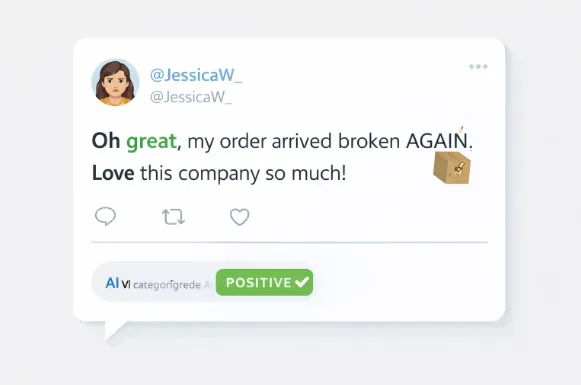
Misinterpreting sarcasm or cultural nuance: A customer tweets “Oh great, my order arrived broken AGAIN. Love this company so much!” — the words “great” and “love” might confuse AI into categorizing this as positive when it's clearly sarcastic. Cultural differences compound the problem. “Not bad” reads as lukewarm in American English but often means “quite good” in British English. Training AI on your specific customer base helps, but you still need human oversight to catch these nuances.
Bias toward certain types of reviews: AI models develop blind spots based on their training data. Research shows that AI sentiment analysis can achieve 80%–90% accuracy with domain-specific training, but that also means 10%–20% of reviews might be misclassified. Younger customers use different language patterns and slang than older ones. Regional dialects can trip up models that weren't exposed to diverse training data.
Privacy issues: AI-powered monitoring collects massive amounts of data about what customers say and how they feel. While public posts are legally fair game, transparency matters. Your privacy policy should clearly explain what data you collect, how you use it, and how long you retain it. Best practice: Be transparent about your monitoring, allow customers to request data deletion, and don’t store more information than necessary.
Over-automation of customer responses: Nothing damages reputation faster than obviously robotic responses. “Thank you for your feedback! We value all our customers!” posted identically under every review signals that nobody's actually reading what customers say. According to Sprout Social, 73% of consumers will switch to a competitor if brands don’t respond on social media — but responding badly with automated nonsense might be even worse. Set clear boundaries: AI can draft responses, but humans should review and approve anything customer-facing.
Storing customer data without clear disclosure: Many businesses collect sentiment data and behavioral patterns without explicitly telling customers. GDPR and various US state laws increasingly require explicit consent. Even where it's not legally required, ethical practice demands transparency about what platforms you monitor, what you store, and how customers can request deletion.
The goal is not to replace humans but to scale their awareness.
Why Does Human Involvement Still Matter?
AI can't tell which negative review is valid, which is a troll and which is just someone having a terrible day. Humans bring judgment and context that algorithms lack.
Humans are needed to:
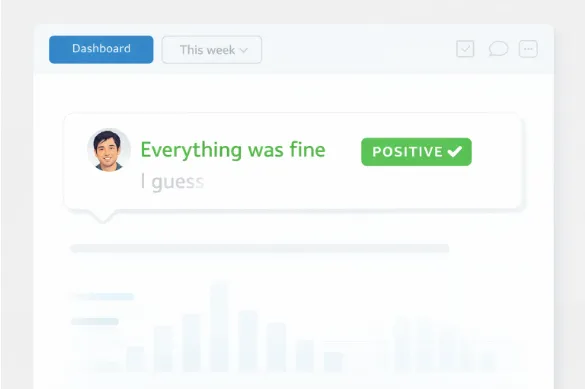
Correct AI misinterpretations: Even well-trained AI makes mistakes. A review says “This product is sick!” — does that mean broken or amazing? When AI flags a neutral industry discussion as a negative attack on your brand, human review prevents wasting resources on a non-issue. When AI misses warning signs in seemingly positive feedback (“Everything was fine... I guess”), humans detect the underlying dissatisfaction that predicts churn.
Respond with empathy: Customers can tell when they’re talking to a bot. Two customers both leave one-star reviews — one furious about late delivery ruining a birthday, another disappointed about product colors. Both need responses, but completely different ones. AI might generate similar responses because they’re both one-star. Humans recognize the emotional difference and respond appropriately.
Escalate issues that algorithms overlook: A customer mentions in a positive review: “Love the product, though I did notice some mild skin irritation.” AI sees positive sentiment and doesn't flag it. Humans recognize this as a potential safety issue requiring immediate escalation. Similarly, humans spot coordinated attack campaigns that AI treats as isolated negative reviews.
Review high-impact decisions: Should you pursue legal action against defamatory content? Should you publicly address accusations in a viral post? These decisions involve legal risk, brand positioning and strategic considerations that AI cannot evaluate. The cost of getting high-stakes decisions wrong demands human oversight.
Keep your brand tone consistent: Your brand has a personality. AI struggles to maintain this consistently across different situations. It might use overly formal language when your brand voice is conversational, or switch between tones inconsistently. Humans understand brand voice intuitively and know when to bend the rules and when strict adherence matters.
AI Is the Engine — Humans Are the Drivers
Using AI reputation management tools lets businesses monitor, respond and improve at a scale that’s just not possible manually. AI finds the issues. Humans decide the strategy. Together they create a resilient online reputation that protects your brand and boosts customer experience.
Talk to our reputation specialists.
FAQ
What role does AI play in online reputation management?
AI monitors brand mentions, analyzes sentiment and provides actionable insights from customer feedback across platforms in real time.
How is AI changing reputation management?
It automates monitoring, speeds up response time, provides predictive analytics and gives businesses visibility they never had before.
What are the risks of AI that ORM should address?
Bias, misclassification, tone problems, over-automation, privacy concerns and incorrect sentiment interpretation — all solved through human oversight.

 0
0
 0
0
 0
0
 0
0
Related Articles
Online Local Advertising for Small Businesses: How Neighbors Find You Online
Discover how small businesses use online local advertising to show up in search, maps, and social feeds — and turn neighbors into customers.
How to Do SEO for a Cleaning Company in 2026? From Invisible to Fully Booked
If you do it right, cleaning service SEO becomes your most sustainable growth channel — bringing in clients, lowering acquisition costs, and building long-term online visibility.
13 Leading Healthcare Marketing Trends for 2026
Discover the 13 hottest healthcare marketing trends in 2026 that will help your brand stay ahead, engage patients, and drive results. Stay smart, stay relevant!