
Ahhhh, just when you’d mastered traditional SEO, everything shifted. Large Language Models like ChatGPT, Claude and Gemini are now answering user queries directly, which means your carefully crafted content might never be seen if you’re not adapting to this new reality.
LLM SEO is the practice of optimizing your content so it appears in AI-generated responses, and if you’re not thinking about it yet, you’re already behind the curve. According to Gartner, traditional search engine volume is expected to drop by 25% by 2026 due to AI chatbots and other virtual agents. That’s not a typo — a quarter of your potential traffic could vanish in this new reality.
The rise of AI search is fundamentally reshaping how customers discover brands, products and solutions. And while everyone’s still figuring out the rules, there’s a huge opportunity for early adopters to dominate visibility in LLM-generated responses before the space becomes as crowded as traditional search results.
Why Is LLM SEO Crucial Right Now?
Let’s talk stats. OpenAI’s ChatGPT reached 100 million users in just two months, making it the fastest-growing consumer application in history. Google’s AI Overviews now appear in roughly half of search results. Microsoft’s Copilot is baked into Windows 11, Edge and Office 365. The message is clear: AI-powered search has arrived here, and it’s devouring traditional SEO.
But unlike traditional search where 10 blue links give everyone a fighting chance, LLMs typically cite only 3–5 sources when answering queries. If your brand isn’t in that handful of references, you might as well not exist in the AI-powered search landscape.
Researchers from Princeton University, Georgia Tech and The Allen Institute of AI came to the conclusion that brands using generative engine optimization strategies are seeing citation rates up to 3.2x higher than the baseline, with some optimization methods boosting LLM visibility by over 40% in AI-generated responses. The businesses currently investing in this space aren’t just getting a leg up — they’re basically installing themselves as the default answer to thousands of customer questions.
What If You Don’t Adapt to LLM Search?
Ignoring LLM SEO is like ignoring mobile optimization in 2010 — you might survive for a while, but you’re basically volunteering as tribute — to irrelevance. Here’s what happens:
Your traffic slowly hemorrhages. As more users turn to ChatGPT or Claude for answers instead of scrolling through Google results, your organic traffic drops gradually, like watching a leaky faucet slowly flood your kitchen.
Your competitors become the “default” answer. When an LLM consistently cites your competitor as the solution to problems in your industry, that’s free advertising you’re paying for through your absence. One e-commerce company we worked with discovered that ChatGPT was recommending their product but describing it with features from two years ago. Not great. Read our case studies for more on how we’ve helped clients surpass their goals.
Your content marketing ROI tanks. You’re still creating great content, but AI systems aren’t highlighting it when customers search for answers. It’s like you threw an amazing party but forgot to invite anyone.
LLM SEO Compared to Traditional SEO
Think of traditional SEO as teaching your content to rank on a scoreboard, while LLM SEO is teaching your content to be the best answer in a conversation. They’re similar, but they’re fundamentally different beasts.
Traditional SEO focuses on backlinks, technical site health and keyword placement. You’re convincing Google’s algorithm that your page is the most relevant result. Success means landing on page one.
LLM SEO is about making your content so clear, authoritative and structured that AI models confidently cite you as a source. You’re not competing for rankings; you’re competing to be the answer. As our guide on how to rank in AI explains, this requires a completely different approach.
|
Factor |
Traditional SEO |
LLM SEO |
|
Goal |
Rank in search results |
Be cited in AI responses |
|
Success metric |
Position on SERP |
Citation frequency |
|
Content focus |
Keywords and structure |
Clarity and accuracy |
|
Optimization cycle |
Continuous refinement |
Harder to measure |
The weirdest part? You can rank #1 on Google but never appear in an LLM response. Also, you might have mediocre traditional rankings but dominate AI citations because your content structure and clarity make you the obvious choice for LLMs to reference.
What Factors Affect LLM Visibility?
Understanding what influences LLM SEO results requires some detective work since LLMs don’t publicly share their ranking criteria — but they do leave clues if you know where to look.
Old SEO Factors That Still Matter
Domain authority and backlinks remain relevant. High-authority sites with robust backlink profiles are more likely to be included in LLM training datasets.
Content freshness matters, though differently than in traditional search. Updated content signals that information is current, which is crucial for LLMs trying to provide accurate answers.
Brand mentions across the web act as signals of authority. The more your brand appears in authoritative contexts within your industry, the more likely LLMs are to associate you with expertise in that space.
New Factors to Take Into Account
Factual accuracy and clarity are non-negotiable. LLMs preferentially cite sources that present information clearly and accurately. Ambiguous content gets ignored or worse — misattributed.
Answer density is crucial. Can someone find the answer quickly, or do you bury the lede? LLMs favor content that delivers clear answers efficiently. This is especially important for LLM optimization and getting recommended in AI product comparisons.
Entity relationships matter more than keywords. LLMs understand relationships, not repetition. Clearly establishing how your brand, product or service relates to relevant industry concepts improves citation likelihood. Forget keyword stuffing.
Bad: “Our project management software is great project management software for project management.”
Good: “TaskFlow serves remote software development teams practicing Agile methodology, integrating with GitHub and Slack, competing with Asana and Monday.com for teams of 10–50 people.”
The second version tells LLMs exactly what your product is, who it’s for and where it fits, which is basically an engraved invitation to get cited when someone asks a relevant question.
Citation-friendly formatting includes bullet points, clear headings and concise explanations that LLMs can easily extract. Think about how you’d pull a quote from a source if you were writing a research paper — that’s how you should format content for LLMs.
LLM SEO Best Practices: How to Adapt Your Strategy
OK, enough theory. Let’s talk about what you actually need to do to optimize for AI search and start appearing in those coveted LLM citations.
Step 1: Audit Your Current Content
Query major LLMs (ChatGPT, Claude, Gemini, Perplexity) with questions your customers typically ask. Does your brand appear in the responses? If not, which competitors are being cited instead? Document which topics you’re visible for and which ones you’re not in.
Step 2: Restructure High-Value Content
Take your most important pages and restructure them for LLM citation:
-
Lead with clear definitions in the first paragraph
-
Use FAQ-style sections that answer specific queries
-
Add comparison tables for structured information
-
Implement clear H2 and H3 hierarchy
Step 3: Create Answer-First Content
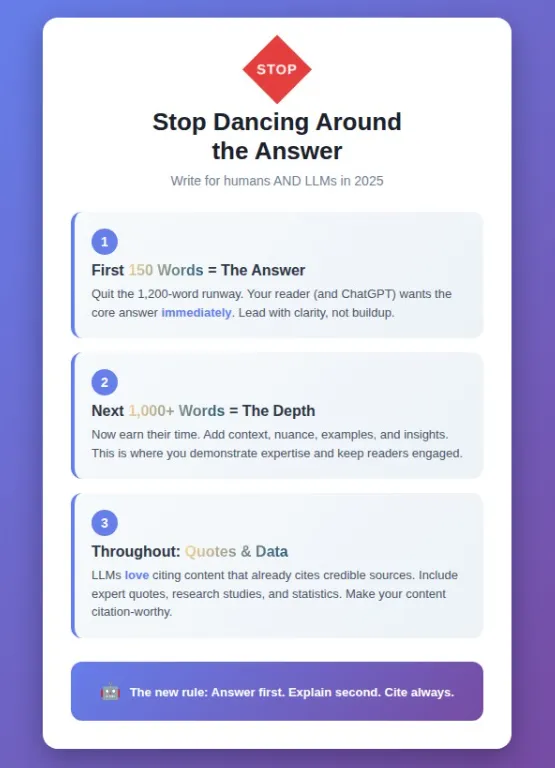
Stop writing blog posts that dance around the answer for 1,200 words. Put the core answer in the first 150 words. Then use the rest of your content to provide context and depth. Include expert quotes and data — LLMs love citing content that already cites credible sources.
Step 4: Focus on Generative Engine Optimization
Generative engine optimization (engine optimization GEO) is the specific practice of optimizing content for AI-powered search engines and chatbots. Our guide on how to rank in ChatGPT results with generative engine optimization covers this in detail, but here are the essentials:
-
Build citation-worthy authority through mentions in reputable publications
-
Optimize for zero-click answers that LLMs can quote
-
Monitor brand mentions and ensure your brand story is consistent
-
Create quotable content with clear, concise statements
Step 5: Test and Measure Your Visibility
You can’t improve what you don’t measure, which is why knowing how to measure LLM performance matters. Use specialized LLM SEO tools to track your visibility. Services like our GEO solutions help track how often your brand appears in LLM responses, in what context and compared to competitors.
Manually query LLMs regularly with key questions in your industry. Keep a spreadsheet tracking whether you’re cited, how you’re cited and which competitors appear instead.
Step 6: Build Cross-Platform Presence
LLMs don’t train exclusively on your website. They ingest data from across the internet, which means your digital marketing strategy needs to extend beyond your owned properties:
-
Contribute to industry publications
-
Maintain active social media presence
-
Encourage third-party reviews and mentions from customers
-
Participate in forums like Reddit and industry communities
Step 7: Optimize for Google’s AI Overviews
When you optimize for LLMs, you’re also optimizing for Google’s AI Overviews. And vice versa.
Google’s AI Overview (which now shows up in almost half of all searches) pulls from the same kind of content that ChatGPT and Claude love to cite — clear answers, good structure, accurate info. So when you nail answer-first formatting and citation-worthy authority, you’re boosting your visibility in both AI Overviews and LLM responses.
It works both ways, too. Content that performs well in AI Overviews naturally becomes more attractive to other LLMs. Same principles, different platforms.
This is great news for your content strategy. The brands winning in one space are usually winning in both because they’ve figured out the same key thing: answer-first, clarity-focused content.
Your LLM SEO investment isn’t siloed. Every tweak you make compounds across the entire AI search ecosystem — from Google’s AI Overview to ChatGPT citations to Perplexity references.
How Can You Manage LLM SEO Performance?
Managing LLM SEO results is trickier than traditional SEO because the feedback loops are slower. Create a list of 20–30 core questions that potential customers ask about your industry, products or services. Query multiple LLMs monthly and track the results.
Track citation context, not just frequency. If an LLM mentions your brand but frames it incorrectly, that’s a problem you need to address through content optimization. Monitor competitor visibility to identify gaps in your strategy.
The reality is that LLM SEO measurement is still evolving. But that’s actually an advantage for early adopters — you can experiment, learn and establish visibility while measurement is still imperfect and competition is relatively light.
Helpful Tools for LLM SEO
The best LLM SEO tool ecosystem is still emerging, but several solutions can help:
- Specialized GEO platforms like what Netpeak offers are among the best LLM SEO analysis tools for tracking your brand’s appearance in AI-generated responses, with pricing that varies based on tracking volume and features. These LLM SEO tools automate the querying process and provide competitive benchmarking.
- Traditional SEO tools with LLM features are starting to add AI visibility tracking. Tools like SEMrush and Ahrefs are beginning to incorporate AI Overviews.
- Manual LLM testing remains essential. No tool can fully replace manually querying ChatGPT, Claude, Gemini and Perplexity to see how they respond to key questions in your industry.
- For businesses serious about LLM SEO, investing in a combination of these tools plus working with specialists who understand engine optimization GEO provides the most comprehensive approach.
Mistakes to Avoid
Keyword stuffing for AI. LLMs are sophisticated language models — they understand context and semantics. Unnatural keyword density makes your content less citation-worthy, not more.
Ignoring factual accuracy. One of the fastest ways to get ignored by LLMs is publishing content with errors or outdated information. LLMs increasingly have fact-checking capabilities.
Over-optimizing for one LLM. Different AI models have different training data and behaviors. Content optimized exclusively for ChatGPT might underperform in Claude or Gemini.
Forgetting about humans. Yes, you're optimizing for AI, but humans still need to think your content is valuable. Content that reads like it was written for robots won’t be shared or linked to — factors that indirectly affect LLM visibility.
Expecting instant results. LLM SEO operates on longer feedback cycles. Training data can be months old, and there’s no guarantee your optimization efforts will show up immediately.
Ignoring the evolving landscape. The AI-powered search ecosystem changes rapidly. Features like ChatGPT Atlas launch regularly. Stay informed and adaptable.
When Opportunity Knocks…
LLM SEO is simultaneously critically important and frustratingly imperfect to execute. We’re in the Wild West phase, where early movers can capture disproportionate visibility, but the rules keep changing.
But that’s actually the opportunity. The brands that start optimizing now — while most competitors are still figuring out what LLM SEO even means — will have a substantial advantage.
Test-and-learn. Implement the best practices we’ve outlined, track your visibility systematically and be flexible. Focus on creating genuinely valuable, clearly structured content that helps your audience. The AI optimization will follow.
And if this all feels overwhelming, that’s OK! Generative engine optimization is complex enough that most businesses benefit from expert guidance. Whether you work with a specialized agency or build internal expertise, the important thing is to start now rather than waiting for “perfect clarity” that may never come.
The future of search is already here — it’s just unevenly distributed. Make sure your brand is on the right side of that distribution.
FAQ
How should I set KPIs for LLM SEO?
Focus on citation frequency (how often you appear in LLM responses), citation context (whether you’re accurately represented) and share of voice compared to competitors. Track downstream metrics like branded search volume and direct traffic as your LLM visibility grows.
Which LLM is best for SEO?
You’re not choosing which LLM to use — you’re optimizing to appear in all of them. ChatGPT has the largest user base currently, making it a logical priority for testing, but you want visibility across ChatGPT, Claude, Gemini and Perplexity since different users prefer different AI assistants.
What businesses are affected by LLM search the most?
Information-based businesses feel the impact first — SaaS companies, professional services, education, healthcare and B2B where customers research extensively. Any industry where customers start with questions rather than specific product searches needs to prioritize LLM SEO immediately.

 0
0
 0
0
 0
0
 0
0
Related Articles
Local SEO for Home Service Companies: 8 Fool-Proof Ways to Reach Your Customers
When something breaks, people go straight to Google to find a plumber, an electrician, or a roofer right away. And local home services SEO is what makes sure you’re the one they find (and choose!) instead of your competitor.
Local SEO for Construction Companies Explained
If clients can’t find you online, they hire someone else. Learn how local SEO puts your construction business in front of ready buyers.
How to Market a Security Company in 2026?
Most security companies are invisible online. Here's how to fix that and turn your digital presence into a steady stream of qualified leads.