
SaaS founders often think, “We built something amazing — of course, users will show up.” But in real life, without marketing and especially SEO, your SaaS product can sit alone in the dark while worse tools get all the attention.
It’s like you’re Steve Wozniak — the shy genius who built something special… but all the attention only went to Steve Jobs, because he had a public presence. SaaS businesses need to know how to present their software to Google — because whoever said “good things stay hidden” has never successfully launched… well, anything.
This SaaS SEO guide will show you how to make search engines fall in love with your product. You know, Google’s love language is more sign-ups and increased revenue.
SaaS SEO Is Your Saver
SEO for SaaS is a tongue-twisting abbreviation that stands for “Software-as-a-Service Search Engine Optimization.” It is not “just a marketing thing” that IT guys are often so skeptical about. More like the part of your SaaS business that goes out into the world, grabs your ideal customer by the hand, and says: “Hey, the thing you’re searching for? It’s right here.”
SEO for SaaS companies helps you attract users who are Googling keywords related to your software and build a steady flow of organic signups. Here is some more info:
-
Organic search drives 53% of SaaS traffic.
-
The average SEO ROI for a B2B SaaS company is 702%, with a break-even point in 7 months.
-
In a study across 500+ SaaS businesses, the average organic traffic growth was 24% year-over-year. Top performers hit 70% YoY SaaS organic growth.
-
Inbound leads (people who come to you, e.g., from SEO) cost 61% less than outbound leads (people whom you chase).
-
SEO leads for SaaS have a 14.6% close rate.
We at Netpeak US are masters of IT marketing with 19 years of experience. If you want to delegate it and have some time to polish your product, just give us a call!
SaaS SEO Strategy Isn’t Basic
Classic SEO often focuses on driving as much traffic as possible, without worrying too much about who those visitors are. But when SEO is applied to SaaS, the goal changes: it becomes more about attracting the right people.
|
SaaS SEO |
Classic SEO |
||
|
1. |
Primary Goal |
Find people who are ready to try free trials and demos, and to sign up. |
Drive traffic and content views from everyone interested. |
|
2. |
Content Purpose |
Turn visitors into users and guide them to the onboarding point. |
Teach, entertain, inform — and hope they come back someday to bring more traffic. |
|
3. |
Keyword Strategy |
Use long-tail, high-intent terms. |
More about broad keywords, informational queries, and evergreen topics. |
|
4. |
SEO Assets |
Product-led content, comparison pages, templates, calculators, and feature pages. |
Blog posts, guides, how-to articles, and listicles. |
|
5. |
Measurement |
You need to track results from the whole funnel. |
Traffic, backlinks, rankings — the lightweight stuff. |
|
6. |
Retention Signals |
Product usage, brand searches, and reviews. |
Less dependent on product retention or user behavior. |
|
7. |
Time to ROI |
Can show results in 2–6 months if your product actually solves a pain point. |
Usually works slower — you have to build content mountains first. |
The Three Elephants Your SaaS SEO Turtle Stands On
Securing a spot in the top 10 of search results used to be a big win. Now, it's no longer enough with AI search on the table. Organic clicks may drop by up to 70% with AI overviews.
So now we need to work even harder to get to the top 3 — more than 50% of all clicks are concentrated there. To become that Olympic champion, read this guide to SaaS SEO.
Elephant 1: The Product (Your Website)
Your website exists to convert visitors into free trials, demos, and paid users. If it’s slow, ugly, or not optimized, even all the content and backlinks in the Universe couldn’t save your results.
-
Keep load times under 3 seconds. Over 53% of mobile users will leave if they need to wait a second more.
-
Use clean layouts, intuitive navigation, and mobile-first design.
-
Your site needs to pass Core Web Vitals to see ~24% higher user engagement. Only exam results in our lives that really make a change.
Elephant 2: SaaS Content Marketing
Use content to target high-intent keywords — ones your customers search for with their precious hands, and guide people through the funnel from “hmm interesting” to “take my money.”
-
Every piece must be helpful and well-researched. Not by AI! Hire a writer.
-
Don’t lower the quality. If an article isn’t strong enough, it doesn’t go live.
-
Before writing, ask: Does this actually help my target audience? If the answer is no, skip the topic.
Companies that blog generate 55% more website traffic and 67% more leads than those that don’t, so do it!
Elephant 3: Backlinks
Link building is a cheat code for dramatically improving your search engine rankings. The number 1 result on Google has, on average, 3.8 × more backlinks than the top 10 results.
-
Use backlinking from SaaS websites in your industry or from closely related ones. Google weighs backlinks by context — and ignores irrelevant ones.
-
Choose strong sites with DR 70+ and clean backlink profiles. And ghost even high-DR domains with weak content, toxic links, or declining traffic.
-
The best backlinks are earned because your quality content is worth citing — so make it great.
The Core Stages of SaaS SEO
Let's explore how to run SEO that fits your SaaS product.
Step 1: Know your enemies
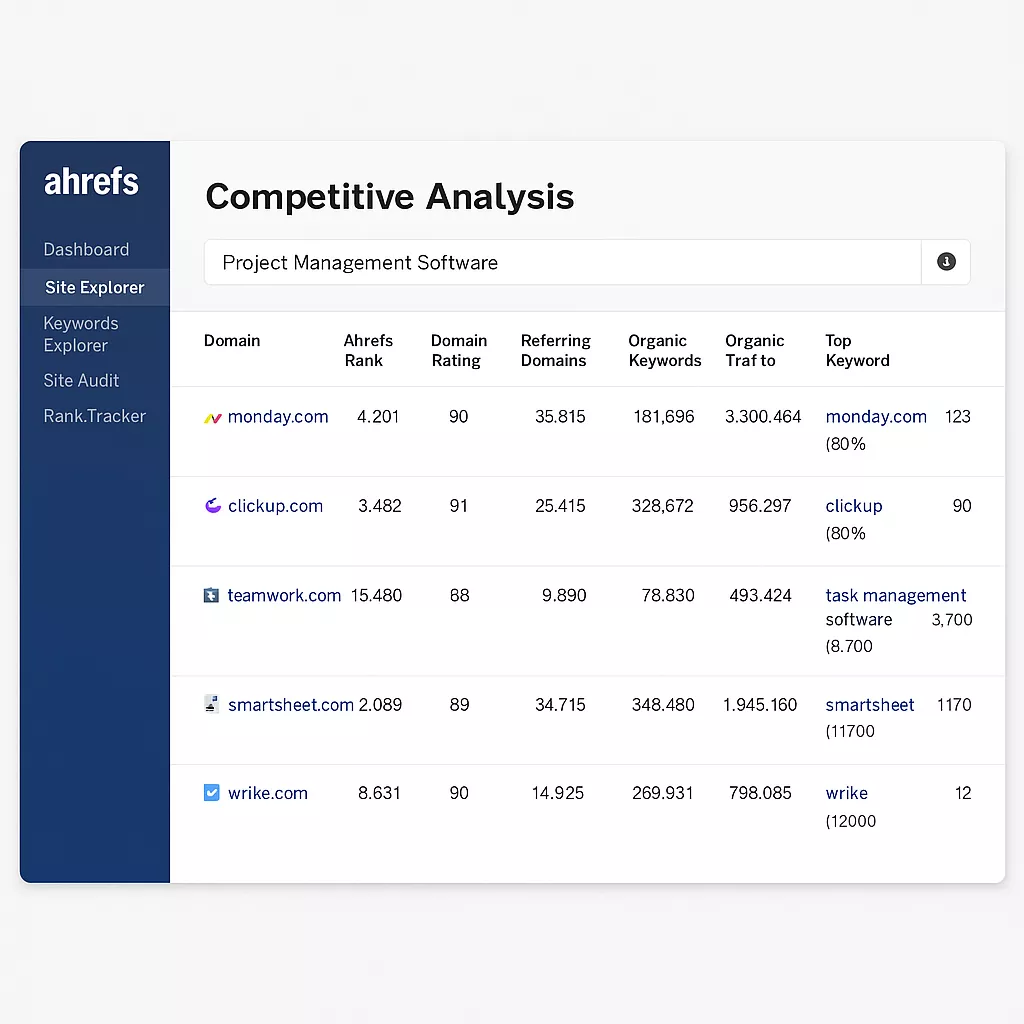
Some companies are already in the market with software that solves similar user problems. Before you write a single keyword, you need to snoop on them:
-
How high are they ranking and by which keywords?
-
What content do they use?
-
Where are they strong — and where are they weak?
Useful tools: Ahrefs, SimilarWeb, SurferSEO.
Why this matters: SaaS SEO in 2025 is brutal — only 5.7% of pages ever reach the top 10. If you don’t size up your competition first, you’ll miss the chance to learn from them.
Step 2: We're Going On the Keyword Hunt
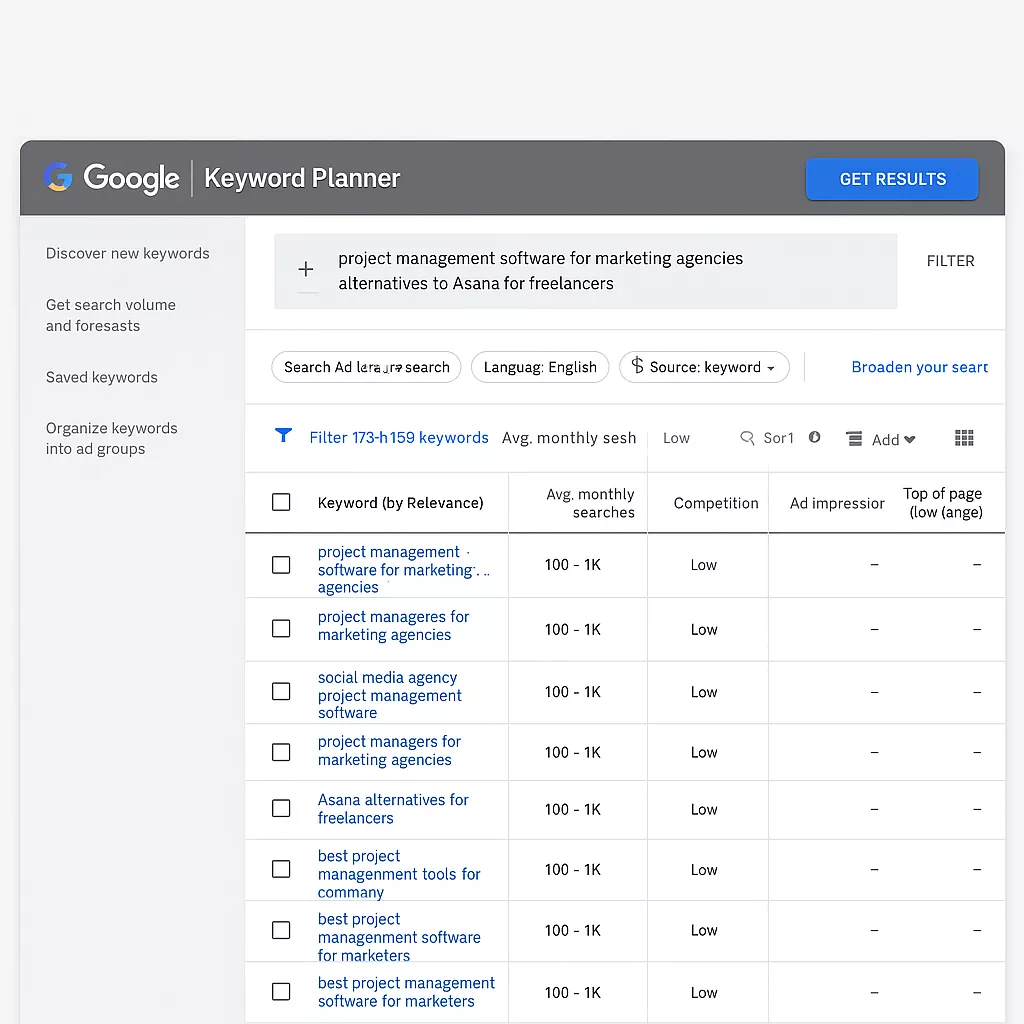
To do keyword research properly, you first need to understand what your users actually search for: their problems, comparisons, use cases, etc.
For example, you created project management software. With some proper research, you can realise that your main keywords are:
-
“project management software for marketing agencies”
-
“alternatives to Asana for freelancers”
-
“how to automate task assignments in marketing teams.”
Tools that help you know for sure: Google Search Console, Google Keyword Planner, AnswerThePublic.
Why this matters: Long-tail keywords drive 68% of SaaS organic traffic. High-intent keywords in SaaS niches convert 2.3× better than info keywords.
Keyword Clustering
Group all the keywords into themes that reflect how SaaS buyers think, search, and make decisions. Pages optimized for semantic clusters perform 32% better.
Step 3: Doing SEO After the Website Launches Is Too Late
Your website core should be optimized for Google search. Make sure the site structure supports growth, that you have a proper admin panel for adding content, that URLs are not gibberish, and that schema markup is just there.
-
Core sections could look like /features, /solutions, /use-cases, /blog, /compare.
-
Clear URL patterns are yoursite.com/features/marketing-workflow instead of yoursite.com/page12345.
Why this matters: Clean site structure and URLs help search engines to crawl. And schema markup can increase click-through rate (CTR) by up to 30% in large-scale cases.
UX-design
Check how users and search engines move through your site: how easily they can find information, how fast their experience is, how clear your call-to-actions are, etc. If something is wrong, fix it!
Your wallet will thank you, because every $1 invested in UX yields a return of $100 (≈ 9,900% ROI).
Step 3: Your Favourite — Technical SEO for SaaS
Dig deep into the behind-the-scenes elements that enable search engines to crawl, index, and trust your site. Fix everything under the hood: Core Web Vitals, indexing, schema, internal linking, JavaScript rendering, duplicate content, XML sitemaps, etc.
Why this matters: Your website needs to work hard; it’s only possible if the technical side is taken care of. No 404 No Found errors! Bonus: sites improving Core Web Vitals see up to 24% more user engagement.
Step 4: Your Writer’s Favourite Part: On-Page SEO
Your SaaS content is all about features, use cases, comparison, and blog pages. You need to optimize them so that they can rank and convert.
Use strong H2s, product screenshots, internal links, and a clear CTA like “Start free trial”. Optimize alt-texts for screenshots and write a meta description.
Why this matters: Pages with a strong heading hierarchy and semantic relevance have 32% higher visibility. Optimizing call-to-action copy lifts conversions by 22% on SaaS landing pages.
Step 5: Create SaaS SEO Content That Doesn’t Look Like One
Google's central idea is that a website deserves a high ranking when people consider it the best. If a person clicks the link, sees a pyramid of keywords, and leaves, Google considers it a quality defect and assigns a lower ranking. So, create content for living creatures, but keep search engines in mind too.
Write articles on evergreen topics related to your product to attract readers and rank at the top. Inside, add a link to your case studies, product comparisons, feature pages, etc., that can convert viewers into paying customers.
Why this matters: For B2B SaaS, SEO content can drive an average ROI (return on investment) of 702%, with break-even in about 7 months.
Step 6: Make Others Write About You
Even with a website that converts and mind-blowing content, you’ll struggle without authority. You need to do off-page SEO (backlinks, mentions, digital PR, guest posts, partnerships) to build your domain’s credibility in Google’s eyes.
-
Write guest articles for your industry blogs
-
Collaborate with influencers to write about your SaaS
-
Create free templates and tools that others naturally link to
Why this matters: Google says that backlinks are one of the strongest ranking signals, and we believe them.
SEO for SaaS Cheat Code Strategies You Should Use
In SaaS SEO, you want to attract people with money and the intention to spend it on your product. Here are a few ways to do it.
Target High-Intent, Long-Tail Keywords
You need to find people who are already searching for your product to solve their problem. They often use long, specific searches like:
-
“CRM for small real estate teams”
-
“email automation tool for Shopify stores”
-
“best meeting scheduling software for consultants”
You need to use these keyword phrases on your website and in your content so that Google can set you up.
Build a Solution-Exploration Funnel With Content
In SaaS, users don’t buy instantly. They first explore solutions, compare tools, and check reviews. Your content must match every step of that journey.
The solution-exploration funnel with content looks like this:

Why it works for SaaS: You meet the buyer exactly at their research stage — and guide them naturally toward choosing your SaaS.
Use Internal Linking to Create Authority Clusters
Google rewards topic expertise. To show it, create clusters:
-
A main page (e.g., “Project Management for Marketing Teams”)
-
10–20 support articles around it
-
Internal links connect all pages together
Why it works for SaaS: Clusters help new pages rank faster and improve your topical authority.
We at Nepteak US helped a SaaS finance company recover after a Google update. They saw a 73% increase in average monthly traffic. If you want SEO services for your SaaS too, give us a hint!
SEO for SaaS Mistakes You’re Too Smart to Make
When you start something new, it’s only natural to make some mistakes. But we hate it, right? So let's explore common SaaS SEO mistakes others made before us to act smart.
-
Writing Content That Never Mentions the Product. Some SaaS blogs publish nice educational articles that attract traffic… But their visitors never become users because they forget to write about the product. Fix: Use product-led content: show the tool, explain how it solves the problem, add examples, and CTAs.
-
Ignoring the User Journey. Many SaaS teams create content “because we need to blog,” not because it supports the user journey. Fix: Build content for every stage of the Solution Exploration Funnel: problem → solution → comparison → decision → onboarding.
-
Skipping Comparison & Alternatives Pages. Don’t think that these pages are “too salesy.” In reality, they have the highest conversions in SaaS SEO.
-
No Analytics or Wrong Metrics. Many SaaS teams don't set clear goals and track “traffic” rather than sign-ups, demos, or activations. Traffic means nothing if nobody tries the product.
FAQ
What is SaaS SEO?
SaaS SEO is the process of helping people find your software on Google at the exact moment they search for problems your product solves. The goal is to attract high-intent users who convert into trials, demos, and paying customers.
How is SaaS SEO different from traditional SEO?
Traditional SEO focuses on traffic. SaaS SEO focuses on users, sign-ups, and revenue. It includes product-led content, comparison pages, use-case pages, feature pages, and a funnel explicitly designed for software buyers.
How do I measure the effectiveness of SaaS SEO?
Track metrics tied to product growth, not just traffic:
-
organic sign-ups
-
demo requests
-
activation rate
-
conversion to paid
-
organic CAC (cost per acquisition)
-
keyword growth for high-intent terms
When will I see results from SaaS SEO?
Most SaaS companies start seeing measurable traction in 3–6 months, and significant compounding results in 6–12 months, depending on competition, content quality, and technical health.

 0
0
 0
0
 0
0
 0
0
Related Articles
Local SEO for Home Service Companies: 8 Fool-Proof Ways to Reach Your Customers
When something breaks, people go straight to Google to find a plumber, an electrician, or a roofer right away. And local home services SEO is what makes sure you’re the one they find (and choose!) instead of your competitor.
Local SEO for Construction Companies Explained
If clients can’t find you online, they hire someone else. Learn how local SEO puts your construction business in front of ready buyers.
How to Market a Security Company in 2026?
Most security companies are invisible online. Here's how to fix that and turn your digital presence into a steady stream of qualified leads.