
Why the January Reset Is Hurting Your Marketing — And What Growth-Focused Companies Do Instead
Every December, marketing teams around the world start having the same conversation: “Let’s just pause everything and start fresh in January.”
And every February, those same teams are scrambling to figure out why their costs are up, conversions are down and their rankings are doing some kind of interpretive dance they didn’t authorize.
The hard truth is that the January reset is a trap. And I’ve watched countless companies walk right into it, thinking they’re being strategic when, in reality, they’re setting themselves up for weeks of stress that could have been avoided.
The Myth of the “Clean Slate”
January feels like a fresh start. New year, new goals, new budget meetings where the finance department asks you to predict the future with 100% accuracy (which, cool, let me just pull out my crystal ball). But when you treat January 1st like some magical rebirth moment? Absolutely nothing changes for your customers.
Consumers don’t turn into completely different people on New Year’s Day. Yes, overall spending dips as people recover from holiday spending — that’s real. But they’re still your target audience with the same core needs and problems. Mastercard Economics Institute data shows that nearly a third of all gift card spending happens in December and January, with the economic impact spilling into 2026. Meanwhile, a survey from Chain Store Age found that 23% of shoppers are more likely to shop during the beginning of the year.
The problem is that companies make January worse by completely abandoning their marketing. They ghost their audience right when they should be capturing gift card redemptions and shifting messaging from gift-buying to self-focused purchases. January 1st is just another day on the calendar, except now you’ve voluntarily decided to forget everything you learned about them over the past 12 months. Face palm.
And when you pause your campaigns, you’re not just hitting a temporary stop button. Industry experts report that it can take 3 to 6 weeks to rebuild your campaign performance after an extended pause. Google doesn’t give you a “welcome back” discount. You start over from scratch — with higher costs, unstable performance and all the momentum you spent months building vanished into thin air.
The maturity of an organization shows up most clearly in how they handle this transition. Mature businesses analyze what’s working and what’s not before they change course. Most businesses? They see something that didn’t perform perfectly, decide the whole experiment was a failure and throw everything out to start over.
You’re essentially throwing the baby out with the bath water. And then you’re left wondering why you’re having to rebuild momentum from scratch while your competitors who kept their campaigns running are already optimized and humming right along.
What Happens When You Ghost Your Existing Campaigns
What happens under the hood when you hit pause on everything in December and then try to restart in January?
Your PPC Campaigns Forget Everything They Learned
Google’s algorithm isn’t sitting there going, “Oh, they’re taking a strategic break, how thoughtful!” It’s going, “Well, I guess this advertiser isn’t serious anymore” and giving your ad space to someone who stuck around the whole time. When you come back in January, you’re starting over with higher costs per click, janky conversion tracking, and having to re-teach the algorithm everything it knew about your best customers. One case study found that when a company paused their brand campaigns, Google Paid revenue dropped 50% while organic only picked up 15% — resulting in a 21% net loss of revenue. On Bing, it was even worse: a 42% net revenue loss.
Your SEO Rankings Get Nervous
Search engines reward consistency and fresh content. When you go dark for weeks, you’re sending signals that maybe your site isn’t as relevant or active as it used to be. Then January hits and everyone collectively decides to start creating content again, so now you’re fighting for visibility in a suddenly crowded space while your site is still recovering from its holiday nap.
Your Social Algorithms Forget You Exist
Ever notice how your first few posts back after a break get terrible reach? That’s not an accident. The algorithms deprioritize accounts that go silent because they’re trying to show users content from active, engaging sources. Facebook’s average organic reach has plummeted to just 1.37%, while Instagram’s organic reach sits at around 3.5% — and both decline further when you’re inconsistent. Posts that used to reach 20%–30% of your audience might now hit only 2%–5%. Going silent trains the algorithm to assume you’re not worth showing to people anymore.
The Real Cost of Starting Over
The January reset doesn’t just affect your ad campaigns and rankings. It’s systematic destruction of everything you’ve built — your audience understanding, your channel optimization, your refined processes and all those hard-won insights that make your marketing successful.
Losing Audience Continuity
Let’s say your CEO walks in and says, “We need to make more money this year. Let’s target a different demographic.” Maybe you’ve been selling to one audience all year, and now suddenly you’re pivoting to a completely different segment you have no experience with.
This happens more than you’d think. And it’s almost always a dumpster fire.
Growth is always based on the results you’ve achieved and understanding what’s keeping those results working. You can’t just decide to target a different audience without saving what you already have and building on it.
Any kind of growth means moving from your core audience to another segment, but that’s expansion, not replacement.
I’ve seen major companies that know their audience incredibly well suddenly change course for whatever reason. Your company has been marketing heavy-duty belts to beardy macho guys all year. Your brand community is strong. These dudes love you. They talk about your brand on their podcasts. They put your brand stickers on their trucks. Then one quarter, someone decides to launch a line of pink belts and shift the marketing to match. Suddenly your gun-toting loyal customers feel alienated. They’re confused about whether your brand is still for them.
Abandoning Optimized Channels
But it’s not just about the audience. When you reset in January, you’re also throwing away months of learning. You spent Q4 figuring out that LinkedIn drives better leads than Facebook for your B2B product, that your email open rates spike on Tuesday mornings, that Instagram Stories convert better than feed posts for your e-commerce brand.
Come January, someone decides “this year we’re going Instagram-first” or “let’s pivot to TikTok” without considering that you’ve spent zero time understanding those channels, building audiences there or learning what content performs. You’re starting from scratch in unfamiliar territory while abandoning channels where you’ve already done the hard work.
Destroying Proven Processes
And then there are the processes — the unsexy but crucial systems that make your marketing function. Your content calendar workflow. Your approval processes. Your reporting cadences. The way your team collaborates with sales. The creative briefs that finally started producing good work in Q4.
The January reset often means “let’s change everything,” which sounds strategic but really means unlearning what works and building new processes from zero. Your team spends the first quarter of the year figuring out new workflows instead of executing great marketing.
Erasing What You’ve Learned
Maybe worst of all, you lose all those little insights that don’t make it into reports but inform better decisions. You learned that your audience hates overly salesy copy. That your product demos need to be under 90 seconds. That customer testimonials outperform feature lists 3-to-1. That your highest-value customers come from a specific webinar topic.
None of that makes it into your January strategy deck. It’s just gone. And you’ll spend months relearning it.
Taking a leap like that — whether it’s audience, channels, processes or all three — can cost you real revenue and momentum during the year. Not because change is bad, but because you abandoned continuity with what was already working.
PPC Turbulence: The First Three Weeks Are Chaos
If you pause your campaigns in December or drastically change your approach in January, buckle up. It’s gonna be a bumpy ride.
The first 2–3 weeks of Q1 are when PPC campaigns “break” the most. Your cost per click shoots up because you’re competing in a fresh auction environment without the performance history that was keeping your costs stable. The platforms don’t recognize you as a reliable advertiser anymore, so they charge you more.
And now you’re trying to fix everything during the same window when every other marketer who DID keep their campaigns running is already testing new strategies, optimizing based on real data and taking advantage of insights they never stopped collecting. You’re rebuilding while they’re winning.
SEO Volatility: Why Your Rankings Are Doing the Cha-Cha
January is already a volatile month for SEO. Algorithm updates tend to cluster around major calendar transitions. New content floods the internet as everyone executes their new year content strategies simultaneously. User behavior shifts create uncertainty about what content is most relevant.
If you went quiet in December or you’re scrambling to publish a bunch of rushed content in early January just to “be active,” your rankings are going to jump around like a cat with a laser pointer. Search engines are trying to figure out where you belong in this new landscape, and you’re not giving them stable signals to work with.
The companies with stable January SEO performance are the ones that kept content consistency through December, who planned their Q1 content calendar in advance and who understood that search visibility is a marathon, not a sprint that rests for the holidays.
The GEO Reality Check: January Intent Isn’t December Intent
It’s common sense: User behavior and search intent shift dramatically in January.
People aren’t searching for holiday gifts anymore. They’re searching for solutions to new year goals, budget-friendly options, ways to fix problems they’ve been putting off, and yes, probably gym memberships they’ll abandon by February (but that’s on them).
Generative Engine Optimization becomes critical here because the way people ask questions changes. Here’s what that looks like:
|
December Search Intent |
January Search Intent |
|
“best gift for dad” |
“home workout gear” |
|
“holiday party outfit ideas” |
“professional work wardrobe essentials” |
|
“last minute Christmas deals” |
“best sales after New Year” |
|
“winter vacation packages” |
“cheapest travel destinations this year” |
|
“office party catering” |
“meal prep ideas to save money” |
|
“what to buy my coworkers” |
“how to organize my workspace” |
|
“best toys for 5-year-olds” |
“educational toys for kids” |
|
“luxury gift sets” |
“affordable self-care” |
The shift isn’t subtle — it’s a complete reorientation from buying for others to help for yourself, from holiday indulgence to practical solutions, from gift-giving to goal-setting. If your content strategy doesn’t account for this intent shift, you’re optimizing for questions nobody’s asking anymore.
And here’s the opportunity that others miss: While your competitors are still in budget meetings and waiting for approvals, there’s a window to capture attention and market share in early January. But only if you’re active and ready to go — which you won’t be if you paused everything in December.
What Growth-Focused Companies Do
The businesses that thrive through the January transition aren’t doing anything mystical. They’re just refusing to fall into the reset trap.
- They maintain campaign continuity. Even if budgets are reduced in December, they keep campaigns running. They preserve the performance data and signals they’ve built. They understand that predictability is key because it gives you a baseline — you can experiment with new things, but you always have something solid to return to.
- They think in channels, not activities. When planning for Q1, they’re not obsessing over individual tactics. They’re thinking about partnerships, events, networking, website performance, blog strategy. The channel mix might shift, but the presence remains consistent.
- They embrace the flexibility-experimentation paradox. Organic growth means you need to sell more products for less money. That requires testing. Will your jeans sell better in Orlando than Chicago? You won’t know unless you try. But here’s the key: They’re ready to test results and ready to fail. The worst nightmare of every marketer is failure, but if you don’t experiment, you don’t grow.
- They measure what matters and preserve what works. Before they change KPIs or shift focus, they analyze what part of a potential change is useful and what part is ineffective. They don’t start with a completely new set of metrics in January and expect them to be just as efficient as the ones they spent all year optimizing.
- They ignore the hype cycle. Jumping on new trends without analyzing or planning is a mistake. Just because everyone’s talking about some new platform or tactic in January doesn’t mean it’s right for your business or your audience.
Five Steps to Protect Your Q1 Performance
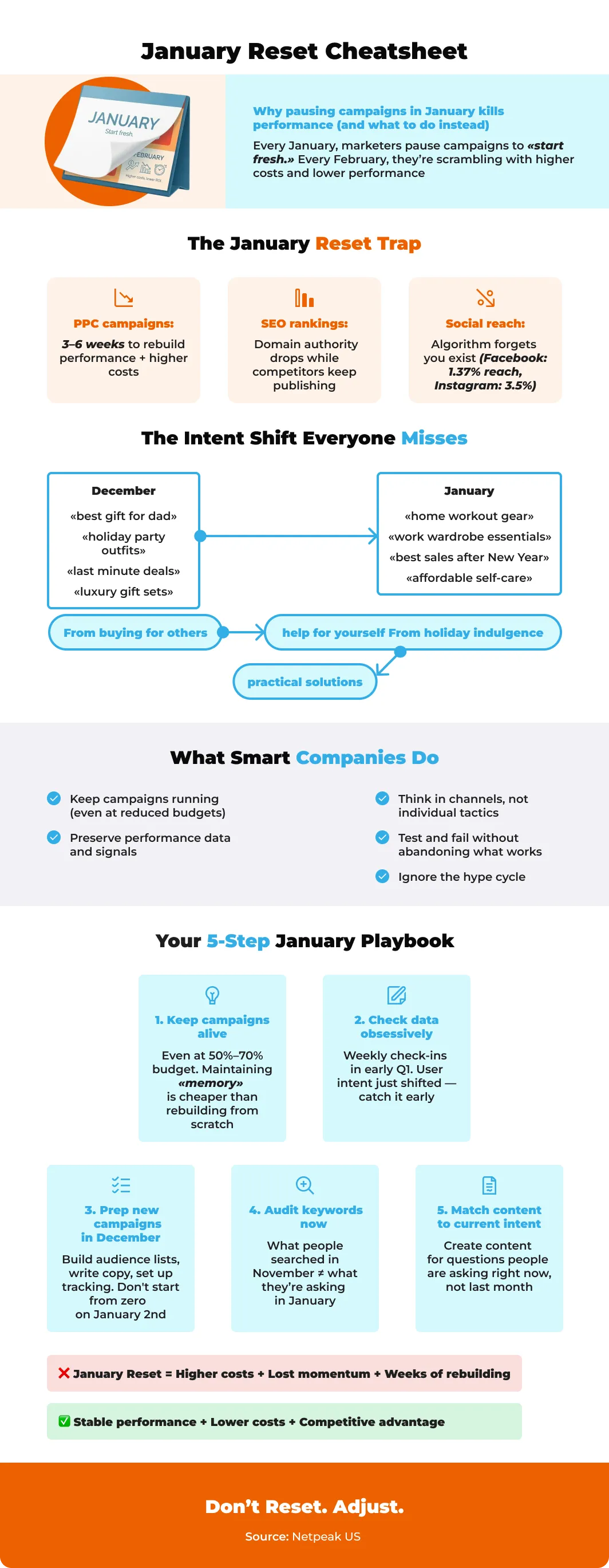
If you want to avoid the January scramble and set yourself up for growth, here’s your playbook:
- Keep campaigns alive in December. Even if you slash spending by 50% or 70%, keep them running. The cost of maintaining your campaign’s “memory” is way cheaper than rebuilding it from scratch in January. Think of it like keeping your car running versus letting it sit all winter and wondering why the battery’s dead.
- Check your data obsessively in early Q1. User intent shifts in January. Set up weekly check-ins (or even daily for your biggest campaigns) for the first few weeks to catch performance changes early. What worked in Q4 might need tweaking now that people are asking different questions.
- Prep new campaigns before you need them. Planning to launch something in January? Start building it in December. Set up your audience lists, write your ad copy, prep your landing pages. Don’t wait until January 2nd when you’re competing with everyone else who also just got budget approval.
- Audit your keywords and content. User search behavior changes after the holidays. Review what people are searching for, identify new patterns and adjust your content. The questions people are asking in January are fundamentally different from the ones they asked in November.
- Match your content to how people are actually searching. Make sure you’re creating content that answers the actual questions your audience is asking right now, in the way they’re asking them. Search engines and AI tools pull from content that matches current intent, so your December content strategy needs an update.
January Isn’t a Reset — It’s a Test
Reinventing a business takes time. You can’t just flip a switch on January 1st and expect everything to magically improve. The companies that grow through Q1 understand that January isn’t a magical fresh start — it’s a high-stakes period that requires preparation, consistency and strategy.
Your customers haven’t reset. The algorithms haven’t reset. The competition hasn’t reset (but if they have, that’s your chance to pull ahead while they’re rebuilding from scratch).
So before you walk into that January planning meeting with grand ideas about starting over, ask yourself: What am I gaining by losing 12 months of data and momentum?
Most of the time, the answer is nothing but a longer, more expensive climb back to where you already were — except now with the CEO breathing down your neck asking why everything costs more and performs worse.
Ready to build a Q1 strategy that sets you up for growth instead of a three-month panic attack? Stop treating January like a reset button. Treat it like what it is: the continuation of everything you built last year, with a few adjustments for changing customer behavior.
Your competitors are still figuring out their “fresh start.” You can be three steps ahead.

 0
0
 0
0
 0
0
 0
0
Related Articles
Sustainability Marketing: 7 Smart Ways to Earn Trust (and Customers)
Learn how to grow your brand efficiently while using eco-friendly marketing practices to build trust and long-term revenue.
Why Your Amazon Pet Ads Are Getting More Expensive Every Quarter Since 2025 (and How Smart Brands Manage It)
What happened to the auction prices? Where is the margin going, and what should be done next quarter?
How to Track Brand Mentions in AI Search? Find Out Whether You Are in the Answer
Being mentioned in an AI search boosts visibility. Discover how to monitor your brand mentions in ChatGPT, Perplexity, or Gemini and follow our approach to higher mention frequency.