
The jewelry industry is having a moment. On one hand, the global jewelry market hit nearly $367 billion in 2024 and is projected to reach $578 billion by 2033. On the other hand, traditional jewelry marketing — you know, those ads with soft focus and whispered promises of forever — is about as effective as trying to sell engagement rings on LinkedIn.
Your digital marketing strategy for jewelry brands can’t look like it did even two years ago.
Gen Z is projected to account for 40% of the global luxury goods market by 2035, and they're not buying the same fairy tales their grandparents did. They want transparency about where stones come from, they’re comparison shopping before buying, and they’ll absolutely roast your brand on TikTok if your marketing feels corny.
The jewelry marketing trends heading into 2026 are about being real and having a real strategy.
What Is a Digital Marketing Strategy for Jewelry Brands?
A marketing strategy for jewelry brands isn’t just about posting pretty pictures on Instagram. You need a plan to reach customers where they actually shop — and convert them once they get there.
Your digital strategy for jewelry should answer these questions: Who’s buying (and why now)? Where are they looking before they buy? What makes them choose you over the hundreds of other jewelers in their search results? How do you turn browsers into buyers and buyers into repeat customers?
This means coordinating everything from SEO and paid ads to social media marketing, email campaigns, content marketing and how (or if!) you show up in AI-powered search results.
For small jewelry businesses competing against big names, your strategy needs to be even sharper because, in this brutally competitive niche, you can’t afford to toss money at every platform and see what sticks.
What’s Happening? 2026 Trends in Jewelry Marketing
Before we get into tactics, here’s what’s changing the jewelry marketing landscape:
- AI is rewriting how people discover jewelry. With nearly 60% of Google searches now ending without a click, customers are getting answers directly from AI overviews instead of visiting your site. If your brand isn’t optimized for generative engines, you’re not even playing. Traditional SEO isn’t dead, but it’s definitely having an identity crisis.
- Sustainability isn’t optional anymore. Gen Z — on track to control $12 trillion (yep, that’s a T) in spending by 2030 — isn’t here for your vague “eco-friendly” claims. A whopping 62% actively choose sustainable brands, and 28% have already dumped companies with sketchy ethical practices. So, if you can’t prove where your stuff comes from, they’re not buying it. They want to know exactly where that diamond came from and who touched it along the way. Marketing that glosses over supply chain transparency gets immediately called out.
- The lab-grown vs. mined diamond war is heating up. Lab-grown diamond sales rose 43% in 2024, and natural diamond producers are sweating. Your marketing needs to pick a side and own it, because trying to play both sides makes you look like you don’t share your customers’ values.
- Social commerce is where sales actually happen. Instagram and TikTok aren’t just for inspiration anymore — 67% of consumers purchase directly through social platforms once a month. If your jewelry marketing strategies don’t include shoppable posts and seamless checkout, you’re losing sales to brands that do.
- Personalization is key. Customers expect emails addressing them by name, product recommendations based on their browsing history and ads that somehow know they were just looking at vintage art deco rings. Creepy? Maybe. Effective? You betcha.
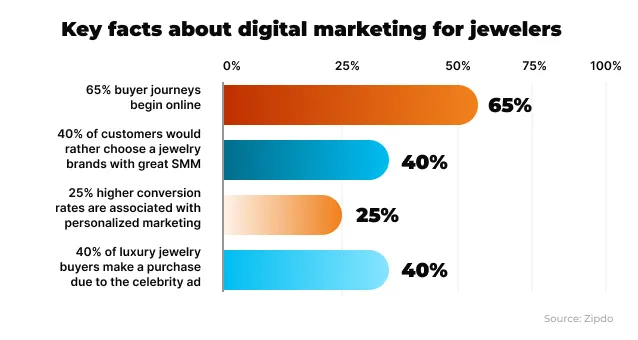
10 Digital Marketing Strategies For Jewelry Businesses
Now let’s talk about what you can actually do about these trends.
-
Your Website
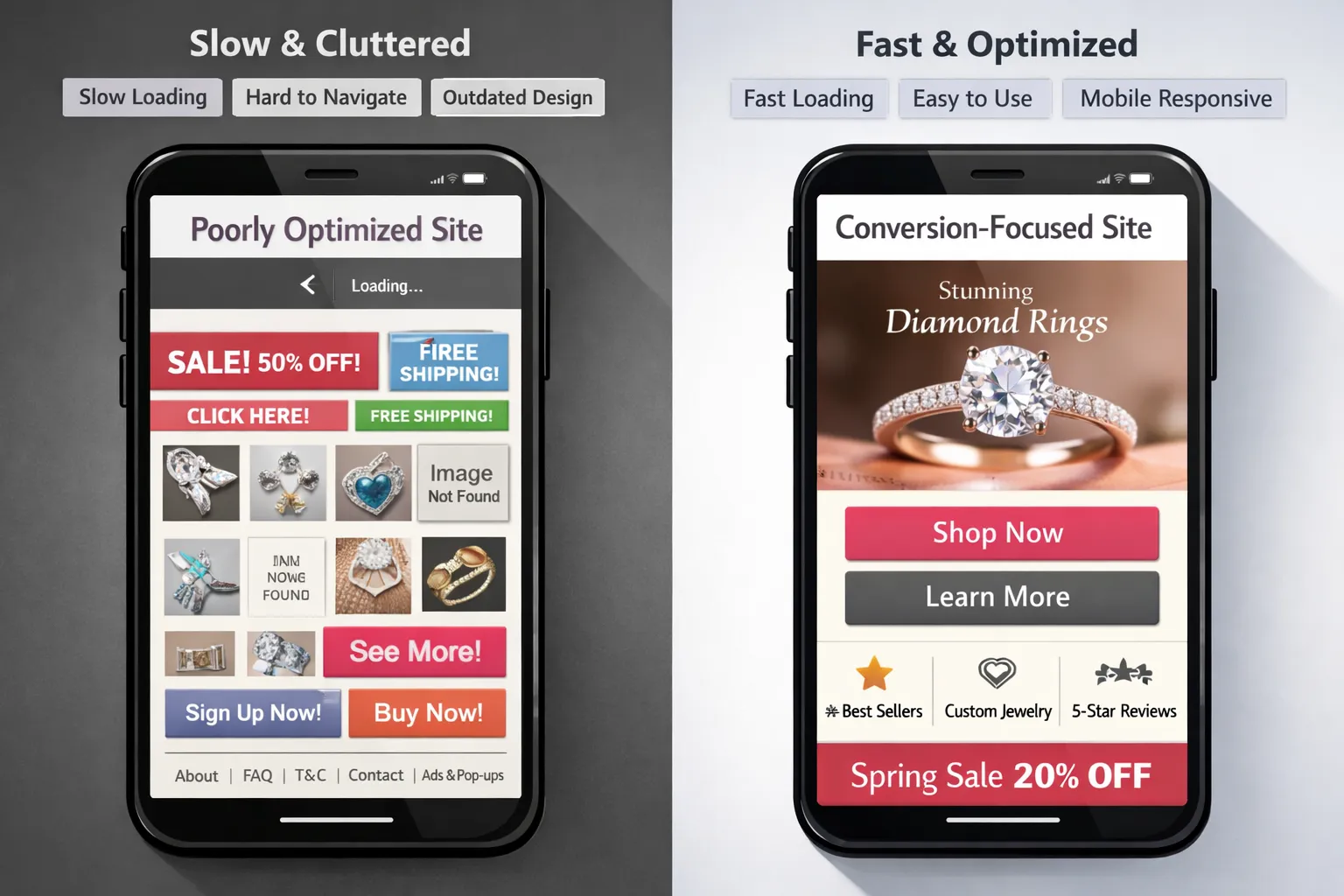
The average jewelry site converts at 1%–2%. Why? Most prioritize sparkle over sales. Your site has to be a place people want to visit (and hang around). It needs high-quality product images, 360-degree views, detailed specs (cut, clarity, carat weight, metal type), clear pricing, customer reviews and mobile optimization. Technical SEO — page speed under 3 seconds, logical user experience, structured data — directly impacts rankings and conversion rates.
-
Search Engine Optimization
Target long-tail keywords like “engagement rings under $3,000,” not "artisan handcrafted jewelry.” Local SEO is critical — 76% of local searches result in store visits within a day. That means an optimized Google Business Profile, location pages for each store, consistent NAP (name, address, phone) across directories and local content that mentions your city. Strategic SEO services make the difference between page one and extinction. For example, we helped Ukrzoloto.ua achieve 100% more traffic from search engines after optimizing their site migration strategy.
-
Social Media: Build Community, Not Billboards
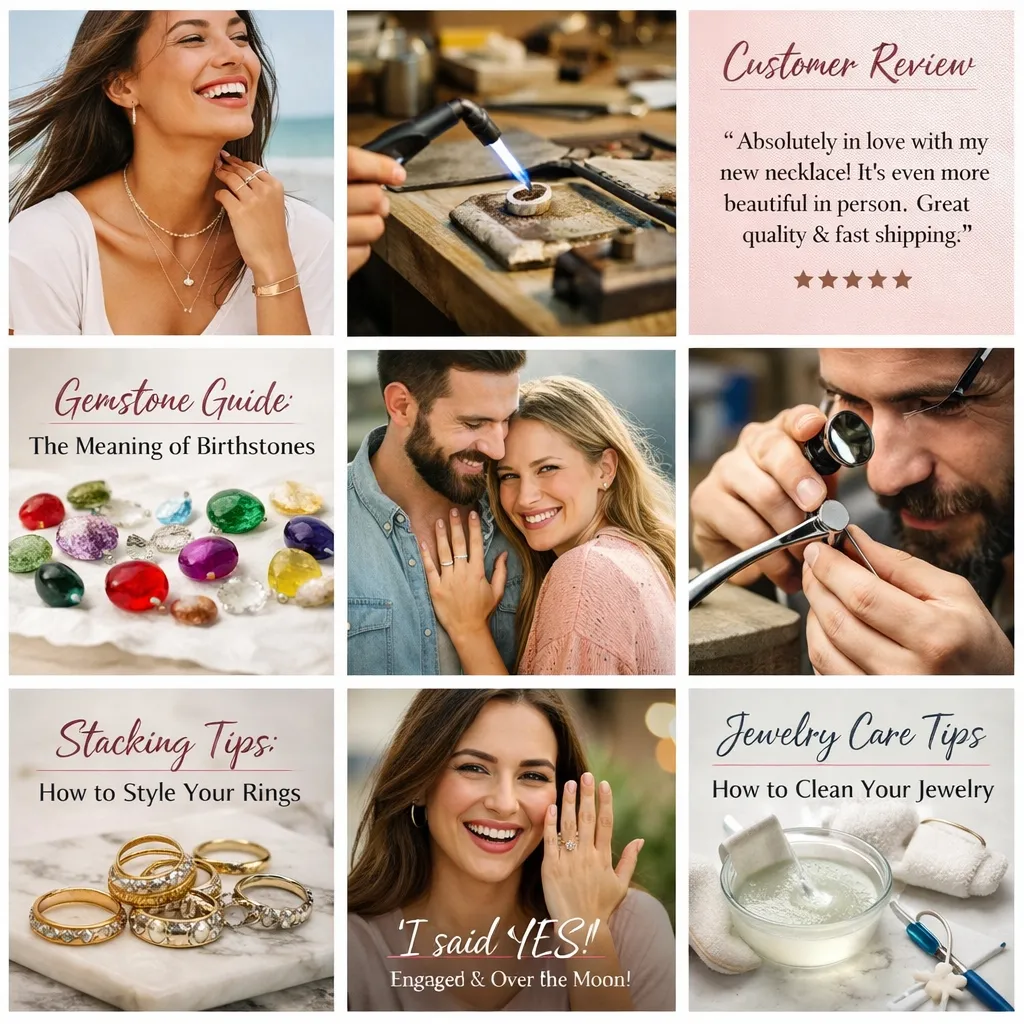
Instagram and Pinterest drive discovery. TikTok drives Gen Z purchases. But each platform requires different content:
Instagram: Lifestyle shots showing jewelry in context, Reels featuring behind-the-scenes craftsmanship, user-generated content from customers, carousel posts explaining the 4 Cs of diamonds
TikTok: Short-form educational content (“how to spot a fake diamond”), trend-jacking with jewelry angles, authentic founder stories, unboxing videos
Pinterest: High-quality product shots optimized for search, idea pins showing styling tips, seasonal gift guides
Powerful product design and engagement matter more than sparkly perfection.
-
PPC for Immediate Visibility
Jewelry has expensive CPCs. Your PPC strategy can’t be sloppy. You need insightful audience targeting (engaged couples 25–35, anniversary shoppers, Mother’s Day gifters), compelling creative that shows product detail, optimized landing pages that match ad messaging and relentless A/B testing.Google Shopping showcases products directly in search, and remarketing catches pesky cart abandoners.
-
Email Marketing
Many jewelry brands think of emails as an afterthought, but they’re actually a great way to connect with potential customers.
Essential sequences:
Welcome series: Introduce brand story, showcase bestsellers, offer a first-purchase incentive
Abandoned cart emails: Send within 1 hour, 24 hours and 72 hours with different messaging
Post-purchase follow-ups: Care instructions, styling tips, request reviews, hint at complementary products
Life Cycle campaigns: Someone who bought an engagement ring should get wedding band emails 6–9 months later, not random earring promos
-
Content Marketing: Show Your Expertise
Create content that answers customer questions before they even know what to ask:
-
Comprehensive buying guides (“How to Choose an Engagement Ring on a Budget”)
-
Educational content explaining diamond grading, metal types, gemstone care
-
Trend analysis (“Jewelry Trends 2026: What’s in Style?”)
-
Authentic brand storytelling about sourcing, design process, artisan partnerships
This strategy improves SEO (Google rewards helpful content), establishes authority and provides pre-purchase value that builds trust. Someone who reads your 2,000-word guide on ethical diamond sourcing is far more likely to buy from you than from your competitor.
-
AI Search Optimization (AIO & GEO)
ChatGPT, Google’s AI Overviews and Perplexity are now mediating search. With tools like ChatGPT Atlas launching, your approach to AI search needs constant evolution. Your brand needs to appear in AI responses, not just the old-fashioned kind of search results.
How to show up in AI answers:
-
Implement structured data markup (Product, Organization, FAQPage schemas)
-
Create authoritative, well-cited content that AI can reference
-
Maintain consistent NAP information across the web
-
Encourage and respond to reviews
-
Build knowledge graph integration through Wikipedia, Wikidata and industry databases
-
Amazon
Yes, you’re competing with the big dogs here, but can you afford not to?
What you need:
-
Optimized listings with keyword-rich titles and bullet points
-
High-quality images (minimum 7 per listing, including lifestyle shots)
-
Competitive pricing that accounts for Amazon’s fees
-
Consistent review generation
-
Strategic use of Amazon Ads (Sponsored Products, Sponsored Brands)
-
Data-driven competitive analysis (see our Amazon marketing statistics for fashion brands for benchmarks)
A comprehensive Amazon marketing strategy helps jewelry brands stand out in a crowded marketplace. Referral fees, FBA fees and advertising costs can kill your margins, so understand exactly how much of a cut Bezos gets and learn how to minimize those costs.
-
Lab-Grown vs. Mined: Pick Your Lane
Lab-grown diamonds are 15%–20% of the market and cost 30%–40% less. Your strategy for jewelry marketing needs a decisive stance.
Marketing mined? Emphasize rarity, romance and heirloom quality. Articulate why mined diamonds are worth the expense.
Marketing lab-grown? Lean into affordability, environmental benefits, conflict-free sourcing and larger stones for the same budget. Your customers are younger, price-conscious and buy with their values in mind.
Gen Z knows about diamond mining’s human toll. They don’t care about “forever” if it funded conflict or destroyed ecosystems.
-
Resale & Vintage Market
The luxury resale market hits $51 billion by 2026. Gen Z and millennials actively prefer pre-owned — it’s unique, sustainable and often better quality (they don’t make ‘em like they used to!).
Smart brand approaches:
-
Trade-in programs that give customers credit toward new purchases
-
Vintage and estate jewelry partnerships
-
Certified pre-owned collections with authentication guarantees
-
Marketing that emphasizes sustainability and uniqueness
Every vintage piece has history and storytelling potential. A 1920s art deco ring isn’t just jewelry — it’s a piece that survived the Depression and witnessed a century of proposals. That’s powerful.
Common Mistakes to Avoid
Many jewelry brands — especially small jewelry businesses — make these expensive errors:
-
Treating all platforms the same instead of tailoring content
-
Ignoring mobile
-
Not capturing emails
-
Poor product photography
-
No clear differentiation
-
Inconsistent branding across channels
-
Not tracking which campaigns drive sales
-
Spending 100% on acquisition, 0% on retention
Guide to Marketing for Jewelry: Building Your Strategy Step-by-Step
1. Define Positioning & Target Audience
Get specific. “Everyone who might buy jewelry” isn’t a target. Engaged couples? Fashion-forward women 25–40? Vintage collectors? Those are real target audiences.
2. Audit Your Digital Presence
What’s your conversion rate? Organic visibility? How do metrics compare to benchmarks? For small jewelry businesses, this shows exactly where limited resources have the biggest impact.
3. Set Measurable Goals
“Increase sales” is a basic birthday wish. Be specific: Plug in your goals for more organic traffic, conversion rates and expected monthly revenue.
4. Prioritize 3–5 Channels
SEO, Instagram, email and Google Ads. Master those first.
5. Create a Content Calendar
Plan months ahead. Consistency beats perfection.
6. Implement Tracking
Google Analytics 4, conversion pixels, email tracking — before spending a dollar.
7. Launch, Test, Optimize
A/B test everything. Analyze monthly, kill what fails, double down on the winners.
8. Build Systems & Scale
Once you know what works, create processes. Hire specialists, or work with a digital marketing agency focused on e-commerce SEO.
“Jewelry runs on emotions more than my student years ran on Dunkin.
A marketing strategy here can’t stop at good old pains and gains or ‘just bring us organic traffic.’ It has to be built around brand-defining emotions that flow through ad creatives, website copy, influencer selection (yes, wedding bloggers are a thing), reviews and beyond.‘Emotions research’ sounds like an easy box to check. If done right, it is not,” — Leonid Kovalenko, Head of Marketing Netpeak
How Netpeak Can Help
Building a digital marketing strategy for jewelry brands requires expertise across SEO, PPC, social media, content and analytics — plus e-commerce and luxury product marketing knowledge. No pressure, though: You only need to conquer the art of ranking for “engagement rings under $2,000” while also convincing someone that yes, they absolutely need that gold watch they’ve always wanted.
Netpeak US is a full-cycle digital marketing agency delivering data-driven strategies for jewelry and fashion brands. We offer technical SEO, PPC strategy, e-commerce SEO services and Etsy marketing. Check our case studies for specific results and success stories.
Your digital marketing strategy for 2026 must acknowledge reality: Lab-grown diamonds are staying. Resale is growing. AI controls discovery. Social commerce drives sales, and customers will always choose the brands that adapt.
Growth in jewelry marketing in 2026 looks a lot like smart strategy, honest storytelling and thoughtful testing, without chasing every shiny object.
FAQ
What are the essential digital marketing strategies for jewelers in 2026?
Focus on a mobile-optimized website, SEO targeting commercial keywords, visual social media marketing on Instagram and TikTok, targeted PPC, email marketing for retention and optimization for AI-powered search through GEO and AIO tactics. Additionally, develop clear positioning around lab-grown diamonds, use Amazon as a discovery channel and work with a digital marketing agency that understands jewelry-specific strategies.
How is AI changing digital marketing for jewelers in 2026?
Jewelry brands must optimize for Generative Engine Optimization (GEO) to appear in AI-generated responses while using AI-powered digital marketing services to automate tasks and optimize ad spend in real-time.
How can a small jewelry business stand out in a competitive market?
Small jewelry businesses can compete by finding a specific niche and owning it completely — whether sustainable lab-grown diamonds, vintage estate pieces or culturally inspired collections. Differentiate through authentic storytelling about sourcing and design, leverage content marketing to demonstrate expertise and optimize for local SEO.

 0
0
 0
0
 0
0
 0
0
Related Articles
Online Local Advertising for Small Businesses: How Neighbors Find You Online
Discover how small businesses use online local advertising to show up in search, maps, and social feeds — and turn neighbors into customers.
How to Do SEO for a Cleaning Company in 2026? From Invisible to Fully Booked
If you do it right, cleaning service SEO becomes your most sustainable growth channel — bringing in clients, lowering acquisition costs, and building long-term online visibility.
13 Leading Healthcare Marketing Trends for 2026
Discover the 13 hottest healthcare marketing trends in 2026 that will help your brand stay ahead, engage patients, and drive results. Stay smart, stay relevant!