
Personalization 2.0: Breaking the Deadlock of Cold Newsletters
To put it mildly, mass scripts do not work in 2025. Most leads in managerial positions receive dozens of similar messages every day. To stand out in such a competitive environment, you need to write in a way that compels people to respond.
Netpeak Ukraine's test funnels show that 90% of replies are written in response to messages that make the recipient feel like they were written specifically for them. Below, I will present the algorithms and techniques that increased our partners' campaign conversion rates from 1% to 11%.
Why personalization works
-
Algorithms love it.
LinkedIn and email services prioritize unique content when ranking search results.
-
As people scroll through massive amounts of content, they tend to click on what stands out.
Mass option (ignored):
Hello!
We can help e-commerce businesses boost sales through email, push, and Viber campaigns.
We also provide a free audit of your retention marketing. Let me know if you’d like to discuss this further.
Personalized version (catchy):
Hi Alexander!
I noticed your company gets around 800k visitors each month. I am curious how many of them return.
In e-commerce, most traffic is lost forever simply because visitors are not captured or encouraged to make a second purchase.
I have a few ideas on how to fix that. Do you want me to share them?
The numbers speak for themselves:
|
Metric |
Mass scripts |
Personalized messages |
|
Email open rate |
18–22% |
40–50% |
|
Response rate (LinkedIn) |
3–5% |
15–20% |
|
Calls from leads |
<1% |
8–12% |
The data is based on an average of 50 Netpeak Ukraine campaigns from the first half of 2025.
What is personalization based on?
Strong personalization is more than just inserting a name. It always includes these three things:
-
The context of the company or the individual. What is happening to them right now? Is there a product release, fundraising, a new job opening, a post, or a mention in the news?
-
A pain point or challenge that is likely relevant to them:
-
A new Head of Growth signals that the team is focused on growth, looking for new channels, or rebuilding the funnel.
-
An e-commerce site without a newsletter subscription form probably doesn't use email marketing as a retention channel, so they're losing their base and the opportunity to increase sales.
-
A job opening for DevOps/SRE indicates technical debt or the need to stabilize the infrastructure.
-
A signal that you not only know the company or person but truly understand them.
Someone checked out your website. They liked the catalog but couldn't find a newsletter subscription form. Without one, you lose 2–4% of customers every month. We can show you two or three options for a quick launch without changing the design.
How to launch personalization on a large scale
It can be scaled if built on the right logic and automation.
1. Segmentation + logic = template
For example, we segment leads based on their position and pain points, which should be relevant to the offer.
Message template:
As a [role], you have probably encountered [pain point].
We recently solved this issue at a similar company and managed to achieve a specific result.
Would you be interested in a brief overview of the case study?
2. Search for data for the template
To determine the role of the lead, you will need LinkedIn or Sales Navigator. Use these tools to determine the following:
-
Position and area of responsibility. E.g., CMO, involved in AI, and responsible for automation.
-
Activity in the feed/groups. E.g., comments, reposts, and posts mentioning the user in a message.
-
Team size and company stage. E.g., startup, scale-up, or enterprise.
-
Location and regional focus. E.g., working with clients in the EU or with a team in Dubai.
Use tools such as BuiltWith and SimilarWeb to explore the website and identify potential pain points. Look for these elements:
-
Products/features. Does it have a chatbot, email forms, or a SaaS model with a trial period?
-
Tech stack. Examples include React, Shopify, WordPress, and Stripe. Use BuiltWith.
-
Traffic level and sources. How active is the company? What channels do they use? Use SimilarWeb.
-
Pain points or opportunities for improvement: a lack of subscription options, weak retargeting, and slow website loading.
3. Create a template
To create a more complete template, you will need Clay, Zapier, and ChatGPT.
-
Clay combines data from different sources, such as LinkedIn, your website, email, and CRM, and extracts specific variables.
-
Zapier configures integrations, such as updating Google Sheets when there is a new lead in the CRM.
-
ChatGPT generates custom insights and short, personalized messages based on data.
Below is an example of personalization for an IT company targeting FinTech products with payment infrastructure.
The goal is to provide:
-
Support in developing core financial logic
-
Verification modules, AML/KYC, and card integration
-
Optimization of transaction speed, API, and backend
Step 1: Collecting data
From Sales Navigator, extract the following:
-
Company name.
-
Website.
-
Position: CTO, Product Lead, or Head of Payments.
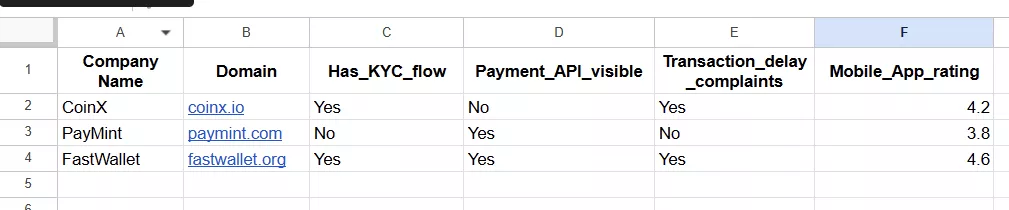
Add the following to Google Sheets:
-
Has_KYC_flow (yes or no). Is the verification process described? Look for it in the FAQs, the onboarding process, or Google site:[domain] kyc.
-
Payment_API_visible (yes/no). Is there a public API or documentation? Check in the footer or Google site:[domain] API.
-
Transaction_delay_complaints (yes/no). Are there any complaints about delays? Analyze Trustpilot, Reddit, or Google search.
-
Mobile_App_rating (1–5). Check the app rating through the App Store or Google Play, or use a scraper such as SerpAPI or Apify.
Step 2: ChatGPT prompt
Write a concise prompt to analyze the collected information.
Act as a FinTech dev consultant and reply.
Input variables
– Has_KYC_flow: {{Has_KYC_flow}}
– Payment_API_visible: {{Payment_API_visible}}
– Transaction_delay_complaints: {{Transaction_delay_complaints}}
– Mobile_App_rating: {{Mobile_App_rating}} / 5
Output **exactly two sentences** (no greetings, no line breaks).
If Has_KYC_flow = "No", state that the absence of a KYC-flow slows integrations and lowers partner trust.
If Payment_API_visible = "No", add that the lack of a public API also hinders integrations.
Combine both issues in one concise sentence when both are «No".
Offer help in one concise sentence:
We can help you quickly implement custom KYC modules and open APIs with basic documentation.
Tone: credible, conversational, non-salesy.
ChatGPT generates the following:
I noticed that you don't have a KYC flow or a public API. This often slows down integration and reduces trust from partners.
We can help you quickly implement custom KYC modules and an open API with basic documentation, without any unnecessary overhead.
Step 3: A template for a newsletter
Manually write the introduction and conclusion, and ChatGPT will fill in the rest.
Hi [firstName],
I came across [company]. It's impressive how you’re scaling in FinTech while balancing such high expectations around UX and customer trust.
[gpt_pitch]
If you find it useful, I can share a checklist of common risks in payment flows. Alternatively, we could set up a quick audit and provide some technical feedback. Would that be interesting?
Best,
[Your Name]
Step 4: A ready message
Hi Anna,
I looked into PayWave, and I found it really interesting how you’re scaling in FinTech while navigating the high expectations around UX and trust.
I noticed that you don't yet have a KYC flow or a public API. Both are often critical for smoother integrations and building partner confidence.
We can help with that. We implement custom KYC modules quickly and can open up APIs with clear, lightweight documentation (no unnecessary overhead).
If you're interested, I'd be happy to share a checklist of common payment flow risks or provide some technical feedback from a short audit. Would either of these be of interest?
Best,
[Your Name]
Step 5: Scaling
-
Collect 50-100 company names in a Google Sheet.
-
Write one prompt in ChatGPT to generate 50 personalized responses.
-
Insert the options into the template.
-
Send out the mailing.
What to remember
-
Personalization means paying attention to context and speaking plainly.
-
An honest message is worth more than a "warm" letter. If the message is not relevant to the recipient, it is spam.
-
Scaling is possible and necessary, but only if the structure is flexible and not based on a template.
-
AI speeds up the process. Good data leads to strong copy, while insufficient data leads to poor personalization.
-
Always include a call to action (CTA). Without a clear next step, even the best hook is ineffective.
-
Measure and update. Use A/B testing to evaluate hooks. Remember that triggers age quickly, so data needs to be refreshed.
Want to see how it works? Contact us, and we'll show you an example from your niche.
You definitely will be impressed by the level of personalization.

 0
0
 0
0
 0
0
 0
0
Related Articles
Local SEO for Construction Companies Explained
If clients can’t find you online, they hire someone else. Learn how local SEO puts your construction business in front of ready buyers.
How to Market a Security Company in 2026?
Most security companies are invisible online. Here's how to fix that and turn your digital presence into a steady stream of qualified leads.
Sustainability Marketing: 7 Smart Ways to Earn Trust (and Customers)
Learn how to grow your brand efficiently while using eco-friendly marketing practices to build trust and long-term revenue.