
PPC advertising works like buying front-row seats at a concert: you get the best spot in the crowd, but it comes at a premium price.
Think of that iconic 2004 Pepsi commercial with Britney Spears, Pink, and Beyoncé. They put three pop goddesses, singing “We will rock you,” in a gladiator arena and drew attention outright. That’s precisely what PPC for e-commerce does for your store: you pay top dollar to get in front of your target audience in a way people can’t ignore.
Pepsi knows all about deadly competition (remember Coca-Cola?). And your e-commerce store surely knows that feeling too: how to be in that arena with competitors and fight for life.
In this article, you’ll learn why PPC e-commerce is often the best choice for a crowded market and how to squeeze revenue out of every single cent you spend on ads.
Who Is The Champion in the Digital Colosseum?
Even with great products and low prices, it takes months to get Google to show you on page 1 organically, or to create enough high-quality content to shine on Instagram or TikTok. PPC (Pay-Per-Click advertising) is the shortcut that helps you to skip the line and go straight to the ride.
How it works:
-
You pay a platform (Google, Meta, TikTok, Amazon, whatever is best for you).
-
Shoppers see your products instantly: on Google search, on Instagram as a cute carousel, on TikTok as a video ad, on Amazon as “Sponsored”, etc.
-
You pay every time someone clicks your ad.
Why PPC Advertising Is the Biggest Player at the Arena?
PPC e-commerce advertising is one of the most popular paid channels: 73% of B2C marketers used it in the past 12 months. That’s why:
-
The internet is crowded — 28 million e-commerce stores worldwide. PPC for e-commerce sites gives you visibility today, even if your store is 10 minutes old.
-
You target shoppers who are actively searching for what you sell. Intent-based traffic brings more sales — it just makes sense.
-
84% of brands and marketers are happy with their PPC advertising campaigns.
-
Big ad platforms are great with data, so you know for sure which product is a bestseller, whether your pricing is too high, which keywords people search for, etc.
-
The return on investment from Google Ads is $2 for every $1 spent.
We at Netpeak US have realised 260+ successful PPC projects and counting. If your e-commerce company wants some help with its e-commerce PPC from people who know what they're doing, give us a call!
Your Digital Arsenal: 7 E-commerce PPC Campaign Types
There are more variations of PPC than new Netflix releases. It means everyone can find the format that works best for them. Let’s figure out your perfect match!
Search Ads (Keyword-Based PPC)
These are text ads that appear high in search results when someone searches for specific keywords. So, you can catch potential buyers when they're looking for your product.
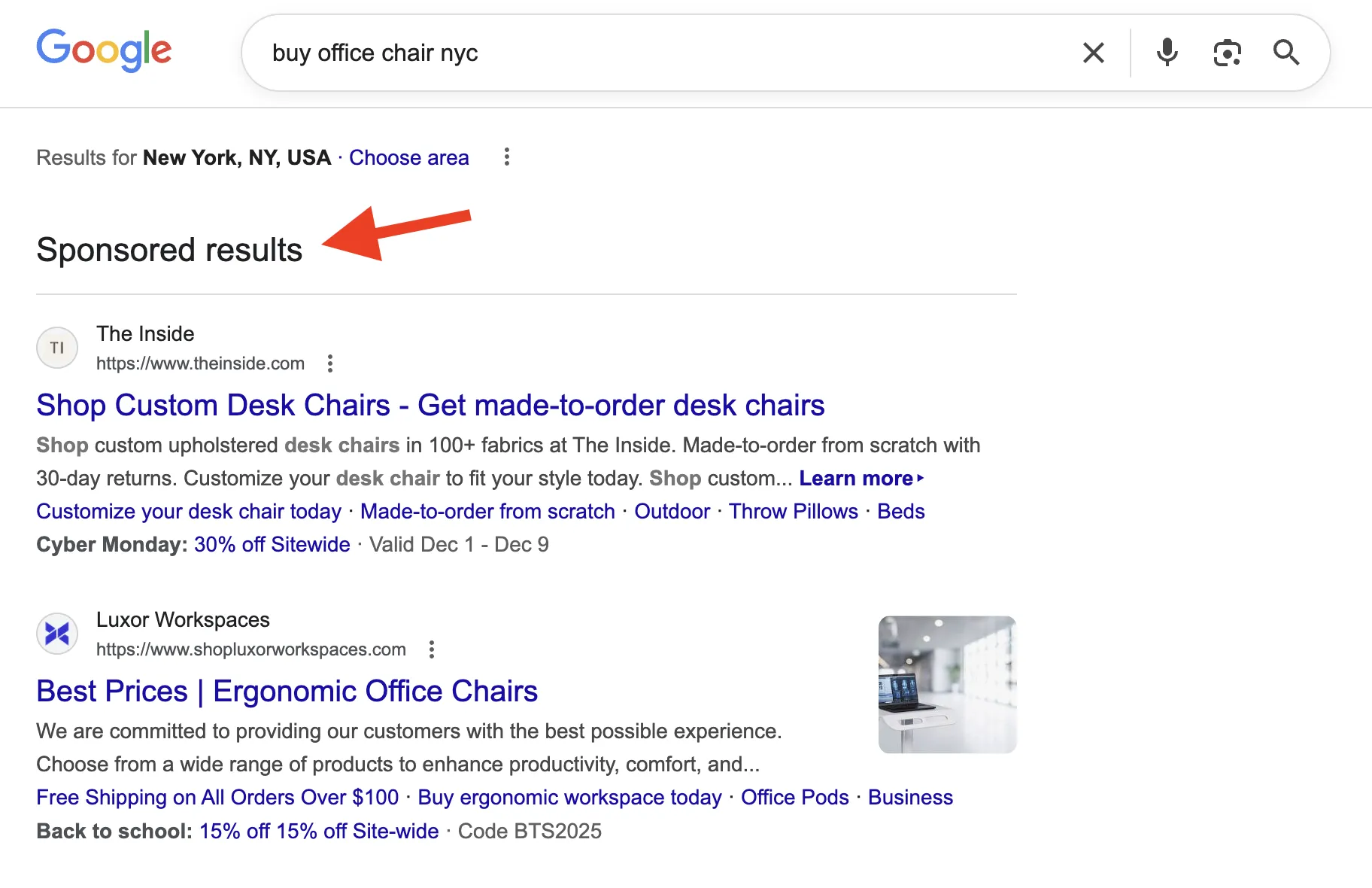
Google Ads for the keyword “buy office chair NYC.”
Search Ads are perfect for:
-
Products with clear keywords (“ceramic mugs,” “gaming desks,” “dog beds”, etc.)
-
If you sell solutions to specific problems (e.g., “you need to sit all day” → ergonomic chair).
-
Seasonal or gift shopping (“Valentine’s gift for her”).
-
Local products (“same-day flower delivery Long Island”).
Business Results: Google Ads is the go-to ad platform and holds a dominant share (~ 39–40%) of the PPC e-commerce market. Average cost-per-click (CPC) for paid search is around US$2.69.
Google Shopping Ads (Product Listings Ads)
These are the picture-based product ads you see at the top of Google, with a price, an image, and a store name. Shoppers see your product right in the search results, so the chance they’ll click is as high as the sky.
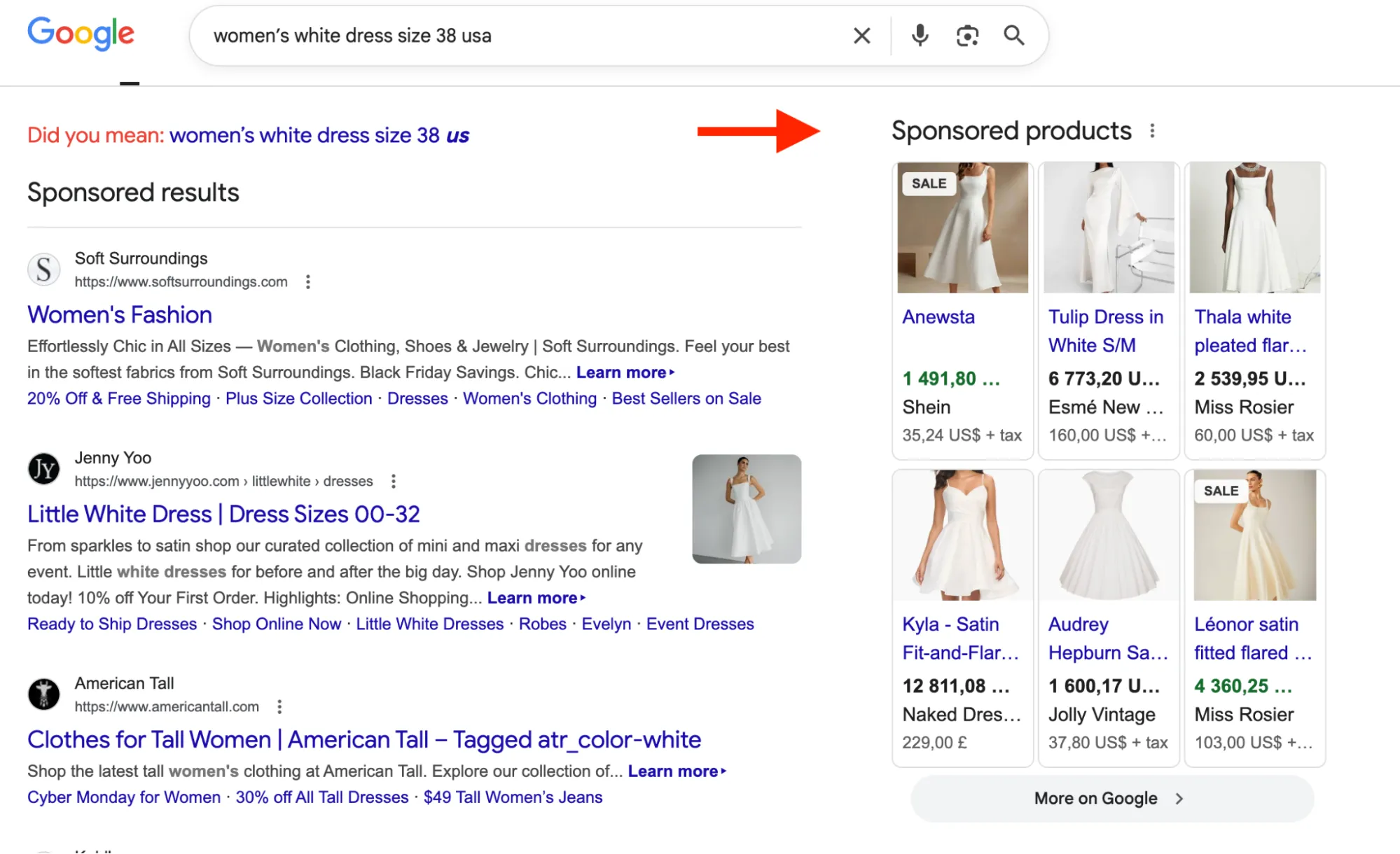
Google Shopping Ads for the keywords “women’s white dress size 38.”
Google Shopping Ads are perfect for:
-
Products where the image sells the product (shoes, dresses, makeup, home decor, etc.)
-
Stores with lots of items — Shopping Ads automatically rotate thousands of products, so there is no need to create individual ads.
-
Competing on price — Shopping Ads show your cost up front so that you can steal sales from big competitors.
Business Results: Shopping Ads account for 76% of retail search ad spend and generate 85% of clicks on e-commerce PPC campaigns.
YouTube Video Ads
These are short video ads that appear before or during YouTube videos or directly in YouTube search results.
And since YouTube is the world’s 2nd-largest search engine with over 2.5 billion monthly active users, it’s a powerful place to reach shoppers.

A fitness app shows its workout video in the YouTube search results
YouTube Video Ads are perfect for:
-
Products that need to be demonstrated (tech gadgets, fitness equipment, educational tools & apps, etc.)
-
High-ticket products that need more reassurance — people want to see the benefits and feel confident before spending big.
-
Reaching people on Smart TVs.
Business Results: YouTube ads helped 70% of YouTube viewers discover new brands.
Facebook & Instagram Ads (Meta Ads)
These are visual ads that appear across social media: Facebook and Instagram feeds, Stories, Reels, and even Messenger.
People aren’t actively searching here — you’re catching them mid-scroll. But when the deal is worth it, they don’t mind the interruption at all.

These are the ads on Facebook that see the person who has saved a lot of Reels with watercolor guides lately.
Meta Ads are perfect for:
-
Storytelling-heavy products ( to show a candle in a cozy home, a backpack on a mountain, before/after skincare results, etc.)
-
Impulse purchases at social media (trendy items, seasonal products, limited editions, low- to medium-ticket goods from $10 to $80).
Business Results: 86% of marketers use Facebook for marketing purposes, and 79% use Instagram.
TikTok Ads
These are short video ads that appear right inside the “For You” feed. TikTok users buy based on emotion, and these ads blend so well with organic content that they feel more like recommendations than advertising.
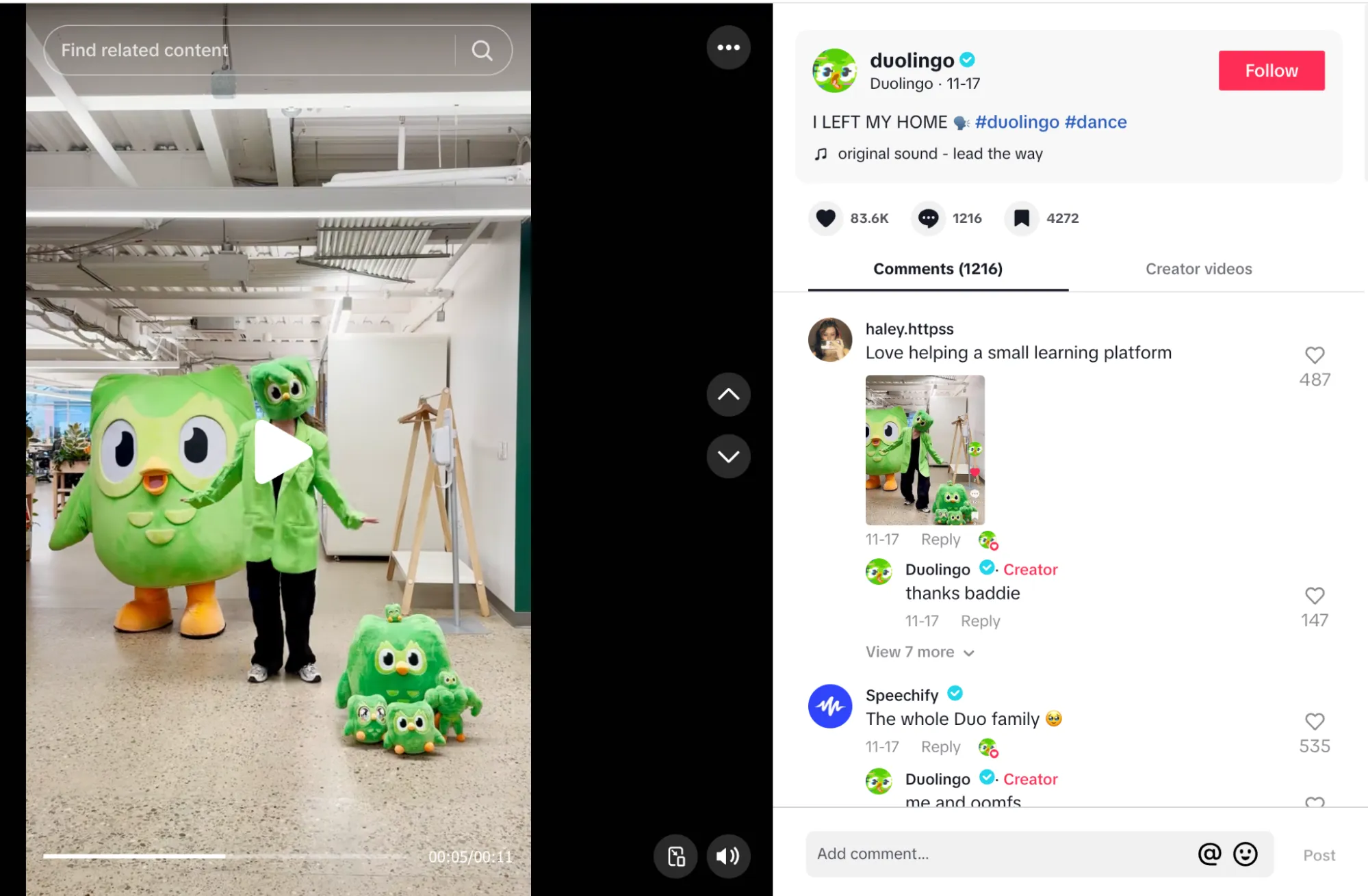
Duolingo has the funniest content on TikTok. People link from posts to a TikTok Shop and make purchases.
TikTok Ads are perfect for:
-
Impulse-buy products that “go viral” easily (beauty, clothing, gadgets, hobbies).
-
Demonstration-heavy products (makeup transformations, before/after results, cooking tools, etc.)
-
Brands with creative content.
Business Results: For every $1 spent on TikTok Ads, businesses earned around $1.41 back.
Amazon Sponsored Products / Sponsored Brands
Ads on Amazon appear above the search results, on product pages, and across Amazon’s recommendation sections. These ads put your products in front of people who are already in buying mode — making them ideal for any brand selling on Amazon.
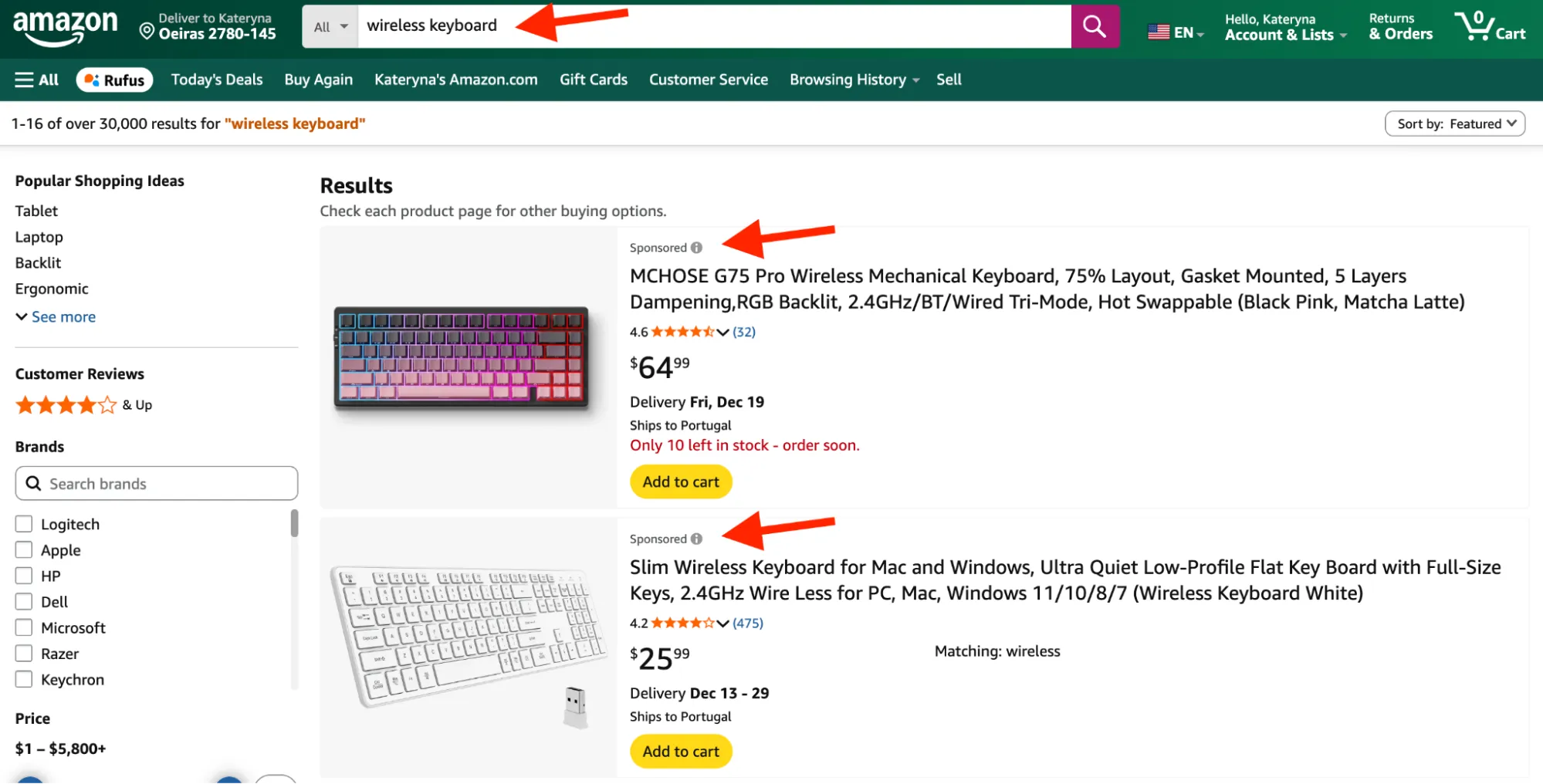
When someone searches “wireless keyboard” on Amazon, the first results are paid listings.
Amazon Ads are perfect for:
-
Winning competitive product categories (in niches like electronics, home goods, beauty, or supplements).
-
Supporting Prime Day, holidays & sales events.
Business Results: For every $1 you spend on Amazon ads, you earn about $3.32 back in sales.
“There’s a common claim that Amazon is the superior ad platform because users go there solely to buy, while Google has too much informational intent. But this ignores scale and real shopping behavior.
Google’s audience is significantly larger, and a considerable portion of buyers still start or finish their purchase journey on Google. Informational-intent users aren’t “wasted”; they’re future buyers. If they discover your brand while researching, learn from your product pages, and trust your expertise, they often return to your site when they’re ready to purchase — something Amazon can’t replicate.
And let’s not forget: even Amazon relied heavily on Google Ads. For years, they pushed their Amazon campaigns into Google Shopping and dominated auctions during events like Prime Day. They wouldn’t have spent millions there if Google’s traffic didn’t convert.
Yes, Amazon Ads capture buyers at the final step, but Google captures them at every step — and lets you own the traffic, the data, and the customer relationship. Innovative e-commerce brands use both, not because they overlap, but because together they cover the whole buyer journey,” — Andriy Vankhadlo, Netpeak US PPC Specialist
Retargeting Ads (Across Google, Meta, TikTok, etc.)
These ads target people who visited your website but haven’t bought yet. Most shoppers don’t purchase on their first visit; retargeting helps bring them back to finish the order.

Retargeting ads are perfect for:
-
Recovering abandoned carts.
-
Reminding shoppers about the product they loved.
-
Showing buyers precisely what they viewed.
Business Results: Retargeting ads can increase conversions by up to 150%, compared to non-retargeted traffic.
A Step-By-Step Walk Through the E-commerce PPC
PPC can feel mysterious: you put money in, and sales somehow come out. But it’s not magic — it’s just a process, supported by powerful platforms. Now, let's take a closer look at PPC management for e-commerce.
|
What to Do |
How It Works |
Tips |
|
|
Step 1. |
Decide on your goal |
Before touching any buttons, decide: Do you want sales? Add-to-carts? Leads/sign-ups? Or just traffic for a new store? For e-commerce, most of the time your main goal is purchases. |
Choose “Sales” / “Conversions” as the objective in Google Ads / Meta Ads. |
|
Step 2. |
Create your ads |
You need to create product images, titles, and prices for Google Shopping; short headlines + texts for Search Ads; images/ videos + captions for Meta / TikTok / YouTube. |
Use clear images and show the benefits in texts: “No-slip yoga mat” instead of just “Yoga Mat.” Always add a CTA: “Shop now” or “Order today”. |
|
Step 3. |
Select keywords (for Search / Shopping) |
They tell the platform which searches should trigger your ads. |
Start with buying-intent keywords: “buy…”, “order…”, “best [product].” Avoid super-broad stuff, like “shoes” or “makeup” – too expensive. And add negative keywords (things you DON’T want): “free”, “DIY”, “template”, “used”, “jobs”. |
|
Step 4. |
Launch the campaign |
Once you hit “Publish”, the platforms go into a learning phase. They show your ads on different placements, devices, and creatives to find which work best for you. |
Don’t judge performance in the first 48-72 hours. Machine learning needs some time. |
|
Step 5. |
Engage in bidding (the auction part) |
Every time someone searches on Google or scrolls Instagram/TikTok, there’s a tiny auction happening in milliseconds. You “bid” how much you’re willing to pay for a click or for a conversion. |
Use automated bidding with a clear goal: “Maximize conversions” or “Target ROAS” for Google and “Lowest cost” with a daily budget for Meta. Start with small, safe budgets, e.g., $10-$20/day per campaign. |
|
Step 6. |
Track what happens next |
Tracking shows you which clicks became sales — and which parts of your campaigns are profitable. |
Useful tools for tracking: Google Analytics, Meta Pixel, Google Ads conversion tracking, TikTok Pixel, and your own e-commerce platform (Shopify, Woo, etc.) |
|
Step 7. |
Optimize based on real data |
Look at results (sales, clicks, costs) and improve your ads so you spend more on what works and less on what doesn’t. |
|
PPC for e-commerce is one of our favourite digital marketing specializations here at Netpeak US. For example, we helped La Novale Dress Boutique receive 73 calls and 32 fitting requests. If you want some help with your PPC advertising, give us a hint!
Three PPC Practices That Actually Work for E-commerce
Here are three simple PPC practices that actually work — nothing complicated, just the kind of tips that keep your budget happy.
Good Creative = Cheaper Clicks
The quality of your creative decides how much you pay for clicks — and how many of those clicks turn into sales. Google, Meta, TikTok, and YouTube reward great visuals with lower CPCs and punish bad visuals with fewer impressions.
Here’s what you should do:
-
Use clear, bright product photos with a centered product and neutral background.
-
Keep text minimal, 1–3 words max: “New Arrival”, “40% Off”, etc.
-
Show the product in use (especially on Meta/TikTok/YouTube): a blender making a smoothie, a dress in motion, etc.

Don’t Mix Cold Traffic and Retargeting in One Campaign
When you run ads, your target audience falls into two very different groups:
-
Cold traffic — people who have never heard of you. They’ve never visited your website, never seen your product, and don’t trust you yet.
-
Warm traffic / Retargeting — people who already interacted with your store: visited your website, viewed product pages, added to cart, etc. These people already know you and are much closer to making a purchase.
Retargeting usually has the highest ROAS of all PPC campaigns. You’re advertising to people who already liked something enough to click or browse. Don’t dilute this powerful audience by mixing it with strangers — give it its own ads.
Scaling is the New Black
When your ads finally start performing — strong clicks, steady sales, great ROAS — it’s tempting to crank up the budget right away. But scaling too fast almost always destroys that performance.
Instead of going from $20 → $200 in one jump, do this:
-
Increase to $25 (approx +20%)
-
Wait 48–72 hours
-
If results stay stable → go to $30, then $36, $45, $55, etc.
This tells the algorithm: “Relax. Same campaign and audience, just a little more fuel.”
Increasing the budget is called vertical scaling. But often, especially for small stores, you can successfully use horizontal scaling too:
-
Test new audiences, creatives, and placements.
-
Launch a duplicate campaign.
-
Add a “Top 20% Lookalike Audience.”
-
Add “View Content” retargeting, etc.
This spreads risk across multiple PPC campaigns rather than forcing a single campaign to carry all the weight.
We at Netpeak US scaled real brands on Amazon with PPC advertising:
-
Sister’s Aroma (fragrances): +333% increase in orders
-
Xado (vehicle transmission and fuel additives): +33% total sales growth
-
Biosphere (household products): +300% month-over-month sales increase
Four Sneaky E-commerce PPC Mistakes to Avoid
These aren’t dramatic errors — but sometimes small things can chip away at your performance every single day until your ROAS collapses. We don’t want it, do we?
-
Sending traffic to slow or messy product pages. Sometimes sellers blame the ads when the real problem is the landing pages: slow loading, confusing descriptions, cluttered layout, low-quality photos, too many pop-ups, etc. Fix: Aim for a load time of < 2.5s and invest in the landing page UX design to reduce bounce rate.
-
Running too many campaigns at once. When your budget spreads too thin across many ads, each campaign gets so little data that the algorithm can’t learn. Fix: Start with 1-2 cold campaigns + 1 retargeting campaign. Add new PPC campaigns only when existing ones stabilize. Keep daily budgets meaningful (e.g., $20–30+ per active campaign).
-
Letting Google/META auto-generate bad product titles. Platforms rewrite titles themselves if your feed is weak — often horribly. And you don’t see these rewritten titles unless you check the Search Terms. Fix: Write clear, keyword-rich product titles from the start. Include essential details: color, size, gender, material, etc.
-
Sending retargeting traffic to the homepage. People who viewed a specific product want to return to THAT product. Retargeting is about continuing the journey, not restarting it. Fix: Send each retargeting segment to the exact item or category: they viewed a ring → send them back to that ring. It improves customer experience dramatically.
Key Things to Take With You
Once you understand how PPC advertising works, it becomes one of the fastest, most reliable ways to bring potential customers into your store. It does so today, not months from now.
If you take anything away from this guide, let it be this: PPC strategy for e-commerce is a money-maker when used intentionally — and a money-burner when used blindly.
FAQ
Which PPC agency for e-commerce stores is best?
There’s no single “best” agency — it depends on your niche, budget, and goals. Look for agencies that specialize in eCommerce, have proven ROAS case studies, and manage platforms like Google Shopping, Meta, TikTok, and PMax. Always choose experience over fancy branding.
Can PPC be used in e-commerce?
Absolutely. PPC is one of the fastest and most effective ways for eCommerce stores to get immediate traffic, test products, and drive sales. It puts your products in front of people who are already ready to buy.
What are e-commerce PPC metrics?
Key metrics include:
-
ROAS (Return on Ad Spend)
-
CPA (Cost per Acquisition)
-
CTR (Click-Through Rate)
-
CPC (Cost per Click)
-
CVR (Conversion Rate)
-
AOV (Average Order Value)
-
LTV (Customer Lifetime Value)
How much should an e-commerce store spend on PPC?
Most stores start with $20–$50/day per campaign and scale as soon as they reach a stable, profitable ROAS. The proper budget depends on your niche, product price, and competition — start small, learn fast, then scale.

 0
0
 0
0
 0
0
 0
0
Related Articles
Local SEO for Home Service Companies: 8 Fool-Proof Ways to Reach Your Customers
When something breaks, people go straight to Google to find a plumber, an electrician, or a roofer right away. And local home services SEO is what makes sure you’re the one they find (and choose!) instead of your competitor.
Local SEO for Construction Companies Explained
If clients can’t find you online, they hire someone else. Learn how local SEO puts your construction business in front of ready buyers.
How to Market a Security Company in 2026?
Most security companies are invisible online. Here's how to fix that and turn your digital presence into a steady stream of qualified leads.