
SEO for HVAC Companies: 12 Mistakes That Make Your Business Invisible (+Best Practices Template)
You got into the HVAC business because you’re great at making homes livable again when the heat dies on the coldest night of the year or the AC quits right when your city breaks a heat record. But here you are, wondering why that guy down the road — you know, the one whose trucks always have crooked decals — is somehow outranking you online.
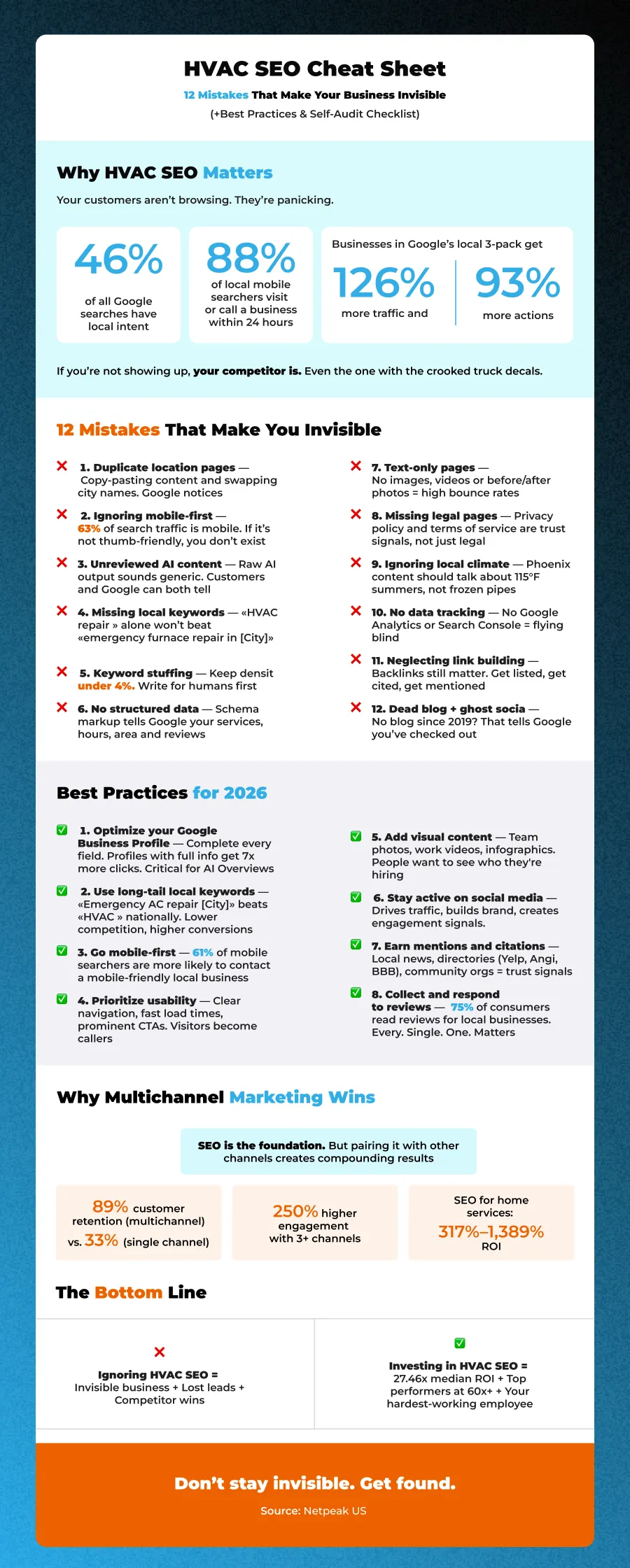
SEO for HVAC companies is exactly how customers find you when their furnace decides to retire without giving notice. Nearly 46% of all Google searches have local intent, which means about half the people firing up Google right now are looking for someone nearby. If that someone isn’t you, it’s your competitor. And that competitor might even be the guy who uses duct tape on ductwork.
This guide covers everything you need to know about SEO for HVAC company growth — from the basics of local SEO for HVAC contractors to the 12 mistakes that are making your business invisible online. We’ll also dig into best practices, explain why multichannel marketing is a game changer and hand you a self-audit checklist so you can start fixing things today. No fluff. Just actionable HVAC SEO tips from the experts.
What Is HVAC SEO?
HVAC SEO is the process of optimizing your online presence so potential customers can find you when their system breaks down — not your competitor three towns over. SEO for HVAC companies covers everything from fine-tuning your HVAC website and Google Business Profile to targeting location-specific keywords, earning quality backlinks, building customer reviews and improving your visibility in local search results. Whether you’re focused on HVAC local SEO to dominate your service area, sharpening your HVAC SEO strategy to climb search engine rankings or just learning the SEO basics for HVAC companies, the goal is the same: getting your business in front of the right people at the exact moment they need you. Think of HVAC search engine optimization as your 24/7 digital sales rep — one that never calls in sick, never takes a lunch break and never accidentally backs the van into a client’s mailbox.
The Basics of HVAC SEO: 4 Key Components
Before you can dominate local search, you have to understand the four pillars of HVAC search engine optimization. Think of these like the components of an HVAC system itself — if one part fails, the whole thing runs poorly (or not at all).
Technical SEO
This is the behind-the-scenes work that makes sure Google can actually find and crawl your website. We’re talking site speed, mobile responsiveness, clean URL structures, XML sitemaps and fixing crawl errors. If your HVAC website takes longer to load than it takes your tech to diagnose a bad compressor, you have a problem.
“Technical SEO is also really important. You need to have no technical issues on your site — because if Google can’t crawl it properly, nothing else you do matters,” says Liudmyla Tiusova, Deputy Head of SEO at Netpeak Agency.
Local SEO
This is the big one for HVAC. Local SEO for HVAC companies is what puts you on the map — literally. Optimizing your Google Business Profile, managing reviews, ensuring consistent NAP (name, address, phone number) across business listings and targeting location-specific keywords are all critical. When someone searches “AC repair near me,” local SEO is the reason you either show up in the Google Map Pack or get buried beneath three competitors and a Yelp page.
On-Page SEO
On-page SEO for HVAC involves optimizing the content and HTML source code of your pages. That includes title tags, meta descriptions, header tags, internal linking and making sure every service page targets the right keywords. Your “furnace repair” page shouldn’t also be trying to rank for “commercial refrigeration” — that’s like sending an HVAC tech to fix a plumbing issue.
Off-Page SEO
Off-page SEO is everything that happens away from your website to boost your authority. This includes classic link building, getting listed in local catalogs and directories, earning mentions on Q&A platforms like Reddit and Quora and building citations in industry-relevant databases. Think of it as your online reputation beyond your own front door.
Why Local SEO for HVAC Businesses
HVAC is inherently hyperlocal. Nobody’s flying someone in from three states away to fix their furnace. Your customers live within your service radius, and they’re searching for you on their phones, usually in a mild-to-moderate state of panic.
The numbers don’t lie: 88% of consumers who search locally on a smartphone visit or call a business within 24 hours. That’s not casual browsing — that’s someone with a broken AC unit on a 95-degree day making a buying decision right now.
And it gets better: Businesses in Google’s local 3-pack receive 126% more traffic and 93% more actions (calls, clicks and website visits) compared to those ranked 4–10. If your local SEO for HVAC company SEO marketing game isn't aiming for that top-three spot, you're actively avoiding income.
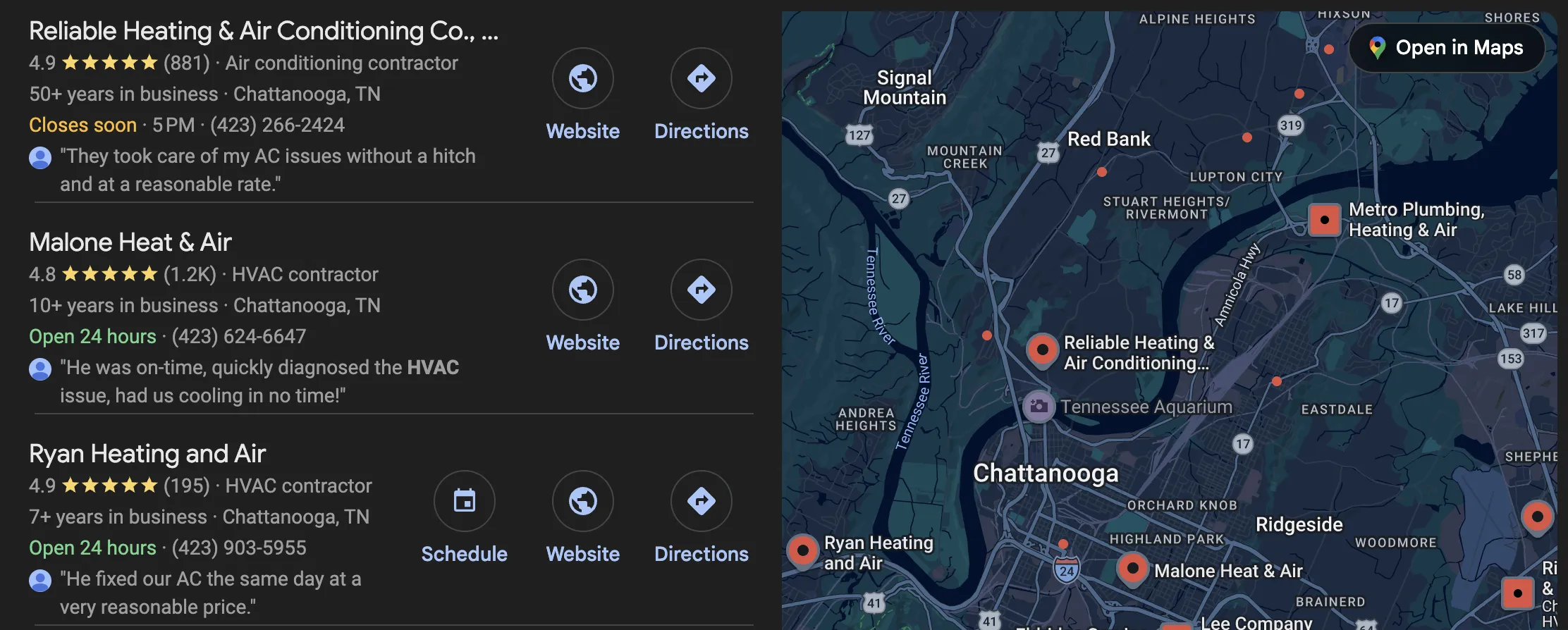
“Local SEO is most important because consumers are looking for local services,” Tiusova emphasizes. “If you’re an HVAC company, your Google Business Profile isn’t optional. It’s your digital storefront.”
This is where you want to be. Not on page two.
Unique Traits of HVAC Companies SEO-Wise
HVAC SEO isn’t like SEO for an online clothing store or a SaaS company. Your industry has quirks that make it uniquely challenging — and uniquely rewarding when you get it right. Here’s what sets HVAC SEO strategy apart.
Seasonality and Weather-Triggered Demand
SEO for HVAC is beautifully predictable in one way: In winter, everyone searches “heater repair NOW.” In summer, it’s “AC not working emergency.” And in spring? Google basically says, “See you in six months.”
Seasonality means your SEO strategy can’t be static. You need to plan content and optimize pages around peak seasons before they hit. If you’re publishing your “top AC maintenance tips” article in August, you’re already too late — Google takes time to index and rank content. People choose HVAC companies during certain parts of the year, so your content needs to be ready and waiting.
Emergency-Driven Searches
A huge chunk of HVAC searches are emergencies. Nobody wakes up thinking, “You know what sounds fun today? Researching furnace repair providers.” They search when something breaks, and they needed help yesterday. That urgency makes your appearance in local search results absolutely critical — you’re competing for panicked, credit card in hand customers.
Hyperlocal Service Area
You serve specific ZIP codes and neighborhoods. Your HVAC SEO strategies need to reflect that granularity. Generic “HVAC repair” content won’t cut it when someone searches “heating repair in [your city].” Location pages, localized content and geo-targeted keywords are non-negotiable for local SEO tips for HVAC contractors.
High Competition
Every city has dozens of HVAC companies fighting for the same local keywords. The barrier to entry is low — any tech with a van and a business card can call themselves an HVAC company. But the barrier to ranking is higher, which is actually good news for established businesses willing to invest in proper HVAC company SEO.
Trust Issues
There’s another factor for HVAC businesses, and that is trust. You’re asking strangers to let you into their homes. HVAC services can be expensive, and customers want to trust you on both the work and the pricing. According to a 2025 FIELDBOSS survey of 1,000 U.S. homeowners, 69% of customers chose their HVAC provider based on prior experience or a personal recommendation. Only 17% found their provider through an online search. That gap? That’s your opportunity. E-E-A-T signals (Experience, Expertise, Authoritativeness, Trustworthiness), customer stories and testimonials on your site all help bridge it.
Lack of Reviews
Google reviews are currency in the HVAC world. Customers with complete Google Business Profiles are 2.7 times more likely to be trusted. Yet many HVAC businesses have either too few reviews or no system for collecting them. This is one of the easiest things to fix and one of the most impactful for your HVAC company local SEO.
12 Mistakes That Make Your HVAC Company Unnoticeable
Let’s talk about what you might be getting wrong. And yes, that “you” is probably you — we’ve audited enough HVAC websites to know these mistakes are practically an industry tradition.
When the customer says they already tried fixing it.
1. Duplicate Content for Different Areas and Locations
You might serve 15 cities, and making a unique page for each one feels like writing a novel. But copying the same content and swapping out the city name is exactly how you get Google to ignore you. “It’s very important to avoid duplication,” says Tiusova. “Post unique text. Google can tell when you’ve just found-and-replaced ‘Dallas’ with ‘Fort Worth.’” Each location page needs unique descriptions, local landmarks and area-specific details.
2. Ignoring a Mobile-First Approach
When someone’s AC breaks at 1 a.m., they’re not grabbing their laptop. They’re Googling from bed on their phone: 63% of all search traffic comes from mobile devices. If your HVAC website isn’t mobile-responsive, fast-loading and easy to navigate with a thumb, you might as well not exist.
3. AI-Generated Content Without Human Review
Maybe content writing is as foreign to you as makeup tutorials. But publishing raw, unedited AI-generated content is like letting your apprentice do a full system install unsupervised on day one. It’s going to sound generic, miss important nuances and potentially contain errors. Google’s algorithms are getting better at detecting low-quality, mass-produced content — and so are your customers.
4. Missing Out on Local Keywords
If your pages are only targeting broad terms like “HVAC repair” without location modifiers, you’re fighting with the national giants. Long-tail, location-specific keywords like “emergency furnace repair in [City]” or “AC installation near [Neighborhood]” are where the real conversions happen. This is on-site SEO for HVAC at its most fundamental.
5. Keyword Stuffing
On the opposite end, jamming “HVAC repair Dallas HVAC repair Dallas best HVAC repair Dallas” into every paragraph doesn’t make Google like you more. It makes Google suspicious and humans weirded out. Keep keyword density under 4% and prioritize readability. Write for humans first, search engines second.
6. No Structured Data
Schema markup (structured data) helps Google understand your business details — your services, service area, hours, pricing range and reviews. Without it, you’re making Google guess. And Google doesn’t like guessing any more than your customers like guessing why their energy bill just tripled.
7. Text-Only Web Pages
Walls of text don’t convert. Your HVAC website needs images, videos, infographics and before/after photos of your work. Visual content keeps users engaged longer, reduces bounce rates and gives Google additional signals about your page quality. Show off that beautifully installed ductless mini-split system. Show the before-and-after of that furnace that’s been around since 1987.
8. Missing Website Legal Pages
A privacy policy, terms of service and accessibility statement aren’t just legal protection — they’re trust signals. Google evaluates your site's overall trustworthiness, and missing these basic pages makes you look unprofessional. For any HVAC business trying to build online visibility, it’s the digital equivalent of showing up to a job in a filthy uniform.
9. Ignoring Local Climate Aspects
If you’re an HVAC company in Phoenix, your content should reflect the reality that your customers deal with 115°F summers, not –10 winters. If you’re in Minnesota, talk about frozen pipes and heating emergencies. Generic, climate-agnostic content doesn’t resonate with local searchers and misses easy keyword opportunities. A strong HVAC SEO strategy accounts for regional weather patterns — it’s one of the simplest local SEO tips for HVAC contractors that too many businesses overlook.
10. No Data and Metrics Analysis
You can’t improve what you don’t measure. If you’re not tracking your website traffic, keyword rankings, conversion rates and user behavior through tools like Google Analytics and Google Search Console, you’re flying blind. Monitoring your SEO performance is how you figure out what’s working and what’s burning money. That’s fine for a redneck YouTube repair tutorial, but not for a growing business.
11. Neglecting Link Building
Quality backlinks remain one of Google’s most important ranking factors. Yet many HVAC contractors treat link building like an optional upgrade. Get listed in local directories, join your local Chamber of Commerce, contribute to community resources and create content worth linking to. Earning mentions and building citations in trustworthy local and industry sources boosts both your authority and your online rankings.
12. Lack of Social Media Presence and No Blog
If your last blog post is from 2019, and your Facebook page hasn’t been updated since the pandemic, you’re telling Google (and potential customers) that you don’t care about your online presence. Social media and a blog with useful, problem-solution content — think “When Your AC Sounds Like a Haunted House, It’s Time to Call a Pro (Not a Priest)” or “Why Your Furnace Picks the Coldest Night of the Year to Quit (and What You Can Do About It)” — drives online traffic and establishes you as an authority.
Best SEO for HVAC Practices to Follow in 2026
Enough about what’s wrong. Let’s talk about what to do right. These are the SEO basics for HVAC companies that separate the businesses on page one from the businesses on page “does anyone even scroll this far?”
Optimized Google Business Profile Is Key to AI and Local Visibility
Your Google Business Profile (formerly Google My Business) is arguably the single most important asset in your HVAC SEO marketing toolkit. Complete every field: business categories, service areas, hours, photos, Q&A responses and posts. Profiles with accurate and complete information receive seven times more clicks than incomplete ones. In 2026, with AI Overviews changing what searchers see, a fully optimized profile also increases your chances of being surfaced in AI-generated results.
Long-Tail Keywords Tailored to Location
Stop trying to rank for “HVAC” nationally. Focus on long-tail, localized keywords like “emergency AC repair [City Name]” or “affordable furnace installation near [Neighborhood].” This is where local SEO marketing for HVAC companies really shines.
Responsive Mobile Version
Google uses mobile-first indexing, which means the mobile version of your site is what Google evaluates first. An HVAC website that doesn’t work beautifully on a phone is sabotaging its own rankings because 61% of mobile searchers are more likely to contact a local business if it has a mobile-friendly site. Make it fast, tappable and easy to call you with one click.
Usability and Navigation Are Priorities
Your goal isn’t just attracting traffic — it’s getting users to convert. If your website isn’t easy to use, fast-loading and engaging, people will leave. And Google notices when people bounce. Clear navigation, prominent CTAs (call-to-action buttons), fast load times and an intuitive structure turn visitors into callers.
Visual Content Engages Your Audience
Photos of your team, videos of your work and infographics explaining how HVAC systems function all increase time on site and engagement. People want to see who they’re trusting with their home comfort. Bonus points if you post a time-lapse of a particularly satisfying install.
Active Social Media Channels
Social media might not directly boost your SEO rankings, but it drives traffic, builds brand awareness and creates engagement signals that Google factors into its overall assessment. Share tips, seasonal reminders and behind-the-scenes content. Also — this is where those HVAC memes about DIY homeowner disasters really shine.
YouTube is great, but hiring a pro is better.
Earned Mentions and Citations
Getting mentioned by local news outlets, industry publications and community organizations sends powerful trust signals to Google. Consistent citations across directories like Yelp, Angi, BBB and industry-specific platforms reinforce your legitimacy and improve HVAC local SEO. It’s like word-of-mouth, but for search engines.
Word-of-Mouth Marketing
Speaking of word-of-mouth — online reviews are the digital version of your neighbor saying, “I’d happily hire them again.” Encourage satisfied customers to leave Google reviews. Respond to every review, positive or negative because 75% of consumers regularly read reviews when researching local businesses. Your reputation precedes you — make sure it’s a good one.
Why Does Multichannel Marketing Work Best?
“It’s holistic marketing, not just SEO,” Tiusova notes. “Use as many channels as you have to distribute content and build brand authority.”
The data backs her up. Companies using multichannel marketing strategies retain 89% of their customers on average, compared to just 33% for single-channel businesses. And businesses using three or more channels see a 250% higher engagement rate than those relying on just one.
For HVAC companies, SEO is the foundation — but pairing it with PPC ads, email marketing, social media and even direct mail creates a compounding effect. Each channel reinforces the others, so when a homeowner sees your Google listing, then your Facebook ad, then your email newsletter, you’re building familiarity that a single touchpoint can’t compete with.
What to Pair With SEO Depending on Your Budget and Business Context
|
Budget Level |
Recommended Channels |
Best For |
Expected Impact |
|
Low ($500–$1,500/mo) |
SEO + Google Business Profile + Social Media |
Solo operators and small teams building initial presence |
Steady organic growth over 3–6 months |
|
Medium ($1,500–$5,000/mo) |
SEO + PPC (Google Ads) + Email Marketing + Social |
Growing companies wanting faster results while building long-term equity |
Immediate leads via PPC + compounding organic traffic |
|
High ($5,000+/mo) |
SEO + PPC + Local Service Ads + Email + Content Marketing + Social + Direct Mail |
Established businesses expanding into new areas or dominating local market |
Market dominance: 250% higher engagement with 3+ channels |
SEO for home services can deliver 317%–1,389% ROI as organic visibility compounds over time, while email marketing brings in $36–$42 for every dollar spent. The point isn’t to do everything at once — it’s to start with a solid SEO for HVAC business foundation and add channels as your capacity and budget grow.
SEO for HVAC Essentials: Self-Audit Checklist
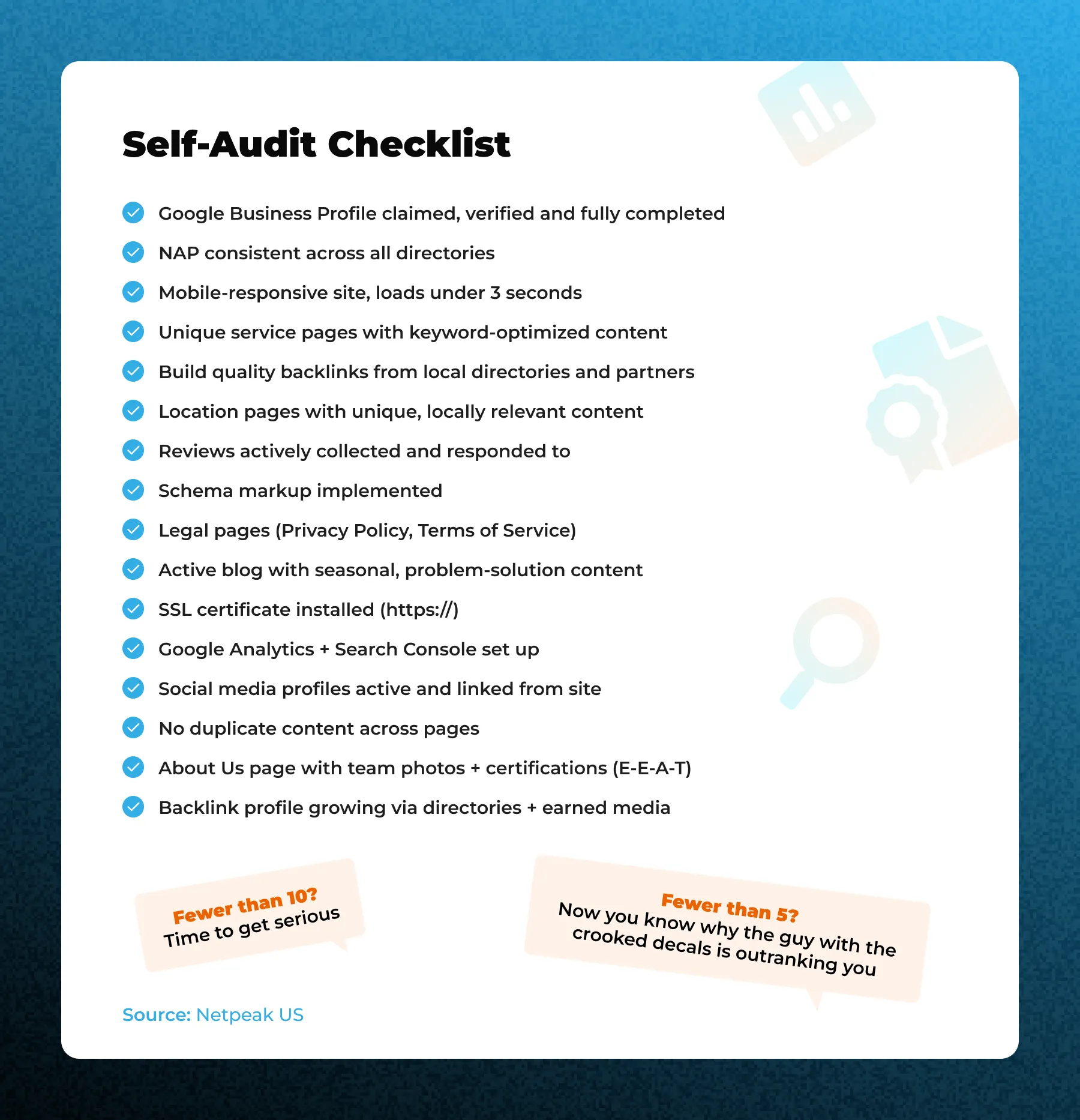
Before you call in the pros (which, honestly, you should), here’s a quick self-audit you can run through right now:
- Google Business Profile is claimed, verified and fully completed (photos, hours, services, Q&A)
- NAP (Name, Address, Phone) is consistent across all business listings and directories
- Website is mobile-responsive and loads in under 3 seconds
- Each service you offer has its own dedicated page with unique, keyword-optimized content
- Location/service area pages exist with unique, locally relevant content (not copy-pasted)
- Customer reviews are being actively collected on Google and responded to
- Structured data (Schema markup) is implemented for local business, services and reviews
- Website has legal pages (Privacy Policy, Terms of Service)
- Blog is active with seasonal, problem-solution content published regularly
- SSL certificate is installed (your URL starts with https://)
- Google Analytics and Google Search Console are set up and being monitored
- Social media profiles are active and linked from your website
- No duplicate content across service/location pages
- About Us page includes team photos, certifications and your company story (E-E-A-T)
- Backlink profile is growing through local directories, partnerships and earned media
If you checked fewer than 10 boxes, it’s time to get serious about your HVAC contractor SEO. And if you checked fewer than five, well — at least now you know why the dude with the crooked decals is outranking you.
Btw, you can grab the checklist to-go in a convenient visual format:
Your Move, HVAC Hero
HVAC search engine marketing is the long game — expect about three months to get started, then six months or more to establish a strong position. But the payoff is real. HVAC and home services companies running SEO see a median ROI of 27.46x, with top performers exceeding 60x. That’s not a typo.
The businesses that win at HVAC SEO in 2026 will be the ones that combine strong local SEO fundamentals with consistent content, active review management, mobile-first design and a multichannel approach. They won’t treat their website like a digital business card — they’ll treat it like their hardest-working employee.
And if all of this feels overwhelming? That’s what HVAC SEO marketing agencies like Netpeak are for. We’ve helped home service businesses build sustainable visibility strategies that actually drive leads — not just traffic. Because at the end of the day, a million website visitors don’t mean anything if none of them are picking up the phone.
When the customer said they handled the ductwork themselves.
FAQ
Why is my HVAC business ranking low, even with good content?
Content is not the only important part of ranking. You also need good technical factors, a healthy website, strong E-E-A-T signals and external promotion. Even the best blog post in the world won’t rank if your site is slow, your Google Business Profile is incomplete or you have zero backlinks. HVAC SEO is a combination of on-page, off-page, technical and local SEO working together.
What is the bare minimum for doing SEO for HVAC companies?
At a bare minimum, you need a fully optimized Google Business Profile, a mobile-friendly website with unique service pages, basic on-page SEO (title tags, meta descriptions, headers) and a system for collecting customer reviews. From there, add local content, link building and consistent social media activity. Think of it as the difference between a basic tune-up and a full system overhaul — the tune-up keeps you running, but the overhaul makes you efficient.
Is a mobile version of the website a must for HVAC businesses?
Absolutely. With over 63% of all search traffic coming from mobile and Google’s mobile-first indexing, a mobile-responsive site is non-negotiable. Many of your potential customers are searching for emergency HVAC services on their phones in real time. A non-mobile-friendly site is essentially invisible.
How long will it take to get my HVAC website to rank high?
SEO is the long game. Expect about three months to see initial movement and six months to start achieving strong positions. This isn’t a sprint — it’s building a system that delivers compounding returns year after year. Patience and consistency are the name of the game.

 0
0
 0
0
 0
0
 0
0
Related Articles
Sustainability Marketing: 7 Smart Ways to Earn Trust (and Customers)
Learn how to grow your brand efficiently while using eco-friendly marketing practices to build trust and long-term revenue.
Why Your Amazon Pet Ads Are Getting More Expensive Every Quarter Since 2025 (and How Smart Brands Manage It)
What happened to the auction prices? Where is the margin going, and what should be done next quarter?
How to Track Brand Mentions in AI Search? Find Out Whether You Are in the Answer
Being mentioned in an AI search boosts visibility. Discover how to monitor your brand mentions in ChatGPT, Perplexity, or Gemini and follow our approach to higher mention frequency.