
AdSense Walked So Ad Exchange Could Run: ME-QR’s £2M Upgrade Story
Does switching from AdSense to Ad Exchange automatically unlock more revenue? Sadly, no. For large projects, this step seems simple and logical: more tools, finer control, and higher bids. In practice, however, it is more complicated.
Take ME-QR — a global leader in the QR services space. Their monetization was already running smoothly through AdSense. However, they wanted more: to build a system that squeezes every bit of value out of ad inventory without harming the user experience. It wasn't easy, but it was worth it.
This case study shows how the transition to Ad Exchange brought the ME-QR an additional £2 million per year. Spoiler: No silver bullet here — just testing, a few mistakes, and a lot of format experiments.
Project: me-qr.com
Promotion period: 01.08.2024 – 01.09.2025.
Region: Worldwide.
Service: ADX monetization.
Our Partner at a Glance
ME-QR, a product by ME TEAM LTD, lets users create universal QR codes on their website for both business and personal use — in a few minutes.
That simplicity (and speed) is exactly why ME-QR is top-1 in its niche across many countries and trusted by more than 100+ companies and 900K+ customers all over the world.
The Starting Point
The partner had a large volume of traffic and was naturally looking to monetize it through online advertising. At the start, they had Google AdSense code installed on the website — ads were automatically displayed on their pages, and they earned money when visitors saw or clicked on them. It was already generating stable revenue.
The project was initially successfully handled by another Netpeak team. However, the client decided to work with us, the newly created AdX Monetization Netpeak unit. They had one request: grow ad revenue further.
The ME-QR’s logic was simple:
-
AdSense is a simple solution designed for small and medium-sized websites.
-
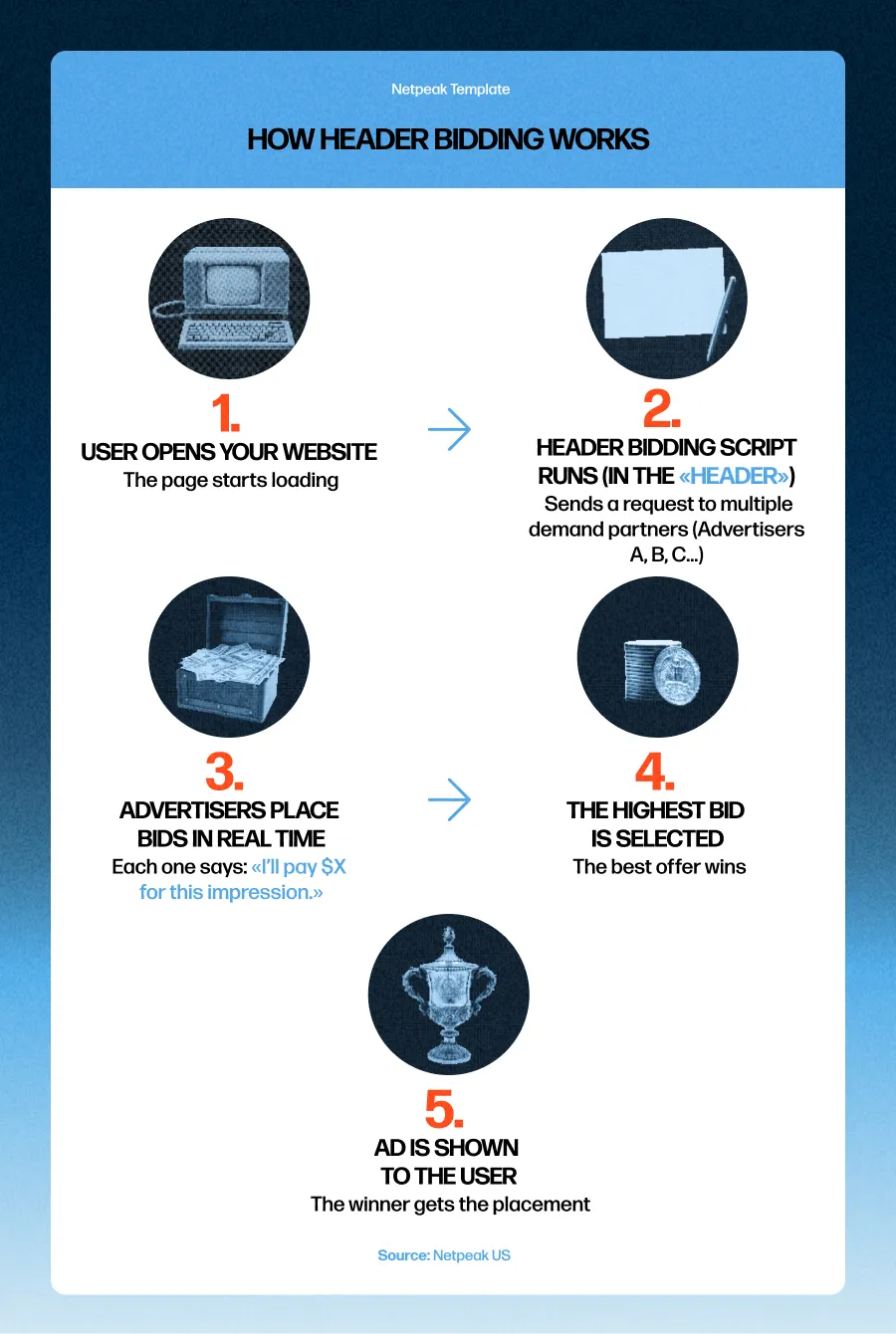
Ad Exchange (AdX), on the other hand, is a platform where advertisers compete in real time to show their ads on your website — and the highest bid wins. It is built for larger platforms, offering more advanced tools — from flexible settings to pricing rules and experimentation.
The main focus was on implementing Ad Exchange, where the auction happens. As a supporting layer, we considered Header Bidding — an open-source setup that brings in not just Google, but other demand-side platforms (DSPs) to compete for the right to show an ad.
The idea was to use these technologies to unlock greater monetization potential.
Your ad creative may be the star of the show, but placement decides which audience gets a ticket. Read our article about ad placements to learn more.
How We Made It Work
We moved step by step, testing different hypotheses and tracking their impact on eCPM (revenue per 1,000 impressions) and user experience.
Based on the data, we selected the format that combined strong profitability with stable auction competition — enabling revenue growth without aggressive ad expansion. Once we confirmed the results, we gradually expanded the format to all traffic, closely tracking financial indicators along the way.
#1: Pilot Markets and the First Introduction to Ad Exchange
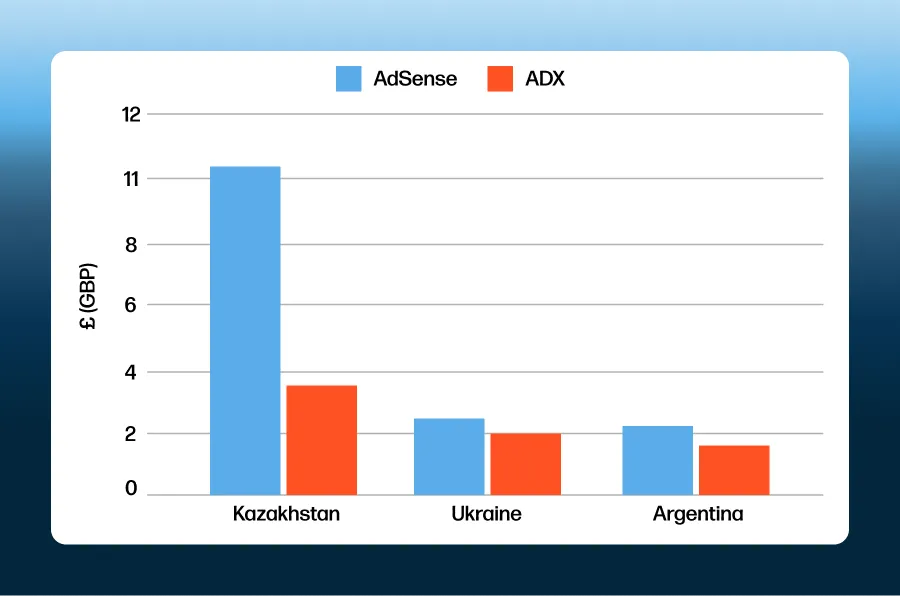
Since ME-QR operates globally, we began cautiously — by launching a pilot project in three markets: Ukraine, Argentina, and, a little later, Kazakhstan. In these countries, we replaced AdSense with Ad Exchange in the same slots.
At the same time, we tested the idea that Header Bidding would strengthen competition between demand sources. But in practice, it came with challenges:
-
Some advertisers needed extra confirmation of traffic quality — even though Google had already validated it — and not all of them were satisfied.
-
On top of that, the difference in bids between AdSense and Ad Exchange was simply too big for Header Bidding to make up for it.
The result of this stage was disappointing: Ad Exchange trailed behind AdSense, and in markets like Kazakhstan, AdSense significantly outperformed it in eCPM — revenue per 1,000 impressions.
#2: Searching for the Simple Path: More Ads and Interstitial
Next, we tested a more aggressive approach: adding more banner placements and introducing a full-screen Interstitial ad format. It shows up over the page during actions like navigation or returning to the tab, covering the content until the user closes it.
Revenue increased, but this did not solve the main problem — Ad Exchange still did not overperform AdSense. It quickly became clear that adding more ads wasn’t the answer — you could get a similar result with AdSense as well.
This approach didn’t deliver the expected results and risked harming the user experience.
#3: Format Experiments: Rewarded Ads
We shifted to a different approach — fewer banners, but a stronger focus on new formats. That’s how the Rewarded Ads experiment came in: a full-screen format where users choose to watch an ad in exchange for a reward, such as access to content, bonuses, or extra features.
This is where the breakthrough happened: Ad Exchange eCPM for this format reached $11–14 versus $6 in AdSense. For the first time, the client saw a clear advantage of Ad Exchange — not from more ads, but from a fundamentally different format.
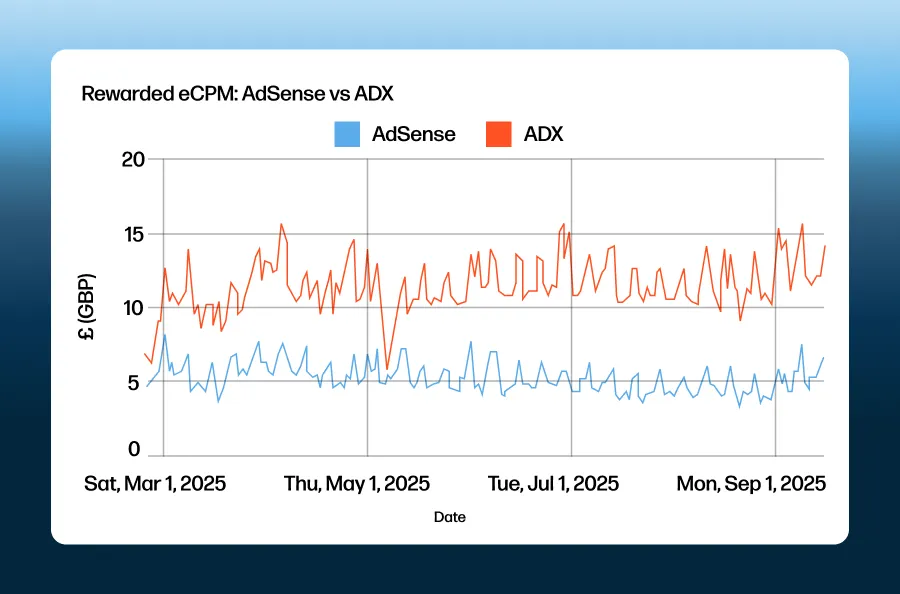
The third approach worked. Rewarded Ads via Ad Exchange showed solid financial results and made further AdX integration worthwhile.
The previous steps — pilot markets, testing auction mechanics, and scaling ad slots — were essential in validating hypotheses and finding the optimal monetization model.
The Revenue Impact
Testing of different strategies paid off. The breakthrough came with Rewarded Ads via Ad Exchange — delivering clear financial impact without adding too many ads to the pages.
As a result of the cooperation:
-
The site’s revenue increased by 60%.
-
The additional annual revenue amounted to about £2 million, and this is a conservative estimate; the figure may be even higher.
ME-QR saw not just significantly higher revenue, but also clear proof that Ad Exchange can work as a primary monetization platform.
Want better results next year? Focus less on resolutions and more on systems. Learn how to compound wins instead of relying on a January reset.
Collaboration Feedback
Murager Sharipov, AdX Monetization Specialist at Netpeak Ukraine
The transition from AdSense to Ad Exchange is not about quick results, but about the right strategy. The first tests showed that AdX can underperform AdSense, and increasing the amount of advertising does not solve the problem systematically.
The key growth factor was the implementation of Rewarded Ads, which delivered a significant eCPM uplift without harming the user experience. As a result, we managed to increase revenue and build a scalable monetization model that works steadily across different markets.
Feedback from the ME-QR Team
We already had stable monetization through AdSense, but we understood that we were not using the full potential of our traffic. We expected that switching to Ad Exchange would bring quick growth, but in practice, everything turned out to be more complicated.
The Netpeak team approached the task systematically: instead of making sharp changes, we went through a series of tests and hypotheses, which allowed us to find an effective monetization model without harming the user experience.
As a result, we received not only significant revenue growth but also a clear, scalable system that we will continue to develop.
Project team: Oleksandr Ostapenko, Project Manager; Murager Sharipov, Head of AdX Monetization Department at Netpeak Ukraine.

 0
0
 0
0
 0
0
 0
0
Related Articles
Amazon's AI Now Builds Complete Looks on Product Pages. How Do Brands Make Sure the Bundle Is Theirs?
Amazon now uses AI to assemble complete, shoppable looks around a single product, and it fills those looks with whichever brands its model picks.
Business Apps in the US: iOS vs. Android, September 2026
We searched for US App Store and Google Play data to see what business apps professionals, shoppers, and investors actually installed in September.
Pet Food Product Patent: How to Protect Your Innovation
Patenting pet products requires careful consideration and proper application filing. With the 8 steps below, you will be able to submit your patent application and protect your invention.