
Online store owners know what it's like to be responsible for a dozen tasks at once. Inventory, emails, ads, live chat, delivery issues — your brain is always juggling open tabs. Have I ordered enough stock? Are those emails even working? Did I answer that chat message at 2 a.m.?
E-commerce AI agents can take some of that mental load off your plate.
Online store owners are a bit like the mum in the family who remembers everyone’s birthdays and keeps track of when the shampoo in the guest bathroom will run out. AI agents are like other adults in the room who can take charge without being told what to do. Some of them are smart enough to assess the situation and act accordingly.
In this guide to AI agents, you can learn how they bring you real-time wins: customers get answers faster, fewer orders fall through the cracks, and support costs go down. That means that you finally get some breathing room to grow the store instead of just keeping it afloat.
E-commerce AI Agents: Buzzword or Business Tool?
For a few years, “e-commerce AI” mostly meant a chatbot that politely apologized and then asked you to email support anyway. Or it was more about GEO tricks to help you show up in popular AI chats.
AI agents are different. They’re smart enough to be like a competent helper that runs parts of your online store for you.
Imagine you hired someone who:
-
Notices when customers get confused during online shopping and answers them immediately
-
Sees which products people like and shows them more often
-
Reminds shoppers to finish checkout when they forget
-
Keeps an eye on stock so popular items don’t suddenly disappear
AI agents can learn and become better. For example, if you use a support-focused agent for your store, it learns which questions come up most and which answers resolve issues fastest.
Over time, e-commerce AI agents answer more tickets correctly, reduce back-and-forth, and lower angry follow-ups.
What Makes E-commerce AI Agents Worth Using
AI agents handle tasks that store owners wish someone would quietly handle without being asked. Below are the key points that make AI agents a desirable “employee” for your online store.
-
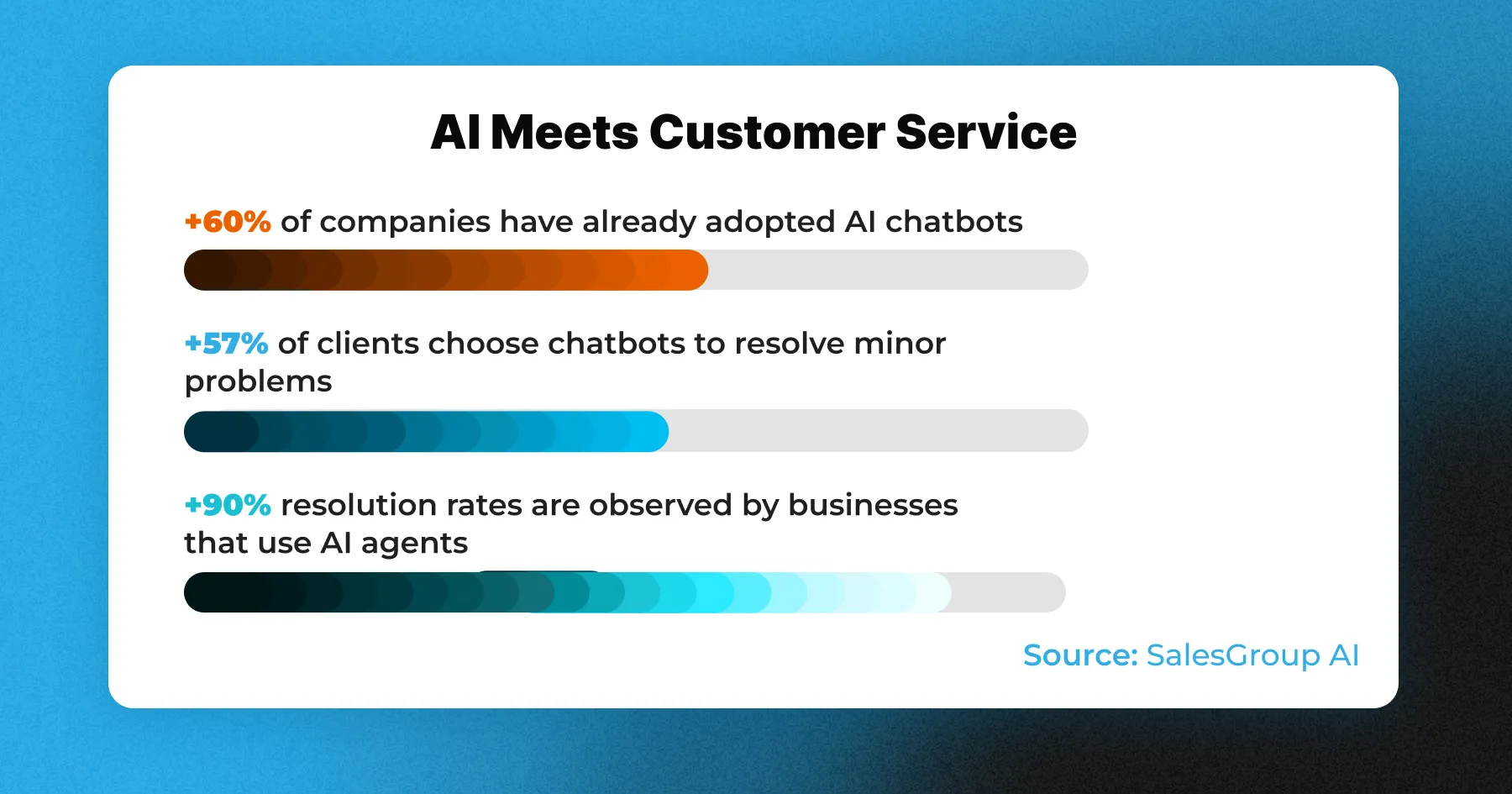
Most online stores use AI because it is worth it. Around 84% of e-commerce businesses are integrating or planning to integrate AI tools for personalization, recommendations, automation, and more.
-
They react in real time. AI doesn’t wait until Monday morning to improve things. AI-powered chatbots and agents can reduce response times by up to 77%.
-
They reduce human agents' workload. In some retail contexts, AI tools manage 85% of inbound service questions.
-
AI agents learn from customer behavior. For example, if shoppers abandon carts at a certain step, AI can detect that trend and adjust offers or messaging. Personalized product recommendations — a core outcome of behavior learning — can drive up to 31% of e-commerce revenue.
Here at Netpeak, we have learnt a great deal about using AI for business purposes and know how to make the most of it. One of the most effective applications is Generative Engine Optimisation, which improves your content visibility in AI search results.
If your business doesn’t appear in Google's AI-powered answers or ChatGPT's recommendations, it's as if you don't exist to the next generation of customers. Get in touch if you'd like to be included — we can help!
AI Agent, AI Tool, or Automation: Which One Do You Need
Before choosing anything for your store, it helps to understand what you're dealing with: a rule-following machine, a rookie waiting for instructions, or an AI agent that runs tasks quietly in the background.
|
Automation Tools |
AI Tools |
E-commerce AI Agents |
|
|
What are they? |
Pre-set rules that do one thing when triggered |
Smart tools that help with specific tasks |
Digital teammates that run parts of your store |
|
How they work |
You say to them, “If this happens → do that.” |
You ask → they respond. |
They watch, decide, and act. |
|
Do they think on their own? |
❌ No |
⚠️ Limited |
✅ Yes |
|
Do they learn over time? |
❌ No |
⚠️ Sometimes |
✅ Always |
|
Need manual control? |
High |
Medium |
Low |
|
React to customer behavior? |
❌ No |
⚠️ Somewhat |
✅ Yes, in real time |
|
Can handle surprises? |
❌ Breaks easily |
⚠️ Needs guidance |
✅ Adapts automatically |
|
Works when you’re offline? |
⚠️ Only if triggered |
⚠️ Limited |
✅ Fully |
|
Typical role in a store |
Doing repetitive tasks |
Helping you do tasks faster |
Running tasks for you |
|
Examples |
Send an email if a cart is abandoned. |
Write a product description when you ask it to. |
Notices abandoned carts, tests reminders, adjusts timing, and improves results without asking you every time. |
AI agents are powerful, but they’re most effective when introduced with a clear plan. Many growing stores benefit from light-touch AI strategy consulting to decide where automation brings real ROI — whether in support, marketing, inventory, or checkout optimization.
How Store Owners Actually Use E-commerce AI Agents
Imagine AI agents as assistants assigned to different areas of your store. Each one observes what is happening and makes routine decisions on your behalf.
Way 1: Customer Service
What problem it solves: Too many messages, slow replies, and repeated questions.
What AI agents support do:
-
Answers common questions instantly (shipping, returns, sizing, etc.)
-
Tracks orders and updates customers automatically
-
Notices unhappy customers and flags issues early
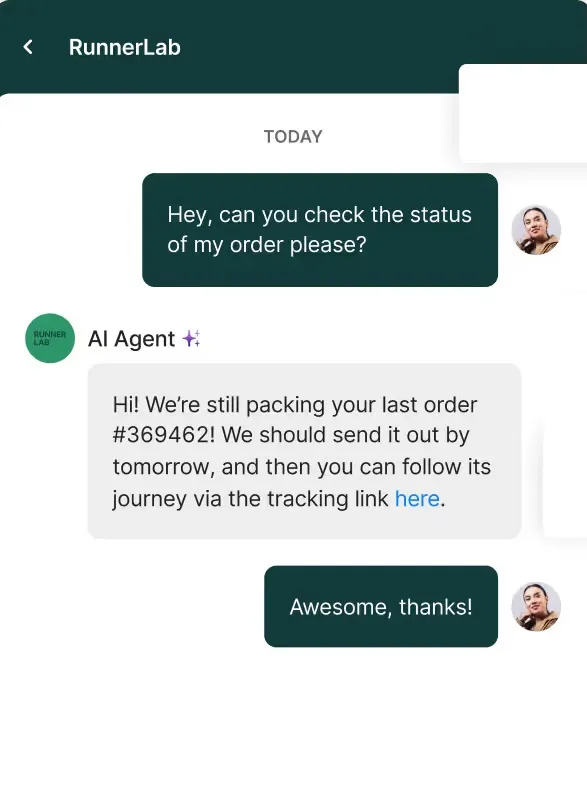
For example, a customer asks, “Hey, can you check the status of my order?” The AI agent checks the order and shipping status and replies immediately.
Way 2: Marketing Optimization
What problem it solves: Ads and promotions feel confusing and expensive.
What an AI agent does:
-
Watches which products people click and buy
-
Pushes best-selling items more often
-
Stops spending money on ads or promos that don’t work
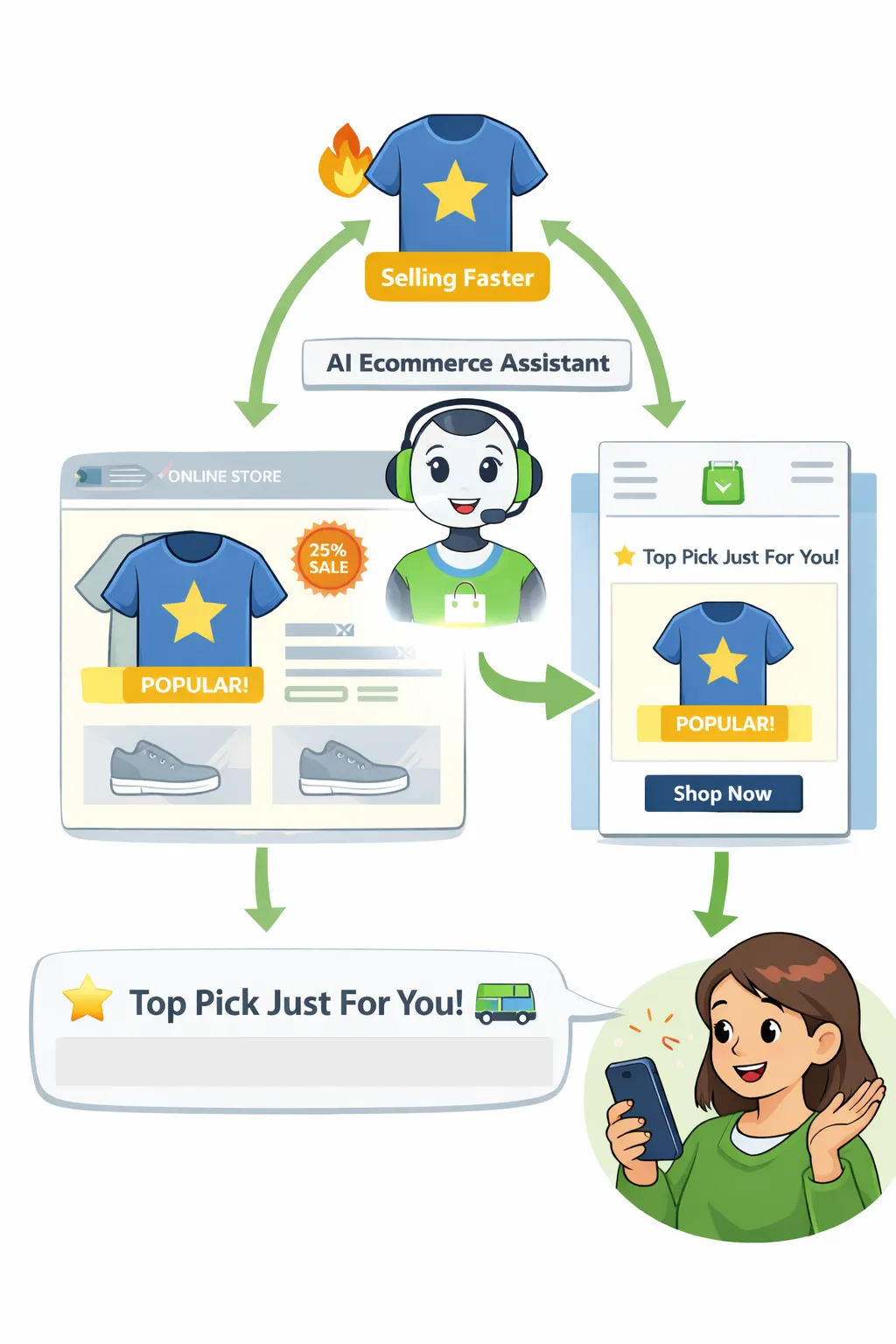
For example, if a product suddenly starts selling better, the AI agent shows it more often on the homepage and in emails.
Way 3: Inventory Management AI
What problem it solves: Out-of-stock surprises and slow-moving products.
What an AI agent does:
-
Tracks stock levels in real time
-
Warns you before popular items run out
-
Highlights products that are sitting too long to improve performance
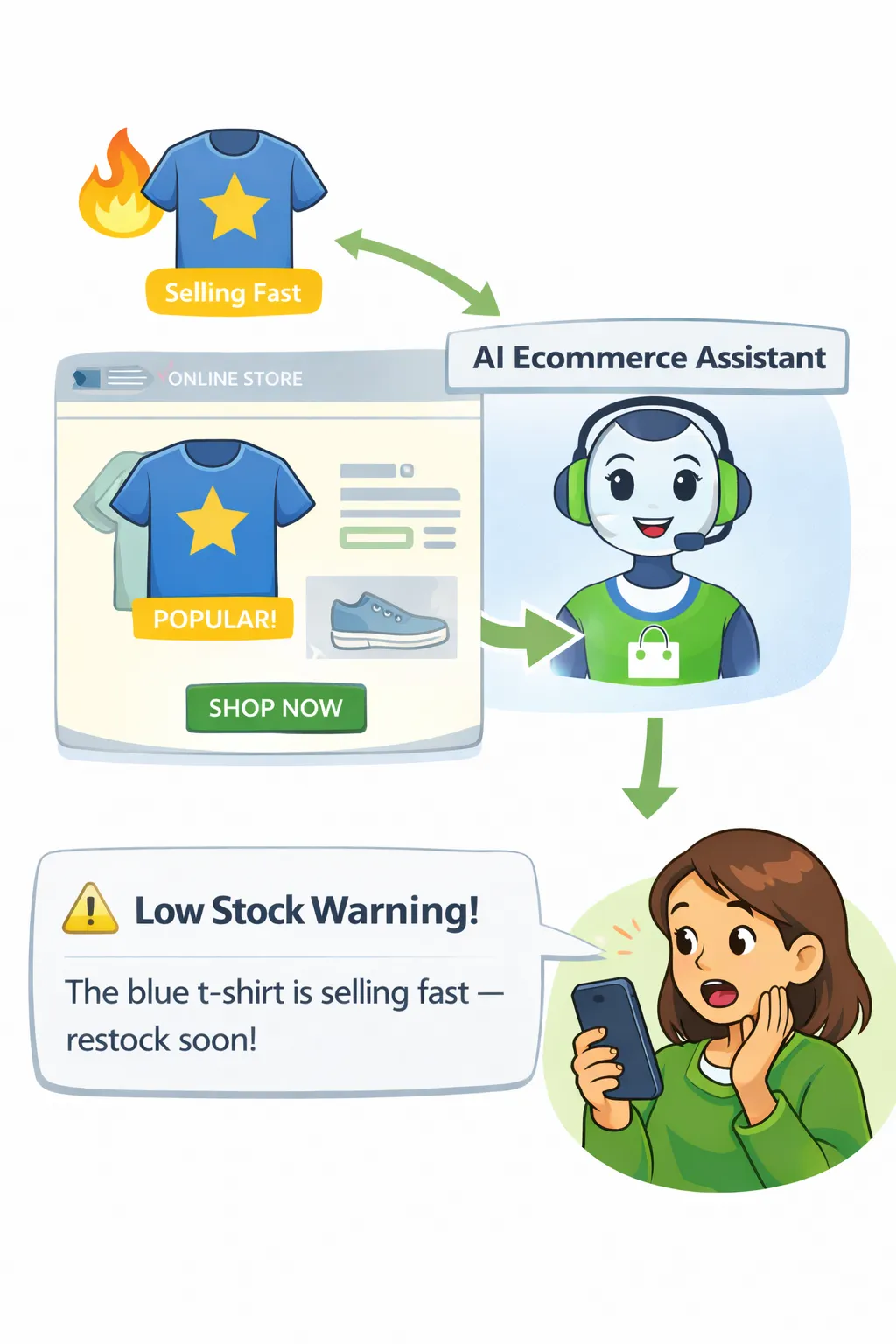
For example, a product is selling fast. The agent alerts you early, rather than after it’s already sold out.
Way 4: Business Insights
What problem it solves: Reports you don’t understand or never open.
What analysis AI agents do:
-
Watches store activity quietly
-
Summarizes what’s working and what’s not
-
Points out problems in plain language
For example, instead of charts, you get: “Between 10 pm and 7 am, better limit ad spending.”
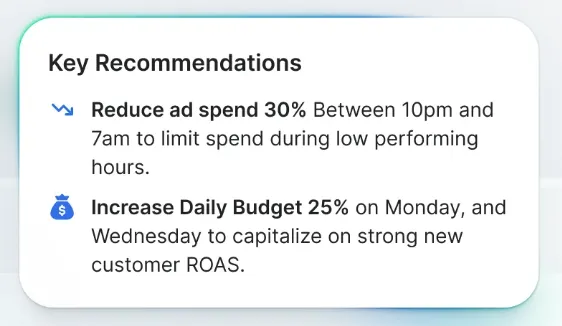
Here at Netpeak, we have years of experience in helping companies with business intelligence analytics. If you want to find out more about the strengths and weaknesses of your online store, drop us a line!
Way 5: Checkout Optimization
What problem it solves: Visitors browse but don’t buy.
What an AI agent does:
-
Notices where shoppers hesitate
-
Tests small changes (messages, timing, offers)
-
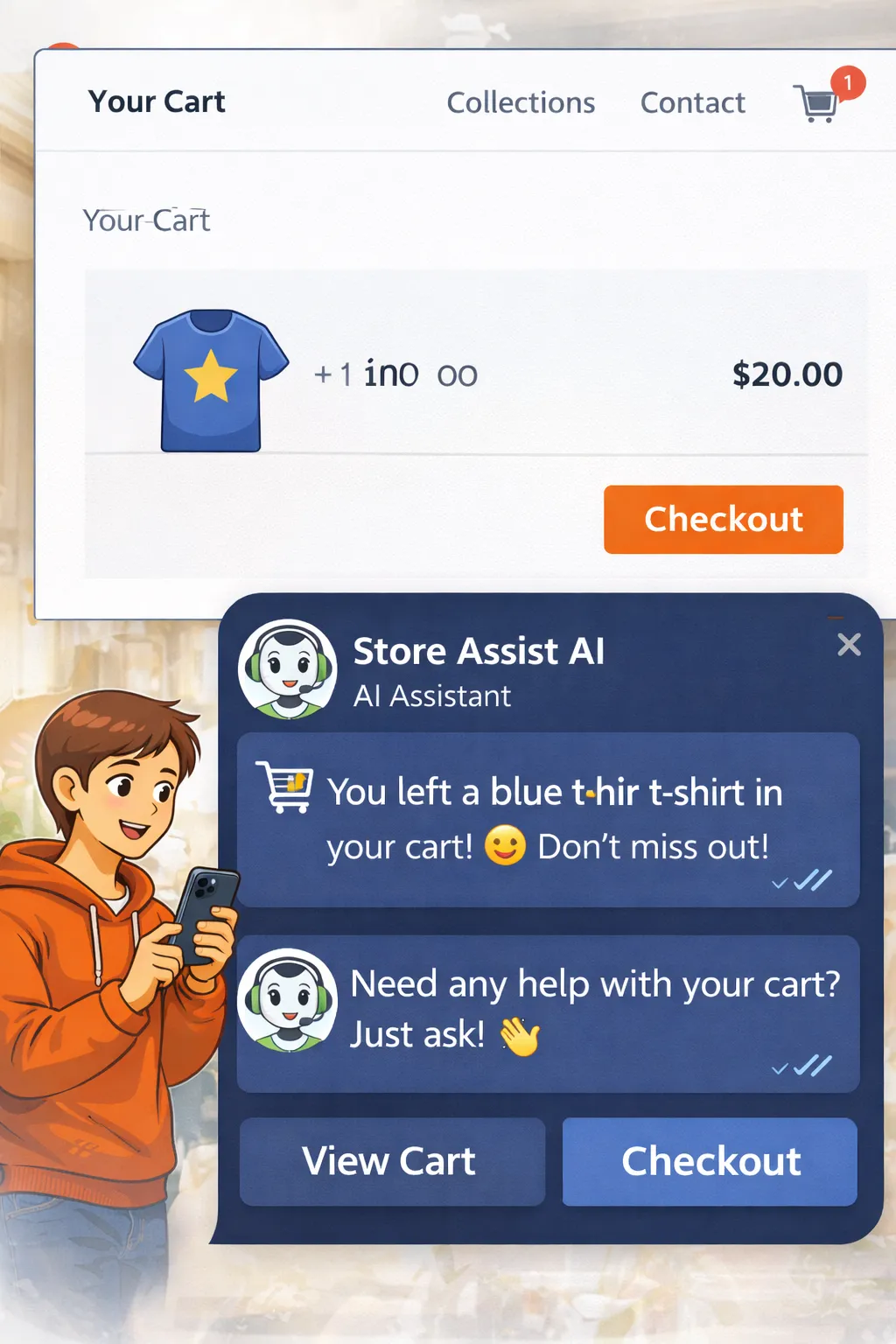
Sends reminders to people who almost bought
For example, someone adds a product to the cart and leaves. The agent sends a reminder or answers a question automatically.
Way 6: Personalization
What problem it solves: One-size-fits-all stores don’t convert well.
What an AI agent does:
-
Shows relevant products to different visitors
-
Adjusts recommendations based on behavior
-
Learns what each shopper prefers
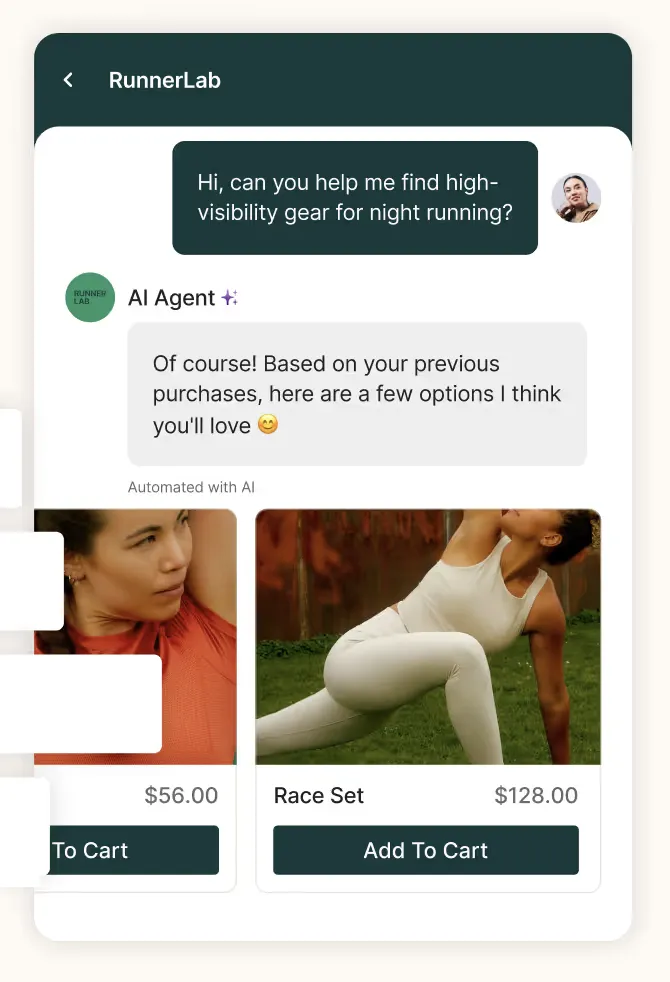
For example, an AI agent ensures that returning customers see products similar to those they liked before.
E-commerce AI Agents That Earn Their Keep
“Now AI agents are not just chatbots or simple automation, but autonomous systems that make decisions based on real user behavior and data. This approach is already familiar to marketplace sellers – similar logic exists in tools like Amazon Seller Assistant, account recommendations, and Amazon Ads algorithms. The key strength is the focus on measurable impact: conversion rate, AOV, and time savings. For growing e-commerce businesses, AI agents become a second operational layer, reducing routine work and enabling scalable growth,” – Anton Tochylo, Marketplace Promotion Team Lead at Netpeak Agency.
Here’s how real, widely used AI agents line up with different e-commerce niches — based on what shoppers actually need in each category.
|
Best-Fit AI Agents |
Why They Work Here |
|
|
Fashion |
Alhena AI, Tidio’s Lyro |
Alhena acts like a stylist (fit, outfits, “Does this suit me?”). Lyro handles fast, routine questions about shipping, returns, and sizing. |
|
Jewelry |
Alhena AI, WotNot |
Alhena provides human-like guidance; WotNot lets you build curated journeys like “anniversary under $300” across chat, WhatsApp, and socials. |
|
Pet Products |
WotNot, Tidio’s Lyro |
WotNot can ask about breed, age, and needs, then match products. Lyro keeps everyday support fast (orders, delivery, substitutions). |
|
Beauty |
Alhena AI, Triple Whale’s Moby |
Alhena builds routines and explains ingredients. Moby isn’t customer-facing, but it guides you — showing what actually converts, which products win, and where money leaks. |
|
Wellness |
WotNot, Triple Whale’s Moby |
WotNot enables guided conversations about goals and safety. Moby helps owners see what truly works and avoid scaling the wrong message or product. |
|
Any Niche at Scale |
Gorgias |
Gorgias is the support command center. It centralizes all channels, auto-tags, drafts replies, and keeps response times low as volume grows. Pair it with any “front-of-store” agent above. |
Alhena AI (Shopping & Support Agent)
Think of Alhena AI as a digital sales assistant for your online store. It’s one of the generation AI agents that engage with customers, understand their needs, recommend products, answer questions, and assist with purchases.

I asked the Ahena AI bot in the VB store whether a particular dress would fit me. After asking me some additional questions about my measurements and height, it recommended the best size for me.
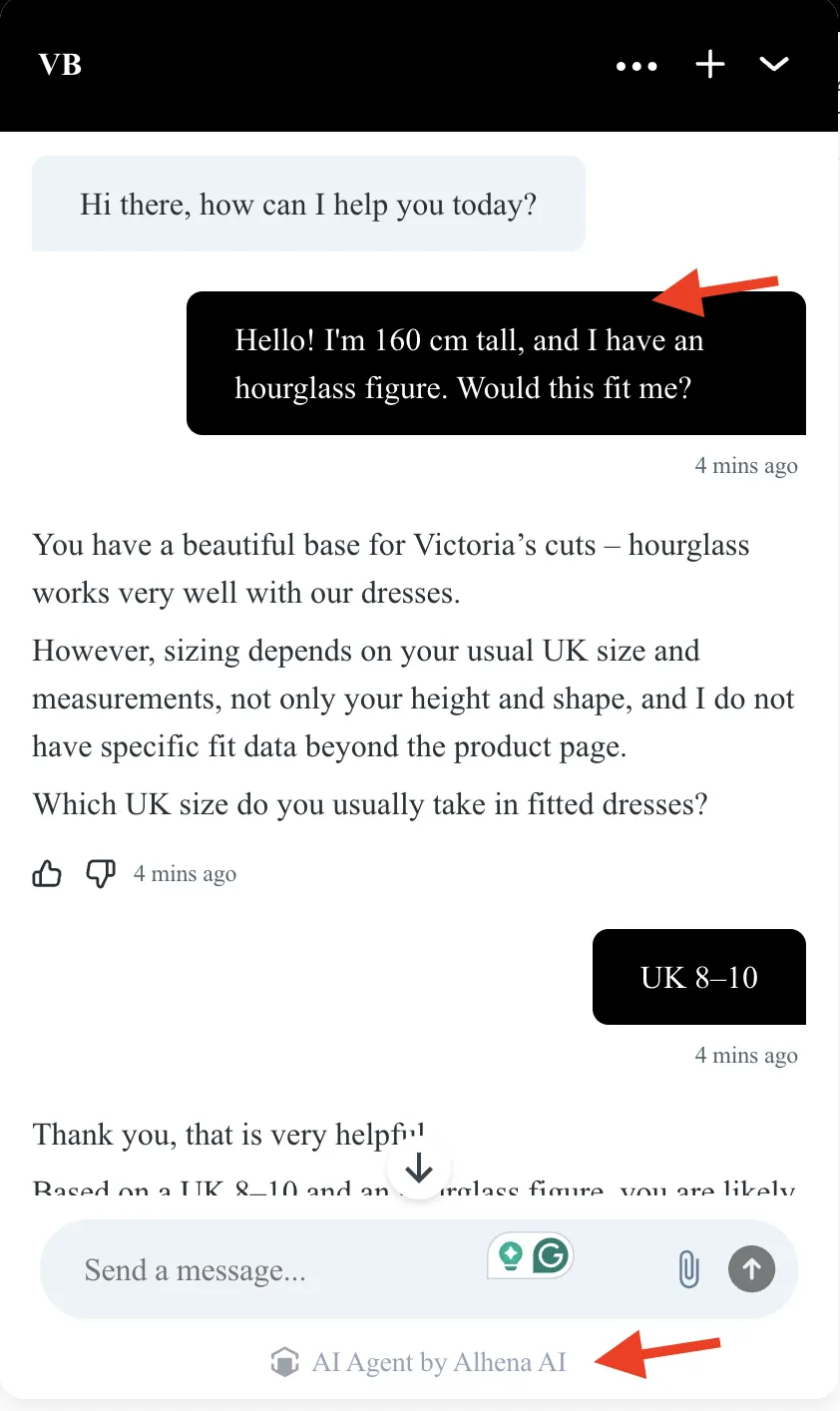
Then they proposed a size 10 dress that will feel especially elegant on a 160 cm hourglass frame, and built a full outfit around this dress (shoes and bag included).
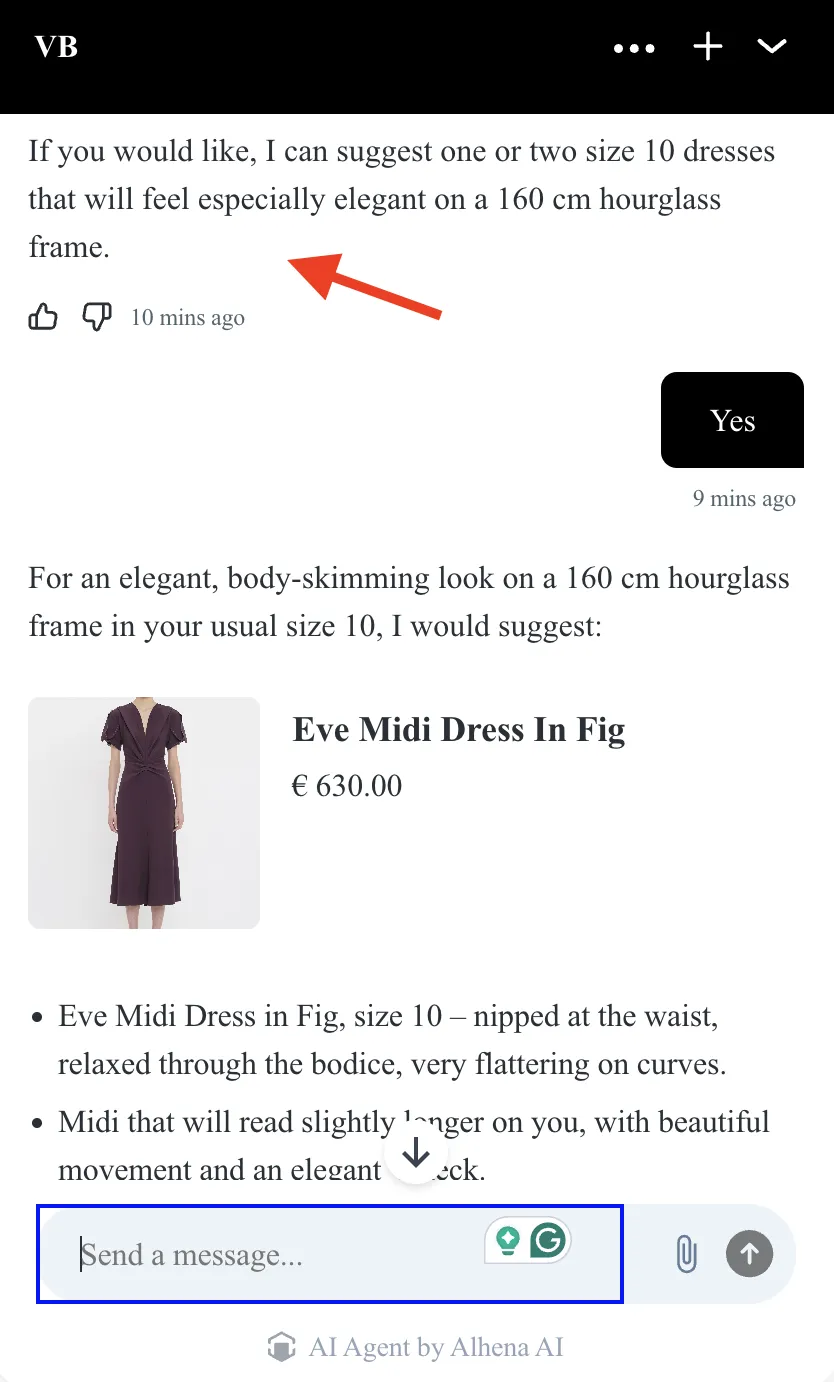
Everything was fine until I asked whether the dress would be too long for me. In the photo, a 180 cm model is wearing it, and the hem touches the floor. Would I, with my 160 cm, need a servant’s help to walk in it like some Victorian princess? ?

The agent was confused because the description said it was “mid-length with an asymmetric hem.” It could analyze a photo to predict the level of comfort.
In the end, we commonly chose a dress clearly described as midi with no train.
Pros
-
Feels like a real shop assistant, not a bot: it asks clarifying questions, explains choices, and guides shoppers
-
Alhena helps before the sale — recommends products and helps customers decide
-
Works 24/7 automatically
-
Can act as a full-time sales assistant without the cost of hiring staff
Cons
-
Best results need clean product descriptions
-
The free plan is limited; advanced customization costs extra
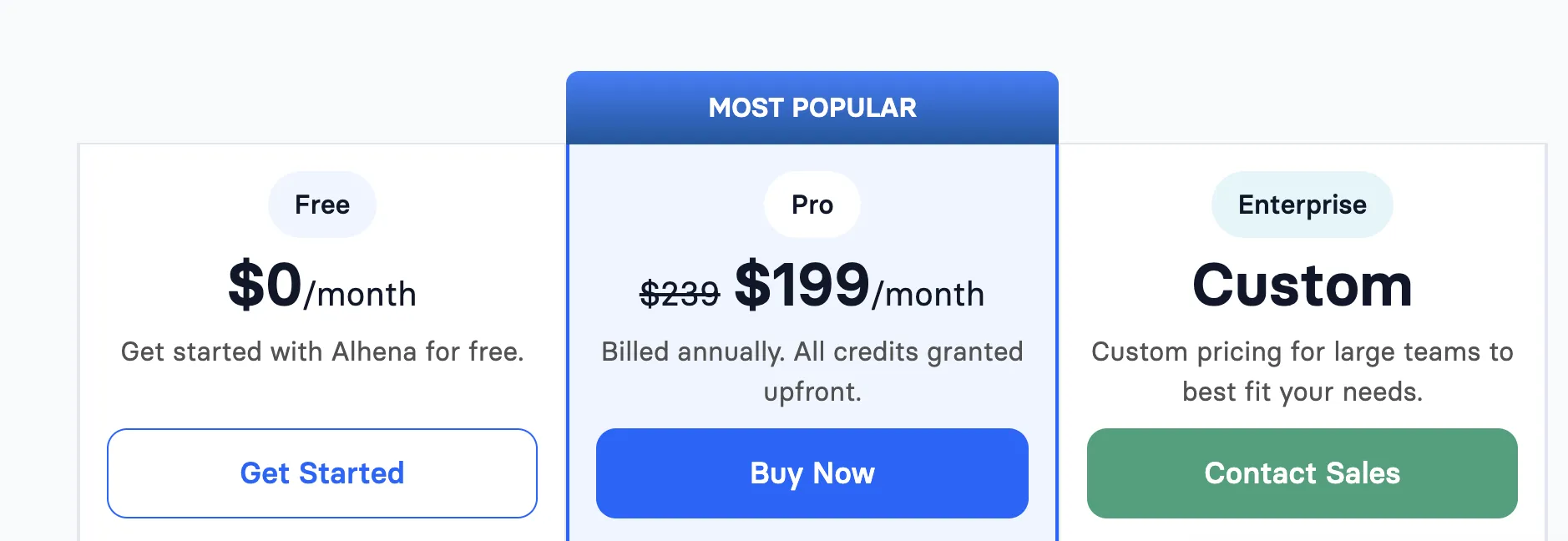
Pricing of Alhena AI
Tidio’s Lyro AI Agent (Beginner-Friendly All-in-One)
Tidio combines live chat and AI agent behaviour. It’s one of the easiest ways for beginners to start using AI in their store right away. It can be used to send cart abandonment messages, replace live chat, provide product recommendations, and answer FAQs instantly.
I asked the Lyro AI chatbot in the Eye-Oo store about their shipping policy and received a full answer on pricing and estimated delivery time.
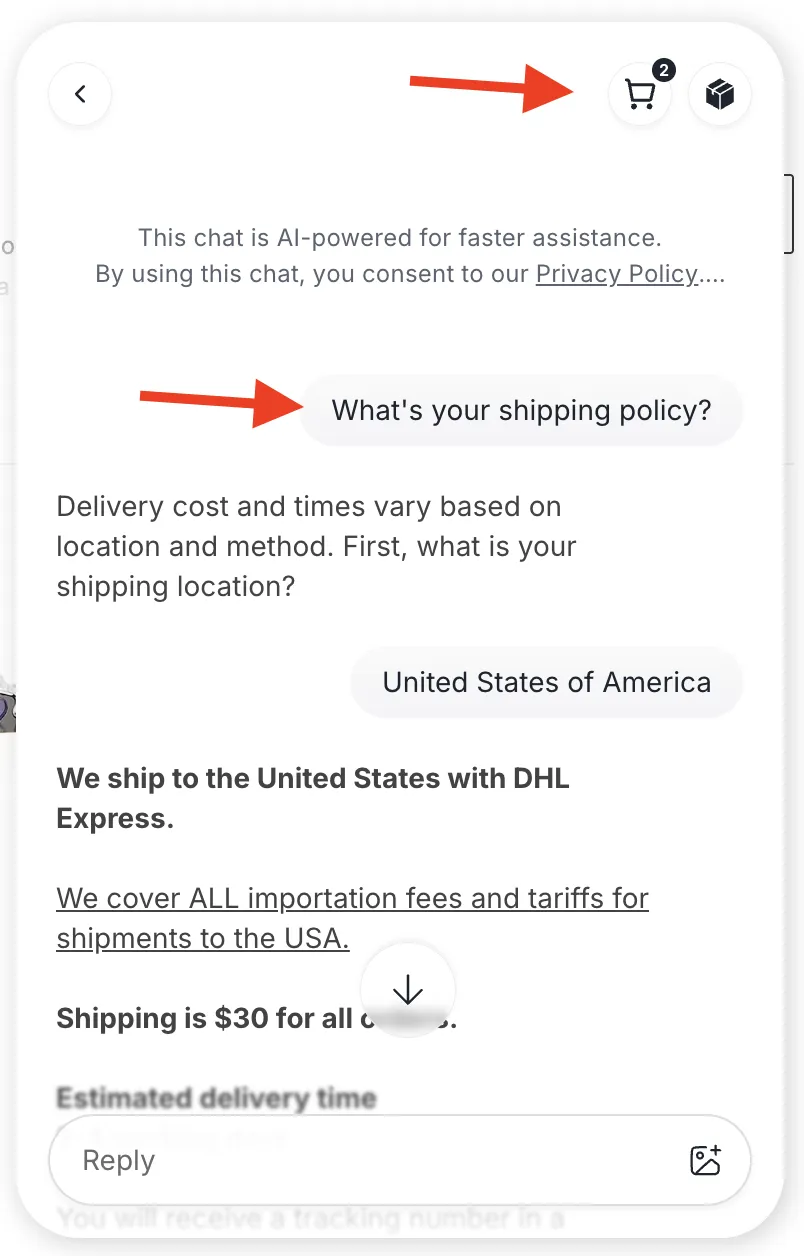
They show a widget with the number of items in the bag and previous orders at the top of the chat, which helps reduce abandoned carts and is user-friendly.
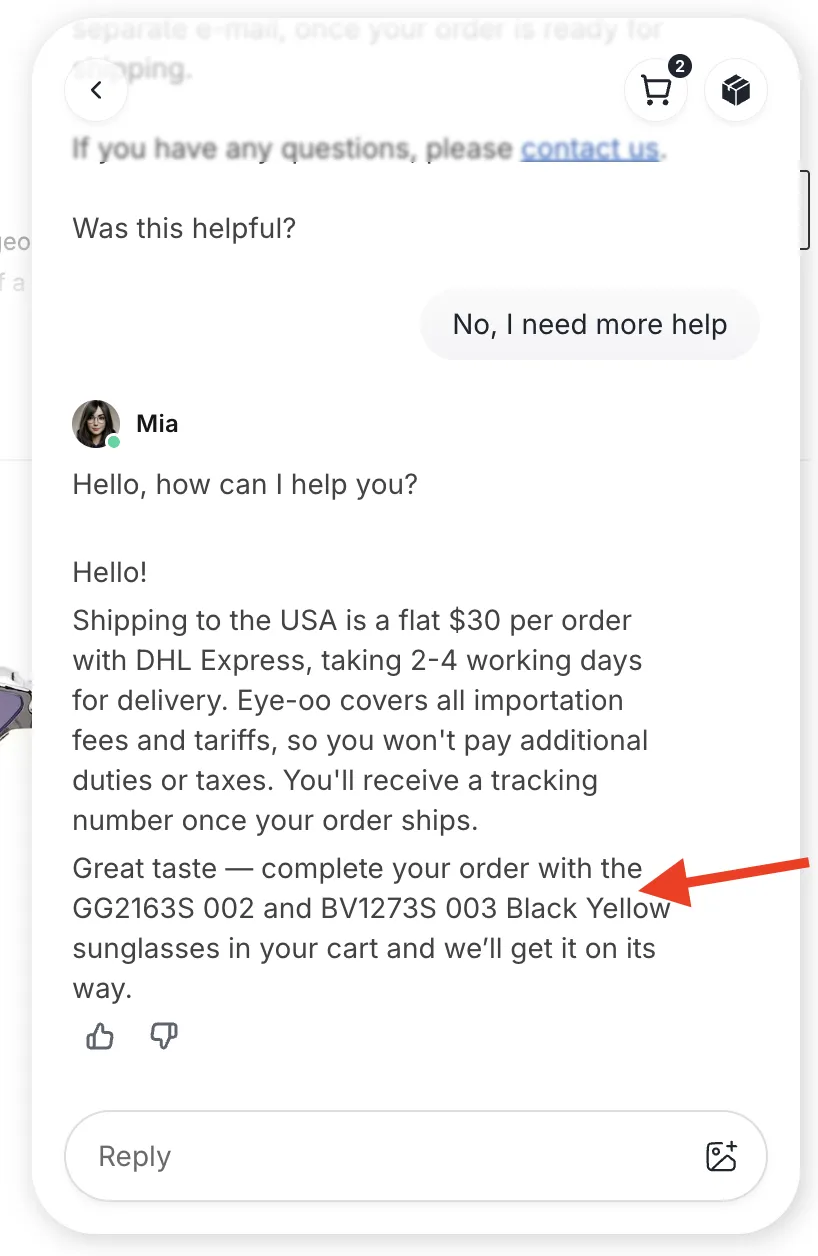
When I asked for more help, the AI agent added chat info about the items I had previously chosen and proposed completing the order. It’s a smart move!
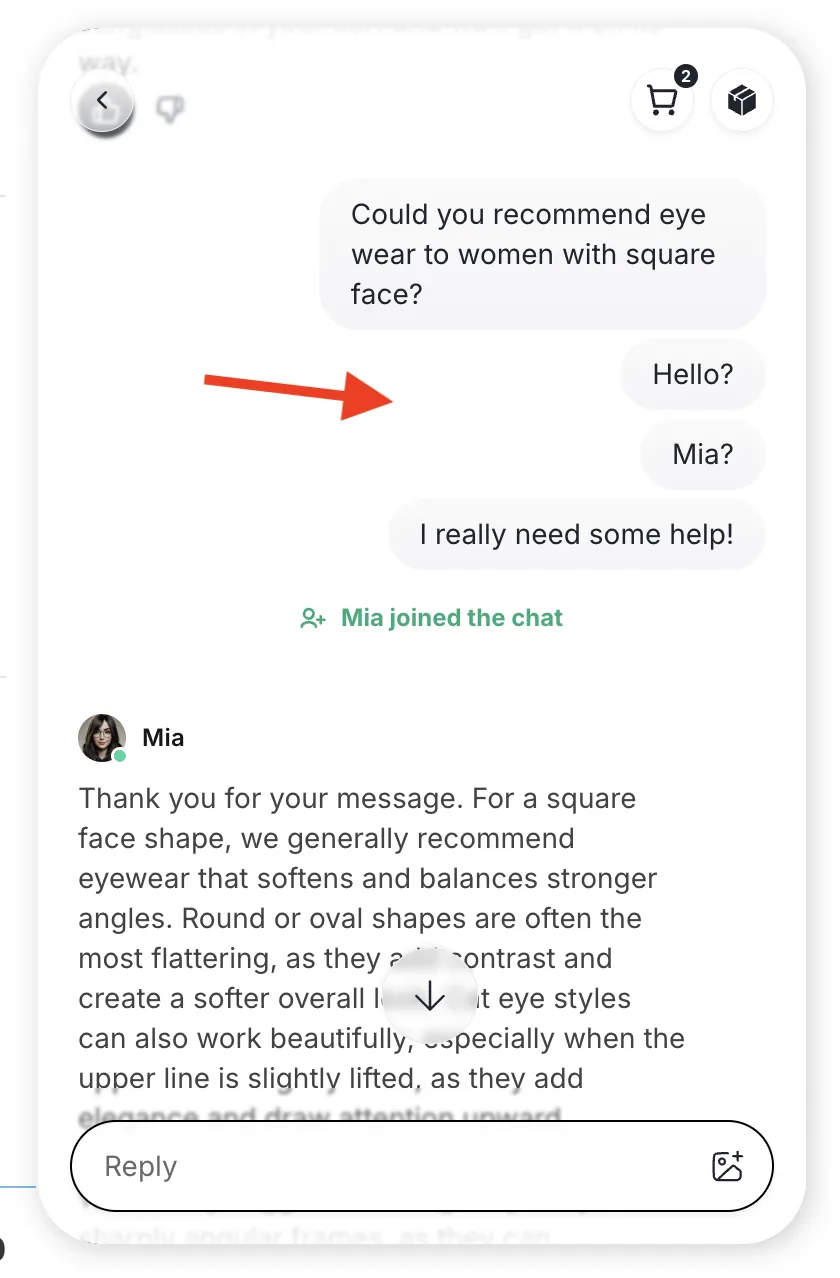
Then I asked a non-standard question about glasses for a square face, and the agent took longer than I would have liked to respond.
I thought it wouldn't work, but then an answer appeared. It was very general, however, and didn't include any product recommendations from the store.
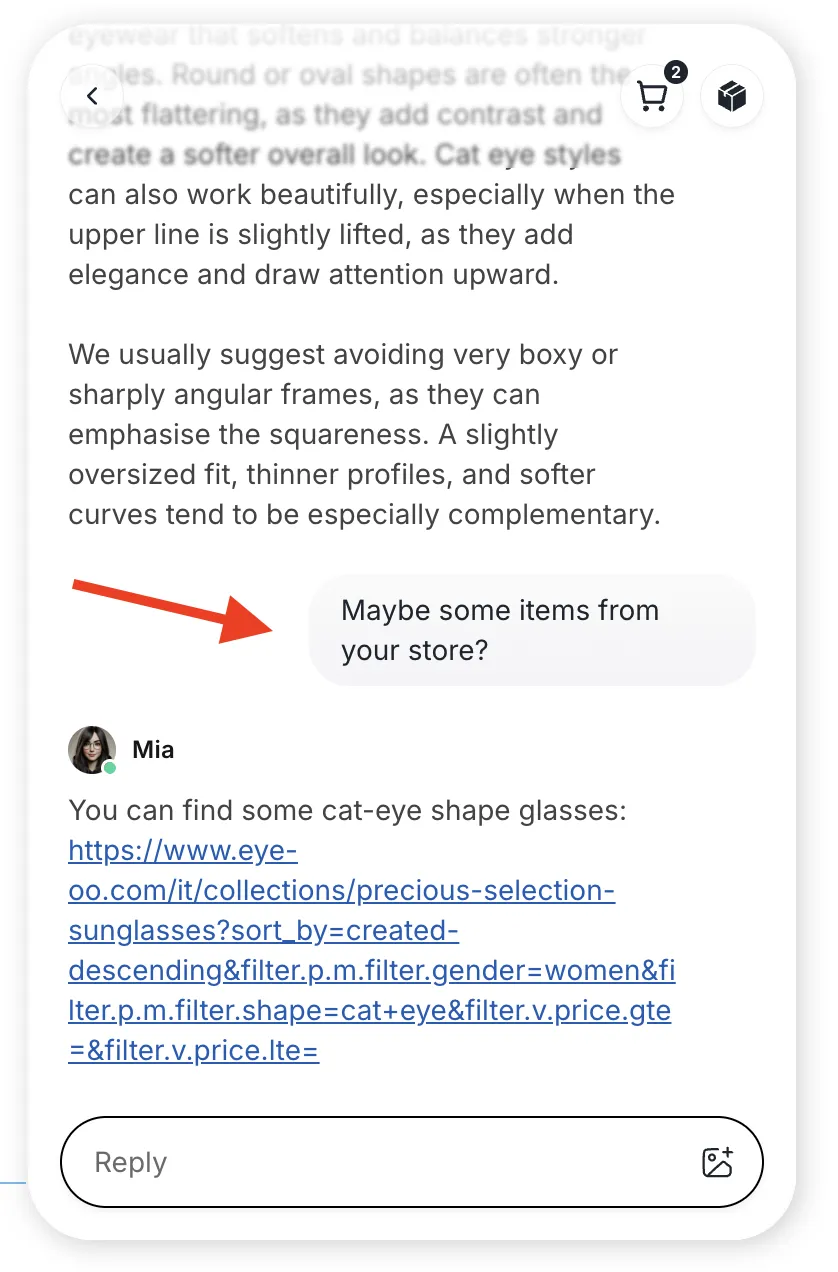
I asked for recommendations myself, and the AI agent sent them to me after a wait. They were just a link, with no photos.
Pros
-
Beginner-friendly with a simple setup and an intuitive interface
-
Works well in small stores. If most customer messages concern shipping, returns, sizing, or order status, it handles them smoothly
Cons
-
Less autonomous than enterprise agents, doesn’t independently plan strategies or run experiments
-
More complex flows require higher-tier plans
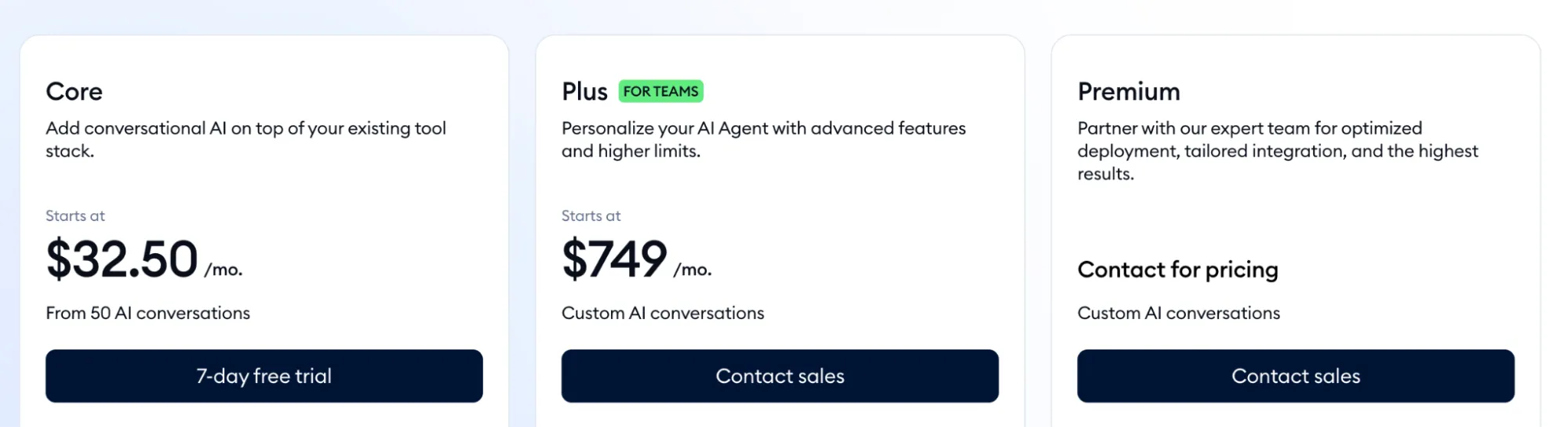
Pricing of Lyro AI
Triple Whale’s Moby AI (Decision & Insight Agents)
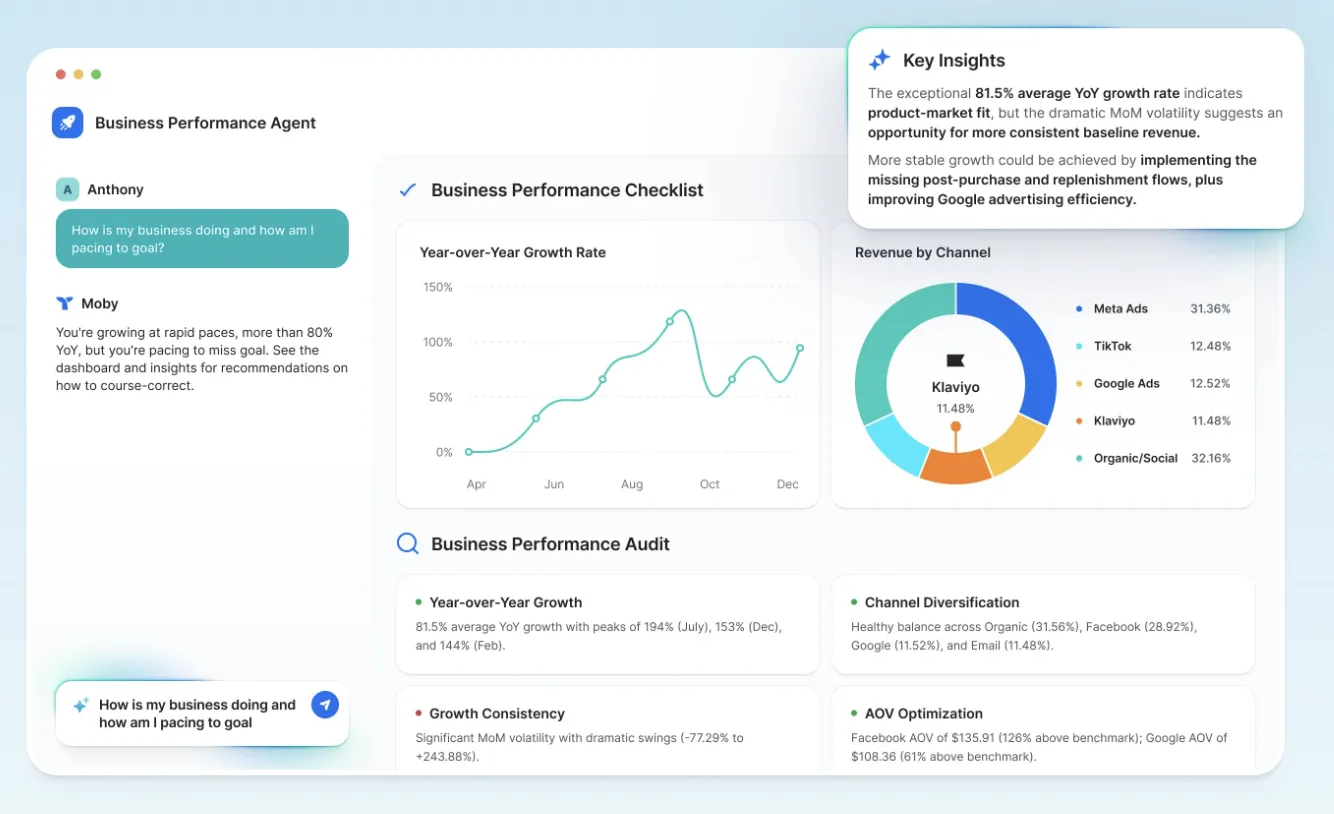
This is not a chatbot for customers. It's an AI decision-making tool designed to help you, the store owner. Think of it as a business brain that monitors sales, adverts, stock levels, and visitor numbers, and then tells you what to do.
Rather than dashboards, you receive straightforward answers.
Pros
-
No analytics knowledge needed. Moby is built for founders and operators, not data analysts
-
Saves hours of reporting: instead of pulling data from Shopify, Meta, Google Ads, and spreadsheets, Moby does the synthesis for you
-
Good at spotting problems early: tracking attribution shifts, declining ROAS, rising CAC, or underperforming campaigns
-
Great for scaling stores
Cons
-
Not customer-facing, it’s an internal decision-making agent
-
Needs enough data to be useful
-
Expensive for tiny stores
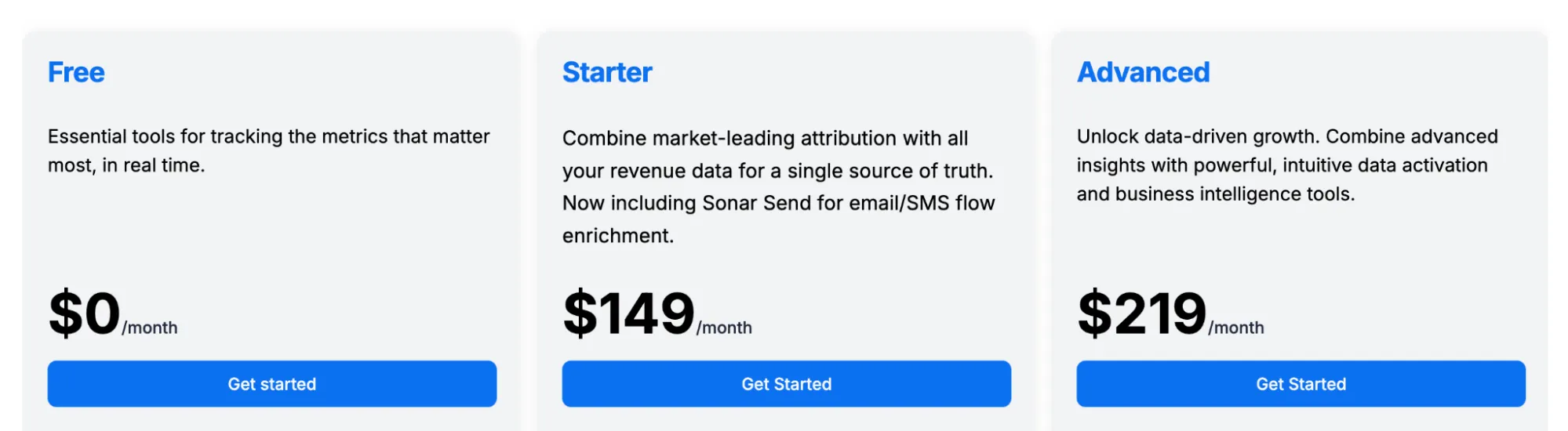
Pricing of Moby AI
WotNot AI (No-Code Custom Agents)
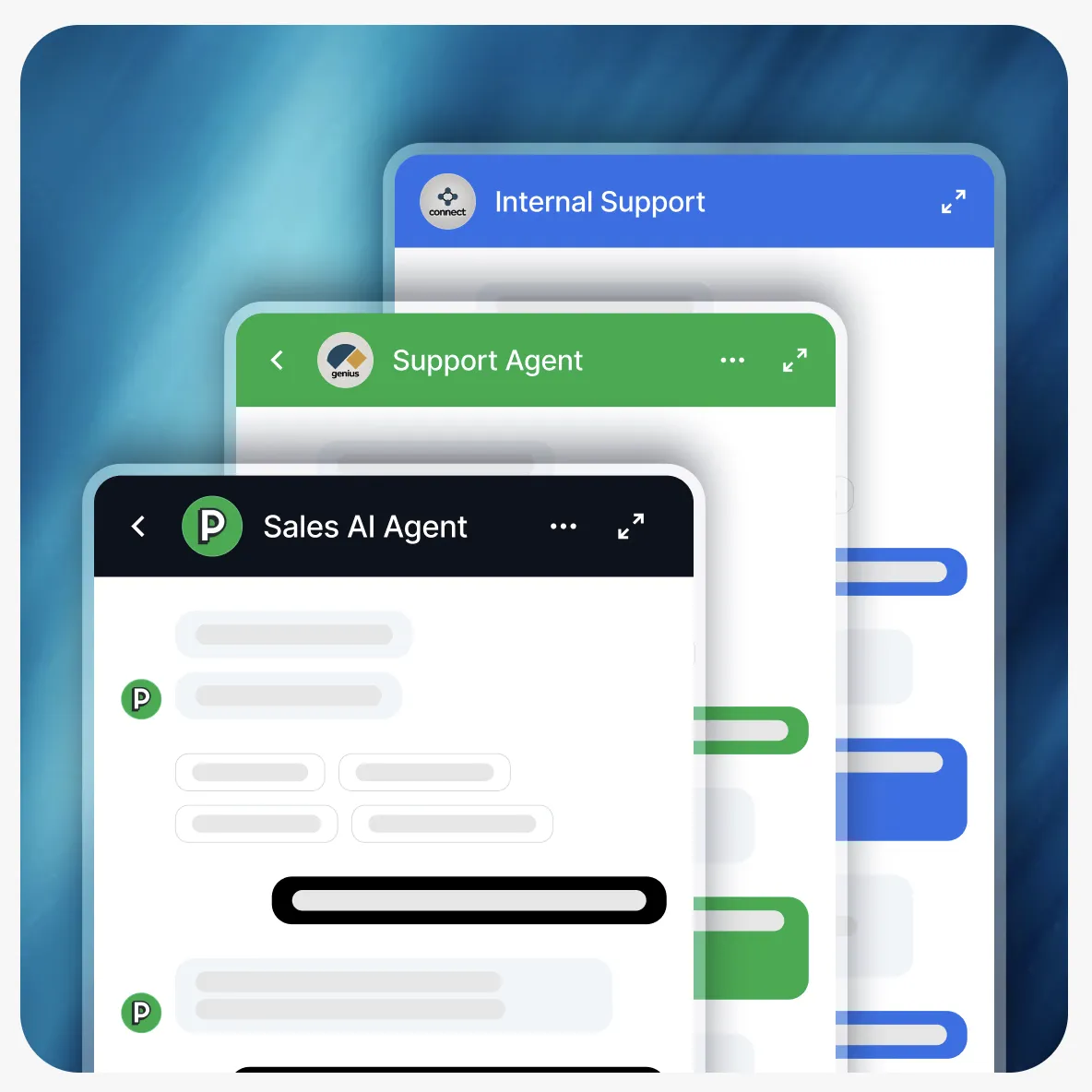
WotNot enables you to create your own AI agent without coding, offering greater control than plug-and-play tools while remaining beginner-friendly.
Use it to create custom AI assistants, guided shopping flows, and combined lead capture and support.
Pros
-
Helps you build AI flows that match your business logic
-
No coding needed, everything is built with visual tools
-
Operate on website chat, WhatsApp, Facebook Messenger, social media, and other channels
Cons
-
You’ll need to think through customer journeys, common questions, and handoff rules to get the most out of it
-
Because it’s so customizable, it needs occasional tweaking and monitoring
-
The interface takes a bit of time to get comfortable with
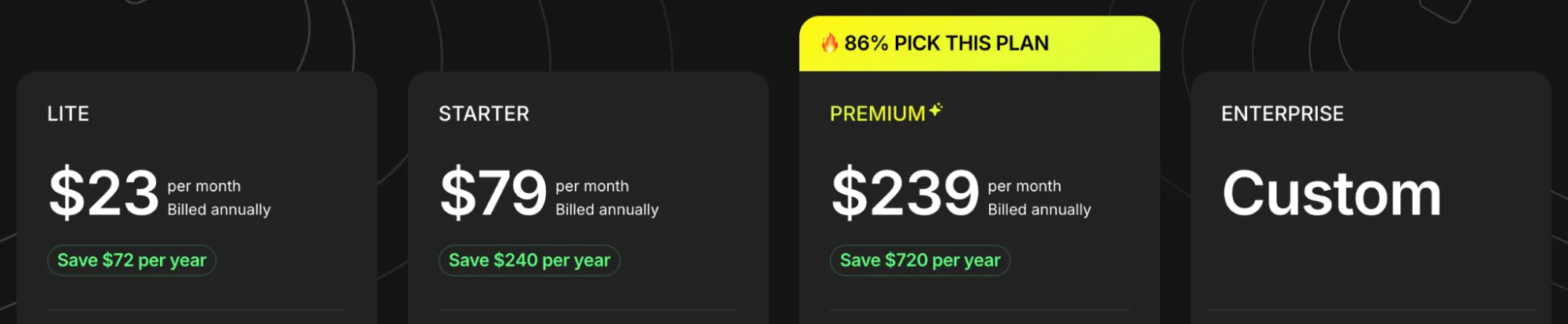
Pricing of WotNot AI
Gorgias AI Agent (Customer Support Agent)
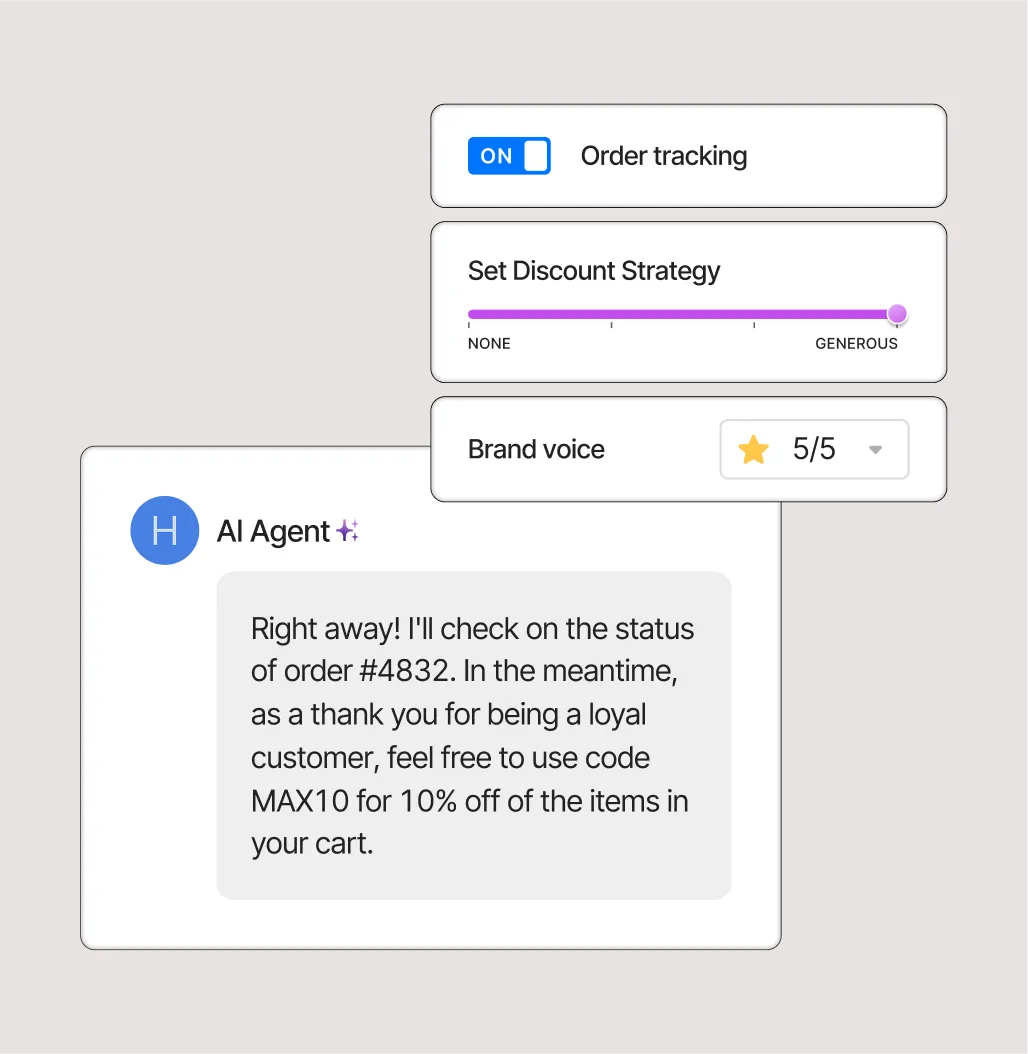
Gorgias AI Agent is a support-first AI agent designed mainly for Shopify stores. It handles customer tickets, resolves issues automatically, and only escalates to humans when needed.
Pros
-
Deep Shopify integration — orders, shipping status, refunds, products, policies.
-
A massive time-saver for support teams
-
Reduces angry emails. Customers usually get angry not because something went wrong, but because no one replies.
-
Trusted by many direct-to-consumer brands.
Cons
-
Pricing grows with usage
-
Mostly focused on support, not sales
-
Needs clean policies
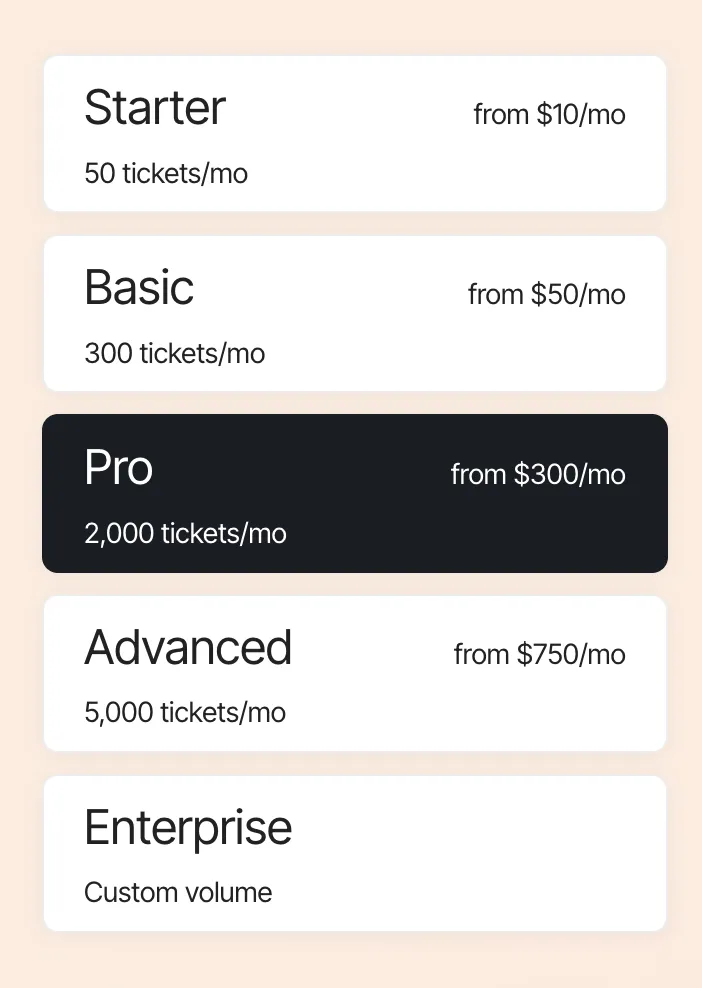
Pricing Gorgias AI
Read our article The Best AI Tools for SEO to find out more about using AI to help your online store grow.
Case Studies: How E-commerce AI Agents Perform in Real Stores
AI agents look great in demos — real stores are where they get tested. These case studies show what actually happens when AI agents meet real customers.
Alhena AI Stylist: Victoria Beckham Store Case Study
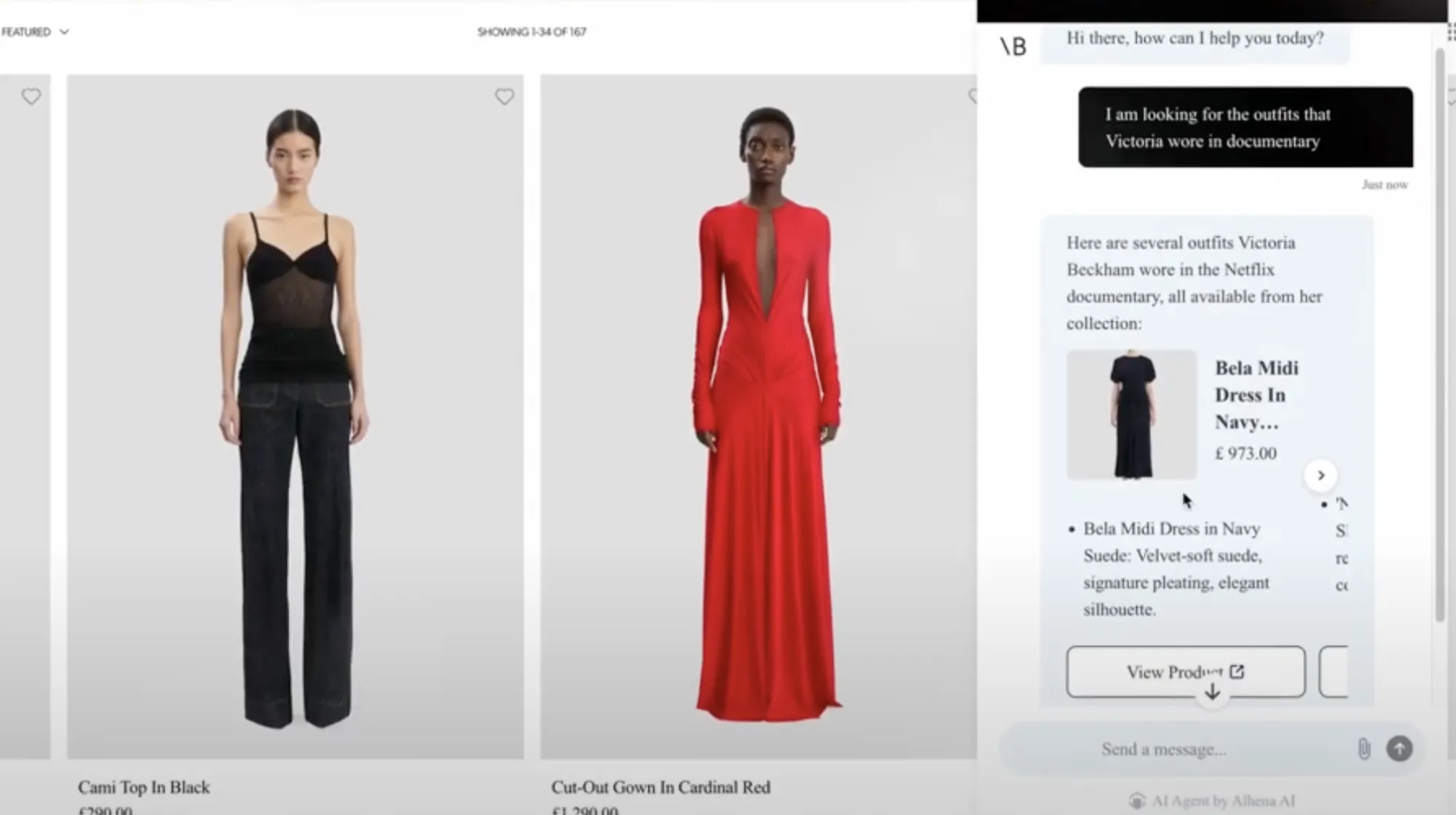
Customers often hesitated on product pages, needing quick advice on fit, fabric, or how to style an item. While the client service team handled this well manually, doing it at scale — across regions and time zones — wasn’t sustainable.
To solve this, Victoria Beckham store introduced Alhena’s Main Agent, supported by specialized sub-agents, including an AI Stylist and Fit Assistant, bringing that same level of guidance to every shopper, anytime.
-
Alhena connects directly to the store’s systems — orders, products, helpdesk, and knowledge base — so it always has up-to-date information, from stock levels to detailed product specs.
-
It’s trained to sound like an in-store stylist, keeping the experience as polished and premium as the brand itself.
-
Instead of just answering FAQs, the AI helps shoppers put outfits together, offering styling advice that builds confidence and makes it easier to click “Buy.”
Results: A 20% lift in average order value and a 10% increase in overall revenue.
Gorgias Shopping Assistant: Arc’teryx Case Study
The outerwear brand received a flood of pre-purchase questions about subtle technical differences across many similar products. To make choosing easier, they introduced a Shopping Assistant that delivers clear product recommendations.
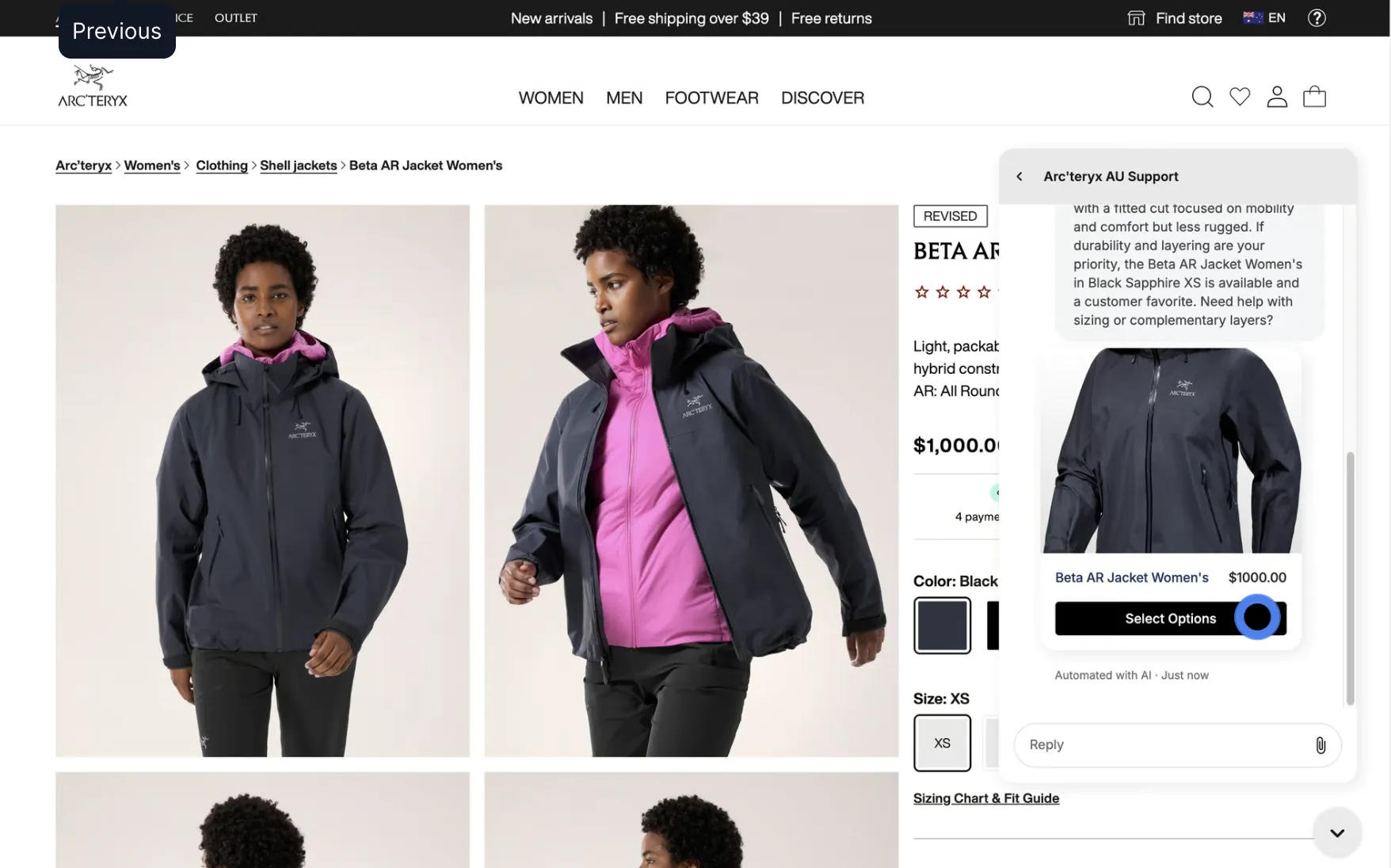
Results: 23x ROI on AI Agent, 75% increase in conversion rate (from 4% to 7%), and 3.7% overall revenue influenced by Shopping Assistant.
WotNot’s Bot: Symphony Case Study
The air-cooling company Symphony struggled to respond quickly to customer questions, especially during peak summer demand. To solve this, WotNot deployed a smart support and lead-generation chatbot on the company’s website.
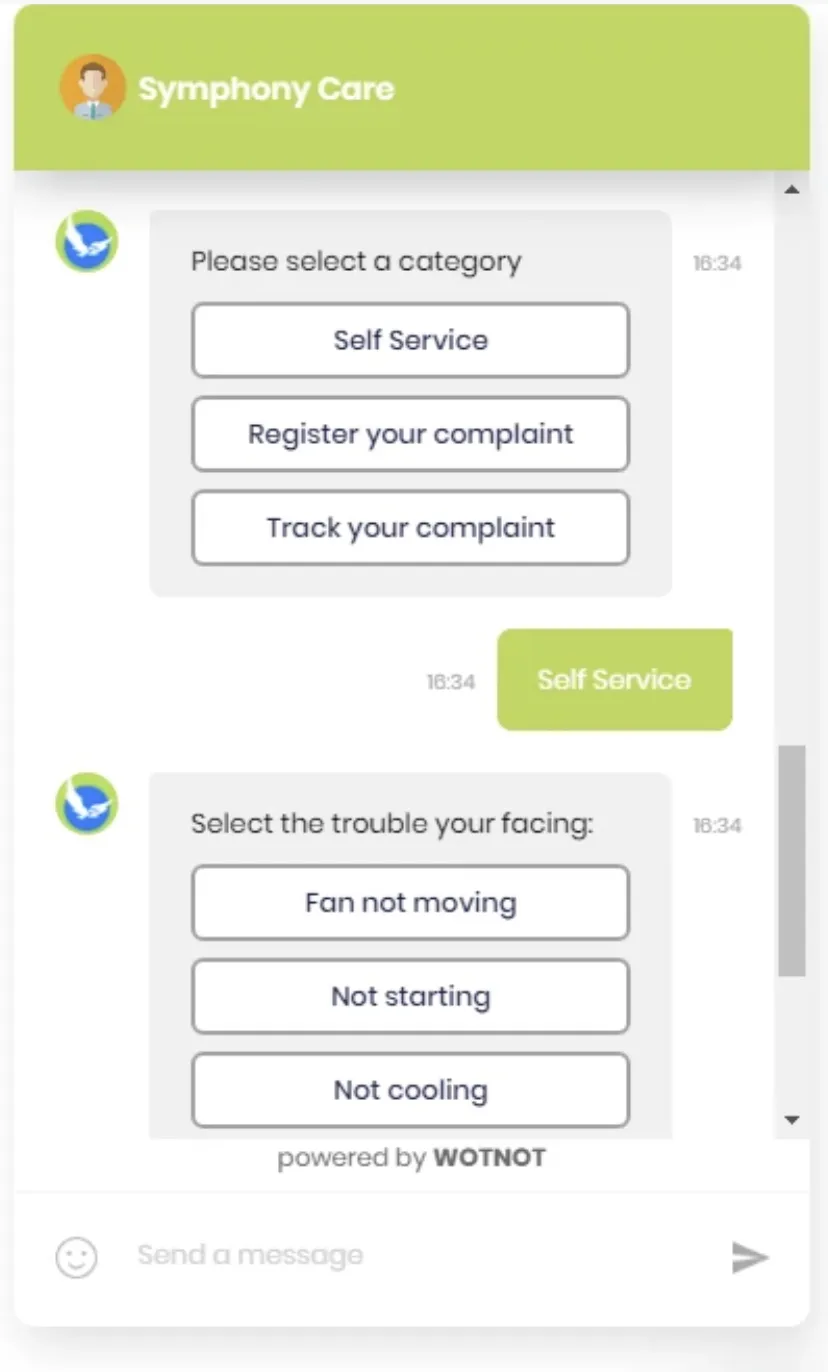
It was integrated with their internal systems to automate repetitive tasks such as ticket creation, status updates, and routing emails to the appropriate support teams.
Results: Symphony generated $3.2 million and saved 3500+ hours in customer support in the 18 months.
Final Thoughts
Over the years, AI has become smarter and can now help with tasks that seemed impossible before. It’s not just about ranking in the chatbots anymore.
AI agents are practical helpers that handle repetitive tasks, respond faster than humans ever could, and improve day-to-day operations without drawing attention to themselves.
Of course, AI agents can’t replace humans; they're just better suited to tasks that don't require creativity, personality, or vision. They handle the boring tasks, freeing up time for you to plan your online store's global expansion.
FAQ
What is an e-commerce AI agent, and how does it work?
An AI agent is a digital worker that can understand customer questions, check your store’s real data, and take action. It connects to your e-commerce platform (like orders, shipping, and policies), answers customers instantly, and handles tasks such as tracking orders, processing returns, or updating tickets — without waiting for a human.
Can AI agents replace human support teams in e-commerce?
Not completely — and that’s a good thing. AI agents handle routine, repetitive questions (delivery status, refunds, FAQs), which usually make up most support tickets. Human agents still step in for emotional, complex, or unusual cases. In practice, AI agents reduce the size of support teams rather than eliminate them.
What’s the difference between AI automation and agentic AI?
Traditional AI automation follows fixed rules: “If X happens, do Y.” Agentic AI can reason, choose actions, and adapt. It understands intent, pulls data from multiple systems, and decides the best next step — more like a junior employee than a script. That’s why agentic AI can handle real conversations, not just workflows.
Is an AI agent worth it for a small or growing online store?
Yes, once you’re spending time answering the same questions every day. If support emails distract you from marketing, product, or fulfillment, an AI agent usually pays for itself by saving hours, reducing refunds caused by slow replies, and keeping customers calm and informed.

 0
0
 0
0
 0
0
 0
0
Related Articles
Why Your Amazon Pet Ads Are Getting More Expensive Every Quarter Since 2025 (and How Smart Brands Manage It)
What happened to the auction prices? Where is the margin going, and what should be done next quarter?
How to Track Brand Mentions in AI Search? Find Out Whether You Are in the Answer
Being mentioned in an AI search boosts visibility. Discover how to monitor your brand mentions in ChatGPT, Perplexity, or Gemini and follow our approach to higher mention frequency.
5 Questions to Expose an Amazon Agency That Can’t Handle Pet Brands
A field guide for CMOs who are tired of getting sold smoke and mirrors — and want an agency that actually understands the difference between a kibble and a kernel.