
What Should Pet Brands Do About Temu in 2026?
For most US pet brands, the right response to Temu in 2026 is disciplined restraint: do not list there, do not cut your Amazon prices to chase it, and do mine it for free trend data. The platform built its name on $1.50 impulse buys, and it just lost the loophole that made those prices possible.
What Should Pet Brands Do About Temu?
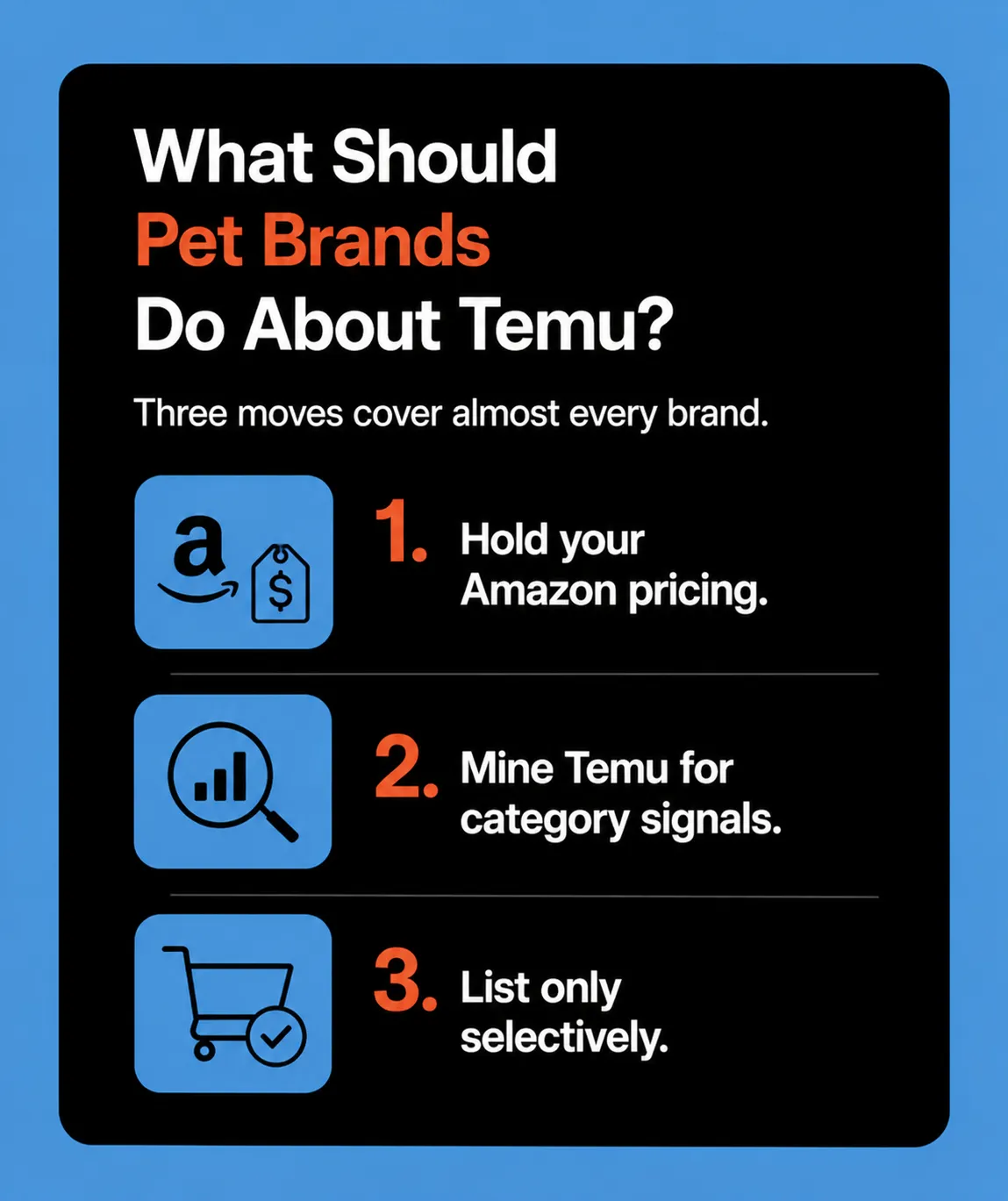
Pet brands should treat Temu as a low-priority competitor and a high-value information source, not as a pricing threat that demands a reaction. Three moves cover almost every brand.
-
Hold your Amazon pricing. The US ended the $800 de minimis exemption in May 2025, and tariffs on Chinese goods climbed as high as 145% before settling into a 25 to 57% range in 2026 (CNBC, 2025). The price gap that once let Temu undercut domestic sellers has narrowed sharply, so matching it is a fight you no longer need to pick.
-
Mine Temu for category signals. What sells there today often reaches Amazon as a private label within a quarter. That makes Temu an early-warning system for the copycat pressure heading toward your listings.
-
List only selectively. Commodity accessory sellers with US-based fulfillment can open a Temu storefront, and even then, as a volume channel rather than a brand home.
The market favors patience. US pet industry spending reached $152 billion in 2024 and was projected at $157 billion for 2025 (APPA, 2025). Pet e-commerce keeps growing on premium demand: North America holds about 40% of the global pet care e-commerce market, which is forecast to grow at a 7.8% CAGR through 2030 (Grand View Research, 2024).
Note: Figures and policy details reflect public reporting as of June 2026. Tariff rates and marketplace policies change quickly. Confirm the current specifics with your trade counsel or Amazon account team before acting.
Why Has Most of the Temu Panic Already Evaporated?
Here is the part nobody enjoys admitting: tariffs solved the Temu problem before your marketing team finished the panic deck. Temu's edge was regulatory, not operational. It shipped cheap parcels straight from China under a duty-free threshold, and when Washington closed that threshold, the trick lost its mirror.
The retreat was not gentle. Temu's US sales fell 23% year over year, and its daily active users dropped 58% in the months after the change (Barrons, 2025). The company pivoted to local warehouses and began recruiting US sellers, which is a polite way of saying the original model no longer works.
So for a serious pet brand, ce n'est pas la mer à boire. The $1.50 squeaky toy that squeaked exactly once is not the rival keeping Chewy executives awake at night.
Your dog may chase every shiny, cheap thing that moves across the floor. Your customer, increasingly, does not.
The One Temu Move That Should Actually Worry You
Ignore the prices. Watch the price anchor. Even in retreat, Temu taught millions of US shoppers to expect a collar, a feeder, or a grooming glove for the cost of a coffee. That expectation does not disappear when the cheap parcels do.
The second quiet risk is recruitment. Temu now signs US sellers under a local-fulfillment model, and pet supplies sit among its fastest-growing categories. Your shelf will get cheaper neighbors regardless of tariffs, only this time with domestic return labels.
Defend the anchor with content, not coupons. A+ content modules, comparison-driven copy, and honest durability claims justify a premium far better than a reflexive price drop. A buyer who understands why your $24 harness outlasts three $7 ones stops comparing you to Temu at all.
Should You Ever List Your Pet Brand on Temu?
Usually, no, and the reason is reputational rather than financial. European regulators found that a majority of tested Temu toys breached EU safety rules, and several US state attorneys general opened supply-chain inquiries (2025).
For a brand selling products that go in a pet's mouth, shared shelf space with that reputation is a liability.
The exception is narrow. If you move undifferentiated commodity accessories, such as basic beds, plain leashes, or bulk waste bags, and you already fulfill domestically, Temu can work as a clearance and volume channel. Keep it walled off from your premium identity, and never run your hero ASINs there.
|
Response |
What it involves |
Best for |
Main risk |
|
Defend and hold |
Keep Amazon pricing; invest in A+ content and brand education |
Premium and mid-tier pet brands |
Complacency toward domestic low-cost rivals |
|
Monitor and mine |
Track Temu listings as a trend and private-label early-warning system |
Every pet brand |
Reacting too slowly to the signals |
|
List and sell |
Open a Temu storefront through the US-warehouse seller model |
Commodity accessory sellers with domestic fulfillment |
Margin erosion and brand-trust contagion |
TikTok Shop went from a dance app side quest to a serious sales channel. Here's what pet brands should know.
What Should I Tell My CEO When They Ask About Temu?
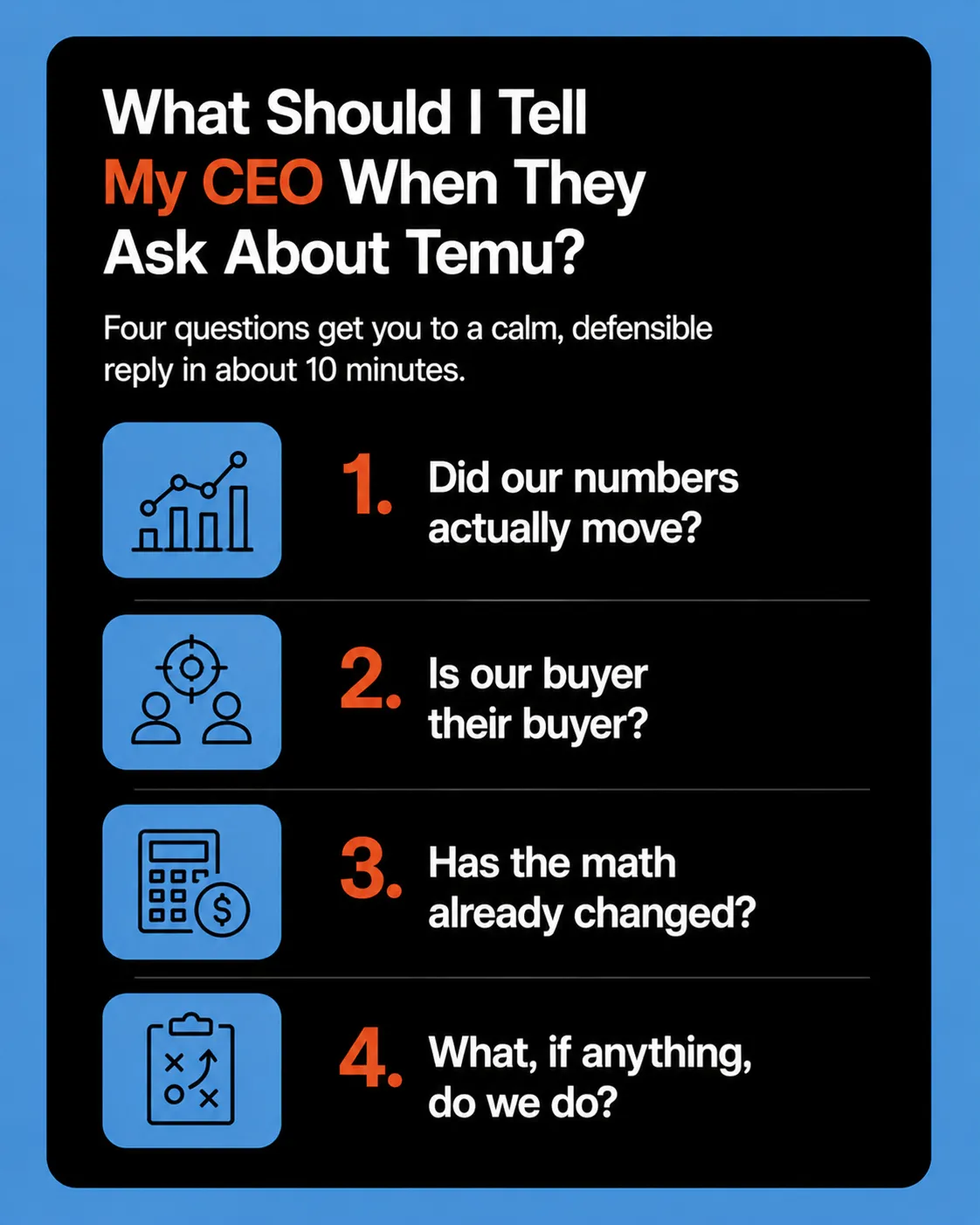
Your CEO read one headline at 35,000 feet, and now Temu is an agenda item. Resist the urge to answer the headline. Answer the P&L instead. Four questions get you to a calm, defensible reply in about 10 minutes.
-
Did our numbers actually move? Pull your pet category's sessions, conversion rate, and Buy Box share for the last 90 days. If session share and conversion held steady, you already have your headline answer: no measurable impact. The watchout: a feeling is not a data source, and neither is your CEO's group chat.
-
Is our buyer their buyer? Temu wins the impulse, single-use, price-first shopper. Premium and subscription pet buyers rarely overlap with that crowd. If your repeat rate and Subscribe & Save base look stable, the two audiences barely touch. The watchout: a thin overlap on your cheapest SKU is not an overlap on your brand.
-
Has the math already changed? Remind the room that the de minimis exemption ended in May 2025 and that tariffs erased most of Temu's price edge. The threat your CEO is picturing mostly belongs to 2024.
-
What, if anything, do we do? Map the answer to one of the three postures in the table above: defend and hold, monitor and mine, or list selectively. For almost every branded pet seller, the honest answer is one of the first two.
Then say it in one breath. The line that lands:
“Temu has not moved our numbers, our buyer is not their buyer, and tariffs have already closed most of their price gap. We are watching their listings as an early read on private-label trends, and we are defending margin with content, not discounts.”
Short, numerate, and it ends the agenda item.
Whatever you do, do not promise to match Temu on price. That single sentence has started more margin death spirals than any spreadsheet ever has. A calm number beats a brave discount every time.
Bonne chance — and may your Subscribe & Save conversion rate be ever in your favor!
Frequently Asked Questions
Is Temu a real threat to US pet brands in 2026?
Less than it was. After the US ended the $800 de minimis exemption in May 2025, tariffs on Chinese goods rose sharply and Temu's price advantage narrowed (CNBC, 2025). It now competes closer to domestic sellers rather than far below them.
Should I lower my Amazon prices to compete with Temu?
Generally no. The pet category grows on premium and humanization demand, with the US pet industry spending reaching $152 billion in 2024 (APPA, 2025). Defending margin with content protects more value than matching low prices.
Can pet brands sell on Temu?
Yes, through Temu's US-seller and local-warehouse model. It suits commodity accessory sellers with domestic fulfillment more than premium brands, partly because of ongoing product-safety and supply-chain scrutiny (2025).
What is the best way to use Temu as a pet brand?
As market intelligence. Monitoring Temu's fast-growing pet listings helps you anticipate which products may reach Amazon as private label, often within a quarter.
Netpeak USA helps pet brands hold their margin on Amazon while turning marketplace noise into category strategy. Reach our team through the French Kiss blog to pressure-test your pricing and your content defense.

 0
0
 0
0
 0
0
 0
0
Related Articles
Business Apps in the US: iOS vs. Android, September 2026
We searched for US App Store and Google Play data to see what business apps professionals, shoppers, and investors actually installed in September.
Pet Food Product Patent: How to Protect Your Innovation
Patenting pet products requires careful consideration and proper application filing. With the 8 steps below, you will be able to submit your patent application and protect your invention.
Digital Marketing for SMBs: How to Grow a Small Business Online
Small or mid-sized businesses compete for the same customers as brands with marketing departments ten times their size, on a fraction of the budget. You can't outspend them, so you have to outsmart them and grow your business deliberately.