
9 Proven Skincare Marketing Strategies to Make Loyal Customers
To build a loyal customer base for your skincare brand, you need to develop a strong brand narrative, collaborate with niche experts, educate and engage your community, reward repeat purchases, simplify returns, provide personalized recommendations, encourage user-generated content, streamline refunds and returns, invest in video content, and own up to your mistakes.
Getting someone to buy your serum once is a task for beauty paid ads and a no-brainer. Getting them to buy it again, and again, and again — is where the real revenue happens.
The beauty industry reality right now is that it’s saturated with skincare brands. The US skincare market reach is projected to generate $26.47 billion in revenue in 2026, up from $25.69 billion in 2025 and $20.18 billion in 2018 (Statista).
That means that customers have gotten really good at ghosting brands after product discovery and one purchase. Plus, customer acquisition costs keep climbing, and a returning customer is far cheaper to keep happy than to find a new one. So, you desperately need to find a way to turn one-time buyers into lifetime customers.
That's what this guide is for. You'll walk away with 9 practical digital strategies that could change your retention numbers. Grab a cup of tea (or your 10-step routine, we don't judge) — and let’s go to sustainable growth!
Why Keeping Customers Pays Off
General retention logic is pretty simple: the more first-time buyers you can turn into repeat customers, the less you have to keep paying to replace them. Business owners already understand this intuitively, and we're simply backing it up with facts.
-
Acquiring a new customer can cost 5–25 times more than retaining an existing one. And even a 5% increase in customer retention can boost profits by 25%–95%, according to research (Harvard Business Review).
-
Customer acquisition costs rose 36% in three years, while only 27% of new customers returned for a second purchase (Adobe).
So, how should skincare brands make their first-time customers come back? The first non-marketing answer, which should be the core of all your future actions, is to create a great product.
It sounds almost too obvious to write down, but we must. No amount of paid advertising will save a product that doesn't deliver results. 40% of customers stay with a brand only because the product works well and is effective for their skin type (McKinsey, 2025).
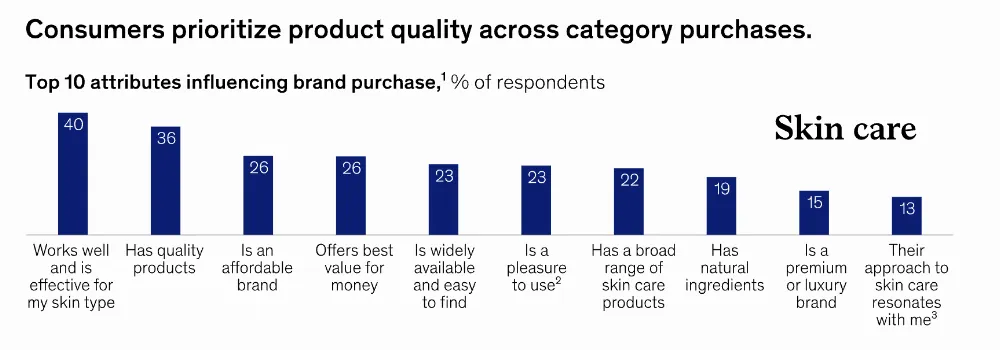
Source: McKinsey’s State of Beauty, 2025
A "pretty bottle, mediocre formula" situation means that customers who trust your product enough to buy it never come back. What a waste!
Here are some practical tips to make people stay:
-
Nail your core formula before you scale your product line. A brand with three excellent products beats a brand with fifteen mediocre ones every time. It's a key part of your overall brand marketing and brand identity.
-
Test across real skin types. Oily, dry, sensitive, mature — get customer feedback from all of them.
-
Be upfront about who a product is (and isn't) for. "Best for combination skin" builds trust. "For all skin types" disappoints half your target market.
-
Ask for feedback. Send a quick "how's your skin doing after two weeks?" email to catch problems early.
Now that you have a great product, let’s look at the marketing strategies that will keep your customers coming back!
1. Partner with Experts in the Niche
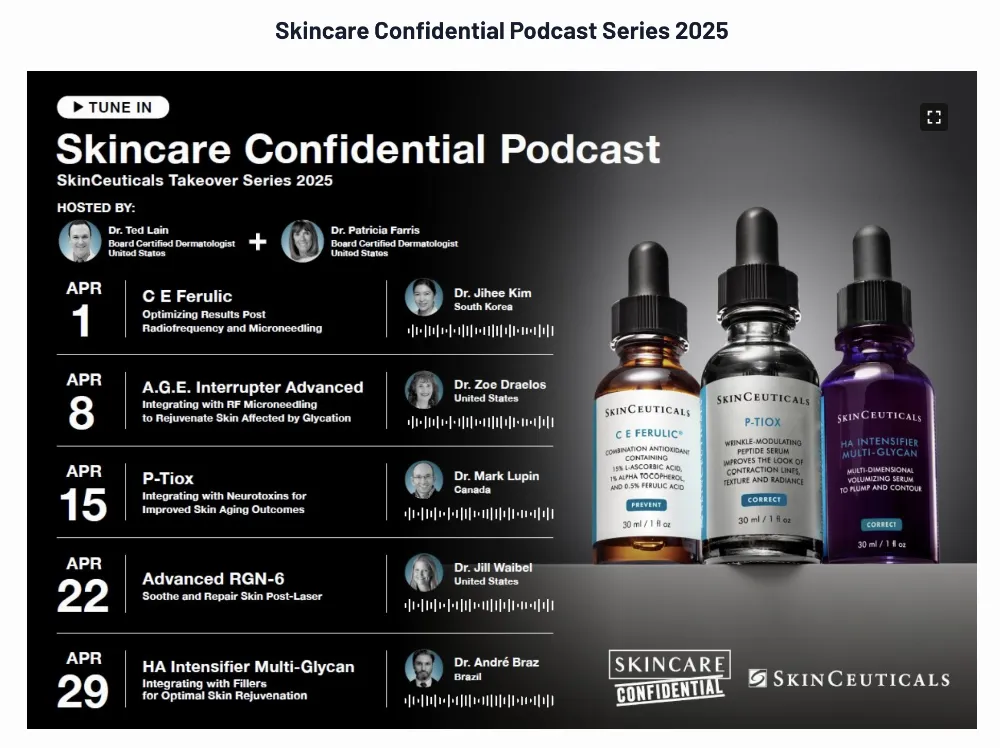
You need dermatologists, estheticians, and skincare formulators to carry your credibility. In a survey of 1,000+ women, "scientific research and clinical trials" ranked as the second most important purchase factor, with 31% of respondents placing it in their #1 spot — right behind ingredient quality (Drive Research, 2025).
This isn't something that only medium and large brands need to do; smaller players can also partner with local experts.
Practical tips:
-
Feature a short dermatologist or esthetician quote directly on your top-selling product pages, near the ingredient list where skeptical shoppers are already looking.
-
Co-author a blog column with an expert, turning it into a useful knowledge hub for customers while helping your brand rank higher in search results.
-
Co-create one educational video per month — an ingredient breakdown, a myth-busting session, or a "what I tell my patients" explainer.
-
Host a quarterly live Q&A on Instagram or TikTok with a dermatologist or esthetician and repurpose the best moments into evergreen, engaging content.
2. Reward Repeat Purchases
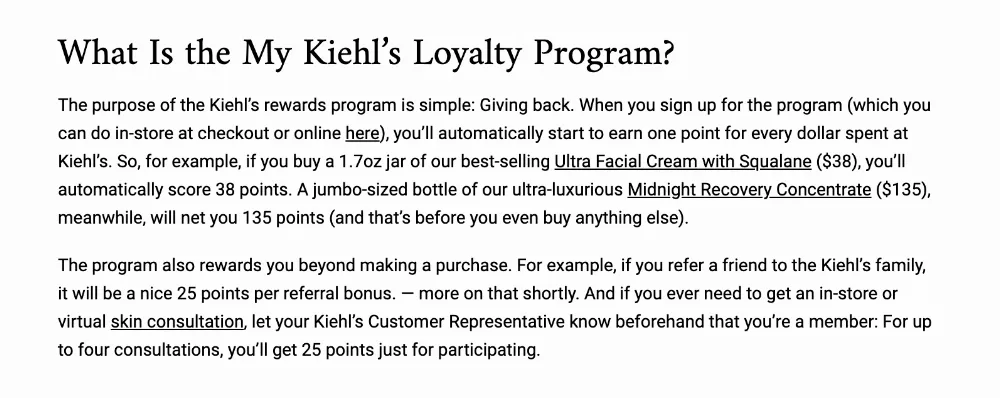
People love games and free stuff. That’s why even simple points-based loyalty programs pay back. For example, Ulta Beauty's CMO said in 2026 that more than 95% of Ulta's sales come from loyalty-program members.
Every repeat purchase raises average order value and pushes your customer retention rate in the right direction.
Practical tips:
- Keep the earning formula dead simple — for example, "$1 spent = 1 point.
- Let people redeem points for products, not just percentage-off discounts: free minis and early access to product launches feel more special than a non-exclusive discount of 10%.
- Send an expiring-points reminder email before a customer's balance disappears; it's a built-in reason to come back and shop.
- Track repeat purchase rate for members vs. non-members monthly so you know the program is actually earning its keep.
3. Create and Educate Your Community
Skincare ingredients can sound like a chemistry exam. All these mentions of retinol, niacinamide, and exfoliating acids are confusing, and potential leads just want to understand what they're putting on their faces and how it works.
Write articles, run content marketing, use beauty SEO, and create a community. This is a great source of user-generated content (UGC), and customers pay attention to it. 79% of consumers say UGC has a major impact on their purchase decisions (Business Wire).
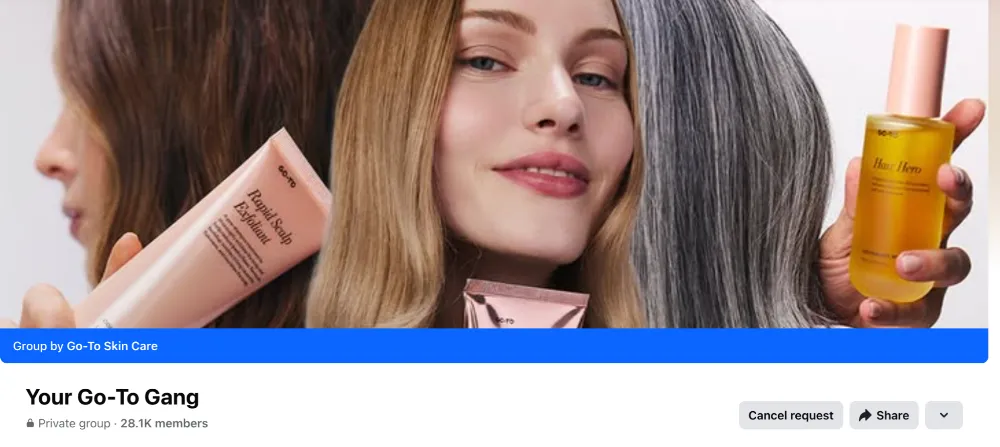
Build a private Facebook or Discord group where you teach, answer questions, etc. It's worth the effort: 74.5% of consumers who are a part of the brand community say that they feel valued as customers. 60% say community access makes them more loyal to a brand (Higher Logic, 2025).
Practical tips:
-
Don’t overcomplicate; a small private Facebook or Discord group is enough.
-
Pin your answers to the most common support questions.
-
Motivate members to share their skin journeys.
-
Use community feedback as informal market research — for example, let repeat customers vote on scent options before a reformulation.
4. Do Not Complicate Refunds/Returns
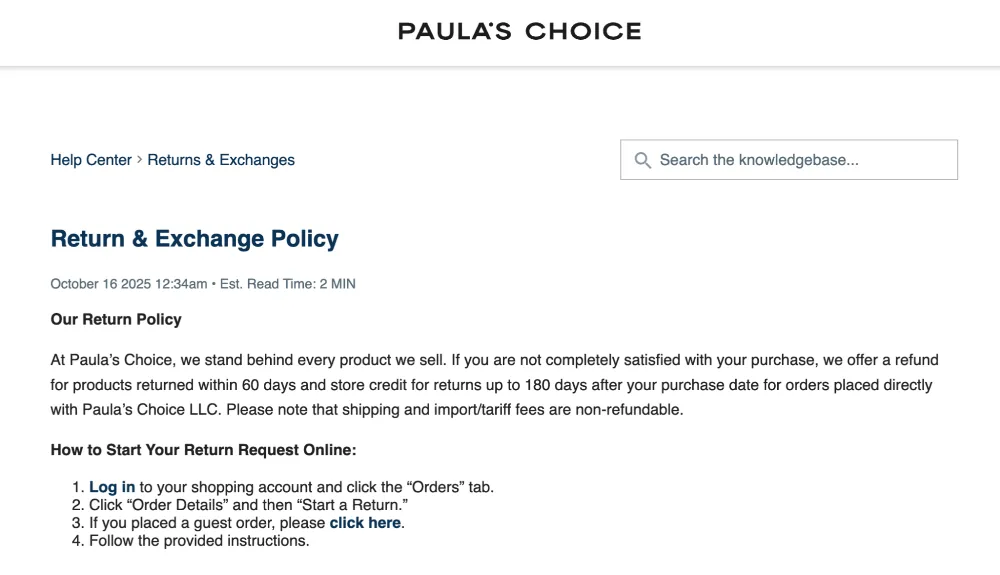
Your return policy should be light and simple to understand. Just imagine it: 81% of consumers read your return policy before purchasing, and 71% say that after a poor return experience they would not buy from a retailer again (UPS, 2025).
Practical tips for higher customer satisfaction:
-
Your return policy should be short, on one screen maximum.
-
Offer exchanges too. Sometimes customers need a different formula, not money back.
-
Automate the return request process so customers don’t wait days for a reply.
-
Share a specific refund timeline — for example, "5-7 business days".
-
Follow up after a return with a personalized recommendation. A thoughtful "maybe try this instead" email can win back a sale you almost lost.
5. Offer Personalized Communication and Recommendations
Tailor your messaging to each customer. Know them better than their mothers. Use their purchase history, skin type, and past interactions to find out exactly what they need. You could recommend their next step in routine, follow up on a product they wanted but didn't buy, etc.
And don't stop at product recommendations: someone's one-year anniversary with your brand, their tenth order, their skin-progress photo six months in — these are worth celebrating, too.
This matters more than most brands realize: 71% of consumers expect companies to deliver personalized experiences, and 76% get frustrated when brands fail to do so (McKinsey, 2021).
Practical tips:
-
Build a short skin-type quiz that outputs a real, specific routine.
-
Segment your email list by skin type and purchase history, not just by whether someone opened your last campaign.
-
Cross-sell. Recommend the logical next step in someone's routine (e.g., a serum after they've bought a cleanser and moisturizer)
-
Use a customer's actual name and skin type in emails and other marketing campaigns.
-
Build separate remarketing audiences. Don’t show the same ad to someone who bought from you six months ago. Their next steps are different, so their ads should be too.
-
Match PPC ads to each audience. For product viewers, remind them what they looked at. For cart abandoners, address common purchase barriers, etc.
6. Invest in Video Content
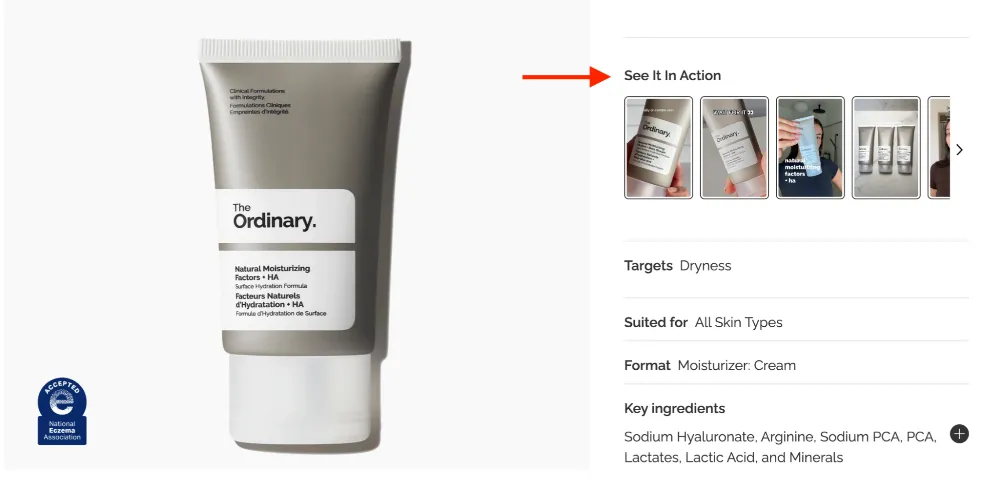
Skincare is visual and tactile — texture, glow, application technique. The numbers make the case clearly: 53% of consumers purchase through social platforms, while 22% have bought beauty products directly through TikTok Shop (NIQ, 2026).
Practical tips to build brand awareness:
-
Film short (under 60 seconds) application and texture close-ups for your best products.
-
Turn your most-asked customer questions into quick video answers.
-
Add at least one video to every core product page, even a simple 15-second texture-and-swatch clip.
-
Caption everything. Social videos often are watched on mute.
7. Leverage Social Media and Encourage UGC Content
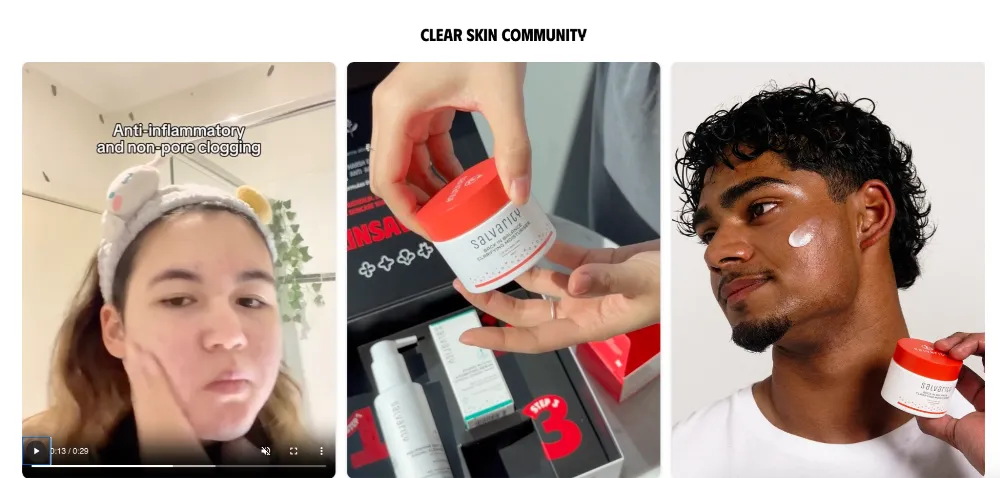
Slime-texture serums, "get ready with me" routines — jump in when it makes sense for your brand voice. Pair it with genuine customer stories and valuable user-generated content: 65% of global shoppers say they rely on UGC like ratings, positive reviews, photos, and videos when making buying decisions, and that number jumps to 80% among Gen Z shoppers specifically (Bazaarvoice Shopper Experience Index, 2025).
Practical tips for your beauty SMM:
-
Set up a branded hashtag and make it easy for customers to find and use it from the mobile app.
-
Repost real customer content weekly — it costs nothing and builds trust.
-
Partner with micro-influencers who already use your product.
-
Feature UGC directly on product pages and your online ads — that's where the purchase decision actually happens.
8. Use Automated Retention Systems
Email marketing and SMS flows that trigger based on behavior (a replenishment reminder 30 days after purchase, a "you left your cart" nudge, a birthday discount) keep you top-of-mind without requiring a human to manually track everyone's purchase history.
Klaviyo did a benchmark analysis of over 183,000 ecommerce brands, and it showed that behavior-triggered flows and market segmentation work better than one-off email campaigns on click and conversion rates by a wide margin.
Marketing automation is one of the few activities that scales without scaling your marketing expenses.
Practical tips for your retention strategy:
- Tie your replenishment flow to how long your product actually lasts (e.g., a 30-day moisturizer needs one cadence and a 90-day sunscreen needs another).
- Remind about a cart abandonment in two or three touches.
- Trigger a win-back flow for potential clients who haven't purchased in 60–90 days, before they forget about you.
- Personalize automated emails with skin type and purchase history, not just first name — generic automation still feels generic.
- Review flow performance quarterly and retire or rewrite the ones that underperform instead of leaving them running on autopilot forever.
9. Admit Your Mistakes
A product recall, a bad batch, a digital marketing claim that didn't age well — it happens. You just need to handle it right. Own it, explain the fix, and move on.
When online businesses are clear about their products, claims, and mistakes, customers are more likely to trust them (NielsenIQ, 2025).
Practical tips:
-
Acknowledge the problem on the same channels where customers wrote about it. How you respond directly shapes your online reputation in search results and on review sites for years afterward.
-
Explain the fix, not just an apology: "Here's what we're changing".
-
Follow up once the fix is in place — silence after an apology reads as if the issue was dropped, not resolved.
-
Avoid corporate hedging language ("we regret any inconvenience this may have caused"). Potential customers can tell the difference between an apology and a non-apology.
For a broader view of how these pieces fit together, digital marketing for beauty brands covers the full picture — from lead generation to marketing analytics.
Skincare Marketing Strategies Template
Copy, adapt, and check off marketing efforts as you go:
-
Find 2–3 skincare experts to collaborate with
-
Launch a brand loyalty program with simple rules
-
Create a space on media platforms like Facebook or Discord for education and community
-
Prepare a communication template for the case something goes wrong
-
Simplify your returns/refund policy into 3 short bullet points
-
Build a short skin-quiz for website visitors that generates a personalized product recommendation
-
Set a monthly cadence for jumping on relevant, on-brand social trends with marketing activities
-
Set up automated flows: replenishment reminder, cart abandonment, birthday offer
-
Film at least one tutorial or ingredient-explainer video per month
-
Create a system to flag and celebrate customer milestones automatically to strengthen customer relationships
-
Plan a quarterly calendar of limited-time offers or seasonal campaigns
-
Segment your email/SMS list for personalization and better customer service
Sell your skincare products on Amazon? Check out one of our success stories worth studying:
Final Thoughts: How to Market a Skincare Brand
Customers with a high lifetime value stay when they have community around them. They crave real education and communication human-to-human. Focus on your loyalty program, your storytelling, and making returns painless, and the rest of your customer engagement tends to follow.
If you only do three things from this list, start your online presence with:
-
Your first loyalty program
-
A return policy even a baby can understand
-
Personalized email and SMS flows
These marketing channels require the least setup and deliver the fastest results.
Ready to put this into action? Pull the template above into your project tracker and start checking boxes today — no bloated marketing budget or six-month business plan required.
FAQ
Is it possible to have lifetime customers for skincare brands?
Yes. Skincare is a routine-based category, so customers need to repurchase products. Brands that stay relevant to a customer's evolving skin concerns can retain them for years, not just one purchase cycle.
Does customer service play a role in customer loyalty?
Absolutely, often more than the product itself. Fast, empathetic responses to questions or complaints can turn a frustrated customer into a loyal one. On the other hand, slow or dismissive service can undo months of good marketing initiatives in a single interaction.
How to turn customers into advocates for my brand?
Give customers great results, a community, and recognition (like UGC reposts or milestone shoutouts). People advocate for brands that make them feel like more than a transaction.
Is offline skincare marketing important in 2026?
Yes, though it looks different now — think pop-up shopping events and in-store sampling partnerships. Offline touchpoints add sensory experience that a screen simply can't replicate.

 0
0
 0
0
 0
0
 0
0
Related Articles
Amazon's AI Now Builds Complete Looks on Product Pages. How Do Brands Make Sure the Bundle Is Theirs?
Amazon now uses AI to assemble complete, shoppable looks around a single product, and it fills those looks with whichever brands its model picks.
What Happens When Amazon Suppresses Your Listing? The New 2026 Rules
Under the new 2026 rules, Amazon warns you first and gives you a grace period to fix the issue.
Business Apps in the US: iOS vs. Android, August 2026
We’ve fetched data from the US App Store and Google Play to see what professionals, shoppers, and businesses are actually installing, and why the market leaders are winning right now.