
How UGC and Algorithms Turn Content Into Viral Trends
Like most people, we have been chronically online for years and have watched new products, memes, and songs suddenly become everywhere. One day, hardly anyone is talking about it. Then, poof — it is in every other video, copied by thousands of creators across TikTok, YouTube, Instagram, you name it.
Virality works like a snowball: the longer it rolls, the bigger it gets. Users like something and then create their own versions of it. And social media algorithms promote the content that gets the strongest response.
So, what exactly is virality and why do certain products and songs take off? Which mechanisms allow small moments to spread across the internet?
Let’s break down how UGC, audience behavior, and recommendation algorithms work together to make something go viral. And how you can use this information to help your business grow.
Virality As a Chain Reaction
Virality is the process by which a piece of content, product, song, or idea spreads from person to person online.
A first post reaches a small group of people. Some watch it, like it, comment, or share it. These signals tell the social media algorithm that the content is interesting, so the platform shows it to a larger group. If those people respond the same way, its reach keeps growing.
Three forces usually drive this process:
-
The content creates a strong reaction. People share posts that make them laugh, cry, feel surprised, or want to join a conversation.
-
Users help recreate it. Viewers create their own memes, remixes, reviews, and reaction videos. This is called user-generated content, or UGC.
-
Algorithms increase distribution. Platforms recommend content that keeps people watching and interacting with new audiences.
What Makes a Product or Song “Viral-Ready”
Not every product or song is easy to spread. Viral-ready ideas usually attract attention quickly, give people something simple to talk about, and can be adapted into new content.
|
Viral-ready quality |
Why it works |
Example |
|
|
1. |
It creates an immediate reaction |
They trigger emotions or interest, and make people stop scrolling. |
Dubai chocolate combined a colourful cross-section, thick pistachio filling, crunchy texture, and ASMR-friendly sound. Maria Vehera’s tasting video generated more than 122 million views, and then thousands of users began posting their own reviews and homemade versions (The Guardian). |
|
2. |
It tells a story people can retell |
It gives audiences an easy way to explain the trend to someone else. |
“Pretty Little Baby” by Connie Francis became a viral hit more than 60 years after its release and gave every post a ready-made story. It was eventually used in more than 28 million TikTok videos. (People) |
|
3. |
It gives creators a reusable format |
Unboxings, reactions, dances, recipes, transformations, and “I tried it so you don’t have to” videos act as templates. |
Labubu blind boxes naturally supported unboxing videos: neither the creator nor the viewer knew which figure was inside (Reuters). |
These qualities often overlap. Dubai chocolate was visually striking, came with a scarcity story, and could be recreated at home. Labubu offered a recognizable character, a blind-box reveal, and an entire collecting culture.
The more ways people can experience, explain, and recreate something, the better its chances of spreading.
How UGC Turns Attention Into a Movement
UGC allows one idea to appear in hundreds of different contexts. Users begin adapting it, and every adaptation gives the trend another opportunity to reach a new audience.
1. UGC Gives Every Creator a Different Entry Point
One person reviews a product, another compares it with a cheaper version, while someone else turns it into a joke, tutorial, or personal story.
Example: the Jet2 holiday meme. In 2025, creators began pairing Jet2’s cheerful “Nothing beats a Jet2 holiday” advertisement with videos of delayed flights, bad weather, pool accidents, and other travel disasters.
The same audio worked across thousands of different stories. By July 2025, it had appeared in more than 1.3 million videos (The Guardian).
Jet2 did not try to regain control of the joke. It joined the conversation and launched a challenge offering a £1,000 holiday voucher.
Practical tip for brands: Develop a flexible prompt rather than one approved storyline. Give creators several entry points.
2. Participation Lowers the Cost of Content Creation
Creators are more likely to participate when the basic concept already exists. They only need to add their face, result, opinion, or identity to it.
Example: Doechii’s “Anxiety.” The song became attached to a dance inspired by a scene from The Fresh Prince of Bel-Air. Creators could reproduce the simple two-person format.
More than 725,000 TikTok videos had used the song by March 2025. Doechii, Will Smith, and Tatyana Ali eventually recreated the trend themselves, connecting the new videos to the original scene (People).
@willsmith Waited 35 years for this dance to trend. Ib: @Mimii ♬ Anxiety - Doechii
Practical tip for brands: Reduce the concept to one repeatable action. A creator should be able to understand it after watching one example. Provide the sound, prompt, hashtag, or demonstration, but leave the outcome open.
3. Repetition Creates Social Proof
One creator can introduce a product, but hundreds of them make it appear culturally important.
Example: Chili’s Triple Dipper. Creators repeatedly filmed close-up cheese pulls, sauce dips, food reviews, and customized appetizer combinations. The videos did not merely show the meal; it’s all about a visual ritual around it.
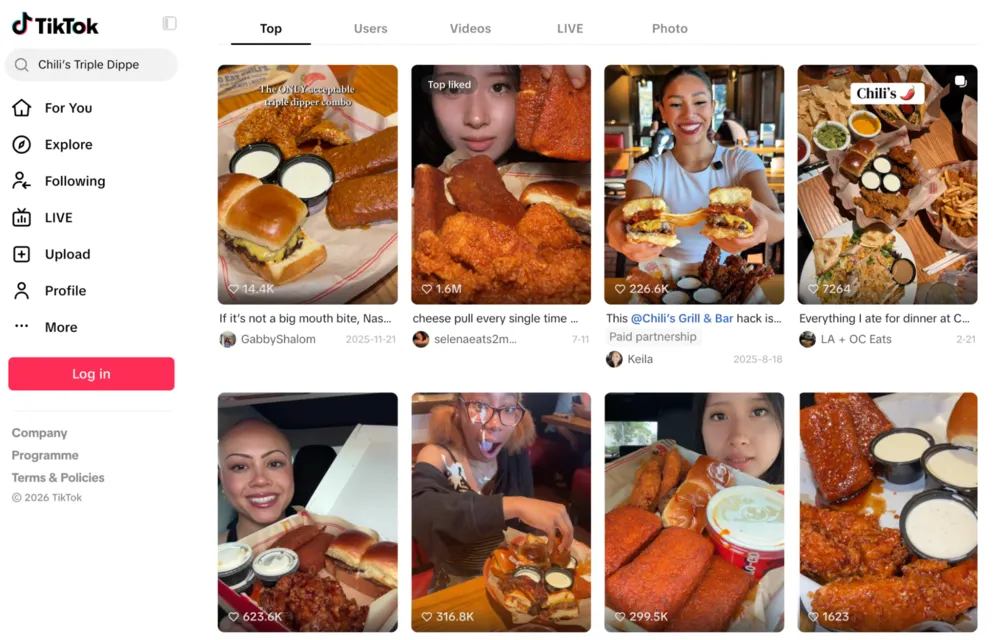
The effect extended well beyond views: Triple Dipper sales grew approximately 70% year over year (Restaurant Business).
Practical tip for brands: Identify one visually repeatable “product moment”: opening the package, pulling the cheese, revealing the result, testing the texture, or showing a before-and-after. Consistency makes the product recognizable.
How Social Media Algorithms Accelerate Virality
Social platforms' recommendation systems compare how different users respond to a post and decide whether to promote it.
1. Platforms Test Content with Small Audience Groups
When a video is published, it is usually shown to an initial group of potentially interested viewers. The platform observes whether they watch, skip, interact, or continue exploring the topic.
Example: “Million Dollar Baby.” Tommy Richman previewed a short clip of the song before its official release. The snippet quickly attracted attention and was repeatedly used by other creators.
After the complete song was released, it debuted at No. 2 on the Billboard Hot 100 with 38 million US streams in its first tracking week. It later spent ten consecutive weeks at No. 1 on the TikTok Billboard Top 50 (Billboard).
Tip for brands: Make the first second understandable without context. Start with the result, surprise, problem, or strongest visual.
2. Watch Time and Completion Signal Genuine Interest
Watching a video until the end requires more attention. Replaying it may indicate that viewers found it entertaining or useful.
TikTok confirms that watching a video to the end, especially a longer one, is a strong sign of interest. It can matter more than smaller details, such as whether the viewer and creator are in the same country (TikTok Newsroom).
YouTube also uses watch time alongside satisfaction signals such as surveys, likes, shares, and dislikes (YouTube).
Tip for brands: Remove any second that does not build curiosity or deliver value. For tutorials, show the final result first and then explain how it was achieved.
3. Shares, Saves and Searches Reveal Deeper Intent
Different interactions communicate different kinds of interest:
-
A share suggests that the viewer expects another person to find the content useful or entertaining.
-
A save suggests that the viewer wants to return to it.
-
A search suggests that the video created enough curiosity for the viewer to actively request more information.
Instagram has advised creators to monitor “sends per reach”: how often a post is privately shared relative to the number of accounts it reaches (The Verge)
Tip for brands: Create content worth sending to a specific person. “Send this to someone who…” is useful only when the video genuinely reflects a shared joke, problem, identity, or need.
Test a structured mix:
|
Variable |
Possible versions |
|
Hook |
A surprising result, question, confession, or problem |
|
Format |
Review, tutorial, comparison, reaction or challenge |
|
Audience |
Beginners, experts, parents, students or professionals |
|
Benefit |
Price, convenience, appearance, performance or emotion |
|
Context |
Home, work, store, car or public setting |
The algorithm does not manufacture interest from nothing. It accelerates content that repeatedly proves its relevance.
The Playbook: Why Everyone Was Listening to “Go” Again in 2026
As Head of the Analytics and AI Team at Netpeak and a big fan of The Chemical Brothers, I put my skills to use analysing the steps that the song “Go” took to go viral after the release of the Netflix film Apex.
-
How this song created a strong reaction.
-
How “Go” virality moved between platforms.
-
How and where users searched for it and created UGC content.
-
How algorithms increased distribution.
Let’s go!
Part 1: How “Go” Created a Strong Reaction
On April 24, 2026, Netflix released Apex, a survival thriller starring Charlize Theron and Taron Egerton (IMDb). In the film's signature scene, Egerton's character gives Theron's character a head start on being hunted for exactly as long as a song plays. That was terrifying to watch, so emotions were there!
And this moment got a large audience thanks to the commercial success of the film:

Source: Deadline, 2026
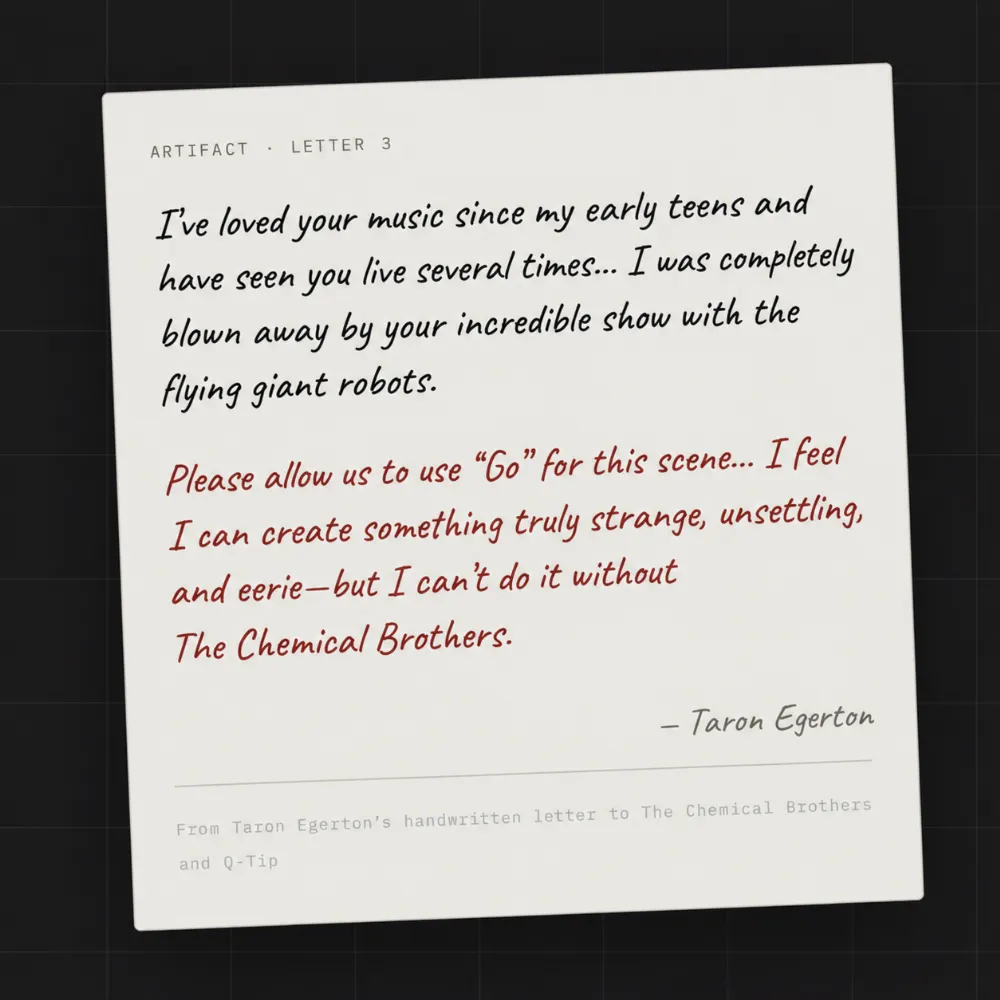
Here’s an interesting fact: the song “Go” wasn’t even in the script. Taron Egerton, a longtime fan of the band, chose it himself. He wrote a handwritten letter to the band members and rapper Q-Tip, in which he recalled how their show featuring giant robots had once blown him away.
Inspired by this, director Baltasar Kormákur completely rewrote the scene, replacing the standard line “you have ten minutes” with a relentless countdown set to the song (Billboard). And, my goodness me, it worked!
Before any of this, "Go" had spent 11 years as a sleepy catalog track. It picked up a Grammy nomination in 2016 and was at No. 46 on the UK singles chart on release, but that’s it. The band's last top-10 UK hit, "Galvanize," dates back to 2004.
Nothing about "Go" suggested that it would have a second life, but it went viral.
Part 2: How “Go” Virality Moved Between Platforms
Four platforms spiked one by one, signals from each one representing a different kind of audience reaction:
-
Shazam (the reflex of "what is this song?")
-
Spotify (a deliberate, repeatable listen)
-
YouTube (viewers going back to watch the original 2015 Michel Gondry music video)
-
TikTok (people actively creating content with the sound)
Each platform shows its own peak, and they’re staggered over time. We tracked one “trace” from each platform: Shazams, streams (Spotify), video views (YouTube), and posts with audio (TikTok).
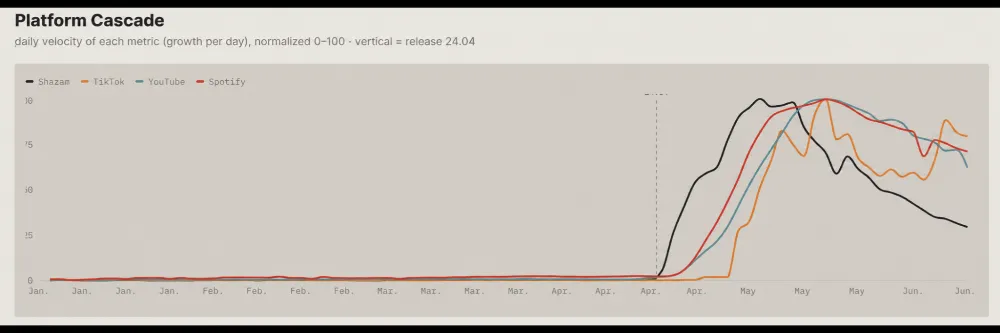
Why did we use a 0–100 scale? It’s not fair to compare millions of streams vs. thousands of Shazams directly. So, we gave each platform’s biggest daily jump a score of 100. This lets us compare when and how quickly each wave grew.
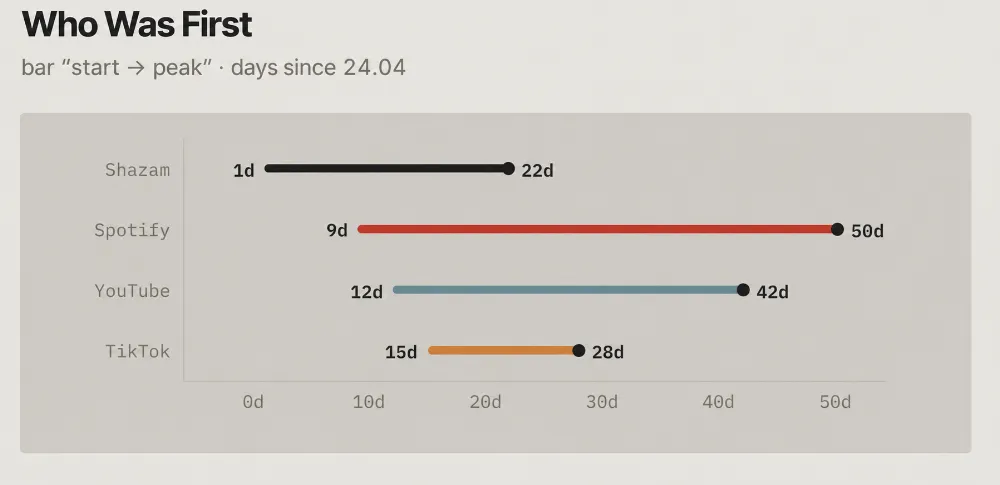
Shazam started strong on day one and picked up speed quickly. Spotify started slower and peaked last. YouTube was in the middle, while TikTok started the latest, but peaked faster.
Part 3: How People Created UGC
The dozen TikTokers who started the trend received the most views and likes for setting trends.
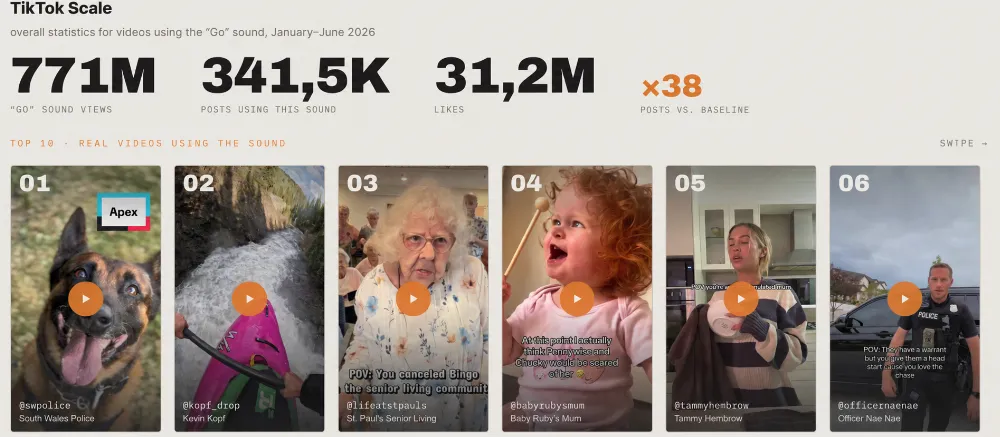
Then other creators caught their ideas, added something new, and made sure that the virality snowball was in action.
@chriseverhart30 #Meme #MemeCut #mentalhealth #mentallyilltiktok #apex ♬ оригинальный звук - Виктор
Part 4: How Algorithms Increased Distribution
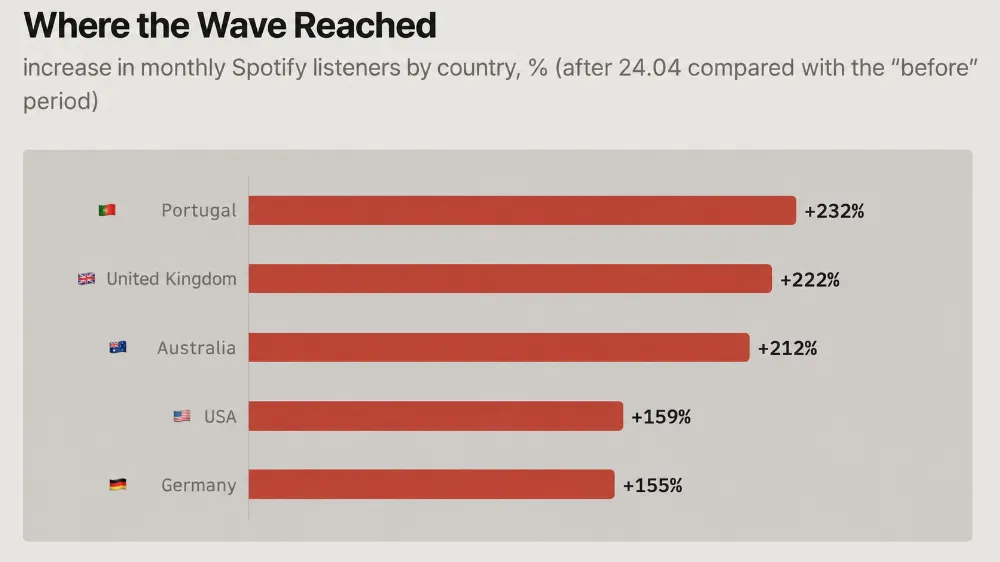
Let’s look at growth in monthly Spotify listeners by country. Portugal got +232%, UK +222%, Australia +212%, US +159%. Clearly, “Go” went on a full world tour.
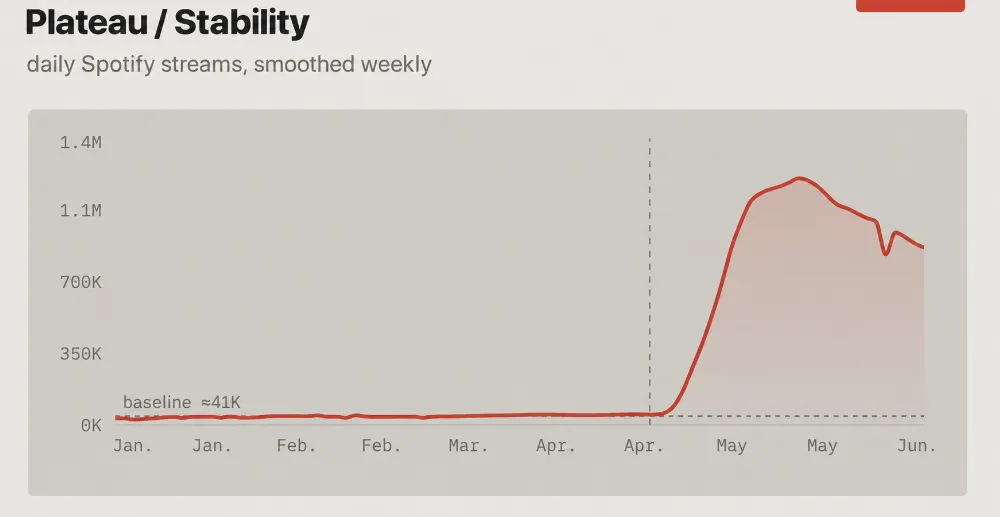
And for two months in a row, the growth rate hasn't slowed down: the figures remain at approximately 21 times the pre-release level. Spotify is still at its peak, so this isn't just a “flash in the pan” kind of story.
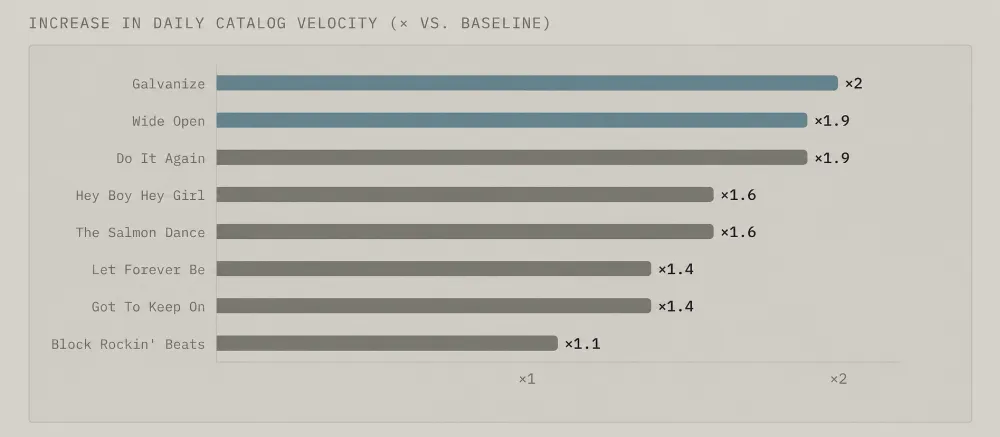
The viral wave affected not only “Go,” but the band’s older hits too. After the movie’s premiere, people began playing them 1.1–2 times more often than usual.
This happened because the track “Go” was featured on 18(!) Spotify editorial playlists, 14 of which added it after April 24. The biggest boost came from the “Big on the Internet” playlist (it has 4.1 million subscribers).
What the Artist Actually Gained
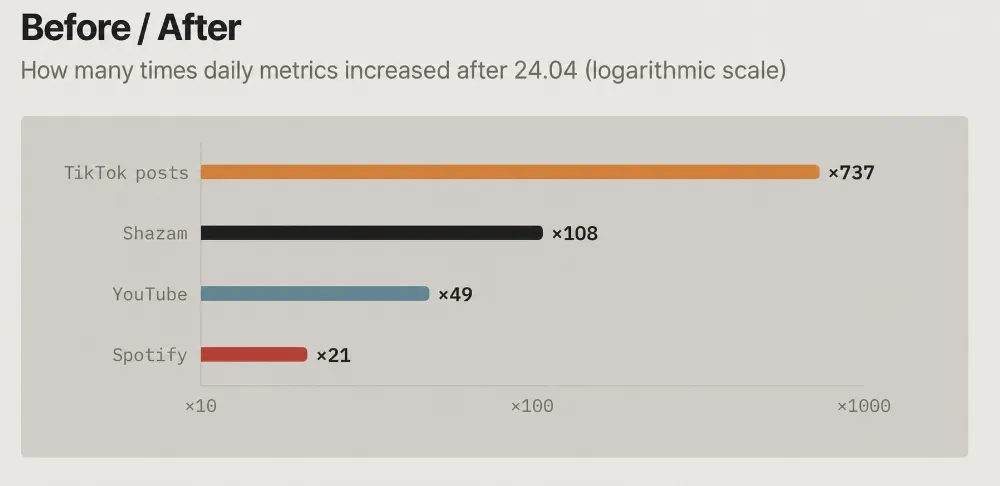
After the Apex release, Spotify streams of “Go” increased х21, YouTube views х49, Shazam searches х108, and TikTok posts saw an extraordinary surge of 737 times! As a result, the track broke into the top 10 of the main charts.
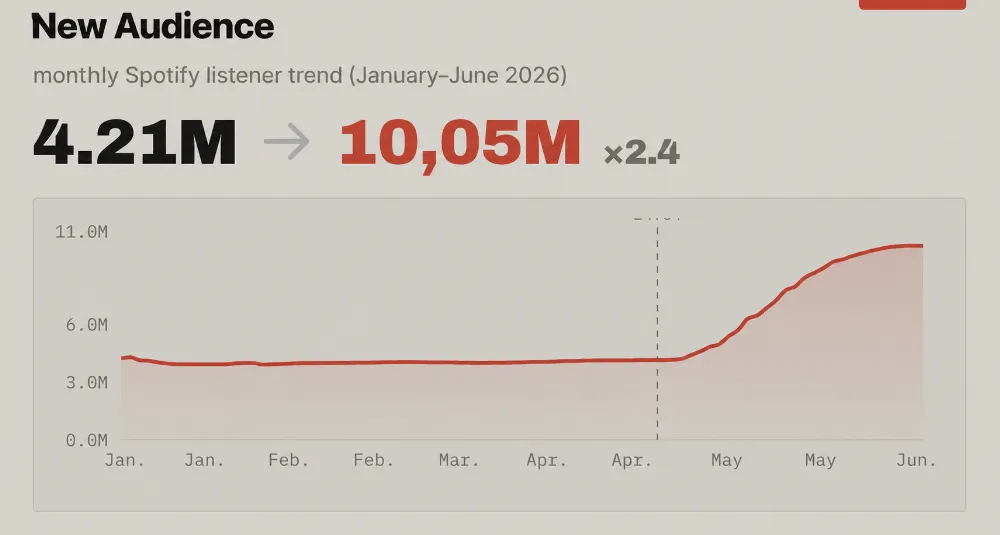
The buzz surrounding “Go” boosted the band’s overall account metrics: the number of listeners increased by a factor of 2.4, and YouTube subscriber growth followed suit.
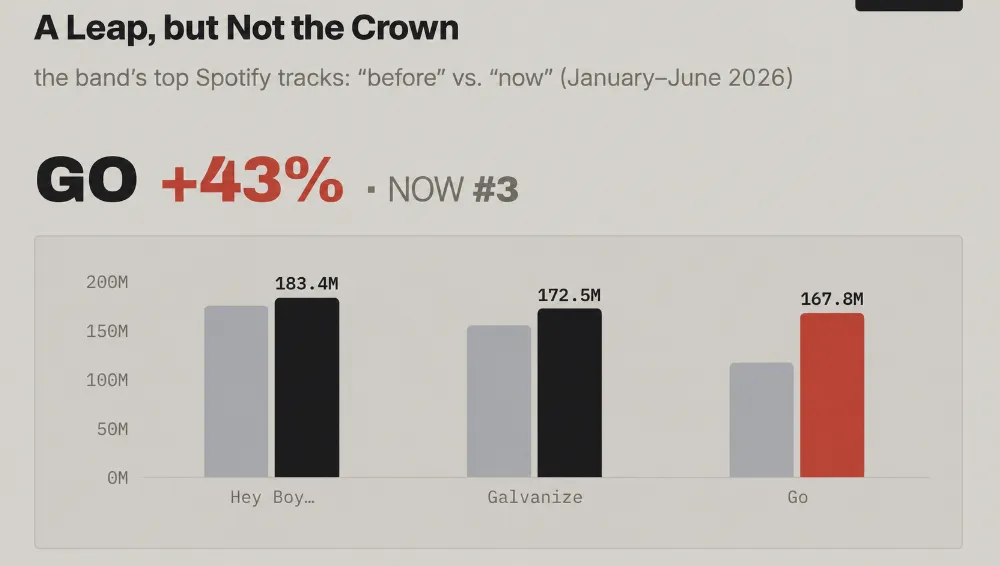
A massive surge from 117M to 167.8M streams: “Go” has shot up to just behind the legendary “Galvanize”, and it’s only 4.7M away from second place. The track currently ranks third on the band’s overall chart, but it’s climbing faster than any other.
Judging by the current pace, “Go” has either already caught up to the leaders or is about to do so.
Final Thoughts
Virality may look spontaneous, but it usually follows a recognizable pattern. A product, song, or idea captures attention quickly, gives people a reason to talk about it, and provides a format they can easily recreate.
Brands cannot order a viral moment on demand, but they can make participation easier. The strongest campaigns give creators a clear starting point without controlling every detail. They leave room for honest reactions, jokes, comparisons, tutorials, and unexpected interpretations.
For brands, the lesson is simple: create something worth noticing, make it easy to share, and give the audience enough freedom to take it somewhere you could not have planned yourself.
FAQ
What makes a product go viral?
How does UGC help products go viral?
How do social media algorithms decide what goes viral?
Can brands intentionally make a product go viral?
Why do old songs suddenly become popular again?
Does going viral always increase sales or streams?
How long does a viral trend usually last?
What metrics should brands track during a viral moment?

 0
0
 0
0
 0
0
 0
0
Related Articles
Business Apps in the US: iOS vs. Android, September 2026
We searched for US App Store and Google Play data to see what business apps professionals, shoppers, and investors actually installed in September.
What Happens When Amazon Suppresses Your Listing? The New 2026 Rules
Under the new 2026 rules, Amazon warns you first and gives you a grace period to fix the issue.
Business Apps in the US: iOS vs. Android, August 2026
We’ve fetched data from the US App Store and Google Play to see what professionals, shoppers, and businesses are actually installing, and why the market leaders are winning right now.