
What Does Amazon’s Full-Funnel Campaigns Beta Mean for My Pet Brand?
Amazon’s Full-Funnel Campaigns beta lets you hand three products, a logo, and $200 a day to Amazon, which then builds and runs Sponsored, display, and video ads in one campaign. For a pet brand, it is the cheapest ticket yet into upper-funnel Amazon inventory, at the price of giving up every bid, placement, and targeting decision.
What Amazon Full-Funnel Campaigns Do
Full-Funnel Campaigns is a beta product inside Amazon Ads. You pick three products, upload a logo, and set a budget. Amazon then creates the creative, chooses the ad formats, and runs the campaign across Sponsored ads, display, and video.
Amazon first announced the concept at unBoxed in October 2025 as an agentic AI tool that opens with streaming TV and audio, reinforces on display and online video, and closes with Sponsored ads (Amazon Ads, 2025). The beta now visible in seller accounts is the self-serve version of that idea.
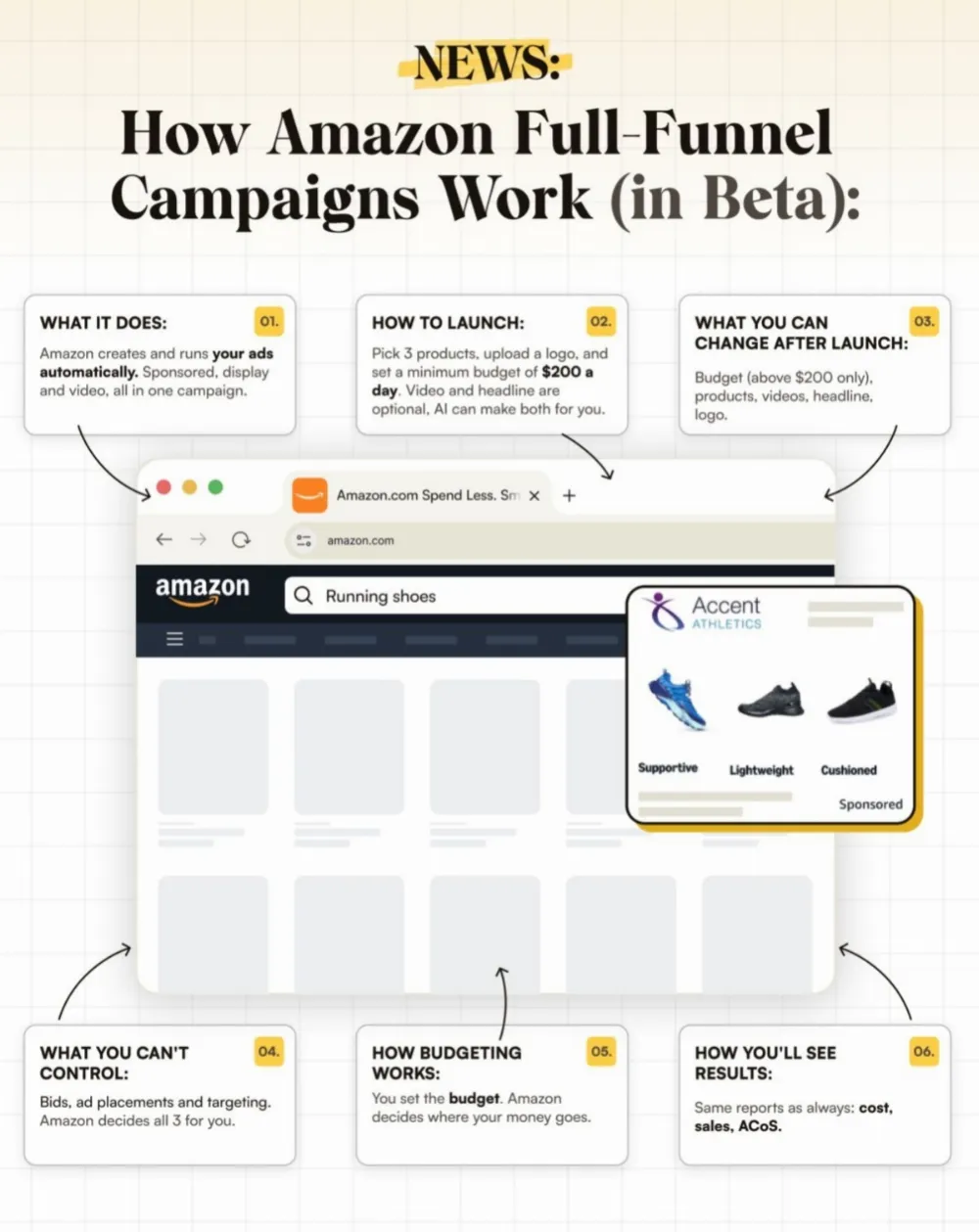
How Amazon Full-Funnel Campaigns work in beta: the six things you need to know.
The pitch is simple. From my experience, most pet brands on Amazon spend 80% or more of their budget on Sponsored Products because that is the only format they know how to manage. Display and video sit untouched because DSP feels like a Parisian restaurant with no prices on the menu. Full-Funnel Campaigns remove that barrier. It also removes the menu.
How to Launch a Full-Funnel Campaign on Amazon
Setup takes about 10 minutes. The decisions behind it deserve longer.
-
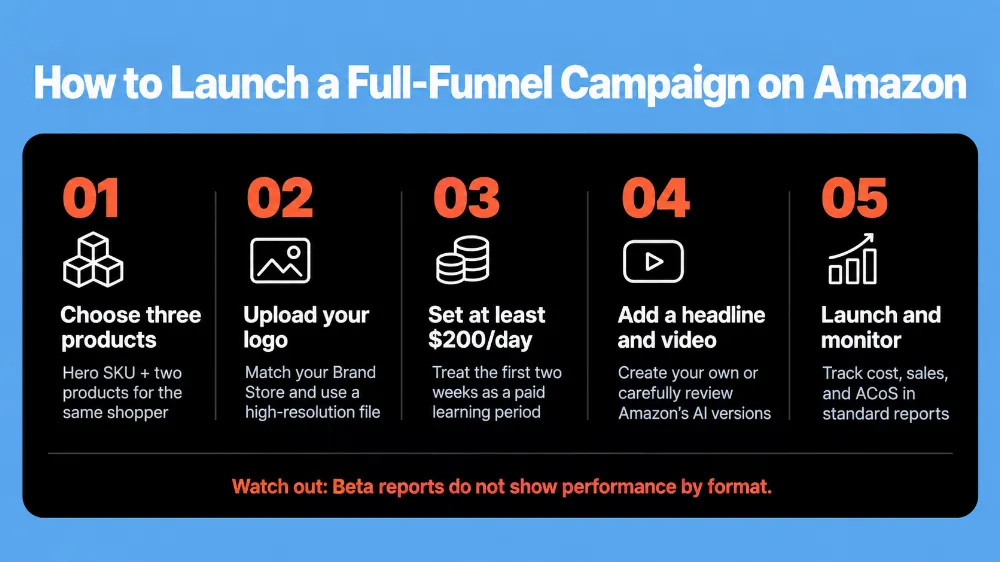
Choose three products. Amazon asks for exactly three. Pick your hero ASIN plus two products that share the same shopper, for example, a joint supplement, a calming chew, and a dental stick. Watchout: three unrelated products will confuse the AI headline and the shopper equally.
-
Upload a logo. Use the same logo as your Brand Store and A+ content. Watchout: a low-resolution file will appear on video placements at full size, and dogs are more forgiving than shoppers.
-
Set a budget of at least $200 a day. That is roughly $6,000 a month at full delivery. You can raise it after launch but never lower it below the floor. Watchout: Amazon decides where the money goes, so treat the first two weeks as a paid learning period, not a sales period.
-
Add a headline and video, or let Amazon generate both. Both are optional. Amazon’s AI will write a headline and assemble a video from your listing images if you skip them. Watchout: review the generated video before launch. AI does not know that your grain-free formula claim needs the exact wording your legal team approved.
-
Launch and wait for standard reports. Results appear in the same cost, sales, and ACoS reports you already use. Watchout: there is no format-level breakdown in the beta, so you cannot see whether video or Sponsored placements drove the sale.
What You Control vs. What Amazon Controls
The table below summarizes the control split in the current beta.
|
Setting |
You control |
Amazon controls |
|
Products |
Yes, three products, editable after launch |
No |
|
Budget |
Yes, $200 per day minimum, can be raised |
How budget splits across formats |
|
Creative |
Logo, optional headline, optional video |
AI-generated headline and video if not supplied |
|
Bids |
No |
Yes |
|
Placements |
No |
Yes, across Sponsored, display and video |
|
Targeting |
No |
Yes, audiences and keywords |
|
Reporting |
Standard cost, sales and ACoS reports |
No format-level breakdown |
In plain terms, you give Amazon carte blanche on the three levers that decide whether an ad campaign makes or loses money. Amazon has an obvious incentive to spend your $200 every day. It has a less obvious incentive to spend it on the placement with the best ACoS for you.
Should Your Pet Brand Test Full-Funnel Campaigns Before Q4 2026?
The US pet market reached $158 billion in 2025, and APPA projects $165 billion in 2026, with pet food and treats alone at $69.7 billion (APPA, 2026). That growth arrives in a category where the Sponsored Products auction is crowded, and cost per click keeps rising. Upper-funnel reach is where the remaining margin lives, and until now it required a DSP seat or an agency.
Here is the verdict for pet care marketing, by brand profile.
Test It Now
-
Brands with a clear hero product, a Brand Store, and at least $8,000 a month in ad budget. You can absorb $6,000 in exploration without starving Sponsored Products.
-
Brands launching a new ASIN before Black Friday. Automated video and display reach is the fastest way to build review velocity in October.
Wait for the Open Release
-
Brands under $5,000 a month in ad spend. The $200 floor would eat your entire budget and leave nothing for the campaigns you can actually steer.
-
Brands with strict claims compliance, such as veterinary supplements. AI-generated copy is a regulatory risk until Amazon adds a creative approval step.
Skip It
-
Brands already running DSP with an agency or in-house team. You would trade granular audience control for a black box and gain nothing except one less dashboard.
Netpeak USA Take
Run Full-Funnel Campaigns as a controlled experiment for four weeks with three products you do not depend on for rank. Compare its blended ACoS against your manual Sponsored Products average for the same ASINs. If it wins, scale the budget. If it loses, you paid $6,000 for a clean answer, which is cheaper than most Q4 mistakes.
Your Sponsored Products manager may sulk like a cat watching you unpack a puppy crate. Reassure them. The beta needs a human to choose the three products, and choosing well is still the job.
Bonne chance — and may your Subscribe & Save conversion rate be ever in your favor!
FAQ
What are Amazon Full-Funnel Campaigns?
How much does an Amazon Full-Funnel Campaign cost?
Can I control bids and targeting in Full-Funnel Campaigns?
How do I measure results from a Full-Funnel Campaign?
Should a pet brand use Full-Funnel Campaigns instead of manual Sponsored Products?

 0
0
 0
0
 0
0
 0
0
Related Articles
Pet Food Product Patent: How to Protect Your Innovation
Patenting pet products requires careful consideration and proper application filing. With the 8 steps below, you will be able to submit your patent application and protect your invention.
Business Apps in the US: iOS vs. Android, August 2026
We’ve fetched data from the US App Store and Google Play to see what professionals, shoppers, and businesses are actually installing, and why the market leaders are winning right now.
Amazon’s New “Sourced from Brand” Buy Box Label: Who Gets It and Who Doesn’t
Amazon is rolling out a provenance line in the Buy Box. A short label under the Brand row now reads “Sourced from [Brand]” on amazon.com and “[Brand] approved” on amazon.de. It tells the shopper that the unit on offer came through the brand’s own supply c