
What Does Amazon Joining YouTube Shopping Mean for My Pet Brand's Black Friday?
On August 27, 2026, YouTube added Amazon to its Shopping Affiliate Program. Eligible US creators can now tag Amazon products directly inside videos, Shorts, and livestreams, and viewers buy without hunting for a description link.
For pet brand marketing, this turns the dog-harness review and the cat-tree unboxing into a checkout button. Black Friday lands on November 27, 2026, and the brands that get their ASINs tagged before then will own that button when the traffic peaks.
What Сhanges When Amazon Joins the YouTube Shopping Affiliate Program
Until last week, a creator who wanted to send viewers to your Amazon listing pasted an Associates link in the description. Viewers had to pause, scroll, find it, and tap it. Now eligible creators select your ASIN in the YouTube Studio product picker, and the tag appears on the video itself, on Shorts, and in livestreams (YouTube Help, 2026).
Videos that used YouTube Shopping product tags recorded over 110% more product clicks than videos that used description links alone (YouTube Internal Data, 2026).
Amazon supplies YouTube with a curated catalog of requested and trending products. Creators can request missing products through YouTube Support. They can also switch on auto-tagging, which scans recent uploads and tags eligible Amazon products without manual work (YouTube, 2026).
To tag Amazon products, a creator must meet four conditions:
-
Enrollment in the YouTube Partner Program.
-
Enrollment in the YouTube Shopping affiliate program in the United States.
-
An active Amazon Influencer Program or Amazon Associates account in good standing.
-
A YouTube channel linked to that Amazon account through the Amazon Storefront portal.
Commissions lock monthly and are paid out through AdSense two cycles later, so January earnings arrive in March. Returns are deducted, and a balance can temporarily go negative. Creators see daily aggregate clicks and estimated revenue in YouTube Studio, but no product-level or video-level breakdown.
Only US creators can tag for now. The tags are visible worldwide. YouTube may match a tagged product with a local merchant offer, or route international viewers to the US or local Amazon storefront (YouTube Help, 2026).
Description Links Versus Amazon Product Tags on YouTube
|
Factor |
Amazon link in description |
Amazon tag via YouTube Shopping |
|
Where the link lives |
Description box or pinned comment |
On the video, Shorts, and livestream product shelf |
|
Viewer steps to reach the PDP |
Pause, scroll, find, tap |
One tap |
|
Product clicks |
Baseline |
Over 110% more (YouTube internal data, 2026) |
|
Who can use it |
Any Associates or Influencer member |
US creators meeting all four eligibility conditions |
|
Setup effort |
Manual, per video |
Product picker, or auto-tagging across the back catalog |
|
Creator payout |
Amazon Associates or Influencer payout |
AdSense, monthly lock, paid two cycles later |
|
Brand-side visibility |
Amazon Attribution, if the creator uses your tagged link |
Not announced; creator sees aggregate metrics only |
Why Pet Brands Gain More From YouTube Shopping Tags Than Most Categories
Pet content is one of YouTube's oldest genres. A golden retriever meeting a new toy is not a video; it is a format with its own subscriber base. Until now, that audience watched, laughed, and rarely bought, because the link sat in the description like a cat under the bed: technically present, not coming out for anyone.
The category behind that content is large and still growing. US pet industry spending reached $158 billion in 2025, and APPA projects $165 billion for 2026, with pet food and treats alone at $69.7 billion. About 95 million US households own at least one pet (APPA, 2026).
Pet buyers also decide on price at the moment of purchase. 63% of consumers rank price and discounts as the most influential factor in their Amazon purchase decisions, and about one-third weigh reviews and ratings (Jungle Scout, 2025). A creator tag delivers the trust cue on YouTube and the price cue on Amazon, in one tap.
There is a catch on the creator's side. Amazon Associates pays a 3% standard commission on pet products, one of the lowest rates in its fee schedule (Amazon Associates, 2026). Creators will therefore tag pet products with higher order values or clear repeat potential: GPS collars, automatic feeders, self-cleaning litter boxes, and premium food. If your hero ASIN sells for $12, you need a different lever. It is in move three below.
How Amazon's YouTube Shopping Tags Help a Pet Brand Win Black Friday 2026
The edge is not the tag itself. Every eligible creator gets the tag. The edge is being the pet brand whose products are tagged, in the right videos, before November 27. Here is what that buys you, in five parts.
-
Your reviews go shoppable before the sale, not during it. Auto-tagging reviews a creator's recent uploads and tags eligible Amazon products (YouTube Help, 2026). The harness review from March and the October gift guide both carry your tag by the time deal traffic arrives. A competitor who starts in November will be requesting catalog additions while your listing is already one tap away.
-
The tag survives the scroll. On Black Friday, a description box holds 30 links and a comment thread arguing about which deal is real. The tag sits on the video, on the Short, and on the livestream shelf. That placement is why tagged videos record over 110% more product clicks than description links (YouTube internal data, 2026).
-
Black Friday livestreams become a checkout. Creators can tag products in livestreams (YouTube Help, 2026). A "my dog's Black Friday haul" stream sends viewers to your PDP while your Lightning Deal or coupon is live, which is the only moment a price-led shopper needs.
-
One video reaches every market. Tags are visible worldwide, and YouTube may match them to a local merchant offer or route viewers to Amazon's US or local storefront (YouTube Help, 2026). Your US creator's video works in Canada and the UK without a second brief.
-
The first sale is not the sale. A tag that converts a bag of food or a supplement at the Black Friday price converts the same household into Subscribe & Save in December. Pet food and treats are the largest pet spending category, at a projected $69.7 billion in 2026 (APPA, 2026), and it is a repeat category. Black Friday is your acquisition cost; the subscription is the return.
Read more Amazon pet category deep dives here:
Five Moves Pet Brand CMOs Should Make Before Black Friday 2026
The French have a phrase for this moment: prendre les devants, to take the lead before anyone asks you to. You have 12 weeks. Here is the order of operations.
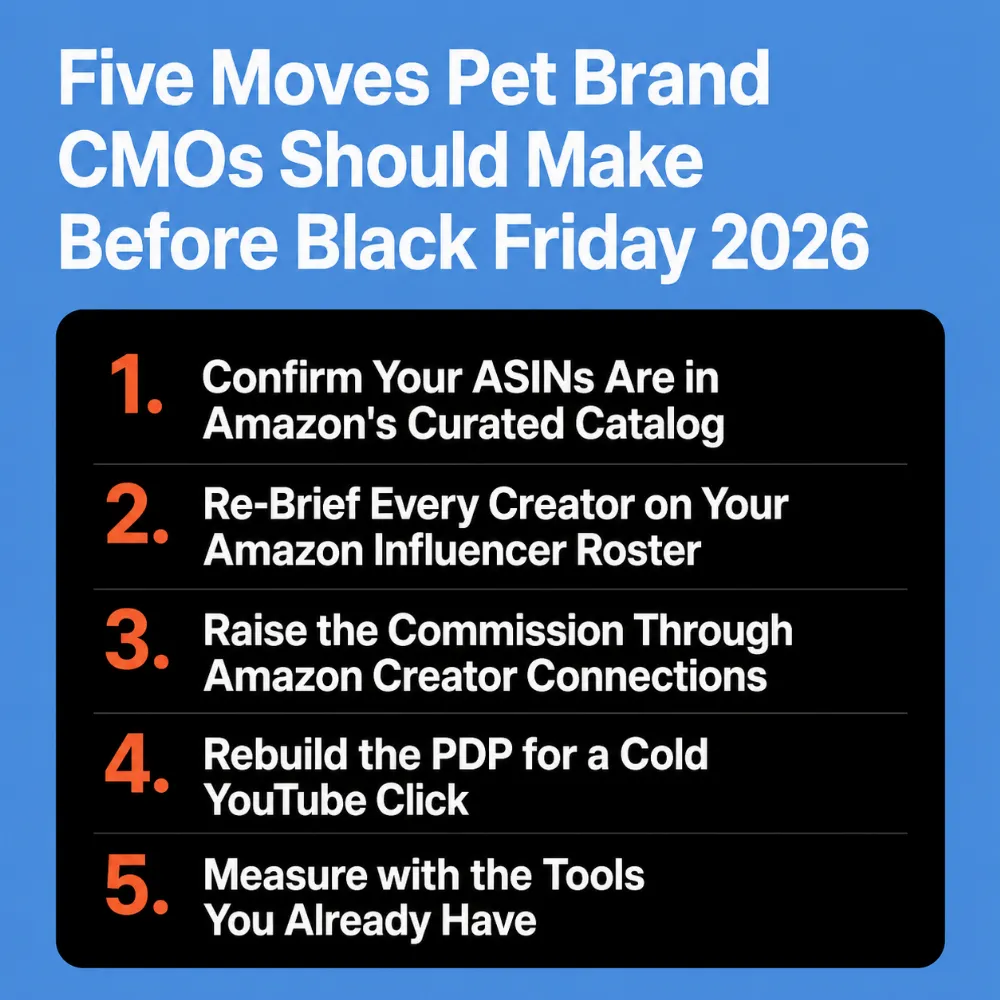
1. Confirm Your ASINs Are in Amazon's Curated Catalog
Amazon is supplying YouTube with a list of requested and trending products, and nobody has published it. Ask your top creators to search the YouTube Studio product picker for your hero ASINs this week. If one is missing, have them request it through YouTube Support, because creators, not brands, hold that channel.
2. Re-Brief Every Creator on Your Amazon Influencer Roster
Most pet influencers already hold an Amazon Influencer Program account. Send them the four eligibility conditions, ask them to link their YouTube channel in the Amazon Storefront portal, and to enable auto-tagging.
Auto-tagging scans recent uploads, so the review your creator filmed in March may become shoppable without a new video. It may also tag the competitor's harness in the same review, which is a good reason to make sure yours is the one in the catalog.
3. Raise the Commission Through Amazon Creator Connections
A 3% standard rate on a $25 bag of treats earns a creator 75 cents, which buys neither loyalty nor a second video. Amazon Creator Connections lets brands offer an additional commission on top of the standard rate.
Set a Black Friday bonus on the ASINs you want tagged, and tell your creators it exists. The creator chooses which product gets the tag; the commission decides which one it is.
4. Rebuild the PDP for a Cold YouTube Click
A viewer who taps a tag arrives from a 45-second Short, not from a search query. They have not compared four listings, and they will not. Put the coupon, the Subscribe & Save discount, and the star rating above the fold on mobile. Price and discounts drive the purchase decision for 63% of Amazon shoppers (Jungle Scout, 2025), and this shopper decides on the first screen.
5. Measure with the Tools You Already Have
Do not wait for a per-video dashboard. It is not coming, at least not yet.
Watchout: YouTube tags run on the creator's Amazon affiliate account, not on your Amazon Attribution tag. Creators see only daily aggregate clicks and revenue in YouTube Studio, with no product-level breakdown (YouTube Help, 2026).
Track lift through Brand Analytics, Amazon Marketing Cloud, and branded search volume, and set your baseline this week, so you can read the Black Friday lift against a clean September.
Bonne chance, and may your Subscribe & Save conversion rate be ever in your favor!
FAQ: Amazon YouTube Shopping Tags and Black Friday for Pet Brands
How do Amazon's YouTube Shopping tags help a pet brand on Black Friday?
They put your Amazon listing one tap away from the creator content pet shoppers already watch, with over 110% more product clicks than description links (YouTube internal data, 2026).
Auto-tagging makes existing reviews shoppable before deal traffic arrives, tags work inside Black Friday livestreams, and tags are visible to viewers worldwide. A first purchase at the deal price can then convert into Subscribe & Save, which is where pet margin lives.
What is the YouTube Shopping Affiliate Program with Amazon?
It is the August 27, 2026 expansion of YouTube's affiliate program that lets eligible US creators tag Amazon products directly in videos, Shorts, and livestreams. Viewers tap the tag to buy on Amazon, and the creator earns a commission on qualifying sales. Amazon supplies YouTube with a curated product catalog, and creators can request products that are missing (YouTube Help, 2026).
Can a pet brand tag its own products on YouTube?
No. Tags are placed by creators who hold an active Amazon Influencer Program or Amazon Associates account and meet YouTube's eligibility conditions. A brand influences which products get tagged through creator briefs, Creator Connections commission offers, and by making sure its ASINs are in Amazon's catalog.
How and when do creators get paid for Amazon tags on YouTube?
Amazon commissions lock on a monthly cycle and are paid through the creator's AdSense account with their other YouTube affiliate earnings, roughly two cycles later. Earnings that lock in January are paid in the March AdSense cycle. Returned products are deducted from the balance, which can temporarily go negative (YouTube Help, 2026).
Does this replace Amazon Attribution for influencer campaigns?
No. YouTube has not announced brand-side reporting for Amazon tags. Creators see only daily aggregate clicks, sales, and estimated revenue in YouTube Studio, with no product-level or video-level breakdown (YouTube Help, 2026). Brands still need Amazon Attribution links for campaigns they run directly and Amazon Marketing Cloud to measure lift.
Netpeak US runs creator seeding, Creator Connections commission strategy, and PDP conversion work for pet brands on Amazon. If you want your ASINs tagged before Black Friday, talk to us.

 0
0
 0
0
 0
0
 0
0
Related Articles
Pet Food Product Patent: How to Protect Your Innovation
Patenting pet products requires careful consideration and proper application filing. With the 8 steps below, you will be able to submit your patent application and protect your invention.
Digital Marketing for SMBs: How to Grow a Small Business Online
Small or mid-sized businesses compete for the same customers as brands with marketing departments ten times their size, on a fraction of the budget. You can't outspend them, so you have to outsmart them and grow your business deliberately.
Business Apps in the US: iOS vs. Android, August 2026
We’ve fetched data from the US App Store and Google Play to see what professionals, shoppers, and businesses are actually installing, and why the market leaders are winning right now.