
What Does the EU Green Claims Ban Mean for My Pet Brand's Amazon EU Listings?
From September 27, 2026, Directive (EU) 2024/825 bans generic environmental claims such as "eco-friendly," "sustainable," "green," and offset-based "carbon neutral" on any product sold to EU consumers. On Amazon EU, the ban covers titles, bullet points, descriptions, A+ content, images, brand names, and physical packaging.
Non-compliant ASINs can be suppressed until the content is corrected. Brands must finish checks and corrections before the ban comes into force. There is no transition period and no exemption for old stock.
Your Amazon.com listing can keep calling that bamboo cat litter "planet-friendly" for now. Your Amazon.de, .fr, .it, .es, .nl, .pl, .se, and .be listings cannot. If your EU catalog was built by copying the US flat file and running it through a translation tool, you have exported the problem to eight marketplaces at once.
A golden retriever would call that enthusiasm. A German consumer authority calls it Annex I, point 4a.
What the EU Empowering Consumers Directive Bans on Amazon EU Listings
Directive (EU) 2024/825, known as the Empowering Consumers for the Green Transition Directive (ECGT or EmpCo), amends the Unfair Commercial Practices Directive. It adds 12 practices to the Annex I blacklist of practices that are unfair in all circumstances (Directive (EU) 2024/825, 2024).
Authorities do not need to prove a consumer was misled. The practice itself is the offence. Member states must set maximum fines of at least 4% of annual turnover in the relevant market for cross-border infringements (Latham&Watkins, 2026).
Five of the new blacklist points hit product listings directly.
|
Annex I point |
What it bans |
Pet listing example that fails |
|
2a |
A sustainability label not based on a third-party certification scheme or set by a public authority |
A leaf icon with "Eco Choice" designed by your creative team, placed on the main image |
|
4a |
A generic environmental claim without recognized excellent environmental performance (EU Ecolabel or ISO 14024 type I ecolabel) |
"Eco-friendly dog poop bags" or "sustainable salmon kibble" in a title or bullet |
|
4b |
A claim about the whole product when only one part qualifies |
"Made with recycled material" on a chew toy when only the box is recycled |
|
4c |
A neutral, reduced, or positive climate claim based on offsetting |
"Carbon neutral cat litter" backed by purchased credits |
|
10a |
Presenting a legal requirement as a distinctive feature |
"BPA-free bowl" as a headline benefit when the substance is already restricted |
The directive defines an environmental claim as any non-mandatory message, in text, picture, graphic, or symbol, that states or implies a positive or lower environmental impact (Directive (EU) 2024/825, Article 1).
The European Commission FAQ, updated on May 18, 2026, confirms that brand names, product names, and visual elements count, judged against an average consumer standard (European Commission, 2026). If you’re interested, read our article about sustainability marketing.
Timeline: Transposition, Amazon's Review Window and the Application Date
The directive was adopted in February 2024, published in March 2024, and had to be transposed into national law by March 27, 2026. It applies from September 27, 2026 (European Commission, 2024). The Commission stated that there is no transition period and that products manufactured, ordered, or shipped before that date are covered.
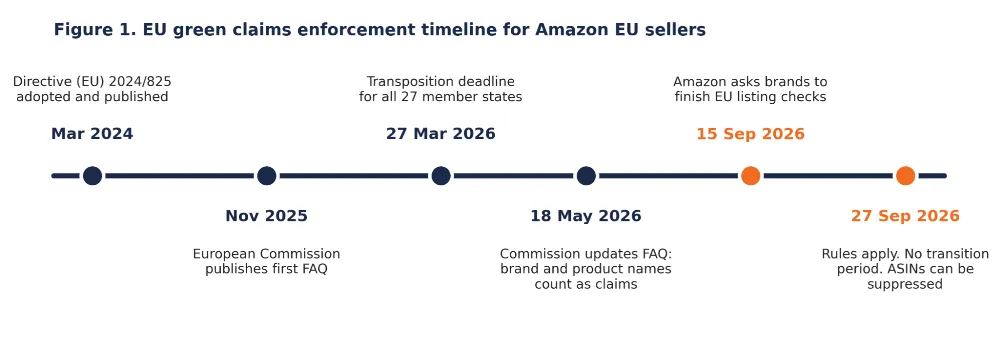
Sources: Directive (EU) 2024/825; European Commission FAQ (November 2025, updated May 2026); Amazon seller communications (2026).
Germany did not wait. The Federal Court of Justice ruled on June 27, 2024, that "klimaneutral" advertising without a clear explanation is misleading, and Deutsche Umwelthilfe has brought more than 100 proceedings against green claims (Senken, 2026).
Why Pet Brands Carry More Green-Claim Risk Than Most Amazon Categories
Pet products marketing is drenched in environmental language. Poop bags say "biodegradable." Litter says "natural." Kibble says "sustainably sourced." Toys say "eco." Much of that copy arrived with the supplier artwork and was never checked. The good news for a CMO is that the words were doing less work than the marketing deck claimed.
37% of US pet owners are willing to pay more for sustainable packaging (Pet Sustainability Report, 2025). Also, American pet owners are also among the most skeptical of pet brand sustainability claims, at 43.3% (Pet Food Industry).
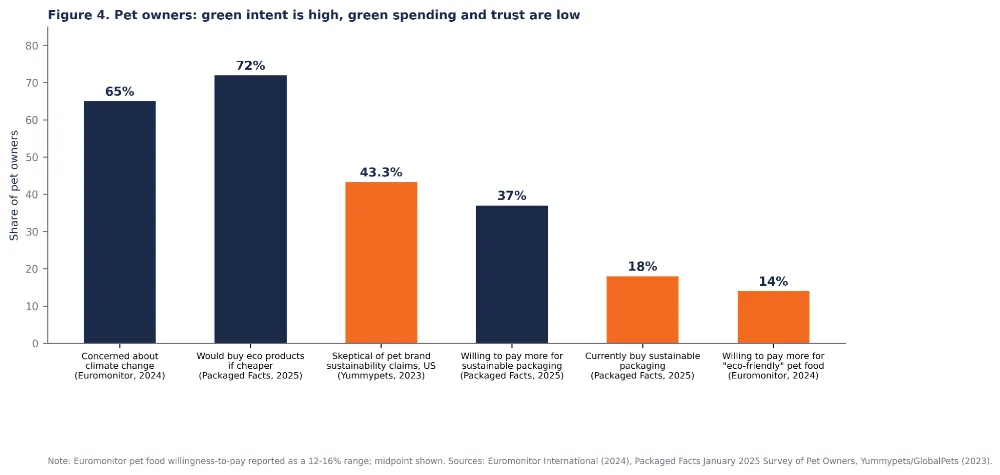
Intent, spending, and trust among pet owners. Sources listed on the chart.
A generic "eco-friendly" bullet therefore buys little conversion and a lot of liability. The directive forces the pet category toward the kind of claim skeptical owners already wanted: one specific fact with a document behind it.
Competitors have started moving. A 36-wave panel of Amazon product pages in France, Germany, and Italy found that generic claims on non-certified products fell 8.7 percentage points relative to the UK around the March 27, 2026 transposition deadline, while qualified and evidence-bearing claims increased (MDPI Sustainability, 2026).
Brands that wait until September 26 will be rewriting bullets while their rivals collect the ranking benefit of stable listings.
Which Parts of an Amazon EU Product Detail Page Are in Scope
Every consumer-facing surface is in scope. That includes the title, bullets, description, A+ content, images and infographics, product and brand names, physical packaging and inserts, the Brand Store, Sponsored Brands headlines and Posts.
Backend search terms are not consumer-facing, though indexing banned words there is a poor strategy once the visible copy no longer supports them.
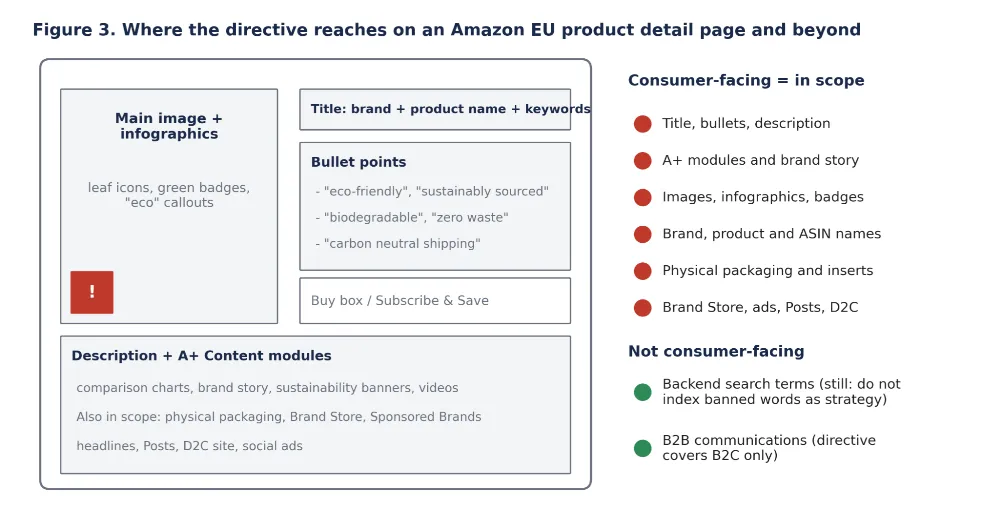
Consumer-facing surfaces on an Amazon EU PDP that fall under Directive (EU) 2024/825.
The "same medium" rule is the trap most brands fall into. A claim counts as generic when its specification is not provided in clear and prominent terms on the same medium (Directive (EU) 2024/825, Article 1). If the bullet says "green packaging" and the substantiation sits on your website, the bullet is still generic. If the main image shows a leaf and the A+ module explains it, the image is still generic.
Put the specification next to the claim: in the same bullet, on the same panel, inside the same image.
Here is a useful French phrase: il faut mettre les points sur les i. The directive is not asking you to stop talking about the environment. It is asking you to dot every i on the medium where the consumer reads it. A recycled-content percentage in the bullet passes. A vibe does not.
How to Rewrite Generic Pet Product Claims into Specific, Compliant Claims
The directive's own recital gives the pattern. "Climate-friendly packaging" is generic. "100% of energy used to produce this packaging comes from renewable sources" is specific (Directive (EU) 2024/825, recital 9). Apply that logic to the six claims that appear most often on pet listings.
|
Current wording |
Why it fails |
Compliant rewrite and what you must hold |
|
"Eco-friendly dog poop bags, 100% biodegradable" |
Generic (4a); "biodegradable" is named in recital 9 and is usually untrue outside industrial conditions |
"Certified home-compostable to TÜV OK compost HOME, certificate no. [X]" with the certificate on file. Otherwise: "Bags made from PBAT and corn starch." |
|
"Sustainably sourced salmon recipe" |
Generic (4a) |
"Salmon from MSC-certified fisheries, chain-of-custody no. [X]" with a valid MSC certificate |
|
"Carbon neutral cat litter" |
Offsetting claim (4c); banned regardless of evidence |
"We fund [named project] per bag sold. Litter: 100% bentonite clay." No neutrality wording |
|
"Natural" + green leaf badge on the main image |
Word plus image forms a generic claim (recital 9); self-made badge (2a) |
Remove the badge. State the composition: "Ingredients: chicken, rice, peas." |
|
"Made with recycled material" on a toy in a recycled box |
Whole-product claim for a packaging feature (4b) |
"Box: 90% recycled cardboard. Toy: virgin TPE." |
|
"BPA-free stainless bowl" as bullet one |
Legal requirement presented as a feature (10a) |
"Bowl made from 304 stainless steel, dishwasher safe." |
Two words deserve a warning. "Recyclable" is not on the generic list, but the Commission FAQ treats it as misleading if the material is not collected in the country of sale (European Commission, 2026). "Natural" is not on the list either, but combined with green imagery it becomes a generic claim through the back door.
Does the Climate Pledge Friendly Badge Survive the EU Directive?
Amazon's Climate Pledge Friendly (CPF) badge is awarded on the basis of third-party certifications and some certifications Amazon created itself, such as Compact by Design (Amazon, 2023). Under point 2a, a sustainability label needs a certification scheme with third-party verification and transparent conditions.
A CPF badge that rests on an external certificate such as FSC, ISCC Plus, or a ClimatePartner label sits on firm ground. ClimatePartner states its label will meet the directive's requirements from September 2026 (ClimatePartner, 2026).
Treat the badge as a display of your certificate, not as the certificate. If the only thing behind it is an Amazon-created standard, ask counsel whether that meets the third-party verification test before September 27.
Wanna be up to date with the latest Amazon updates that affect your pet brand in 2026? Check our other articles:
-
What Does Amazon’s Full-Funnel Campaigns Beta Mean for My Pet Brand?
-
Amazon's 2026 Fee Changes: What Every Pet Brand Should Recalculate Before Q4
Seven Steps to Make Amazon EU Pet Listings Compliant Before September 27, 2026
Most of this is a two-day job for a catalog of a few hundred ASINs.
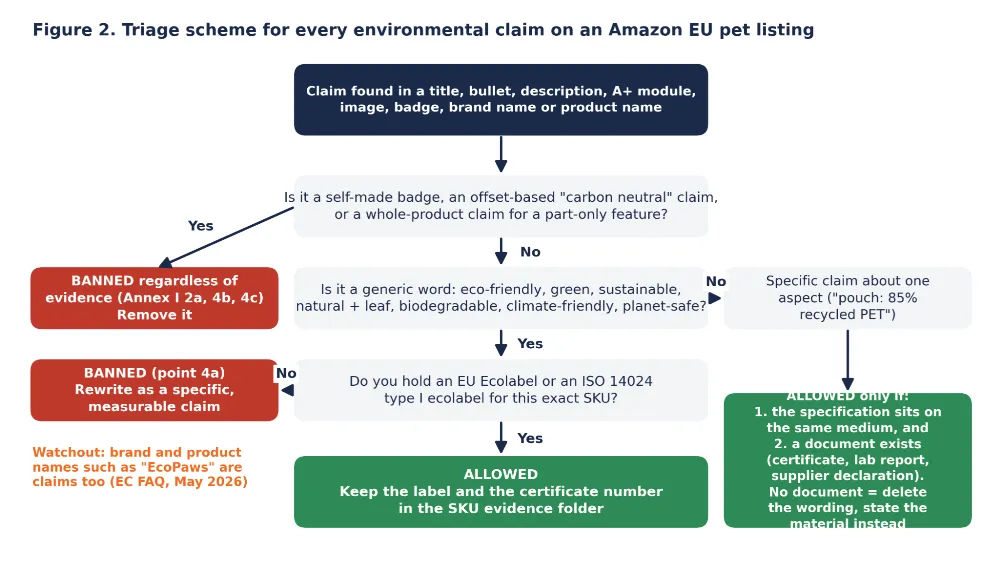
Decision scheme for triaging each claim found in the audit.
1. Export Every EU Listing
Pull the Category Listing Report for each EU marketplace and search titles, bullets, descriptions, and A+ text for: eco, green, sustainable, environmentally friendly, natural, biodegradable, compostable, climate, carbon, planet, earth, zero waste, certified, free.
Watchout: Search the translated terms too: umweltfreundlich, nachhaltig, klimaneutral, écologique, durable, respectueux de l'environnement, sostenibile, ecológico, duurzaam. A German-language bullet is a German-language claim.
2. Triage Every Hit Using Figure 2
Delete it, make it specific, or prove it. Structurally banned claims (self-made badges, offset neutrality, part-for-whole) are deleted without discussion.
Watchout: Brand and product names count. "EcoPaws" or "GreenTail" in the title is a claim under the May 2026 Commission FAQ. Renaming is slow; start that conversation with legal this week.
3. Build One Evidence Folder per ASIN
Certificate, lab report, or supplier declaration with material composition, named by ASIN number. If no document exists, the claim goes.
Watchout: A supplier email saying "yes, it is compostable" is not a certificate. Ask for the EN 13432 or TÜV certificate number and check it on the certifier's register.
4. Fix Images and A+ Modules
Remove leaf icons, green badges, and "eco" callouts from main images, infographics, comparison charts, and brand story modules.
Watchout: A+ resubmissions take days to approve and can be rejected on unrelated grounds. Submit by September 15, not September 26.
5. Decide per ASIN What to Do with Printed Stock Already in EU Fulfillment Centers
Options in order of cost: remove the claim online, add a corrective sticker, add an insert, reprint.
Watchout: Record each decision. The Dutch ACM has said enforcement may consider a company that can show old stock and verifiable efforts to comply (ACM, 2026). Without a record, there is no verifiable effort.
6. Update Advertising and the Brand Store
Sponsored Brands headlines, video ad copy, Posts, the Brand Store, and your D2C site are all commercial communications to EU consumers. The same rules apply.
Watchout: Ad copy is reviewed by Amazon Ads moderation on submission, not retroactively. Do not assume a running campaign is clean because it was approved in 2025.
7. Lock the Artwork Approval Process
Add one line to supplier and agency briefs: no environmental wording, icon, or color story without a document in the ASIN folder.
Watchout: This is the only step that stops the problem from returning with the next production run. Skip it, and you will do this audit again in Q1.
The deadline is close, the fix is mostly editorial, and the brands that move now will spend October selling while others spend it appealing suppressed ASINs. Netpeak USA runs EU PDP claim audits alongside our standard Amazon content work; if you would rather not read Annex I yourself, we have read it for you.
Bonne chance — and may your Subscribe & Save conversion rate be ever in your favor!
FAQ
When does the EU green claims ban apply to Amazon EU listings?
Which words are banned on Amazon EU product pages from September 2026?
Does the directive apply to a US pet brand selling on Amazon.de or Amazon.fr?
What happens to a non-compliant ASIN on Amazon EU after September 27, 2026?
Can I still say my pet product packaging is recyclable or made from recycled material?
Is the Amazon Climate Pledge Friendly badge compliant with the EU directive?
Does the EU green claims ban also cover my D2C website and social ads?

 0
0
 0
0
 0
0
 0
0
Related Articles
What Vibe Coding Means for Business: No Coding Skills, One Weekend, One SaaS
Vibecoding is changing the rules for front-end development and opening up new opportunities for businesses, but there are some nuances to consider.
Business Apps in the US: iOS vs. Android, September 2026
We searched for US App Store and Google Play data to see what business apps professionals, shoppers, and investors actually installed in September.
Pet Food Product Patent: How to Protect Your Innovation
Patenting pet products requires careful consideration and proper application filing. With the 8 steps below, you will be able to submit your patent application and protect your invention.