
How to Plan Marketing Budget for IT: What I’d Do as a CEO with $3K, $30K, or $300K
Here’s the uncomfortable truth for your IT company: your marketing budget is a reflection of where your business actually is. Most businesses get this wrong at some point: beginners try to skip stages, corporations overspend — and both end up paying for it.
The good news is that you don’t have to make every mistake yourself to learn from it.
Over the past 10 years, after getting my Ph.D. and serving as CEO and COO in various businesses, I learned how to think in systems and create them. My goal, as a transformer, is to help companies grow and change while keeping their strengths and improving their weaker areas.
I have seen every possible budgeting mistake and helped to correct them. Now it’s your turn to get insights from the source!
In this article, I’ll break down how planning a marketing budget works at each level and what you can call “successful marketing” for your IT company.
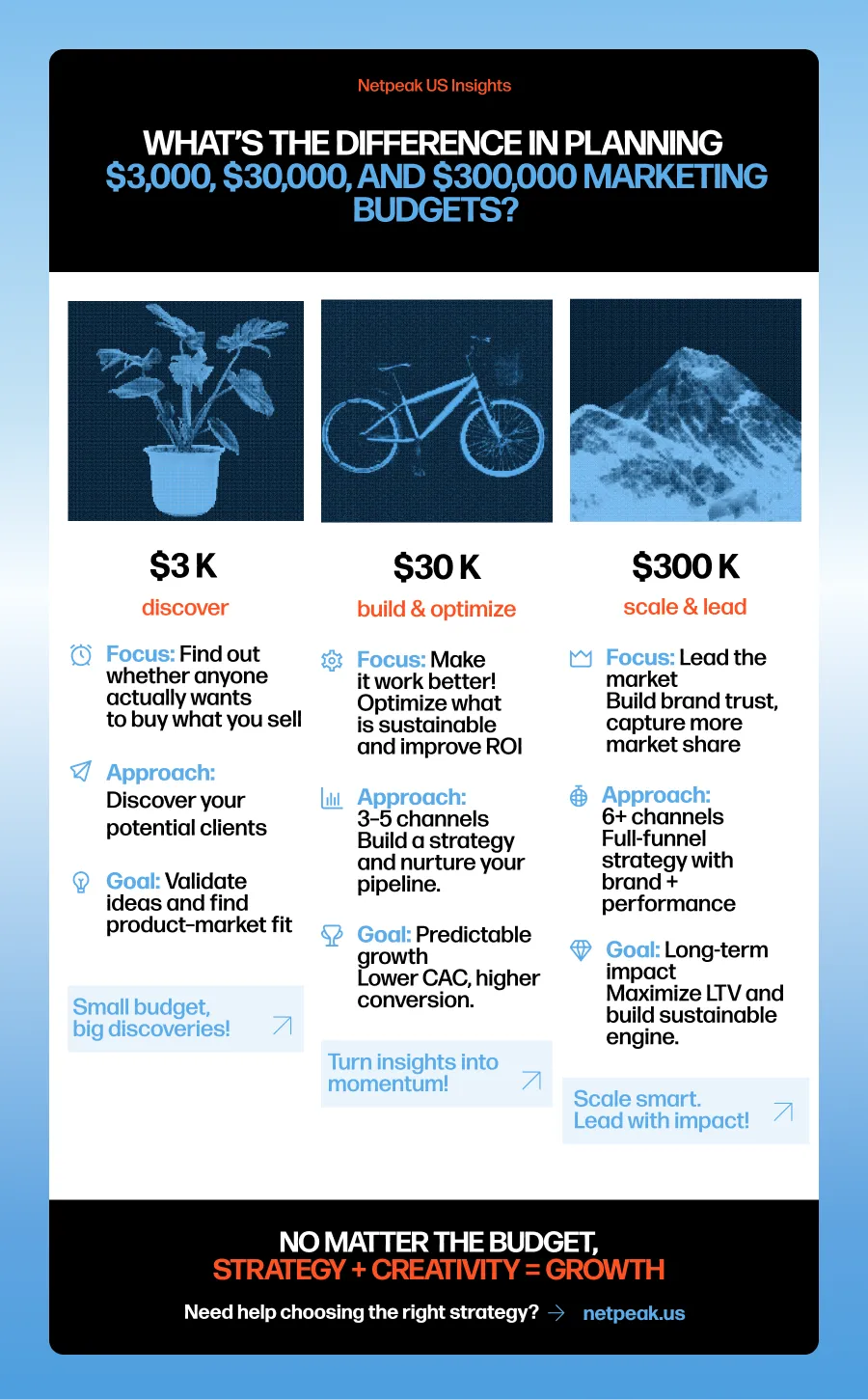
What Is the Difference in Planning $3,000, $30,000, and $300,000 Marketing Budgets?
-
With a $3K marketing budget, you need to test whether anyone actually wants to buy what you sell.
-
A $30K budget is about experimenting with different channels and marketing initiatives and preparing your business for the first lead flow.
-
With $300K, you need to actively build brand reputation and get your market share without breaking operations.
What marketing strategies should each one of them use? Which KPI’s to measure?
Think about it like running. A 2-year-old “wins” if they can run at all without falling. A high schooler — if they run faster than classmates and maybe get an A. A professional athlete “wins” only if they take gold at the Olympic Games. Same activity — completely different standards of success.
So, use the right budget strategy and KPI’s for your stage! If you don’t, you could end up wasting money or holding back your growth. I want to help you avoid both.
Now, let's roll to the part where I share everything I know about marketing budgets at different stages and how to manage them!
If you’re not a big reader and just want to talk with a person who would help you with marketing budget planning, call us at Netpeak US for professional services. We’ll help to do it right!
$3K Budget: Your Marketing Is in Survival Mode
A $3,000 is a newborn rookie budget. I’m sorry to say it, but you can't scale, promote, or build brand awareness for your business with so little.
You may try to find ways to use this money to activate classic marketing channels, but (sorry, again!) none of this will lead to results.
-
At this stage, paid advertising and social media are useless because you won't receive enough attention.
-
Inbound marketing: SEO (Search Engine Optimization), content marketing, and email marketing don't make sense either — they have a cumulative effect and take months.
-
There's also not enough budget for branding: you won't be able to create a scenario, and you'll just end up spending 3K on a beautiful video that you won't know what to do with afterwards.
-
Marketing automation of something or building processes also doesn't make sense.
You may need to rethink what your business truly needs and what you can afford.
From my experience, the best decision you can make is to use this budget to test the product-market fit. For example, you have the idea for a great technological product. Use your $3,000 budget to find out if anyone else wants to buy your product and why they want to do it.

How to Test the Product-Market Fit Right
-
Get an outbound salesperson who works with cold leads on LinkedIn and has experience working with large companies.
-
Share a detailed client profile with them. Describe the kind of people who might be interested in your product, such as their work field or job position.
-
Ask to arrange 10-20 live conversations with your potential clients.
-
Talk to people personally, explain your product, and see if it connects with them. They will give you honest feedback and let you know if they like it.
You might think, “I’ve already done this. I asked people I know.” But that isn’t the same. Friends, family, or colleagues often sugarcoat their feedback. If you want honest opinions, you need to ask strangers directly.
-
Be cool when you hear feedback. This is psychologically difficult; ideas sometimes feel like a baby, and you want to protect them with your life. Totally understandable! However, it is important to be open to constructive feedback and grow based on it.
The biggest rookie mistake is trying to sell instead of listening. Hold back and focus on hearing what people have to say. If you end up thinking, "No, they didn't understand what I was selling," you've wasted your time and money. You weren't really listening.
Remember, your goal here is to gather information, not to find new customers. If someone happens to be interested, that's a bonus, but it's not your main focus.
How to Measure If It’s Working
For now, focus on understanding your product value and your target audience. All you need to do is complete the customer value proposition for your ICP type:
-
What are people’s pain points?
-
What worries them?
-
What would they like to gain while using your product?
-
What tasks do they want to solve using your product?
If you filled it in, you did great.
-
Even if you realized your product is not a good fit, you now know exactly where the gap is and why.
-
You also know what steps to take to find a new ideal customer profile or reach out to as many different people as possible, since your product does not offer value to this group.
Whether your company is at this stage or not, you may need some help with your SaaS digital marketing. Call us at Netpeak US to delegate your lead generation to someone who has handled dozens of cases like yours!
$30K Changes the Game: Here’s How to Use It Smartly
$30K is a solid budget, but not an unlimited one, so stay sharp with every dollar. The danger comes right after the first win. A few compelling results, and suddenly it feels like, “Let’s just pour more money into paid ads — it’ll scale forever.” And yes, it might grow… for a while.
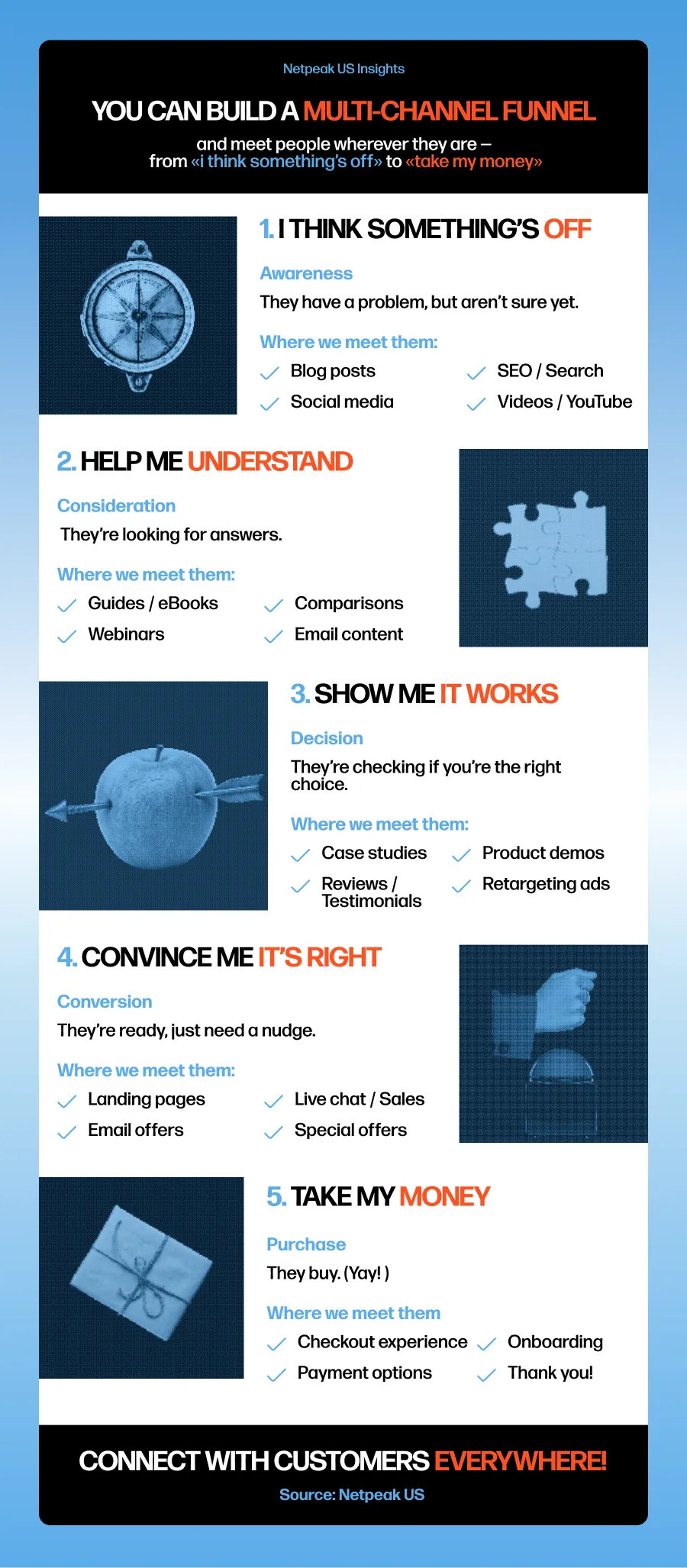
However, this one-channel approach puts your business at risk. Use your $30,000 marketing budget to make some moves and experiment with different marketing channels.
How to Do It Right
-
Build a multi-channel funnel and connect with people at every stage: from when they first sense a problem to when they are ready to buy. Combine paid advertising, outbound efforts, marketing analytics, and SEO.
Depending on just one channel is risky, no matter your market or industry. The moment competition increases or algorithms change, your entire pipeline collapses. Use several channels; if one of them dies, your pipeline survives.
-
Split your marketing costs: Put about 60% into marketing channels you already know work, and 35-40% into experiments to test new formats, audiences, and platforms. At this stage, you can afford it.
Running experiments lets you see what works best for you. Different channels and marketing campaigns can have varying results depending on your niche, audience, and where people are in the funnel.
-
Prepare your business for the stable lead flow. Digital marketing can bring people to your door, but you need to have your operations in place. If leads are coming in but sales can’t close them, the problem isn’t marketing — it’s the sales process. If demand grows faster than your team can handle, the bottleneck is operations.
-
Don’t expect a miracle. This budget can’t bring you the instant, exponential growth that somehow fixes everything. More leads? Yes. Better pipeline? Sure.
At this stage, your main job is to force a more rational view of the business:
-
How are leads actually handled?
-
What’s the real LTV?
-
Which channels are profitable — and which just look good on reports?
How to Measure If It’s Working
At the $30K stage, you can finally start measuring results, but look at the right things. Cheap leads and high volume can lie to you. Sometimes, the charts go up, but profit doesn’t.
What metrics matter:
-
Velocity (how fast money happens). It’s not enough to ask, “Does this channel bring leads?” Ask “How fast those leads turn into customers?” If a channel brings cheap leads but they convert in 12 months (or never), it’s not efficient — it’s just slow.
-
Sales cycle conversion. Look at conversion rates from lead → SQL → closed deal. It can be 3%, 5%, 25%, even 75% — the number itself doesn’t matter as much as understanding your baseline and improving from there.
Every channel has its own typical range, so make sure you understand what is normal for each one.
-
Revenue per lead. A lead isn’t valuable because it’s cheap — but because of the revenue it brings later. High volume with low revenue is just noise; better get fewer leads with higher value.
-
Churn. If customers acquired through a channel leave soon after joining, it’s a warning sign, even if you’re getting a lot of new signups. Usually, low cost and high churn mean you’re not being efficient, and your revenue structure is fragile, while higher cost and low churn lead to long-term steady growth.
Sometimes the “expensive” channel turns out to be your best option because those customers stick around.
Want better results next year? Focus less on resolutions and more on systems. Learn how to compound wins instead of relying on a January reset.
Big Budget, Bigger Problems: How to Handle $300K in Marketing
Great work on putting together the $300,000 monthly budget! It allows your company to expand market reach and generate a large number of leads. However, be careful, because these grand numbers can both scale the business — or sink it.
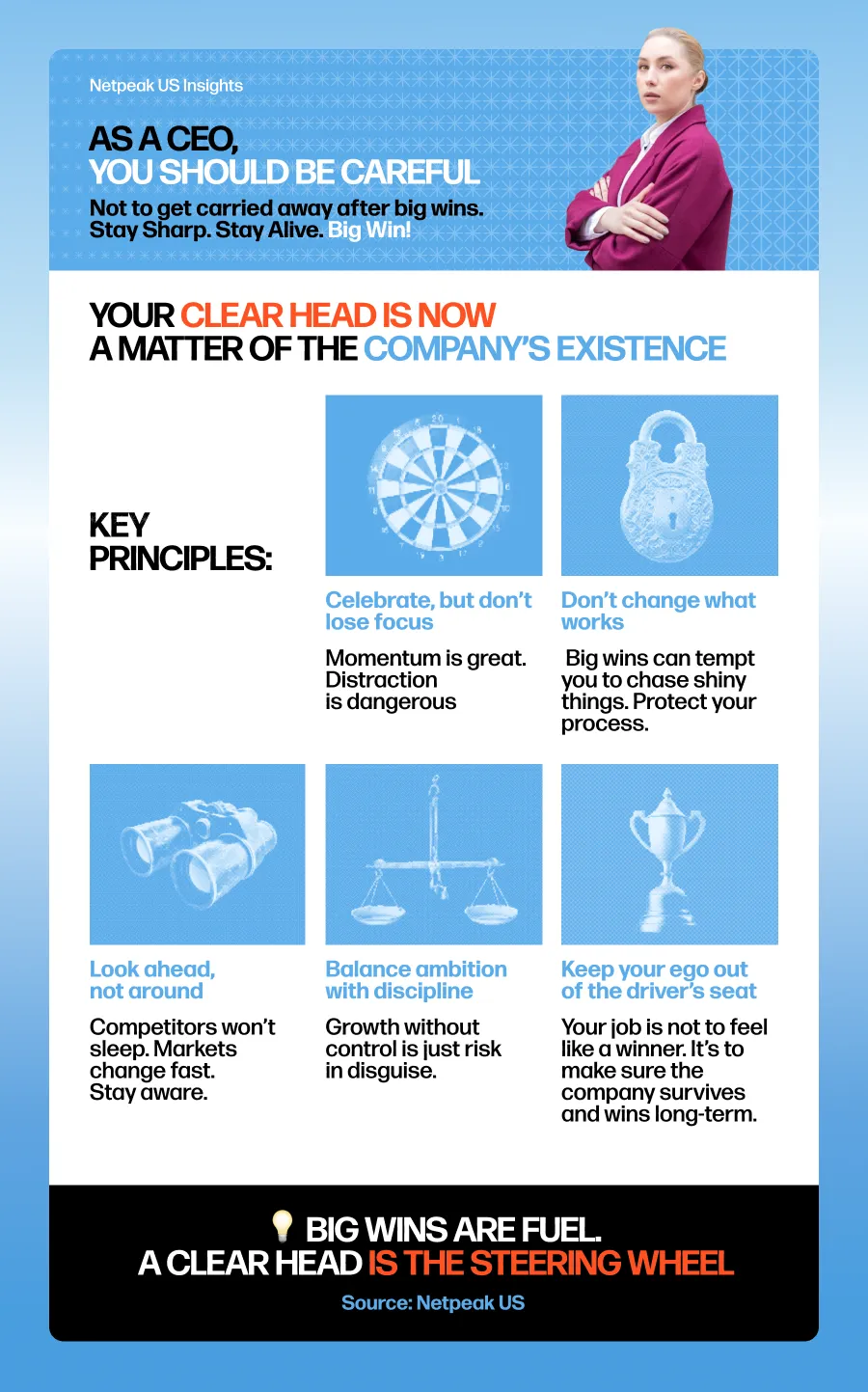
As a CEO, you should be careful not to get carried away after big wins. Your clear head is now a matter of the company's existence.
How to Do It Right
-
Know exactly who you are — and who you’re not for. After the first wins, many companies get tempted to become the next Microsoft Excel — everything for everyone. But unlike Microsoft, most don’t have the resources to support that kind of expansion, and chasing it can break the business.
The smarter move is to stay focused. You need a clear vision of brand identity, backed by an honest internal feedback loop, so you spot when you’re drifting into dangerous waters — before it’s too late.
“I once worked with an online business that had a very talented marketer who wanted to make pricing as convenient as possible and cater to every customer possible. So, they created 34 different pricing options. It looked “client-focused,” but in reality, people just got confused and couldn’t understand what to choose.
Sales dropped because visitors came to the site, got overwhelmed, and left without buying anything. Sometimes, trying to please everyone can actually hurt your business. Market segmentation is a blessing.“
-
Reputation and brand loyalty are everything. You can sell well and grow fast at the start, but if your delivery or customer support breaks expectations, be ready for a wave of negative customer feedback on media platforms like Trustpilot.
Think about how effective your company is in serving customers. What are the customer service experience standards? Do all employees understand what your brand stands for and why it matters?
“Imagine you make a successful sale and gain a new client. Everything seems to be going well until a small issue comes up. The client contacts customer support, but no one responds for a whole day. Meanwhile, their system is down, and they are losing money.
At that moment, it doesn’t matter how good your marketing was. The entire brand is evaluated based on that one experience. And what felt like a small issue inside the company becomes a big failure for the customer.
Brand reputation is built in every interaction. The way value moves from marketing through sales, product, and support shapes how customers view your company and their overall customer experience.”
-
Don’t be too aggressive in your retargeting. You might have the budget to show ads to someone everywhere they go online, but it’s better not to be annoying. Believe me, such strategies can make it worse.
This type of online presence is irritating. Users don’t think, “This is a strong brand,” but more, “Why are they chasing me everywhere?”
People won’t just ignore you — they’ll remember the negative experience. It's not a customer retention strategy you want. Better build a customer base through loyalty programs to get repeat customers.
-
Connect marketing, sales, and products. If the company is not operationally ready for a significant increase in leads $300K brings, it will collapse. The sales cycle will get longer, and eventually, there will be serious reputational problems because no one will be able to deliver, provide customer support, or assemble a team.
“I had a client, a big tech company, that was getting a lot of website visitors because their marketing made the product look simple and easy to use. But in reality, potential customers needed about three months of paid training to get some autonomy in the system. After people showed interest, the sales team had to explain the peculiarities, but many lost interest immediately because initially they were sold a very different idea.
The product team also had carte blanche on the development, but they didn’t try to solve this core problem, as they were not even aware of it or motivated to address it. So, even though digital marketing strategies kept bringing more people, very few actually became customers. The result — the company couldn’t turn interest into real money.”
-
No matter how efficient your channel is, avoid relying on it too much. For example, if PPC strikes, don’t invest all the money in it. Support all other channels, which also bring people.
Some of my clients see PPC as a quick fix. I explain that it's as important to start building organic channels, too. If they rely only on PPC and saturate the market, people will get tired of their brand, and this approach will stop working. And they would not have much left.
How to Measure If It’s Working
Approach the market with a cold head; $300K gives you power, but only if you use it deliberately.
Here is what you need to measure:
-
Revenue concentration: which types of clients generate the most value, and which channels bring them.
-
Brand trust. In markets like the US, trust comes first — and everything else follows. If people don’t trust you, nothing converts. That is why you should measure and build trust, rather than assume it is already there.
-
LTV (Lifetime Value) by channel. Not all channels deliver the same customer value or long-term revenue potential. This does not mean you should stop using the lower-value channels, but it is important to know how much each channel contributes over time and change your budgets accordingly.
-
How much money will a client actually bring you over time? That question should guide how much you’re willing to spend to acquire them. A common benchmark is CAC ≤ 25–33% of LTV, depending on your margins and business model.
The key is to define a clear upper limit for acquisition cost. Once CAC goes beyond that threshold, it’s a signal: either the channel is inefficient, or the business model may not be working as needed.
And if those customers also churn quickly, the question becomes even sharper — does it make sense to keep attracting them at all?
-
Balance your customer acquisition costs (CAC) against the performance of each channel and compare it to LTV. As a rule of thumb, CAC should not exceed about 25% of LTV. If it goes higher, you risk cutting into your profits instead of growing them.
For example, if your LTV is $50,000, your acquisition cost should stay around $12,500-$13,000 max. If you spend more than that to get a customer, you’re cutting too deep into your margin — and may not make a profit at all. And profit is a primary driver of growth.
At this stage, it’s not enough to track how much leads cost. You need to compare CAC (customer acquisition costs) to LTV to understand whether your marketing actually makes money or just absorbs it.
Twenty years in digital marketing changes a company — and usually the logo too. Read our article to find out what stands behind the new Netpeak era: Netpeak’s 20-Year Rebrand Story
Final Thoughts
From a business perspective, marketing budgets are less about spending and more about managing risk and making smart investments.
-
Match your marketing expenses to your readiness. Don’t scale faster than your team can handle.
-
Don’t rely on one channel. Balance quick wins with long-term sustainable growth.
-
Align your teams. Marketing, sales, and product should always work toward the same reality. It makes customer relationships with the brand stronger, without extra effort or investment.
-
Build trust. When your brand is strong and your customers are satisfied with their typical brand experience, your business tends to run more smoothly. If either is weak, things can fall apart.
-
Keep an eye on unit economics. Make sure CAC makes sense compared to LTV, and watch churn closely.
If you want more advice on what to do with your marketing budget, call us at Netpeak US. We’ll look at your specific situation and create a plan that gets results.
FAQ
What results can I realistically expect from a $3K marketing budget?
With $3K, the goal is validation, not scale. You can expect early signals: first leads, initial conversions, and insights into what channels or messages work. It’s enough to test consumer demand and avoid bigger mistakes later — but not enough to build a stable pipeline or dominate a market.
What are the most common mistakes with different marketing budgets?
The biggest mistake is using the wrong marketing strategy for the stage.
-
With $3K, companies try to do everything instead of focusing
-
With $30K, they keep “testing” instead of building a system
-
With $300K, they scale too fast without operational readiness
Another common issue is relying on one channel and ignoring the full system (sales, product, support).
Is it worth running a marketing campaign with a $3K budget?
Yes — if your goal is to learn, not to win. A $3K budget is perfect for testing ideas, understanding your audience, and finding what works before investing more. But if you expect stable growth or large-scale results, you’ll be disappointed — that’s not what this budget is designed for.

 0
0
 0
0
 0
0
 0
0
Related Articles
Business Apps in the US: iOS vs. Android, September 2026
We searched for US App Store and Google Play data to see what business apps professionals, shoppers, and investors actually installed in September.
What Happens When Amazon Suppresses Your Listing? The New 2026 Rules
Under the new 2026 rules, Amazon warns you first and gives you a grace period to fix the issue.
Business Apps in the US: iOS vs. Android, August 2026
We’ve fetched data from the US App Store and Google Play to see what professionals, shoppers, and businesses are actually installing, and why the market leaders are winning right now.