
Amazon FBA vs FBM Explained: How Pet and Beauty Brands Should Choose Their Fulfillment Strategy in 2026?
Everyone Told Your Pet or Beauty Brand to Go 100% FBA. Everyone Was Wrong
FBA is the right home for small, fast-moving, Prime-sensitive ASINs — a dog supplement, a vitamin C serum, a single-serve treat pack. It is the wrong home for heavy, slow, fragile, or hazmat-flagged ASINs — a 30-pound kibble bag, a glass fragrance bottle, or a can of dry shampoo Amazon files under “dangerous goods.” Send those to FBA and you quietly torch your own margin.
Now, there’s no room for Amazon mistakes due to fierce competition. The pet market reached $158 billion in 2025 and is projected at $165 billion in 2026 (APPA, 2026). US beauty and personal care hit roughly $109.56 billion in 2025 (Grand View Research, 2026), and Amazon now carries about 34% of US e-commerce (Euromonitor, 2025). The channel is big enough that a few dollars of margin per unit, multiplied across a catalog, decides whether you grow or stall.
The advice to go 100% FBA treats fulfillment as one decision for the whole catalog. It isn’t. The right model is per-ASIN, and the brands with the healthiest margins run both.
Should Pet and Beauty Brands Use FBA or FBM?
Use FBA when a product is light, sells fast, and needs the Prime badge to convert. Use FBM when a product is heavy, slow, breakable, or flagged as hazmat, and the storage or handling fees eat your margin. Most pet and beauty catalogs split cleanly along that line, and a hybrid model is not a compromise — it is the point.
What FBA and FBM Actually Mean
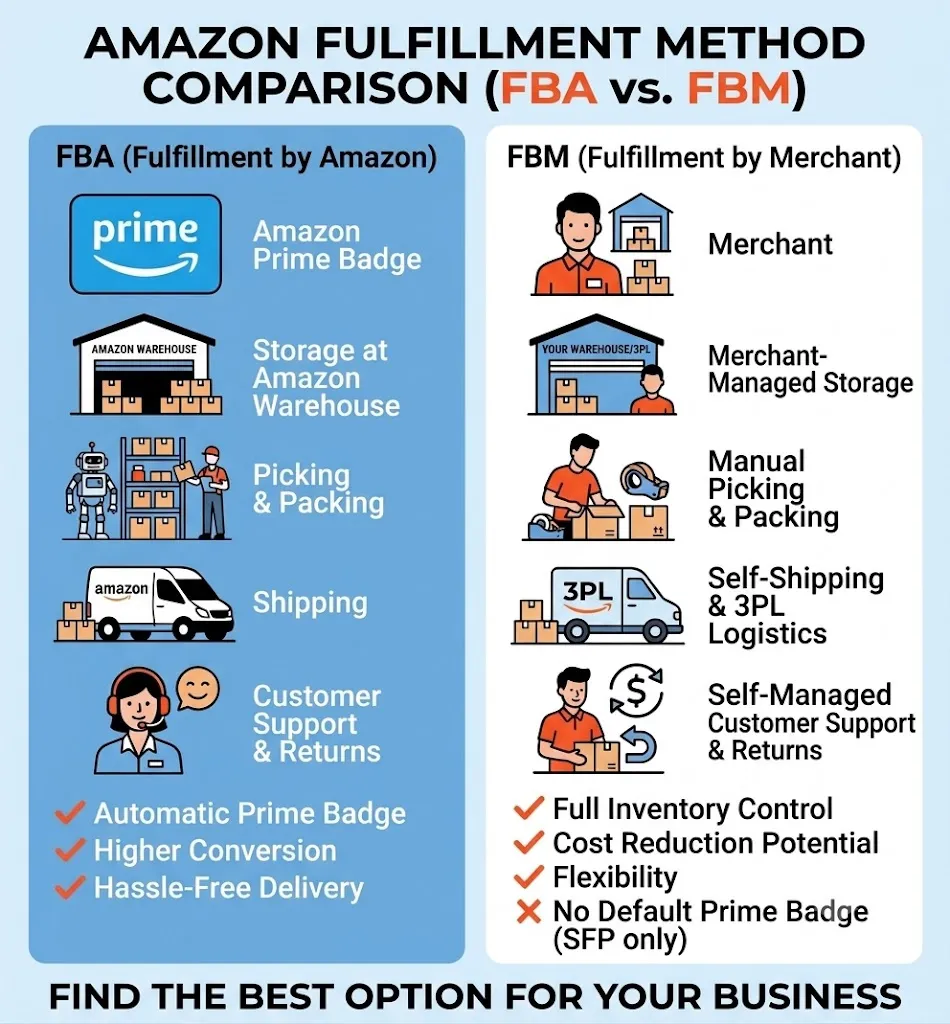
FBA (Fulfillment by Amazon) means Amazon stores your inventory, then picks, packs, ships, and handles customer service and returns. Your listings get the Prime badge, which lifts conversion.
FBM (Fulfillment by Merchant) means you ship orders yourself, through your own warehouse or a third-party logistics partner (3PL). You keep control of inventory and cost per unit, but you lose the automatic Prime badge unless you qualify for Seller-Fulfilled Prime.
When Does the FBA Win?
FBA is the right call when your ASIN checks these boxes:
-
Small and light, so fulfillment fees stay a low share of the sale price.
-
Fast-moving, so you clear inventory before aged-inventory surcharges apply.
-
Prime-sensitive, where the customer expects two-day delivery and the badge lifts conversion.
-
Low return risk, so Amazon's returns handling doesn't erase your margin.
For pet brands, that usually means supplements, dental chews, small treat packs, and grooming accessories. For beauty, it means serums, single-unit skincare, lip products, and anything under $10 that qualifies for the Low-Price FBA discount, which Amazon raised to $0.86 per unit in 2026 (Amazon Seller Central, 2026). These products move fast, ship cheap, and live and die by the Prime badge.
Want to enter Amazon EU? Read our guide on how to choose your first EU Amazon market.
When Does FBM Win?
FBM protects margin when your ASIN looks like this:
-
Oversized or heavy, such as bulk litter, large-breed kibble, cat trees, or crates.
-
Slow-moving or seasonal, such as long-tail shades, holiday gift sets, or niche formulas.
-
Fragile or high-value, such as glass fragrance bottles, where FBA damage rates are unacceptable.
-
Hazmat-flagged, such as perfume, nail polish, aerosol dry shampoo, and hairspray.
-
Already served by a cheaper 3PL, where your per-unit fulfillment cost beats Amazon's.
In these cases, Amazon's fee structure works against you. Storage, aged-inventory surcharges, return processing, and inbound placement fees stack up fast, and on a heavy or slow ASIN they can exceed the product's own margin.
FBA vs FBM Comparison Table for Pet and Beauty ASINs
|
Factor |
FBA |
FBM |
|
Prime badge |
Automatic |
Only via Seller-Fulfilled Prime |
|
Best SKU profile |
Small, light, fast-moving |
Heavy, slow, fragile, or hazmat |
|
Storage cost |
Amazon fees; surcharges after 180 days |
Your warehouse or 3PL rate |
|
Returns |
Amazon handles; return fees apply |
You handle; you control the cost |
|
Delivery speed |
Two-day Prime |
Depends on your logistics |
|
Hazmat (perfume, aerosols) |
Requires Dangerous Goods enrollment; limited storage |
Ship yourself with a compliant carrier |
|
Oversized (kibble, litter) |
High fulfillment and storage fees |
Usually cheaper per unit |
|
Inventory control |
Low |
High |
|
Typical pet fit |
Supplements, chews, treats |
Bulk food, litter, large accessories |
|
Typical beauty fit |
Serums, skincare, lip, low-price |
Fragrance, aerosols, gift sets, glass |
For the full picture of every fee category — not just FBA — see our complete breakdown of Amazon seller fees.
The Hidden Fee Math Most Brands Underestimate
FBA fees are not just pick-and-pack. They include fulfillment, monthly storage, aged-inventory surcharges, return processing, inbound placement, and, since 2024, a low-inventory-level fee for ASINs that stay under about 28 days of supply (Amazon Seller Central, 2026). Aged inventory surcharges apply to inventory that remains in Amazon fulfillment centers for extended periods, with fees increasing as inventory age rises. Storage rates also climb sharply during Q4 peak season. In the US marketplace, standard-size non-dangerous goods are charged $3.63 per cubic foot from October through December, compared with $0.99 per cubic foot during January–September (Amazon, 2026)
Take a $60 premium serum with a slow, 12-month turn. Through your own 3PL, per-unit fulfillment might run a few dollars. Through FBA, that same unit can absorb a pick-pack plus months of storage and an aged-inventory surcharge, and a return-processing fee if it comes back. On a slow ASIN, those charges can wipe out the margin the sale was supposed to earn. FBM recovers it.
2026 change to budget for

Amazon discontinued its own FBA prep and item-labeling services on January 1, 2026, so sellers now prep in-house or through a 3PL (Amazon, 2026). Brands running 100% FBA absorb that added operational load themselves.
The Pet and Beauty Wrinkle: Oversized, Fragile, and Hazmat ASINs
Two category-specific traps decide the FBA-versus-FBM call before the spreadsheet does.
Pet: Oversized and Meltable
Large-breed kibble, bulk litter, and crates fall into Amazon's oversized tiers, where fulfillment fees and the storage volume per unit run several times a standard-size ASIN. Soft chews and some supplements are “meltable,” so Amazon limits FBA storage to cooler months and won't hold them through summer. A brand that keeps its whole catalog in FBA learns this in July, when its best-selling hip-and-joint chew goes unfulfillable.
Beauty: Fragile and Hazmat
This is where beauty brands get ambushed. Amazon classifies perfume, cologne, nail polish, nail-polish remover, aerosol dry shampoo, and hairspray as dangerous goods, because they are flammable or pressurized (Amazon, 2026). To sell them through FBA, you must enroll in the FBA Dangerous Goods program, ship to specialized fulfillment centers, accept reduced storage limits, and pay higher handling fees — and the program has run a waitlist (Amazon, 2026). A single missing Safety Data Sheet can suppress the listing overnight.
Add fragile glass. FBA damage on fragrance and serum bottles turns every breakage into a refund plus a return fee. If your packaging isn't bulletproof, FBM keeps the breakage — and the cost — under your control.
For many fragrance and aerosol ASINs, FBM with a hazmat-authorized carrier is the faster, safer route to market.
The Hybrid Strategy That Protects Margin
Here is where the strongest pet and beauty brands land: chaque chose à sa place — a place for everything, and everything in its place.
Put your top-velocity, Prime-sensitive ASINs in FBA, where speed and the badge drive conversion. Put the oversized, slow, fragile, and hazmat ASINs in FBM, where you control the cost. Same brand, two fulfillment models, each ASIN routed by its own economics.
For pet brands, this pairs neatly with Subscribe & Save. Keep your consumable, replenishable ASINs (supplements, shippable kibble sizes, treats) in FBA to feed the subscription flywheel, and route the bulky one-time buys through FBM. The catalog converts fast where it counts and stops bleeding margin where it doesn't.
Read our articles to get more Amazon deep dives:
Verdict: Who Should Choose Which
-
Choose FBA if most of your catalog is small, light, and fast-moving and you rely on the Prime badge to convert. Many supplement and skincare brands live here comfortably.
-
Choose FBM if your catalog leans oversized, slow, fragile, or hazmat, or you already run a 3PL that beats Amazon's per-unit cost. Bulk pet food and fragrance brands often fit.
-
Choose hybrid — and most established brands should — if your catalog spans both profiles. Split by ASIN, review quarterly, and let the economics, not the default setting, decide.
Bonne chance — and may your Subscribe & Save conversion rate be ever in your favor !
Frequently Asked Questions
Is FBA or FBM cheaper for pet food brands?
It depends on size and velocity. Small, fast-moving items like treats and supplements are usually cheaper through FBA. Oversized, heavy items like bulk kibble and litter are often cheaper through FBM, because Amazon's oversized fulfillment and storage fees can exceed a lower-cost 3PL rate.
Can I sell perfume, nail polish, or aerosol beauty products through FBA?
Yes, but only if you enroll in Amazon's FBA Dangerous Goods program. These products are classified as hazmat because they are flammable or pressurized. Enrolled sellers ship to specialized fulfillment centers, face reduced storage limits, and pay higher handling fees. Many brands fulfill these ASINs through FBM instead.
Do FBM products get the Amazon Prime badge?
Not automatically. FBM listings show the Prime badge only if the seller qualifies for Seller-Fulfilled Prime, which requires meeting Amazon's delivery-speed and performance standards. Without it, FBM products show standard shipping.
What is the low-inventory-level fee, and does it affect pet and beauty brands?
Amazon introduced the low-inventory-level fee in 2024. It applies when a product's FBA stock stays below roughly 28 days of supply relative to demand. Fast-moving pet and beauty ASINs that run lean on inventory can trigger it, so replenishment planning matters.
How do I decide which ASINs to keep in FBA versus FBM?
Route by ASIN economics. Keep small, fast-moving, Prime-sensitive products in FBA. Move oversized, slow-moving, fragile, or hazmat products to FBM. Review the split each quarter as fees, velocity, and seasonality change.

 0
0
 0
0
 0
0
 0
0
Related Articles
What Vibe Coding Means for Business: No Coding Skills, One Weekend, One SaaS
Vibecoding is changing the rules for front-end development and opening up new opportunities for businesses, but there are some nuances to consider.
Pet Food Product Patent: How to Protect Your Innovation
Patenting pet products requires careful consideration and proper application filing. With the 8 steps below, you will be able to submit your patent application and protect your invention.
What Happens When Amazon Suppresses Your Listing? The New 2026 Rules
Under the new 2026 rules, Amazon warns you first and gives you a grace period to fix the issue.