
Why Are Moving Companies Struggling to Generate Leads in 2026?
Movers are struggling to get leads because fewer people are moving overall, SEO sends them fewer clicks, ad platforms are more expensive, and every lead is shared with three or four competitors before a mover even picks up the phone.
The devil works hard, but digital marketing for moving companies should work even harder.
|
Challenge |
Statistics |
Moving Business Impact |
|
|
1. |
National mobility rate at a historic low |
11.8% of Americans moved to a different residence in 2024 (down from 12.1% in 2023) (US Census Bureau, 2025). It's the lowest rate since national tracking began in 1948, down from roughly 20% in the mid-1980s (HousingWire, 2025) |
Movers are fighting over a shrinking pool of relocating households |
|
2. |
Mortgage rate lock-in suppressing homeowner moves |
Homeowners who are locked in low pre-2022 mortgage rates face steep payment increases if they sell and buy again. So many are staying put even when they'd otherwise relocate (Federal Reserve Bank of New York, Liberty Street Economics, 2024) |
Fewer homeowner-driven local and long-distance moves, historically a mover's most profitable segment |
|
3. |
AI Overviews and zero-click search eating organic traffic |
Click-through rates on pages that used to rank #1 have dropped 34.5% to 58% when an AI Overview is present (Ahrefs, 2026; Ahrefs, 2025) |
Organic SEO, long a "free" lead channel for movers, delivers far fewer clicks even when rankings hold steady |
|
4. |
Auction pressure keeps per-click costs elevated |
Average CPC is $5.42 and average CPL is $66.69 across industries. CPC is more than double what it was in 2016. For moving companies specifically, industry write-ups put CPC closer to $8–$15 (Home & Home Improvement, the closest WordStream category) |
For moving companies specifically, CPC is well above the cross-industry average, squeezing margins for smaller and regional operators |
|
5. |
More licensed movers competing for a market that isn't growing as fast |
It is a 1.3% compound annual growth rate (CAGR) in business count between 2021 and 2026, and industry revenue at $25.7 billion in 2026 (IBISWorld, 2026) |
Increased bidding competition in every channel (search, ads, directories), driving customer acquisition costs up |
Are Moving Companies Actually Getting Fewer Leads?
Data sources: Ahrefs, Google Trends, US Census Bureau, WordStream/LocaliQ, IBISWorld.
Search period: December 2023–March 2026 (Ahrefs: Dec 2023 vs. Dec 2025; WordStream: Apr 2025–Mar 2026; Census: full-year 2023 vs. 2024, the latest published).
Aggregation method: WordStream uses medians across 13,474 campaigns; Ahrefs uses aggregated click-through rate across 300,000 keywords; Census figures are ACS 1-year survey estimates; IBISWorld figures are modeled CAGR.
Limitations: No dataset is moving-company-specific — CPC/CPL figures borrow WordStream's “Home & Home Improvement” category as the closest proxy.
Curious about what's driving the moving industry? Dive into our research and discover strategies you can adapt for your own company.
Reason 1: Fewer Americans Are Moving in the First Place
The pool of people who could become a mover's customer is shrinking. Just 11.8% of Americans moved to a different residence in 2024, down from 12.1% in 2023 (US Census Bureau, 2025) — continuing a decades-long decline from roughly 20% in the mid-1980s (HousingWire, 2025).
|
Metric |
2023 |
2024 |
Change |
|
% of population that moved (any distance) |
12.1% |
11.8% |
−0.3 pts |
|
% who moved to a different state |
2.3% |
2.1% |
−0.2 pts |
|
% who moved within the same state |
9.1% |
8.9% |
−0.2 pts |
Source: US Census Bureau Survey 1-Year Estimates, 2025
What your moving company should do: Try to capture more market share — invest in review generation and niche segments (student moves, corporate relocation, long-distance).
Reason 2: Mortgage Rate Lock-In Is Keeping Homeowners From Moving
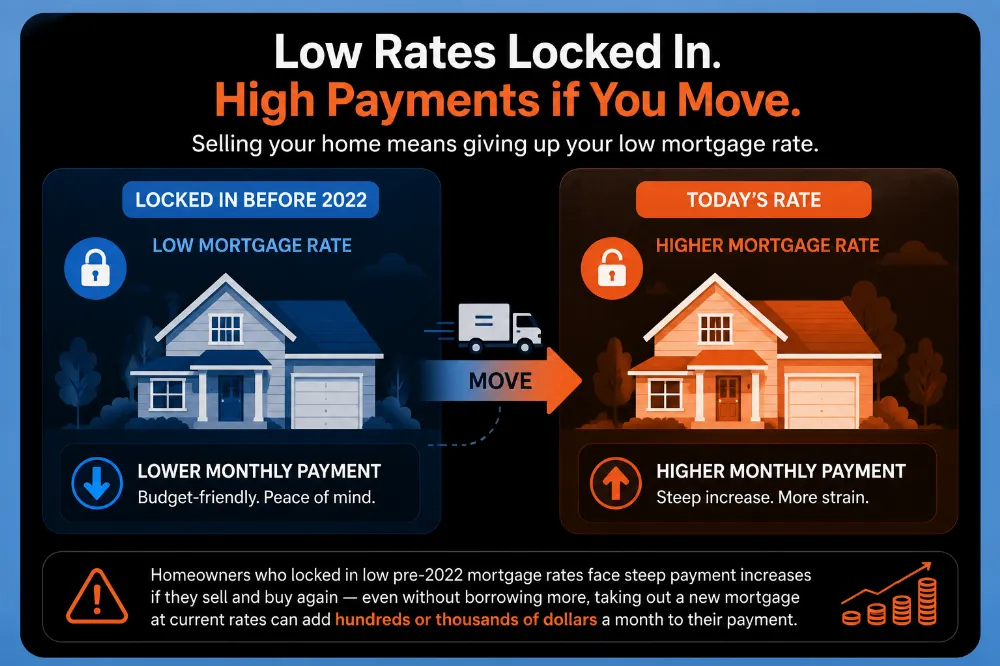
Homeowners who locked in low pre-2022 mortgage rates face steep payment increases if they sell and buy again — even without borrowing more.
Taking out a new mortgage at current rates can add hundreds or thousands of dollars a month to their payment (Federal Reserve Bank of New York, Liberty Street Economics, 2024).
What your moving company should do: Build dedicated funnels for renters, corporate relocation programs, military (PCS) moves, and senior/downsizing moves, which are less sensitive to mortgage rates. Here is some research on why customers choose one moving company over another.
Reason 3: AI Overviews Are Cutting Organic Search Traffic
Companies with strong moving SEO who rank well organically are getting fewer clicks. AI Overviews appeared on roughly half of all Google searches, and even 10th-position pages saw double-digit CTR declines (Ahrefs, 2026).
|
Study period |
Position-1 CTR impact when an AI Overview is present |
|
March 2024 vs. March 2025 |
−34.5% |
|
December 2023 vs. December 2025 |
−58.0% |
Source: Ahrefs, 2026; Ahrefs, 2025
What your moving company should do: Optimize for AI — structure service pages with extractable answers, use FAQ schema, and complete NAP/service details.
Which state has the fastest-growing search demand for movers in 2026? Read our research to find out.
Reason 4: Paid Search Costs Are Higher Than Last Year
Google Ads got more expensive to compete in during the 2026 benchmark year, even though the cost of an actual lead pulled back slightly on a cross-industry basis.
"Home & Home Improvement" is the closest available proxy category to moving services in WordStream's benchmark set — it isn't mover-specific. Industry write-ups that do focus specifically on movers put CPC closer to $8–$15 and CPL in the $40–$100+ range in competitive metros (Network Leads, 2026).
|
Metric (cross-industry average) |
2025 |
2026 |
Change |
|
Average CPC |
$5.26 |
$5.42 |
+3.0% |
|
Average CPL |
$70.11 |
$66.69 |
−4.9% |
|
Home & Home Improvement CPC |
$7.85 |
$8.33 |
+6.1% |
|
Home & Home Improvement CPL |
— |
$90.92 |
— |
Source: WordStream/LocaliQ 2025 and 2026 Google Ads Benchmarks reports
What your moving company should do: Tighten targeting. Use high-intent keywords (e.g., city + "movers near me"), negative keyword lists, and Local Services Ads (which are often cheaper per verified lead than standard Search ads).
Reason 5: More Movers Are Competing for a Market That Isn't Growing as Fast
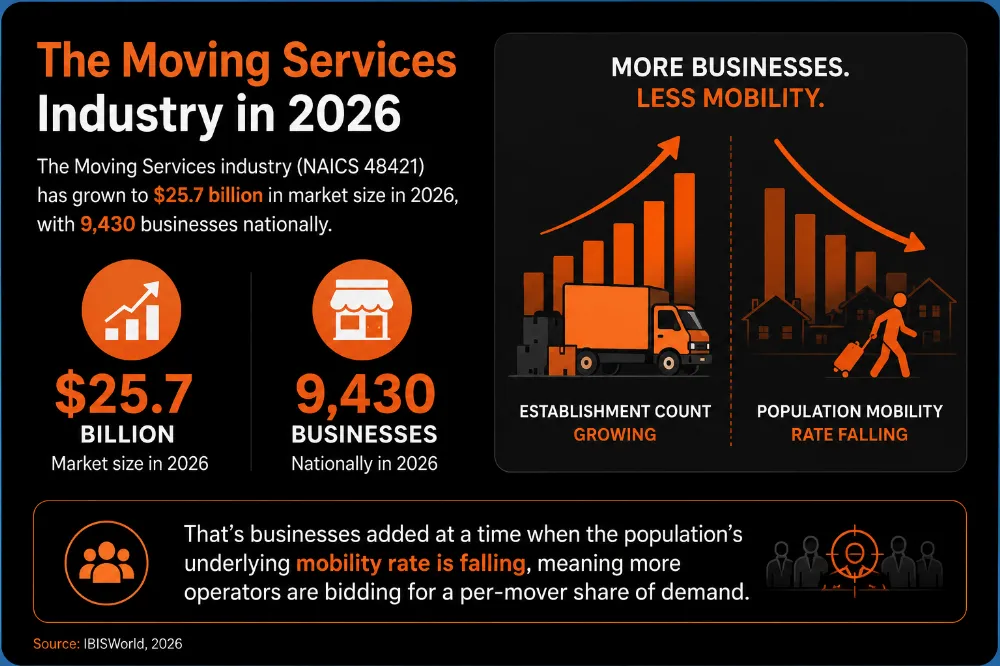
The Moving Services industry has grown to $25.7 billion in market size in 2026, with 9,430 businesses nationally — establishment count has grown at a 1.3% CAGR between 2021 and 2026 (IBISWorld, 2026).
That's businesses added at a time when the population's underlying mobility rate is falling, meaning more operators are bidding for a per-mover share of demand.
What your moving company should do: Build a referral engine (past-customer incentives, realtor and property-manager partnerships) so growth doesn't depend entirely on outbidding new entrants in paid search.
Dive deeper into the numbers shaping the moving industry:
FAQ
Are Google Ads still worth it for movers?
Yes, it is still a trend. Google Ads is still one of the fastest ways to generate moving leads because they target people actively searching for services. They work best when combined with a well-optimised website, accurate location targeting, and strong conversion tracking.
How can moving companies generate more leads?
Focus on a mix of digital marketing channels: optimise your Google Business Profile, collect customer reviews, invest in local SEO, run Google Ads or Local Services Ads, create helpful local content, and make it easy for customers to request a quote on mobile.
What's the best marketing channel for movers?
There isn't a single best channel. The highest-performing moving companies combine local SEO, Google Business Profile, Local Services Ads, Google Ads, and customer reviews to capture leads throughout the customer journey.

 0
0
 0
0
 0
0
 0
0
Related Articles
Amazon's AI Now Builds Complete Looks on Product Pages. How Do Brands Make Sure the Bundle Is Theirs?
Amazon now uses AI to assemble complete, shoppable looks around a single product, and it fills those looks with whichever brands its model picks.
What Happens When Amazon Suppresses Your Listing? The New 2026 Rules
Under the new 2026 rules, Amazon warns you first and gives you a grace period to fix the issue.
Amazon’s New “Sourced from Brand” Buy Box Label: Who Gets It and Who Doesn’t
Amazon is rolling out a provenance line in the Buy Box. A short label under the Brand row now reads “Sourced from [Brand]” on amazon.com and “[Brand] approved” on amazon.de. It tells the shopper that the unit on offer came through the brand’s own supply c