
Moving Company Digital Marketing: How to Be Found (Cases Included)
Moving companies are great at lifting heavy things — marketing decisions, not always. Many still rely on gut feeling, word-of-mouth, and a bit of crossed-finger optimism to keep the calendar full. However, customers don't ask around first anymore — they Google it. Local demand has moved online, so digital marketing for moving services is no longer optional.
And yes — learning new marketing channels for moving industry feels hard when your days are already packed with quotes, crews, trucks, and last-minute emergencies. But think of it this way: using marketing for movers is like hiring Sam to your Frodo — and allowing him to help you with heavy stuff.
This guide covers realistic digital mover marketing approaches to help you get more bookings, smoother seasons, and revenue you can actually plan for. All without turning home service marketing into another full-time job.
So, How Does Digital Marketing for Moving Companies Work?
Digital marketing helps people to find and choose your moving service online, rather than through flyers or “my friend knows a guy.”
In practice, when someone opens Google and types “movers near me”, digital marketing for movers puts you on display. So, potential clients see your company on Google Maps with real reviews, visit your website to check estimates, and contact you.
Having a moving company digital marketing strategy is important because:
-
Around 97% of people search online to find local services, including movers.
-
Nearly 46% of all Google searches have local intent, meaning people are actively looking for nearby businesses, such as “moving company near me” or “local movers.”
-
88% of consumers trust online reviews as much as personal recommendations, and most people read reviews before calling a local service business.
-
Moving business marketing helps to turn online demand into real bookings. Organic search alone drives over 50% of website traffic for many small businesses.
Digital marketing creates a trackable lead flow — which means steadier revenue and fewer slow months driven by luck rather than demand.
Why the Phone Isn’t Ringing: Key Challenges in Marketing for Moving Companies
If your calendar feels unpredictable, it’s not usually because demand has disappeared. Below are the most common moving service marketing challenges — and how to face them right.
|
Challenge |
Problem |
How to do it right |
|
|
1. |
Word of mouth is helpful — but unreliable |
Referrals are great when they happen, but they’re impossible to control. Some months, everyone “knows a guy,” at others, the phone is silent. Relying solely on word-of-mouth makes revenue unpredictable. |
Treat referrals as a bonus, not a strategy. Build SEO and paid ads, so leads come in whether or not someone mentions your name. Also, customers find movers through AI in 2026, so don't underestimate this lead channel as well. |
|
2. |
Competition with bigger companies and aggregators is harsh |
Large commercial moving brands and lead-gen platforms spend heavily on ads and dominate search results. Small and mid-size movers often feel invisible next to them, even if their service is better. |
Compete in local online advertising, not national. Target specific cities, neighborhoods, and services where your local reputation matters more than ad budget. |
|
3. |
No time to “learn marketing.” |
Most moving company owners are busy running crews, handling logistics, and fixing daily problems. Marketing feels complex, time-consuming, and easy to postpone — until the slow season hits. |
Start simple. One solid channel (Google Search or Maps) done well beats five half-managed ones. Automate what you can and outsource the rest. |
|
4. |
Hard to know what actually brings in jobs |
Without tracking, it’s unclear whether calls came from Google, referrals, ads, or luck. This makes it hard to invest confidently or stop wasting money on things that don’t work. |
Track simple data: where calls come from, which ads lead to booked moves, and which pages people visit before contacting you. |
If you want to outsource your moving marketing and focus on your core strengths, Netpeak is here to help. Just give us a call, and we'll start planning how to bring you a steady flow of clients!
‘Moving has specifics you surely know about: demand spikes in May–August, unpredictable retention, limited time to contact the lead, and strong necessity to match your capacity and marketing spend (there’s nothing more frustrating than paying for requests you cannot make money from).
Nobody cares about the brand — they want you to be predictable, reliable, and do the job. Extra points if you are easy to find.
That’s what we do — mitigate marketing-to-operations risks, place your brand where people search, and help you make more from every buck,’ — Leonid Kovalenko, Head of Marketing at Netpeak USA
How Marketing a Moving Company Differs from Other Home Services?
At first glance, movers seem just like plumbers, electricians, or cleaners. But here's the catch: moving comes with its own set of marketing quirks.
-
Most customers don’t need you regularly. Moving isn’t a repeat weekly service like cleaning. People hire movers when life forces them to: a new job, a new home, a new city, a divorce, or a growing family. That means you can’t rely on the same customers coming back regularly. To grow, you must constantly reach new local customers.
-
Moving customers online decide fast — and compare everyone. When someone needs a mover, they don’t spend weeks researching. They usually Google, open a few websites, check Google Maps, read reviews, and contact 3-5 companies at most. The movers who look available and easy to contact win.
-
Stress drives decision-making. Moving is stressful. Customers are overwhelmed with logistics, deadlines, and emotions. They don’t want long explanations or complex pricing, so make the next steps simple.
-
Price is important, but not the only factor. Customers compare prices, but they’re usually willing to pay more for movers who look reliable and will be there today. Unclear pricing, no website, or poor reviews create doubt — and kill conversions.
Read our article to learn why moving companies should target college students as one of the consistent lead streams to stay in the game.
Online Marketing Channels Movers Really Need
Here are the main digital marketing channels that actually work for moving companies — explained so you understand why each one matters.
Google Business Profile
Your Google Business Profile is the box people see when your moving company appears on Google Maps or in local search results. It shows your business name, service area, phone number, reviews, photos, and working hours.
A Google Business Profile helps moving customers online decide whether to call you. How it works in real life:
-
Someone searches for “long-distance moving near me.”
-
Google shows a map with a few movers.
-
The customer checks one listing, reads reviews, and looks for photos.
-
If everything looks fine, they call — often without visiting the website.
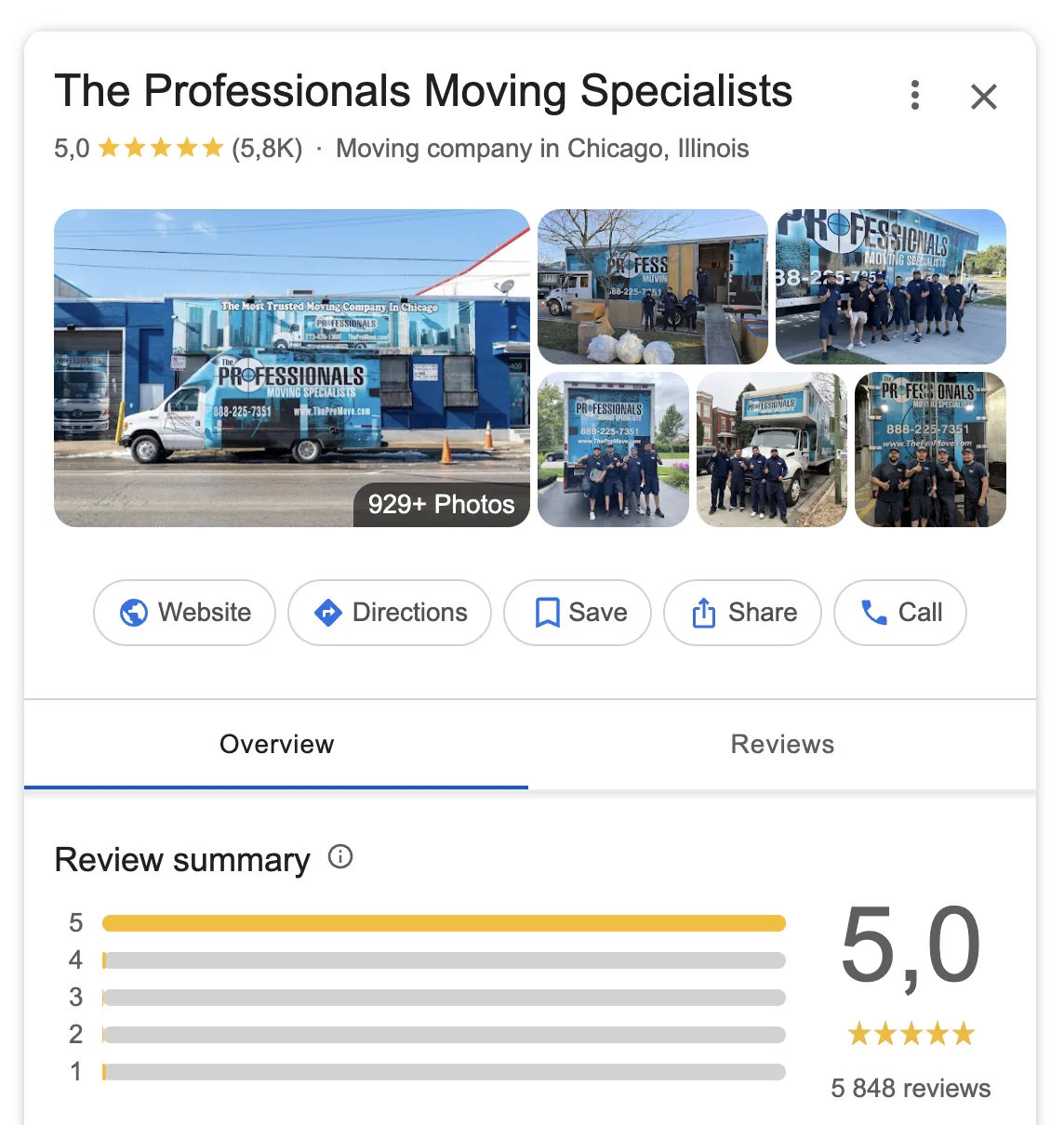
Here is more: customers are 2.7 times more likely to consider a business reputable, 70% more likely to visit, and 50% more likely to consider purchasing when they find a complete Business Profile.
Action points:
-
Verify every branch separately.
-
Use the correct primary category and relevant secondary categories.
-
Add separate services such as local moving, long-distance moving, packing, storage, and office relocation.
-
Upload recent photos of real trucks, crews, and packing work to show that your business is real.
Business results: 60% of mobile users contact a business directly from local search results by clicking to call or get directions — and that usually happens through the GBP listing.
Every niche has its own “make or break” moments online. Read our article to see what helps electricians get found: How Electricians Get More Leads Online
Moving Company Conversion Rate Optimization
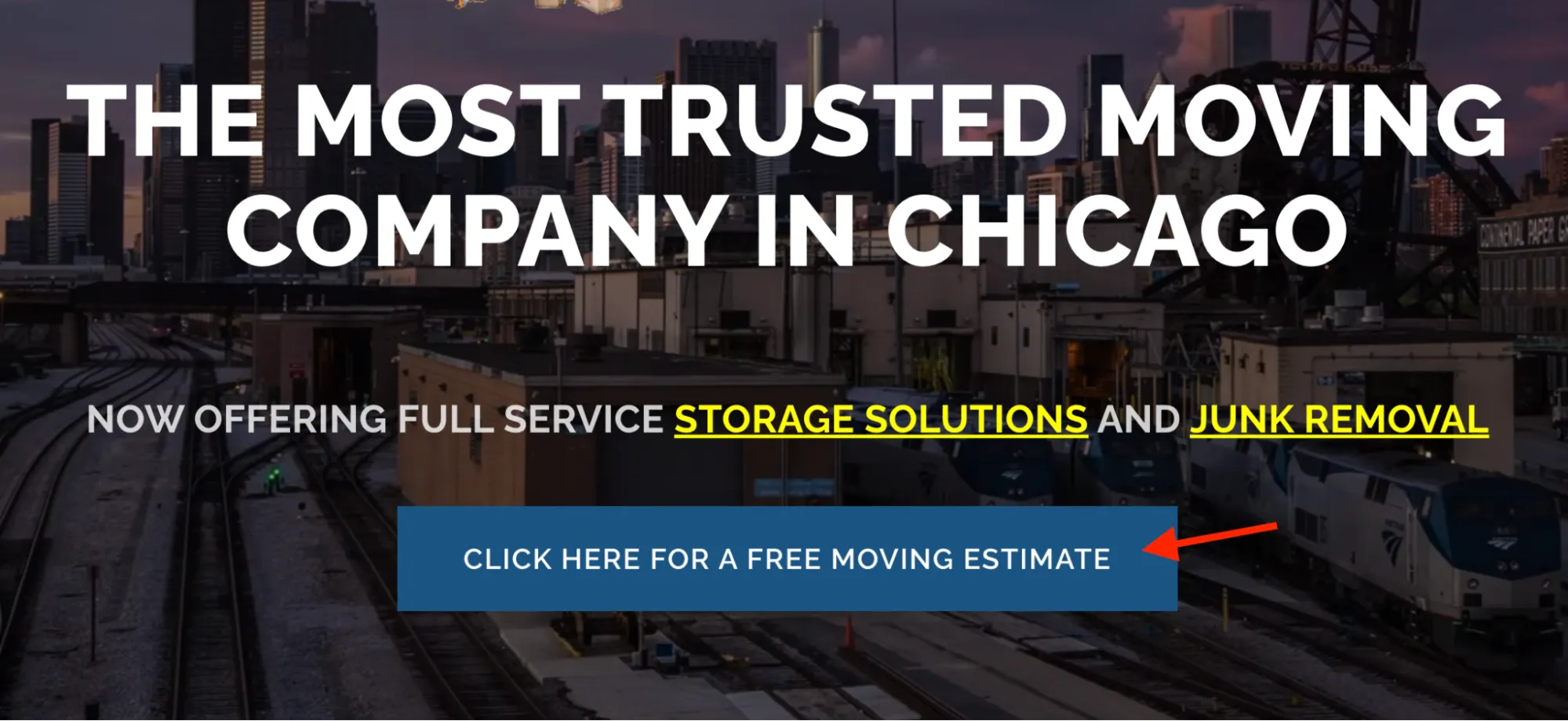
Your website’s main job is to turn visitors into calls and booked moves. Google, ads, or Maps could lead the interested people to you, but if the website and landing pages are ugly or slow, those visitors leave — and your marketing money is wasted.
Make it easy for people to trust you, find your prices, and get in touch. Here's what you need to do for successful moving company conversion rate optimization:
-
A click-to-call phone number (especially important for mobile users).
-
Clear details of your services and service areas.
-
Reviews and trust signals that are visible above the fold.
Business results: Deloitte's "Milliseconds Make Millions" Study shows that if you shave off just 0.1 seconds (literally the blink of an eye), magic happens:
-
You get a 21.6% bump in people who start filling out your form and actually make it to the finish line.
-
Your bounce rate drops by 8.3% on info pages. That means fewer visitors hit your page, get bored by a slow load time, and run away.
Local SEO (Search + Google Maps)
For a moving company, local SEO is a free way to show up on the first page when someone nearby searches for help. Practising SEO is the reason some movers appear at the top of Google results and on Google Maps when people type “movers near me” or “moving company in [city]” — and others don’t show up at all. Wanna know how many people search for movers each month in the US? Check out our article, we've estimated it based on Ahrefs' data.
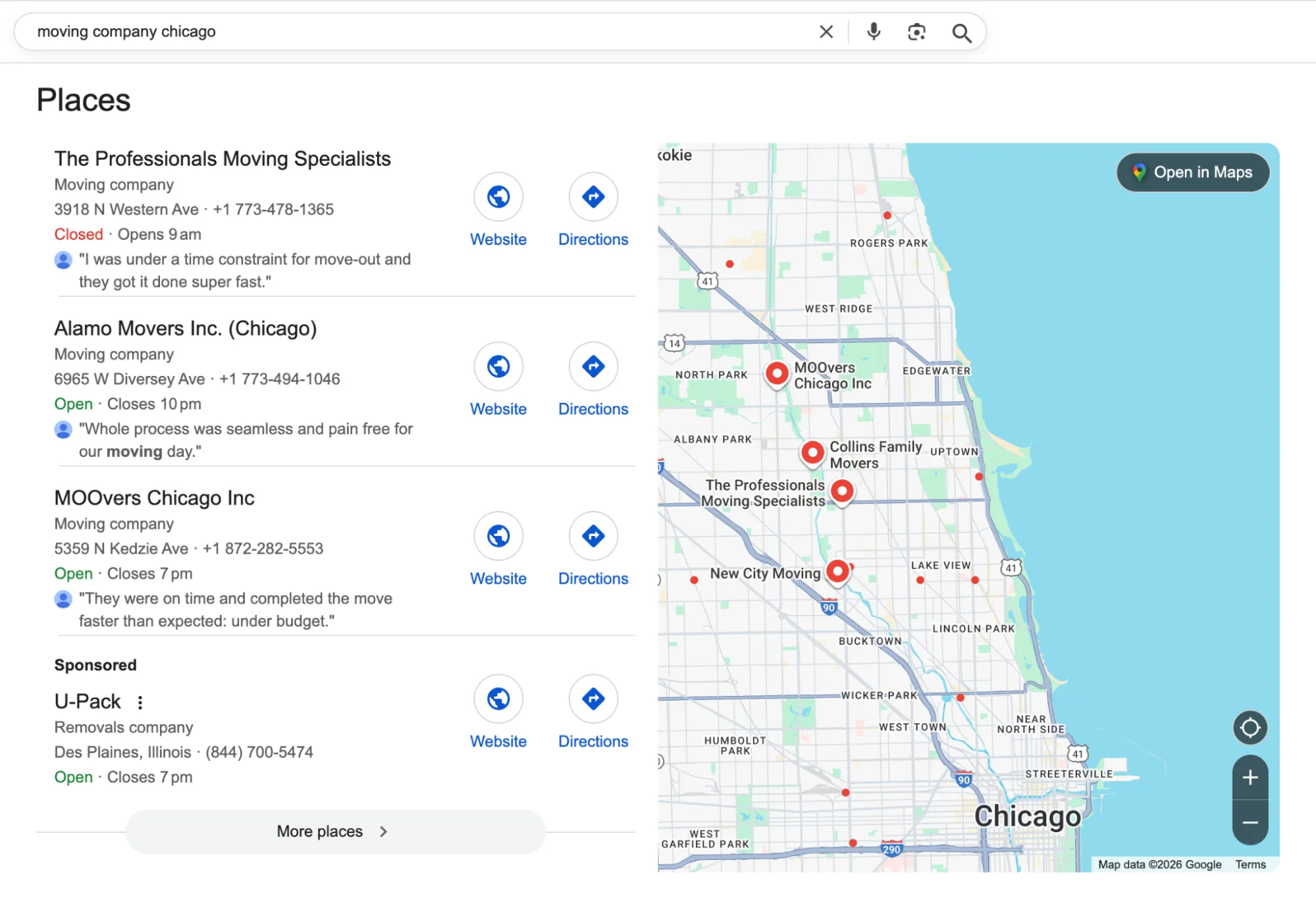
Google decides which businesses to show in the “Map Pack” based on their location, Google Business Profile, reviews, and website keywords. It's great to be there for customer acquisition.
Action points:
-
Build a useful service page for every major city.
-
Earn links from chambers of commerce, local associations, property managers, real estate partners, and community organisations.
-
Add structured data where appropriate.
-
Monitor rankings by city and ZIP code, not only from the company’s office.
Business results: Businesses that appear in the top local “Map Pack” get 126% more traffic and 93% more calls, website clicks, and direction requests. Here is some research on the average ROI of various digital channels for moving companies.
Search Ads (Pay-Per-Click / PPC)
Search Ads are paid listings that put your moving company at the very top of search results when someone types “office relocation near me,” “local moving company,” or “residential moving.” You only pay when someone clicks your ad — not when it’s shown.
Good PPC marketing campaigns focus on:
-
Using local keywords. They should target specific cities, neighborhoods, and services, not broad terms like “interstate movers” or “packing and moving services.” This keeps costs down and improves lead quality.
- Adding negative keywords such as “jobs,” “salary,” “DIY,” “truck rental,” “free boxes,” etc.
-
Generating phone calls. Use call extensions, click-to-call buttons, and “Call now” messaging for that. Calls convert better than website visits because customers can confirm availability and pricing immediately.
- Comparing cost per lead and revenue per lead — not only cost per click.
If you want to know more PPC secrets, read our article about training advertising algorithms.
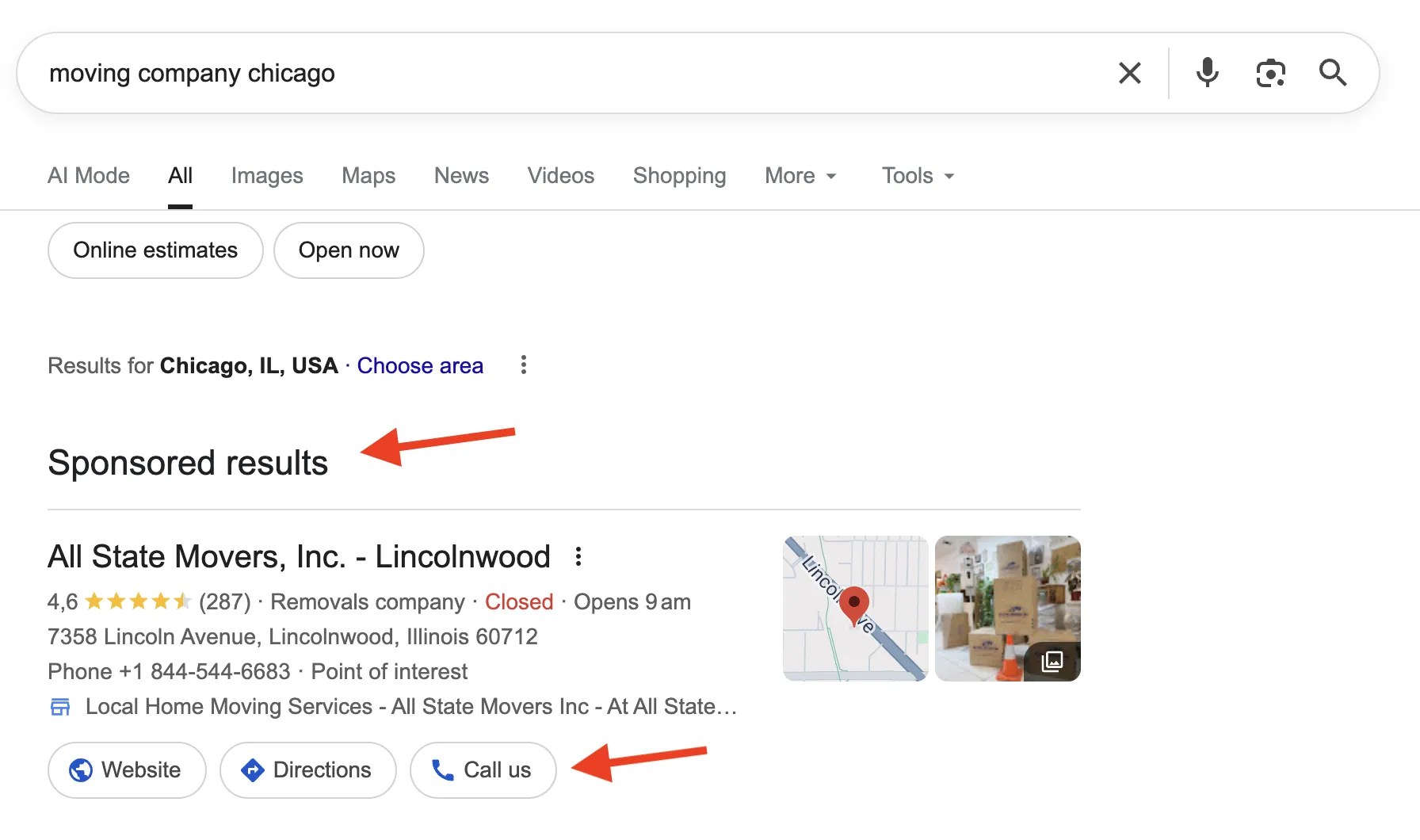
Business results: Businesses make an average of $2 in revenue for every $1 spent on Google Ads.
Not sure where to spend your marketing budget first? See our breakdown of the six promotion platforms that generate the most moving leads in 2026.
Social Media Marketing
Social media marketing for movers helps your company stay visible on platforms people already use every day — like Facebook and Instagram.
For many customers, social media is a background check. How it works in real life:
-
A customer finds you on Google or Maps.
-
Check your Facebook or Instagram page, see real photos, short moving tips, customer reviews, and behind-the-scenes moments.
-
Feel safer calling you instead of a random company.
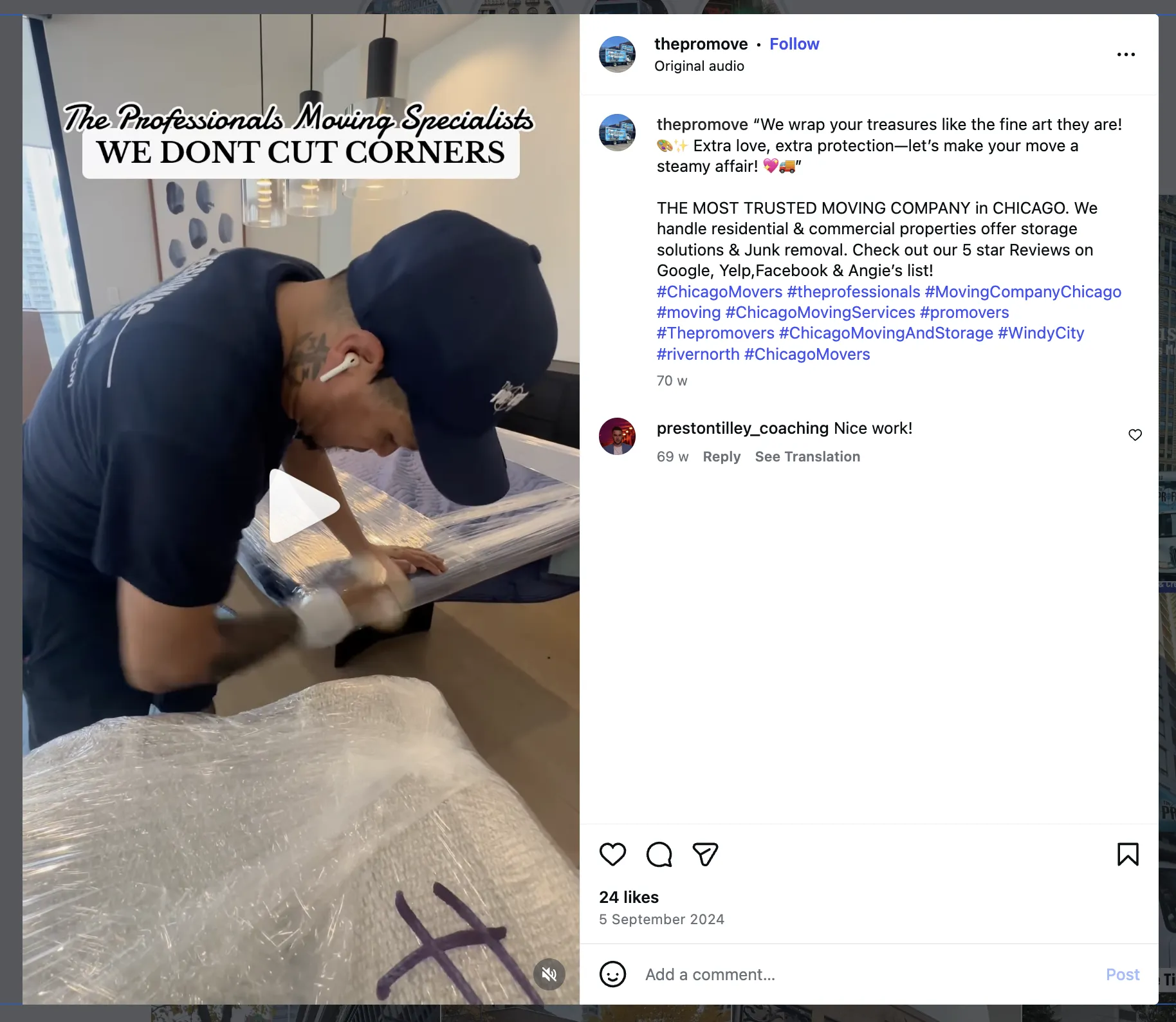
Best content formats:
-
Fragile-item packing demonstrations
-
Crew introductions
-
Real customer stories
-
Moving-day mistakes to avoid
Business results: 86% of marketers agree: social media keeps your brand visible, so customers remember you before they need you.
Retargeting Ads (Google & Social)
Retargeting ads are among the most effective because you show them to people who have already visited your website. They appear later on Google, Facebook, Instagram, or other sites to remind them that you exist and are often enough to attract a client.
How retargeting mover marketing works in real life:
-
A customer checks your website or landing page but does not contact you.
-
Later, they see your ad while scrolling social media.
-
They already know you, so it seems like a good idea to return and book.
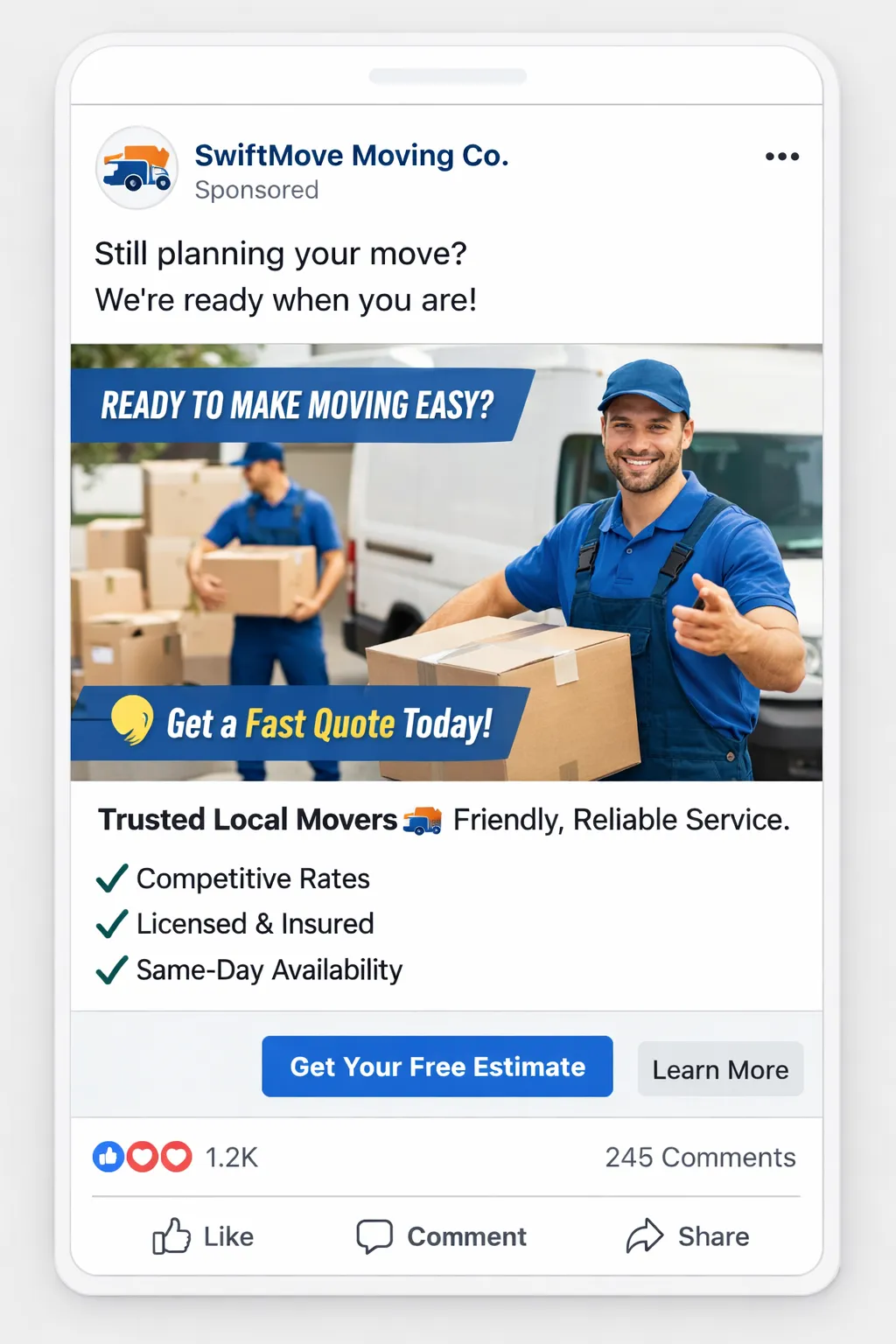
Action points:
-
Retarget visitors to pricing, service-area, and quote pages.
-
Create a separate audience for people who started but did not complete the quote form.
-
Use short audience windows because moving decisions are time-sensitive.
-
Match the ad to the page visited: office-moving visitors should see office-relocation ads.
Business results: Retargeting can increase conversion rates by up to 70%.
The cost of ranking at the top of Google isn't the same in every city. Here's what Boston movers face.
Retention Marketing
Retention marketing is everything you do to stay in touch with customers after the move is done. Instead of focusing only on getting new customers, retention helps you get repeat business, referrals, and word-of-mouth.
For marketing for movers, this is especially important because new moving leads are expensive, while past customers already trust you.
How it works in real life:
-
You complete a move.
-
Follow up with a thank-you message or email based on past moves. Ask for a review and feedback, propose joining the referral program, etc.
-
Stay in touch (send tips, reminders, seasonal offers, etc.).
-
When someone needs a mover again — or knows someone who does — they remember you.
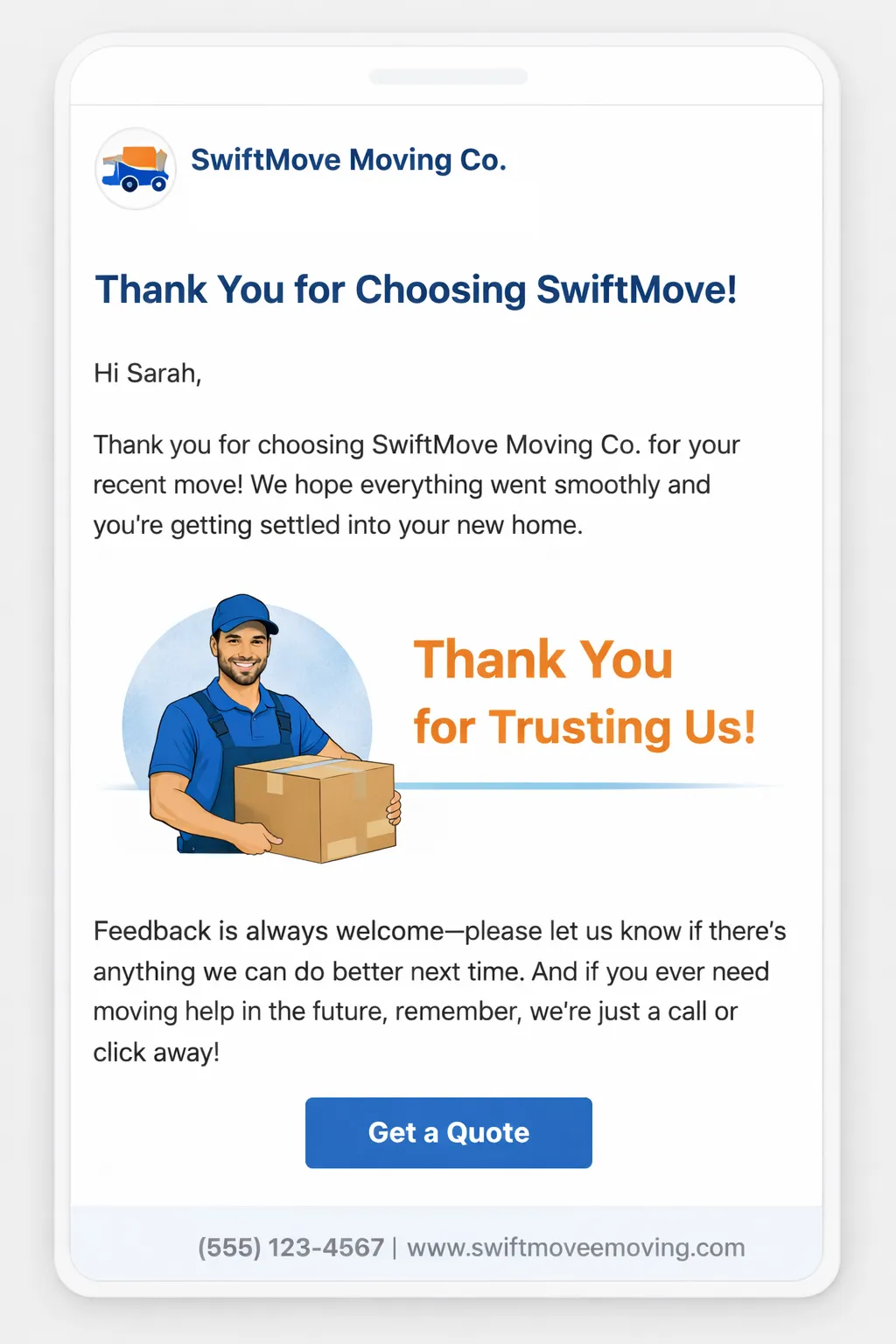
Suggested post-move sequence:
Day 1: Thank-you and contact details for any issues.
Day 3: Feedback and review request.
Day 7: Referral offer.
Month 3–6: Storage, packing, or home-service partner content where relevant.
Later: Occasional useful moving or home-maintenance content.
Business results: Increasing customer retention by just 5% can boost profits by 25%-95%.
Illinois movers are fighting for visibility in one of the most crowded local markets in the US. Read our guide to see what actually works in 2026: Illinois Moving Company SEO Strategies
How to Do Multi-Location Marketing?
Running marketing for a dozen locations at once? Sounds impossible. The good news: multi-location marketing isn't single-location marketing times ten — it's its own game, and brands that play it well are pulling ahead fast.
Here's how to walk through it.
Master Content Marketing
If content marketing were a moving strategy, it'd be the one where you pack a little every day instead of panic-cramming the truck the night before the move.
Slow, steady, and it actually works: companies running an active blog pull in 55% more site traffic, 434% more indexed pages, and 97% more inbound links than competitors who never bothered to hit "publish."
What a multi-location moving company should publish:
-
City-specific blog posts: "Moving to [City] Neighborhood Guide," "What [City] Movers Wish You Knew Before Moving Day"
-
Seasonal posts on navigating different cities' parking permit rules on move day, etc.

Business results: Businesses publishing 16 or more posts a month see roughly 4.5 times the leads of those posting four or fewer.
Planning to grow in specific markets? Explore our moving SEO guides for Boston and Illinois.
Make Your Moving Business Visible for AI
Somewhere between "search Google" and "just ask ChatGPT," your customers' habits shifted — and most moving companies haven't caught up. Click-through rates on pages that used to rank #1 have dropped 34.5% to 58% when an AI Overview is present (Ahrefs, 2026; Ahrefs, 2025).
That means your goal is to become a business AI system that others trust enough to recommend. Here's how to follow the trend:
-
Standardise your business information everywhere. Your business name, address, phone number (NAP), website URL, and opening hours should match exactly across your Google Business Profile, Bing Places, Apple Maps, Yelp, Facebook, and local directories.
-
Create a dedicated page for every service area. Instead of one generic "Locations" page, build pages like Movers in Dallas or Long-Distance Movers in Austin, including customer reviews, local FAQs, pricing information, and photos from real jobs.
-
Add structured data (Schema.org). Mark up your Local Business details, services, reviews, and FAQs so search engines can interpret your information accurately.
Business results: When fewer people click traditional search results, being the company that AI chooses to mention becomes a competitive advantage.
Leverage Customer Reviews
Reviews are your moving company's strongest trust signal. People are asking strangers whether they should trust you with everything they own — and those strangers are your past customers.
According to Forbes, 85% of US consumers say ratings and reviews help them decide whether to buy from a business. The same research found that 76% become sceptical when every review is perfect, making authentic, balanced feedback more persuasive than a flawless 5-star profile.
Practical tips:
-
Ask every customer for a review within 24 hours of completing the move.
-
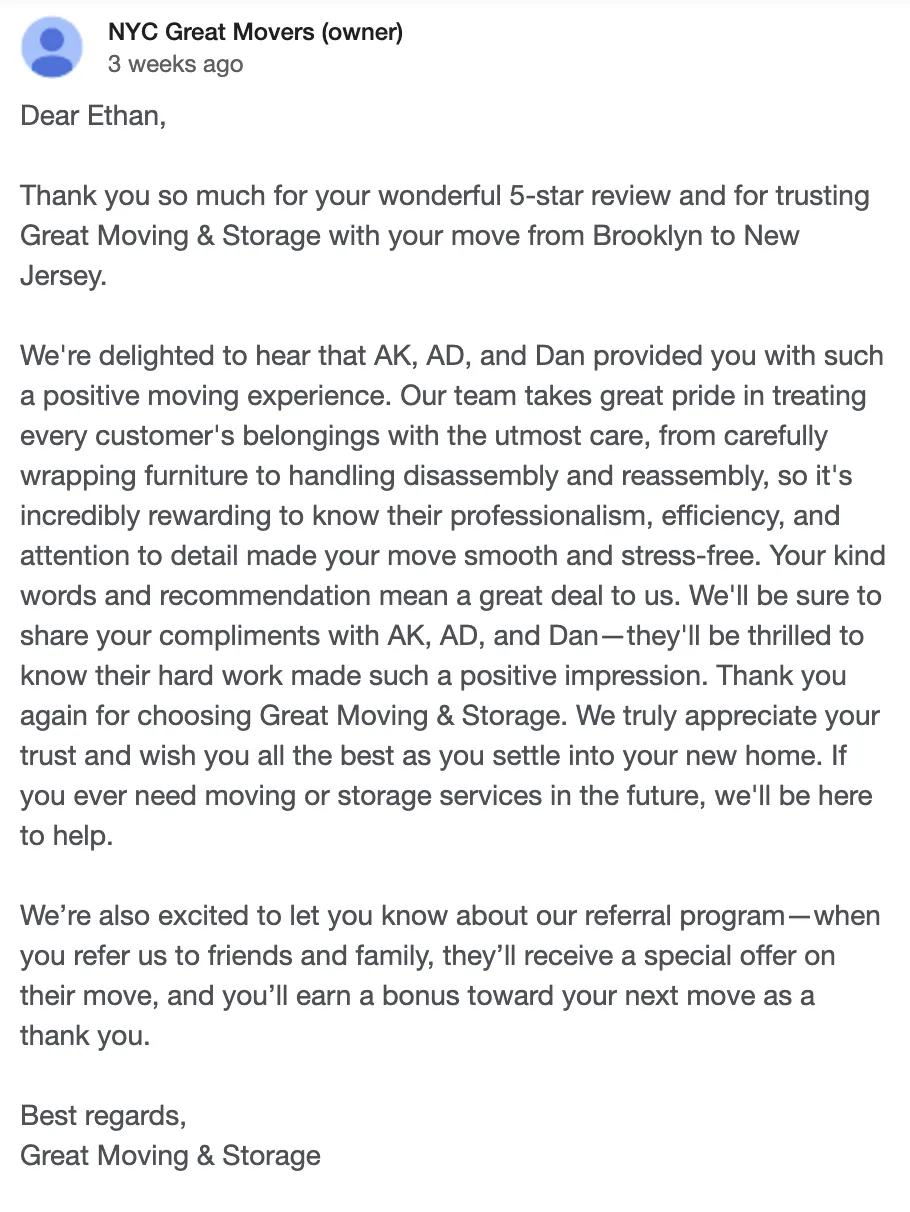
Reply to every review — positive and negative.
-
Encourage customers to mention the city, service type (local, long-distance, office move), and specific crew members. Detailed reviews help both Google and AI systems better understand what your business is known for.
-
Track reviews by branch. One neglected location can damage trust for the entire brand.
Business results: Movers with strong, current reviews show up higher and earn more trust.
Build a Client Referral Engine
The easiest sale you'll ever make is the one that comes from a satisfied customer. 88% of consumers trust recommendations from people they know above all other forms of marketing.
That's why you need to build referral requests into your post-move process instead of hoping word of mouth happens naturally.
How to make referrals work:
-
Send a thank-you email or SMS 3–7 days after the move.
-
Include a unique referral link or code that customers can share in a few clicks.
-
Reward both sides of the referral. You’ll generate significantly more referrals than rewarding only one party.
-
Make the reward simple, such as a gift card, a discount on future services, or a donation to a local charity.
Business results: Referred customers deliver 16% higher lifetime value than customers acquired through other channels.
Support Digital with Direct Mail Services
Yes, actual paper mail. It may feel old-fashioned, but direct mail still earns attention in a world of overflowing inboxes. According to the ANA/DMA Response Rate Report, letter-sized mail achieves an average response rate of 5.3% to house lists, while postcards average 4.4% — far higher than most digital channels.
Meanwhile, Lob's 2025 State of Direct Mail found that 79% of consumers act on direct mail immediately, such as visiting a website, scanning a QR code, or making a purchase.
How to make direct mail profitable:
-
Target neighbourhoods with high moving activity: newly listed homes, recently sold properties, new apartment developments, and areas near major employers.
-
Include a QR code that links directly to a quote request or moving checklist.
-
Personalise the offer with the recipient's city or neighbourhood to increase relevance.
-
Coordinate your mail drops with digital advertising. Coordinated campaigns outperform single-channel marketing by reinforcing brand recall and increasing conversion opportunities.
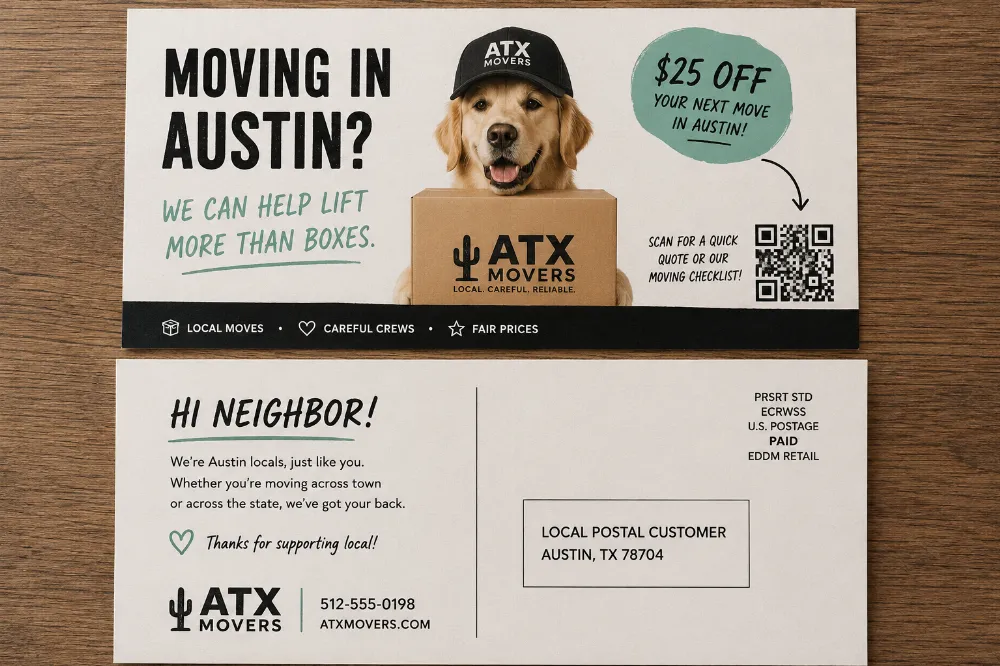
Business results: Rather than competing with dozens of emails or social media posts, your message arrives in a less crowded environment and remains in the home long after a digital ad disappears.
Rely on Local Services Ads
Google's Local Services Ads are the "pay only when someone actually calls" version of advertising, and for moving companies specifically, they punch well above their weight.
Businesses using Local Services Ads can build trust through the Google Guarantee or Google Screened badges, verified licences, and customer reviews, all of which appear directly in the ad before a prospect even visits your website.
How to get better results from LSAs:
-
Create a separate LSA profile for each branch or service area. This allows every location to build its own review profile, service radius, and local relevance.
-
Respond to leads immediately. Google considers responsiveness when determining ad performance.
-
Keep your licence, insurance, and business information up to date to maintain eligibility for the Google Guarantee or Google Screened programme.
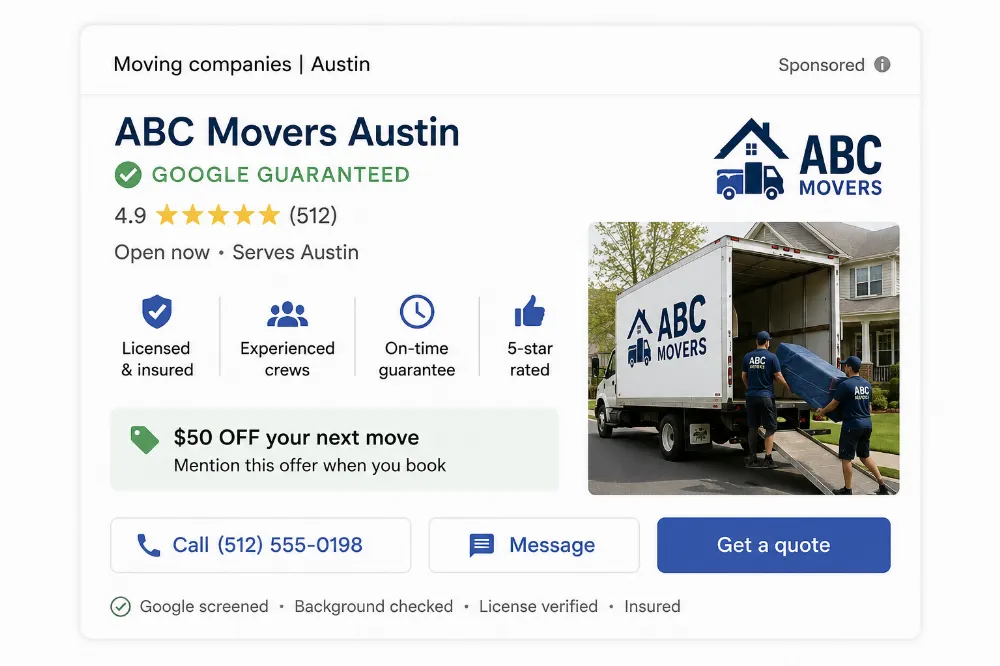
Business results: Businesses that appear with strong trust signals attract more qualified local leads.
Try Affiliate Marketing
Instead of competing for attention online, build partnerships with the businesses your customers already trust. Real estate agents, apartment managers, storage facilities, mortgage brokers, and relocation consultants all interact with people who are actively preparing to move.
Partnership marketing has become a significant revenue driver for many businesses. 74% of brands generate between 11% and 30% of their total revenue through affiliate and partnership marketing.
How to build a successful partner programme:
-
Contact local real estate agencies, apartment communities, storage facilities, mortgage brokers, interior designers, and home organisers.
-
Give each partner a unique referral link or promo code so every booking can be tracked.
-
Offer a simple reward, such as a fixed payment for every completed move or a percentage of the job value.
-
Send monthly performance updates and pay commissions promptly to keep partners engaged.
Business results: Mature partnership programmes contribute more than 28% of total company revenue for leading organisations.
Why Multichannel Marketing Is a Winning Strategy for Movers
Not every marketing channel makes sense for every mover. Here's where each one delivers the biggest impact depending on your company's size.
|
Marketing Channel |
Small Movers (1–5 trucks) |
Growing Movers (5–20 trucks) |
Multi-Location Movers (20+ trucks) |
|
Google Business Profile & Local SEO |
⭐⭐⭐⭐⭐ |
⭐⭐⭐⭐⭐ |
⭐⭐⭐⭐⭐ |
|
Google Local Services Ads (LSAs) |
⭐⭐⭐⭐☆ |
⭐⭐⭐⭐⭐ |
⭐⭐⭐⭐⭐ |
|
Google Search Ads (PPC) |
⭐⭐⭐☆☆ |
⭐⭐⭐⭐☆ |
⭐⭐⭐⭐⭐ |
|
AI Search Optimization |
⭐⭐⭐⭐☆ |
⭐⭐⭐⭐⭐ |
⭐⭐⭐⭐⭐ |
|
Online Reviews & Reputation Management |
⭐⭐⭐⭐⭐ |
⭐⭐⭐⭐⭐ |
⭐⭐⭐⭐⭐ |
|
Referral Programmes |
⭐⭐⭐⭐⭐ |
⭐⭐⭐⭐⭐ |
⭐⭐⭐⭐☆ |
|
Partner Programmes |
⭐⭐⭐⭐☆ |
⭐⭐⭐⭐⭐ |
⭐⭐⭐⭐⭐ |
|
Content Marketing & Local Landing Pages |
⭐⭐⭐☆☆ |
⭐⭐⭐⭐☆ |
⭐⭐⭐⭐⭐ |
|
Email Marketing & Customer Retention |
⭐⭐☆☆☆ |
⭐⭐⭐⭐☆ |
⭐⭐⭐⭐⭐ |
|
Social Media & Short-Form Video |
⭐⭐⭐☆☆ |
⭐⭐⭐⭐☆ |
⭐⭐⭐⭐☆ |
|
Direct Mail |
⭐⭐☆☆☆ |
⭐⭐⭐☆☆ |
⭐⭐⭐⭐☆ |
|
Recommended Focus |
|
|
Small Movers |
Google Business Profile, Reviews, Local SEO, Referral Programme, LSAs |
|
Growing Movers |
Everything above + Google Ads, Partner Programme, Email Marketing, Local Content |
|
Multi-Location Movers |
Full omnichannel strategy: AI Search Optimisation, Local SEO, LSAs, PPC, Reviews, Partner Marketing, Content Marketing, Email, Social Media, Direct Mail, and PR |
Real-Life Case Study: H2H Movers’ Approaches
H2H Movers, a Chicago-based moving company, quickly realized that referrals alone weren’t enough to compete with national franchises and lead aggregators crowding the search results.
They partnered with Netpeak US to build a multi-channel strategy that could generate steady lead flow from Chicago and the surrounding areas. Here are the online marketing approaches they used to achieve the goal.
|
Channel |
Online Marketing Approaches |
|
Pay-Per-Click |
|
|
Social Media Mover Marketing |
|
|
Retention Mover Marketing |
|
The Results
-
+135% increase in Google Ads conversions
-
+35% increase in CPA (growth without runaway costs)
-
Stronger brand visibility across Chicago and the surrounding regions
-
Higher lead quality from users ready to book
If you want to replicate their success in marketing for movers, contact us at Netpeak US! We are both a PPC agency for a moving company and an SEO agency for a moving company, so we can handle all your marketing tasks.
Final Thoughts
Moving company digital marketing comes down to one simple goal: be there when someone needs a mover — and make choosing you the easiest decision of their day.
The good news is you don’t need a massive budget to win. A solid presence in local search, a trustworthy Google Business Profile, and smart use of ads are enough.
Done right, digital marketing for moving company works quietly in the background — bringing in leads while you’re busy managing trucks, crews, and last-minute surprises.
FAQ
What is the best online marketing for movers strategy?
A mix of local search engine optimization, Google Search Ads, and Google Business Profile optimization works best. SEO builds long-term visibility, while ads bring immediate moving leads. Together, they balance fast results with sustainable growth.
How much should you spend on online marketing for moving companies?
Most movers invest 5-10% of their monthly revenue. In competitive cities, allocating more to paid search during peak moving season pays off faster. The goal is to spend where demand is highest, not evenly all year.
Does SEO work for local movers?
Yes. Local SEO helps movers rank for “movers near me,” appear on Google Maps, and capture high-intent customers who are ready to book. These leads are often cheaper and more consistent over time than paid ads.
How long does it take to generate online leads?
Paid ads can generate leads in days, while SEO usually takes 3–6 months to deliver consistent, low-cost moving leads. Your moving company internet marketing should use both to cover short-term needs and long-term stability.

 0
0
 0
0
 0
0
 0
0
Related Articles
Selling on Amazon Europe in 2027: How to Choose Your First EU Market and Build a Successful Business
This guide helps you sell on Amazon Europe without spreading yourself thin. It gives you a marketplace comparison, a weighted scorecard, a fulfillment decision table, and a 90-day launch plan.
What Vibe Coding Means for Business: No Coding Skills, One Weekend, One SaaS
Vibecoding is changing the rules for front-end development and opening up new opportunities for businesses, but there are some nuances to consider.
Amazon's AI Now Builds Complete Looks on Product Pages. How Do Brands Make Sure the Bundle Is Theirs?
Amazon now uses AI to assemble complete, shoppable looks around a single product, and it fills those looks with whichever brands its model picks.