
Pet Brands Must Win Amazon AI Discovery as Alexa Drives 6× More PDP Traffic
Amazon product detail page views coming from Alexa for Shopping grew roughly 6x between June 2025 and May 2026, a 490% increase on an indexed basis (Similarweb, 2026). Those shoppers never typed a keyword. An AI read your listing, cross-checked it against your reviews, decided your product was the answer, and handed the customer a card with your kibble on it.
That is a new front door to your PDP, and most pet brands are still decorating the old one.
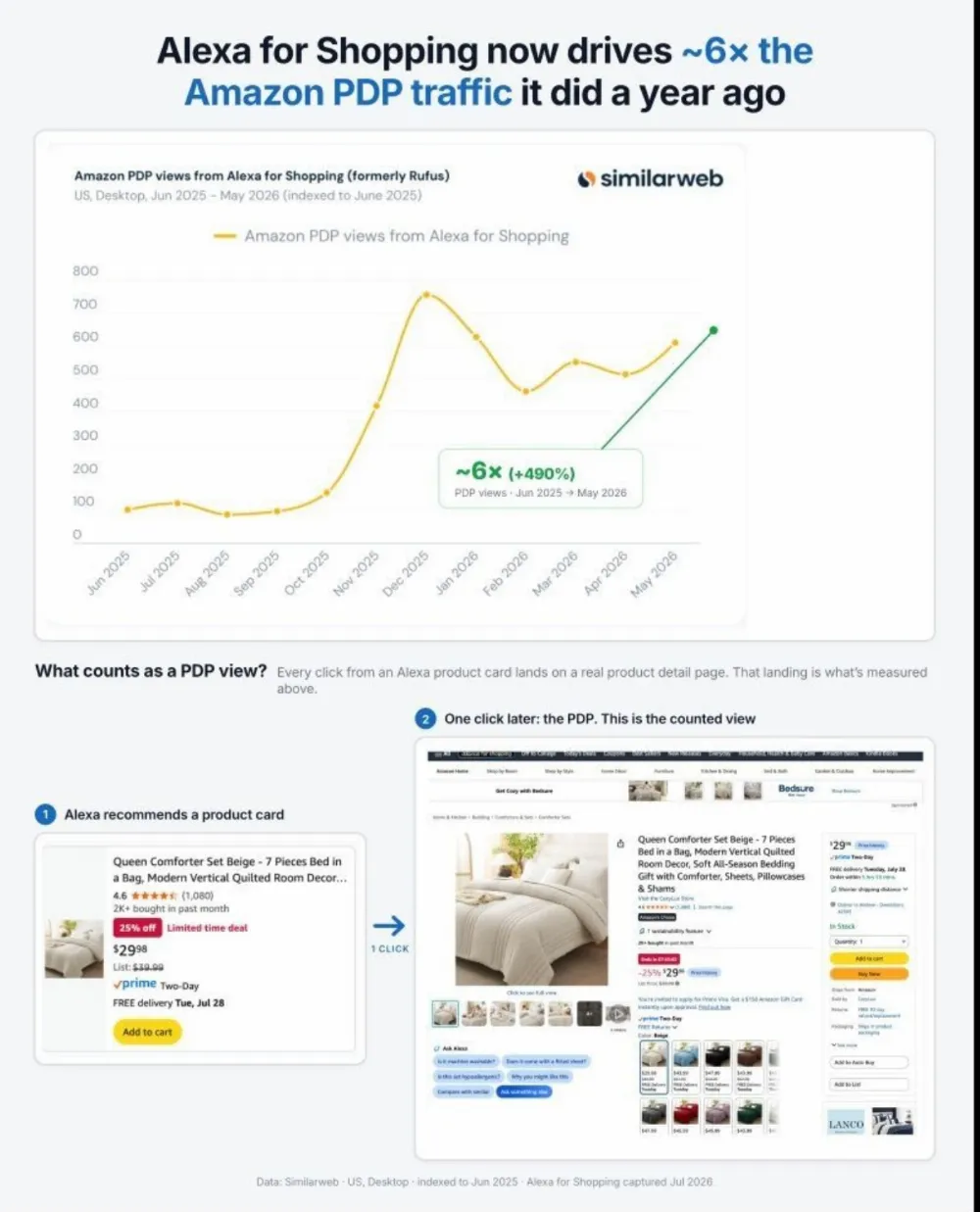
Amazon PDP views from Alexa for Shopping (formerly Rufus). US, desktop, June 2025 to May 2026, indexed to June 2025. Source: Similarweb, 2026.
How Much Traffic Does Alexa for Shopping Send to Amazon Product Pages?
Similarweb tracked US desktop PDP views from Alexa for Shopping, formerly Rufus, over the 12 months to May 2026, indexed to June 2025. The series held near baseline through September 2025, climbed steeply through Q4, peaked above 700 in December 2025, and closed May 2026 near 620. That is a 490% net increase (Similarweb, 2026).
Amazon's own numbers agree. Rufus served more than 300 million customers in 2025, and on the Q1 2026 earnings call CEO Andy Jassy said monthly active users rose more than 115% year over year with engagement up close to 400% (Amazon, 2026).
On May 13, 2026, Amazon retired the Rufus brand and moved the voice assistant out of a side chat panel and into the main search bar, live by default for signed-in US customers (Amazon, 2026). The chart ends the month that shipped. The surface area got bigger after the last data point, not before it.
The short version for your Q4 planning deck
Alexa for Shopping traffic grew about 6x in 12 months, and Amazon then moved the assistant into its highest traffic real estate. Your PDP is now read twice: once by a shopper, once by a model deciding whether to show you at all.
What Counts As an Alexa for Shopping PDP View?
Every product card the assistant surfaces links to a real product detail page. The shopper taps the card and lands on your standard PDP: main image, bullets, Amazon A+ content, reviews, Buy Box. That landing is the view counted in the Similarweb series (Similarweb, 2026).
This carries an analytical consequence. Alexa for Shopping traffic does not appear as its own channel in Seller Central. It lands on the same page as keyword traffic and converts against the same content, so the volume trend matters more than any single session attribution.
Why AI-Mediated Discovery Hits Pet Brands Harder Than Most Categories
US pet industry expenditures reached $158 billion in 2025, up 3.7% year over year, and APPA projects $165 billion for 2026 (APPA, 2026). The global pet care e-commerce market was $94.89 billion in 2024 and Grand View Research forecasts $147.59 billion by 2030, a 7.8% CAGR (Grand View Research, 2025). Hence, the US pet e-commerce niche is very concentrated, so adapting to the AI-discovery trend is a must rather than an option if you want your business to stand out in the crowd.
Four features of the category make it unusually exposed to conversational discovery:
- Constraint-heavy queries. Pet buyers shop against specifications rather than brand names: weight range, life stage, protein source, allergens, breed size. An assistant handles a five constraint request better than a keyword box does.
- Replenishment behavior. NIQ found 10% of US consumers used a voice assistant to buy or reorder items in the past month, and another 10% engaged with an AI shopping assistant (NIQ, 2026). Reorder is the core of pet food and supplements.
- Review dependence. The assistant cross-references listing claims against reviews and community Q&A before recommending. Pet reviews carry very specific outcome language about coat, stool, joints and appetite.
- A high adoption ceiling. NIQ reported 42% of US consumers used at least one AI tool to shop within the past month, from a monthly sample of about 500 US consumers in early 2026 (NIQ, 2026).
Keyword Shopper vs Alexa for Shopping Shopper: What Changes on Arrival
The two visitors land on the same page in a different state of mind. One is still shopping. The other has already been told what to buy and is looking for a reason to disagree.
|
Dimension |
Keyword search shopper |
Alexa for Shopping shopper |
|
Entry point |
Search results grid |
Product card inside an AI answer |
|
Query form |
Two to four keywords |
Full sentence with stacked constraints |
|
Pre-qualification |
Low, still comparing several options |
High, options already narrowed by the model |
|
Visibility driver |
Indexed keywords, sales velocity, ad bid |
Attribute completeness, review agreement, semantic fit |
|
Job of the PDP |
Persuade the shopper to choose you |
Confirm the constraints the shopper already stated |
|
Typical failure mode |
Loses to a cheaper listing in the grid |
Never gets surfaced in the answer at all |
The last row is the expensive one. A listing that loses in the grid at least generates an impression you can measure. A listing the AI model skips generates nothing, and nothing looks identical to normal in your dashboard.
Wanna be up to date with the latest Amazon updates that affect your pet brain in 2026? Check our other articles:
Five Fixes for Your Pet PDP Before Q4 2026
None of this requires a rebuild. It requires finishing the parts of your listing everyone treats as optional, so you can compete with big pet brands in the AI-discovery race.
1. Answer constraint questions in the bullets, not in A+ content
Write bullets that resolve the questions a shopper actually stacks: life stage, weight range, primary protein, grain status, allergens excluded. Put those facts in the first eight words of each bullet. A+ content is an image module, and the assistant treats it as weaker source material.
Watch out: Do not stuff five constraints into one bullet to save space. One claim per bullet reads cleanly for both audiences.
2. Fill every backend attribute field, including the ones nobody checks
This is your mise en place. The assistant reads what is already prepped and it does not wait while you chop. Breed size, age range, item form, flavor, special diet and target species all feed the model directly. Half-filled attribute sets are the most common reason a good product never appears in an AI answer.
Watch out: Attributes reset silently after a category recategorization. Re-audit any ASIN that changed the browse node in the past six months.
3. Make your claims and your reviews align
If your bullets promise a sensitive stomach formula and your top reviews describe digestive trouble, the model reads the contradiction and routes around you. Pull your last 90 days of reviews, tag recurring complaints, then fix the claim or fix the product. Your dog is not the one filing the mismatch report.
Watch out: Do not edit a claim without updating the A+ content and the brand store. Inconsistency across your own surfaces is its own negative signal.
4. Give Subscribe & Save its own line of copy
Replenishment is your best defense against AI-mediated switching, and the assistant can only weigh an offer it can read. State the discount tier, the cadence options and the cancellation terms in plain text on the PDP. Do not leave it to the badge alone.
Watch out: Confirm your Subscribe & Save discount is live on every child ASIN. Parent-level assumptions break at the variation level more often than teams expect.
5. Audit your Sponsored Products prompts every month
Amazon generates AI prompts against your sponsored placements and reports them back. Download the report, disable prompts that describe a product you do not sell, and reinforce the useful ones with matching PDP copy. It takes about 20 minutes and almost nobody does it, which is why it’s still a useful lifehack.
Watch out: Expect ACoS and new-to-brand rate to wobble for 30 to 60 days after any prompt changes. Do not judge the change within two weeks.
What to Watch for Through the Rest of 2026
Observe three things:
-
Whether the traffic curve keeps climbing now that the assistant sits in the main search bar.
-
Whether Amazon ever exposes AI-attributed reporting in Seller Central.
-
How scheduled restocks and auto-buy change repeat purchase behavior in food and supplements.
The strategic point is simpler than the tooling. Your PDP stopped being only a sales page and became a data source. It still has to sell, but first it has to be legible to something that does not care about your brand story and cares enormously about whether you filled in the protein field.
Netpeak USA runs PDP and content audits for pet brands on Amazon, including attribute completeness scoring and review-to-claim alignment. If your listings were written for a keyword box, they are now being read by something else.
Bonne chance — and may your Subscribe & Save conversion rate be ever in your favor !
Frequently Asked Questions
What is Alexa for Shopping and what happened to Rufus?
Alexa for Shopping is Amazon's conversational AI shopping assistant. Amazon retired the standalone Rufus chatbot on May 13, 2026 and merged its product knowledge with Alexa+ personalization into one assistant. It runs in the main Amazon search bar, the Amazon Shopping app, Amazon.com and Echo Show devices. It is free for signed-in US customers and requires no Prime membership and no Echo device (Amazon, 2026).
How much Amazon PDP traffic comes from Alexa for Shopping?
Similarweb data for US desktop shows Amazon PDP views originating from Alexa for Shopping rose roughly 6x, or 490%, between June 2025 and May 2026 on an index set to June 2025 (Similarweb, 2026). Amazon separately reported Rufus monthly active users up more than 115% year over year in Q1 2026 (Amazon, 2026).
Can I see Alexa for Shopping traffic separately in Seller Central?
No, Amazon does not currently break out assistant-originated sessions as a distinct traffic source in Seller Central reporting. Those visits land on the standard product detail page and appear inside your existing session and page view totals.
Does Amazon advertising affect whether Alexa for Shopping recommends my product?
They are separate systems that interact. Amazon generates AI prompts against Sponsored Products placements and reports them in the Sponsored Products Prompts Report, which sellers can check and adjust. Organic assistant recommendations depend on listing completeness, review quality and semantic fit rather than bid level.
What should a pet brand fix first to get recommended by Alexa for Shopping?
Start with backend attribute completeness: life stage, weight range, primary protein, item form, special diet and target species. Incomplete attribute sets are the most common reason a qualified product never appears in an AI answer. Fix contradictions between listing claims and recent Amazon reviews second.
Does Alexa for Shopping work on Amazon marketplaces outside the US?
The May 2026 rebrand rolled out first in the US. Other marketplaces may still show Rufus branding or a reduced feature set. Brands selling across several locales should evaluate assistant behavior marketplace by marketplace rather than assuming parity with Amazon.com.

 0
0
 0
0
 0
0
 0
0
Related Articles
What Vibe Coding Means for Business: No Coding Skills, One Weekend, One SaaS
Vibecoding is changing the rules for front-end development and opening up new opportunities for businesses, but there are some nuances to consider.
Pet Food Product Patent: How to Protect Your Innovation
Patenting pet products requires careful consideration and proper application filing. With the 8 steps below, you will be able to submit your patent application and protect your invention.
Business Apps in the US: iOS vs. Android, August 2026
We’ve fetched data from the US App Store and Google Play to see what professionals, shoppers, and businesses are actually installing, and why the market leaders are winning right now.