
My US Pet Parcel to the EU Now Costs 3€ More. What Next?
If you sell products to Europe, you might notice your shipping costs going up. The EU has replaced the old €150 duty-free limit with a fixed fee on low-value parcels, which changes how cross-border e-commerce works for US businesses.
The good news is you can still sell to European customers. You just need to rethink your shipping approach. If you review your fulfillment strategy, landed costs, and inventory flows now, you can protect your margins.
This guide will explain what the new parcel tax means, how it affects US sellers, and what you can do now to lower costs and keep your European business profitable.
The 30-second version:
-
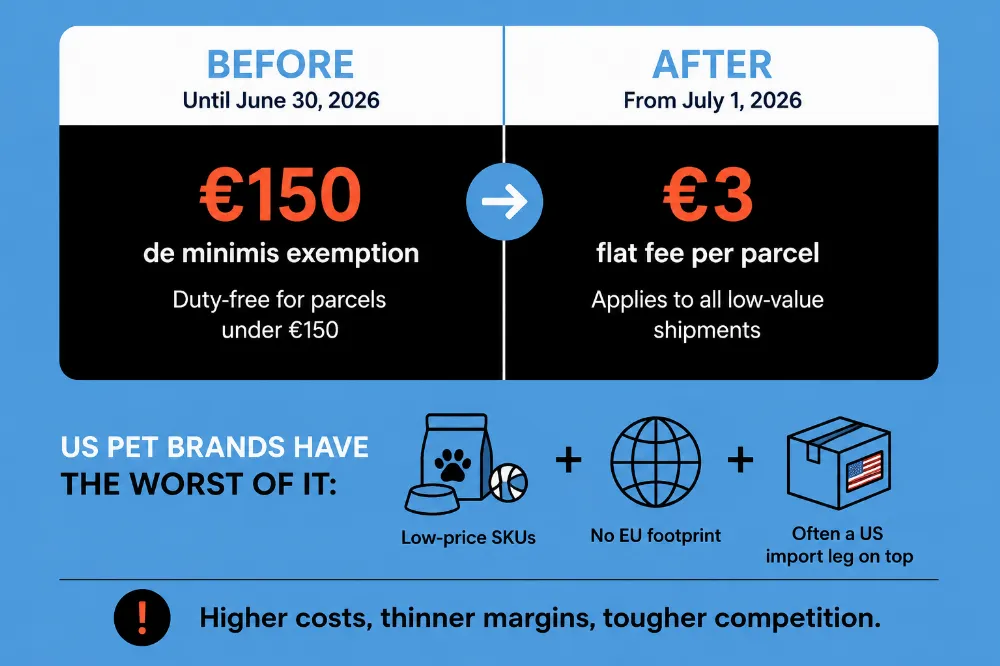
On July 1, 2026, the EU scrapped its €150 duty exemption for low-value parcels and replaced it with a €3 flat customs fee. It applies to every non-EU parcel under that threshold, including the ones you ship from a US warehouse to a customer in Munich.
-
The rule was written to tax Shein and Temu, but they had already stepped around it by pre-positioning inventory inside the EU.
-
US pet brands have the worst of it: low-price ASINs, no EU footprint, and often a US import leg on top.
-
So, what actions should US pet brands take?
-
First, check the landed cost for every EU order shipped from your US warehouse.
-
Avoid sending China-made products through the US before they reach EU customers.
-
Combine EU shipments that are above the €150 threshold.
-
Finally, update your EU category pages to reflect Temu's current costs instead of the previous ones.
What the EU Actually Changed on July 1, 2026
The EU abolished the €150 duty exemption for parcels arriving directly from outside the bloc. A €3 flat customs handling fee replaced it, charged per parcel (European Commission, 2026).
-
It applies across all 27 member states to every non-EU consignment under €150 (European Commission, 2026).
-
Low-price ASINs shipped directly from China, the US or the UK all carry a new per-parcel cost line.
-
Consolidated shipments above €150 stay on the standard customs path and carry no flat fee.
Enforcement is the part nobody budgeted for. Customs authorities in Germany, France, Italy, Spain and the Netherlands read the "responsible party" clause differently. A mismatch surfaces as a surprise invoice, not a rejected parcel.
Want to stay up to date on all the latest Amazon updates, like this one? Check out our other articles below!
How Shein and Temu Bypassed the €3 Duty
Both platforms moved a meaningful share of EU-bound inventory into warehouses inside the EU before July 1 (Carra Globe, 2026). Orders dispatched from a French, German, or Polish 3PL count as domestic, not as cross-border imports. The €3 fee does not apply.
Shein built that network over roughly two years. Temu accelerated through the first half of 2026. The rule is live. The volume it was written to tax largely walked around it first.
Why the Fee Lands Hardest on US Pet Brands Selling in the EU
Temu did not lobby against the rule. It rented a pied-à-terre in Poland. The answer was logistics, not legal counsel, and that is the part US pet brands keep missing.
Start with why you are in Europe at all. APPA puts total US pet industry expenditure at $158 billion in 2025, up 3.7%, with 2026 projected at $165 billion (APPA, 2026). APPA also projects 2026 growth near 4.4%, of which roughly 2% comes from inflation. Strip the inflation out, and your home market grows about as fast as a sleeping cat.
Europe is the answer most US pet brands reach for. A global pet care market is projected to be nearly USD 225 billion for 2026, with Europe at just under one-third of it (Euromonitor International, 2026). Grand View Research values Europe's pet supplements market at USD 846.8 million in 2025. Europe also held a 35.7% revenue share of the global pet toys market that year (Grand View Research, 2026).
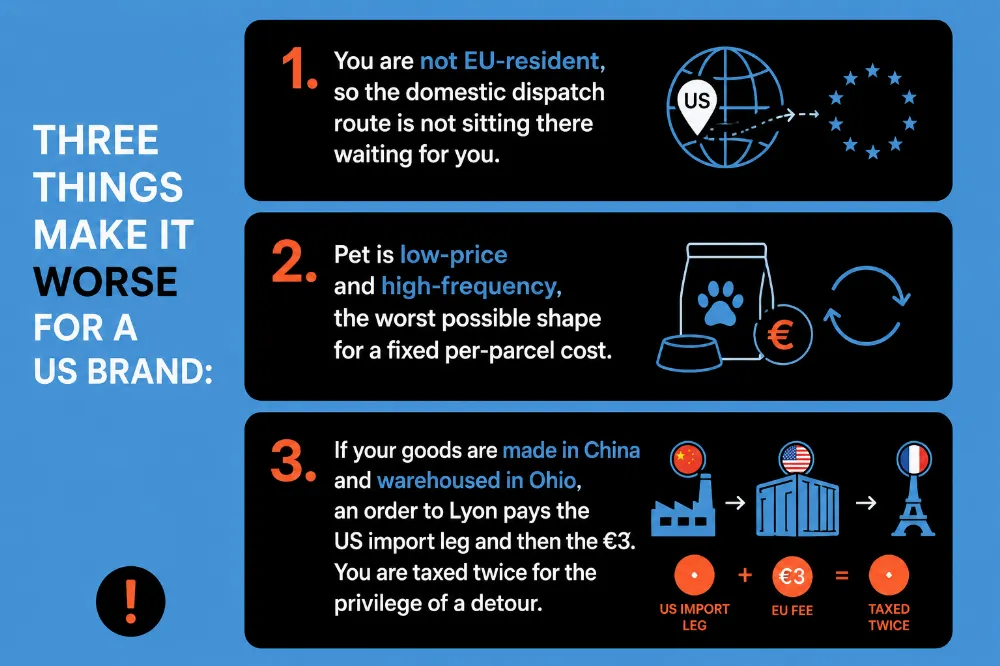
The expansion plan and the fee collide head-on. Three things make it worse for a US brand than a German one.
-
You are not EU-resident, so the domestic dispatch route is not sitting there waiting for you. Shein and Temu had to build it. So do you.
-
Pet is low-price and high-frequency, the worst possible shape for a fixed per-parcel cost. A €3 line on a €12 chew toy is 25% of retail before a single cent of COGS. The same €3 on a €400 consolidated pallet rounds to noise.
-
If your goods are made in China and warehoused in Ohio, an order to Lyon pays the US import leg and then the €3. You are taxed twice for the privilege of a detour.
Frequency finishes the job. Owners restock monthly, not annually, so the line lands 12 times a year again, per ASIN, per customer. Your cat does not care about customs reform. Your contribution margin does.
Read more Amazon pet category deep dives here:
Three Routes Into the EU, Priced for a US Brand
Most US pet brands are running the first row. July 1 repriced all three, and not equally.
|
Route |
Fee treatment |
Speed to customer |
Working capital |
Best for |
|
US 3PL direct to EU customer (FBM export) |
€3 flat fee on every parcel under €150 |
6 to 12 days |
Lowest |
Demand testing, long-tail ASINs |
|
Consolidated inbound above €150 into EU FBA or 3PL |
Standard customs path, duty and VAT, no flat fee |
Prime speed once landed |
Highest |
Proven-velocity ASINs with clean forecasts |
|
China direct to an EU 3PL, skipping the US leg |
No US import duty, no flat fee once domestic |
1 to 3 days |
High |
China-made ASINs with real EU volume |
Read it as a ladder, not a menu. Move ASINs up as velocity proves out.
What US Pet Brands Should Do in the Next 30 Days
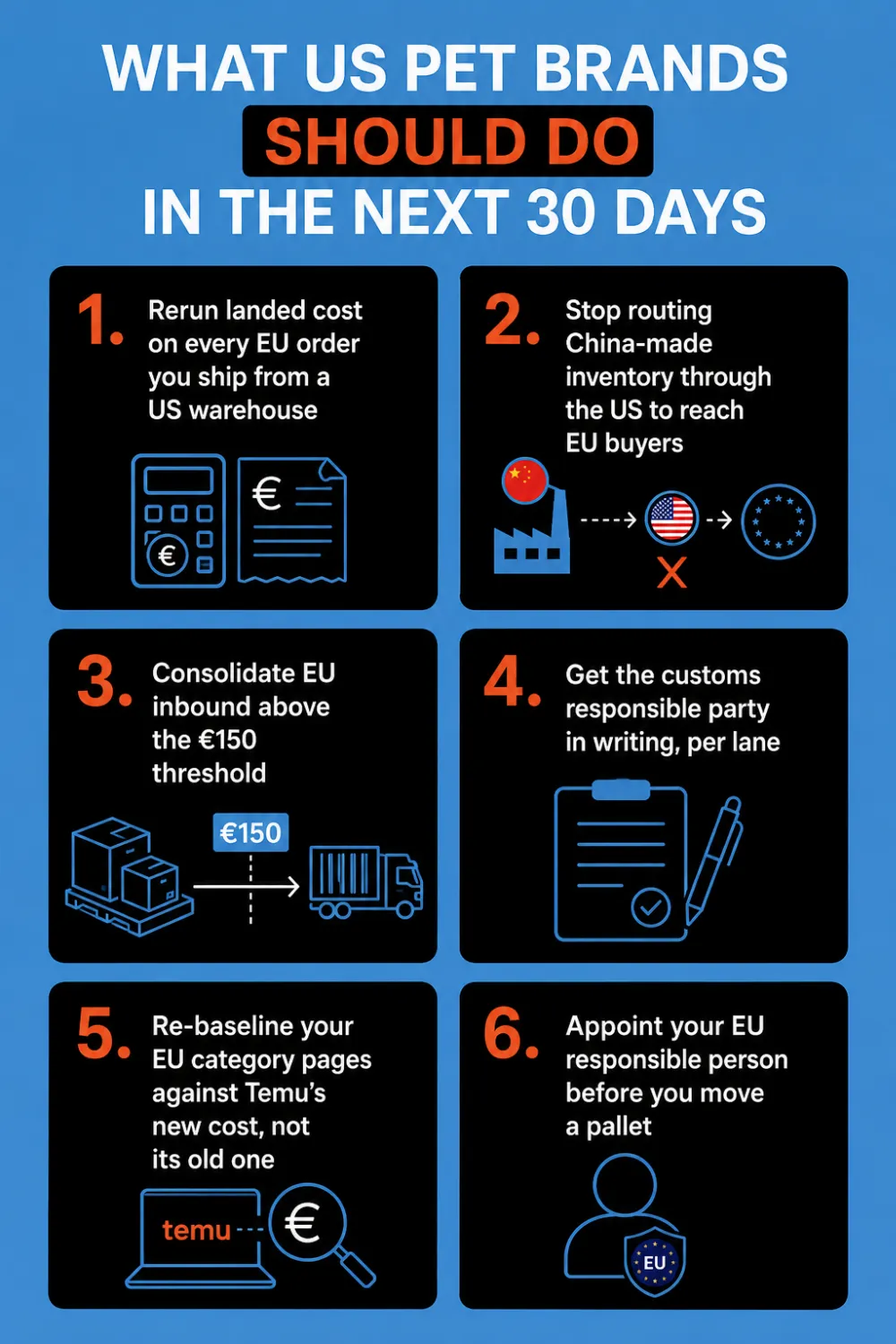
1. Rerun landed cost on every EU order you ship from a US warehouse
Add the €3 line to every parcel under €150 and recompute contribution by ASIN. Anything under 10% needs a repricing decision this week.
Watchout: treats, single toys, and sample-size supplements flip first. They also feed your acquisition funnel, so check what dies downstream before you delist.
2. Stop routing China-made inventory through the US to reach EU buyers
If an ASIN is made in Asia and sells in Europe, the US warehouse is a detour that now costs you twice. Ship it from China to the EU and cut the US leg out.
Watchout: your ops team built the US hub for a reason, usually QC or kitting. Move the process, not just the pallet.
3. Consolidate EU inbound above the €150 threshold
Batch inbound lots above €150 where velocity supports it. Those follow the standard customs path, not the flat-fee regime.
Watchout: do not over-order slow movers to clear the threshold. €3 saved on a pallet of cat sweaters nobody wanted is a storage fee with extra steps.
4. Get the customs responsible party in writing, per lane
Confirm with your forwarder or 3PL who is booked as payer for Germany, France, Italy, Spain and the Netherlands. Per lane, in writing.
Watchout: a mismatch does not stop the parcel. It arrives four weeks later as an invoice nobody modelled.
5. Re-baseline your EU category pages against Temu's new cost, not its old one
Chinese and Turkish sellers on your category pages will absorb, reprice or consolidate. Watch the Buy Box weekly. Hold price where a competitor moves up.
Watchout: the regulation did not level the field for you. It levelled it for the platforms that already owned warehouses.
6. Appoint your EU responsible person before you move a pallet
The EU's General Product Safety Regulation requires an EU-based responsible person, named on the listing, for products sold into the bloc. A US entity cannot fill that role for itself.
Watchout: for pet food and supplements, this is a compliance project, not a shipping change. FEDIAF labelling, batch traceability and shelf-life rules travel with the pallet.
The Next EU Rule Will Be Harder to Warehouse Around
Here is the medium-term read, and it is the one for your board. Parcel-level regulation is easy to route around with a warehouse. Marketplace liability and product-safety rules are not.
GPSR already puts a named EU entity on the hook for your listing. The Customs Union reform arriving by 2028 pushes the same way. Both rules ask a US brand the same question: who in Europe answers for this product?
So treating July 1 as a logistics story is the trap. Build an EU presence purely to dodge €3, and the next rule will ask for a legal entity, an ingredient panel, and a traceable batch record. You can warehouse your way around a customs fee. You cannot warehouse your way around a label.
Netpeak USA has run marketplace go-to-market across more than 100 brand cases, and the pattern repeats. Brands that treat compliance as infrastructure launch faster. Build for 2028, and the €3 problem solves itself on the way.
Bonne chance, and may your Subscribe & Save conversion rate be ever in your favor!
Frequently Asked Questions
What is the EU's €3 flat customs fee and when did it start?
It is a temporary flat customs handling fee on non-EU parcels valued under €150, effective July 1, 2026. It replaced the previous €150 duty exemption. The measure runs until July 1, 2028 at the latest, or until the full EU Customs Union reform takes over (European Commission DG TAXUD, 2026).
Does the €3 EU fee apply to parcels shipped from the United States?
Yes. It applies to any non-EU consignment valued under €150, whatever the origin country. Low-price ASINs shipped direct from China, the US or the UK all carry the new per-parcel cost line (Nova Analytics, 2026). A US pet brand shipping DTC to EU customers from a US warehouse pays it on every qualifying order.
How did Shein and Temu avoid the €3 EU duty?
Both moved a meaningful share of EU-bound inventory into EU warehouses before July 1, 2026. Orders shipped from a French, German, or Polish 3PL are domestic dispatches, not cross-border imports, so the flat fee does not apply. Shein built the network over roughly two years; Temu accelerated in the first half of 2026 (Carra Globe, 2026).
Does the €3 fee apply to inbound FBA shipments into the EU?
It applies to consignments valued under €150. Consolidated inbound shipments above €150 follow the standard customs path with duty and VAT, and carry no flat fee. Brands sending small replenishment lots below the threshold carry the €3 line in COGS on every parcel.
Which pet ASINs are most exposed to the EU low-value import fee?
Low-price, high-frequency ASINs shipped in small lots: treats, single toys, hygiene items, collars and sample-size supplements. A €3 fixed fee is a far larger share of retail on a €12 item than on a €60 one. Europe held a 35.7% revenue share of the global pet toys market in 2025, so the exposed catalog is large (Grand View Research, 2026).
Should a US pet brand move inventory into an EU warehouse?
For proven-velocity ASINs, EU-based inventory removes the flat fee and shortens delivery times. It also requires an EU-based responsible person under GPSR. For pet food and supplements, it triggers FEDIAF labelling, batch traceability and shelf-life rules. Model the compliance cost alongside the duty saving before committing volume.

 0
0
 0
0
 0
0
 0
0
Related Articles
Pet Food Product Patent: How to Protect Your Innovation
Patenting pet products requires careful consideration and proper application filing. With the 8 steps below, you will be able to submit your patent application and protect your invention.
Digital Marketing for SMBs: How to Grow a Small Business Online
Small or mid-sized businesses compete for the same customers as brands with marketing departments ten times their size, on a fraction of the budget. You can't outspend them, so you have to outsmart them and grow your business deliberately.
How UGC and Algorithms Turn Content Into Viral Trends
Let’s break down how UGC, audience behavior, and recommendation algorithms work together to make something go viral. And how you can use this information to help your business grow.