
Amazon Is Changing How Your Pet Brand Displays Prices — Act Before May 18
Amazon is tightening its reference pricing rules in two waves — April 23 and May 18, 2026. If your pet brand:
-
Runs “Subscribe & Save” on kibble
-
Stacks coupons on supplements
-
Shows an MSRP (Manufacturer's Suggested Retail Price — the price a manufacturer recommends that retailers charge customers for a product) on a flea collar that never sold at that price anywhere
You need to check your listings today.
The changes kill inflated MSRPs and punish chronic discounters by recalculating their “sale” baseline downward. Your strikethrough price may disappear, your promotions may stop qualifying for deals, and your conversion rate will be affected before you even notice.Your dog forgives everything. Amazon does not.
What Amazon Is Actually Changing
Amazon announced two distinct updates to reference pricing. They target different mechanics, but they all have the same goal: to make discounts reflect reality.
Change 1: “List Price” (RRP) Validation — Effective April 23, 2026
Amazon will now validate any “List Price” you submit. To show a “List Price” on your product detail page, your product should:
-
Be offered at that “List Price” at another retailer recently, OR
-
Be purchased by customers as the “Featured Offer” on Amazon at that “List Price”.
So, this ends the common practice of setting an artificially high MSRP (Manufacturer's Suggested Retail Price) to make a 40% discount look more dramatic than it is.
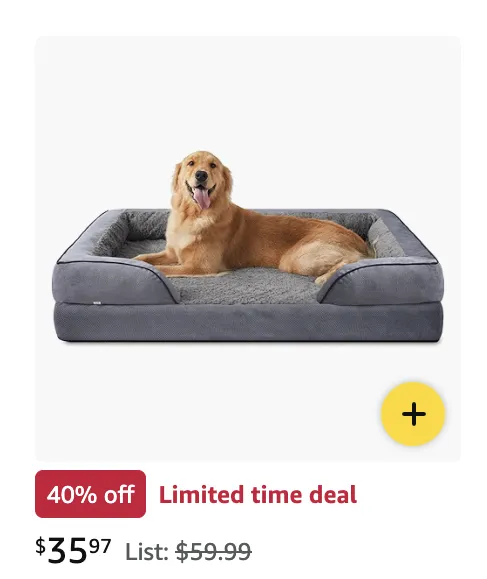
If your premium grain-free dog food has never actually sold at $89.99 anywhere, Amazon will likely remove that reference price altogether.
The specific implication for pet brands: Specialty and DTC-first brands that don't sell widely at retail are especially exposed here. If your “List Price” only exists as a number in your Seller Central back end, it will not survive validation.
Change 2: “Typical Price” Recalculation — Effective May 18, 2026
“Typical Price” is the median price that customers paid for a product over the last 90 days. Promotional prices are usually excluded from this calculation because they are meant to be temporary.
After May 18, if a product's “Featured Offer” price is below its prevailing non-promotional price for more than half of the 90-day period, Amazon calculates “Typical Price” using all sales, including promotional ones.
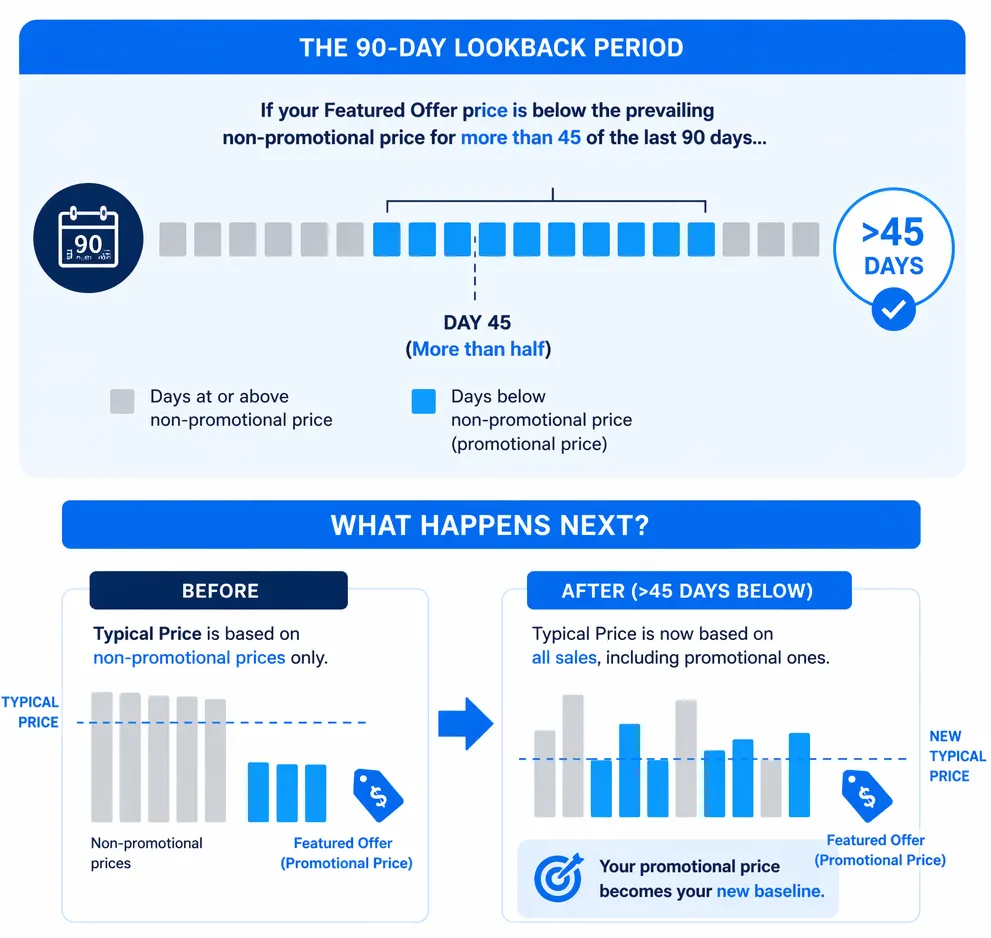
Note: Sales during peak events, including Prime Day, are always excluded from the “Typical Price” calculation regardless of this rule.
Side-by-side summary of both changes:
|
“List Price” (RRP) |
“Typical Price” (Was Price) |
|
|
Effective date |
April 23, 2026 |
May 18, 2026 |
|
What it is |
The reference price you manually submit (MSRP) |
The 90-day median price customers actually paid |
|
New requirement/trigger |
Must be verifiable at another retailer or via historical Amazon sales |
If >50% of the 90-day price history is below the non-promo median, recalculates using all sales |
|
Primary risk for pet brands |
Suppressed “List Price” — discount looks smaller or disappears |
Promotional price absorbed into baseline — sale badge and strikethrough removed |
|
Who is most exposed |
Brands with MSRPs not verifiable at retail |
Brands running always-on S&S discounts, perpetual coupons, or chronic price reductions |
Why Is Amazon's Pet Category Ground Zero for This Change?
Pet supplies are not a typical Amazon category. It is based on subscriptions, loyalty pricing, and repeat purchases. And Amazon's new “Typical Price” rule targets all of that.
According to the American Pet Products Association (APPA, 2024), the US pet industry spending reached $158B. E-commerce — led by Amazon — captures a huge share of consumables: food, supplements, treats, and flea and tick prevention.
These are the exact product types where “Subscribe & Save”, always-on coupons, and bundle discounting are table stakes.
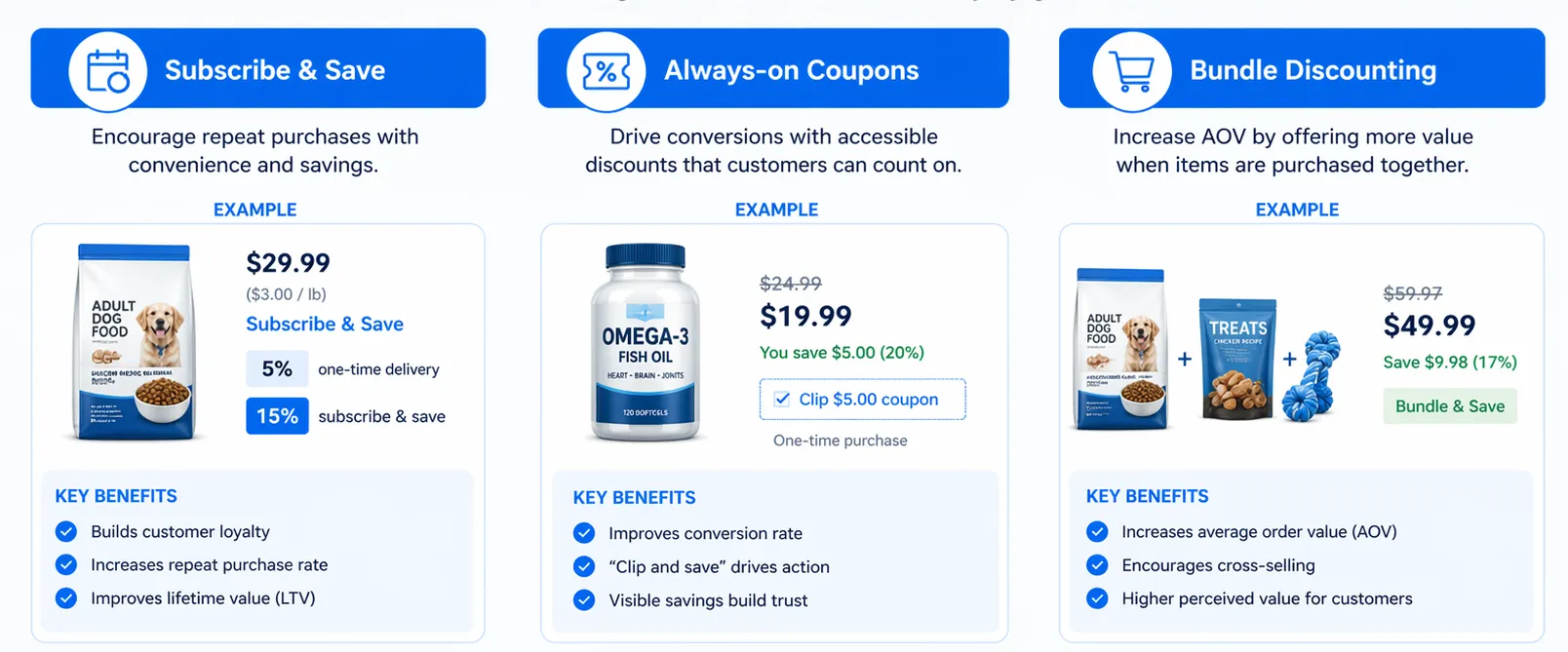
Online channels are growing faster than brick-and-mortar. And every percentage point of that growth comes from repeat-purchase buyers locked in at discounted S&S prices.
Amazon's rule change hits the economics of that model.
Which of The Three Pet Brand Profiles Are Most at Risk?
Profile A: The “Subscribe & Save”-Heavy Brand
Think of Amazon-native pet food brands that have built their entire growth model on subscription lock-in: The Farmer's Dog, Ollie, Nom Nom, Spot & Tango. These brands sell premium fresh or gently cooked food at $80-120 per month per dog, with S&S discounts that make the math work for the consumer.
“Subscribe & Save” is not just a promotion for these brands, but the basis of the product. Almost every order goes through S&S.
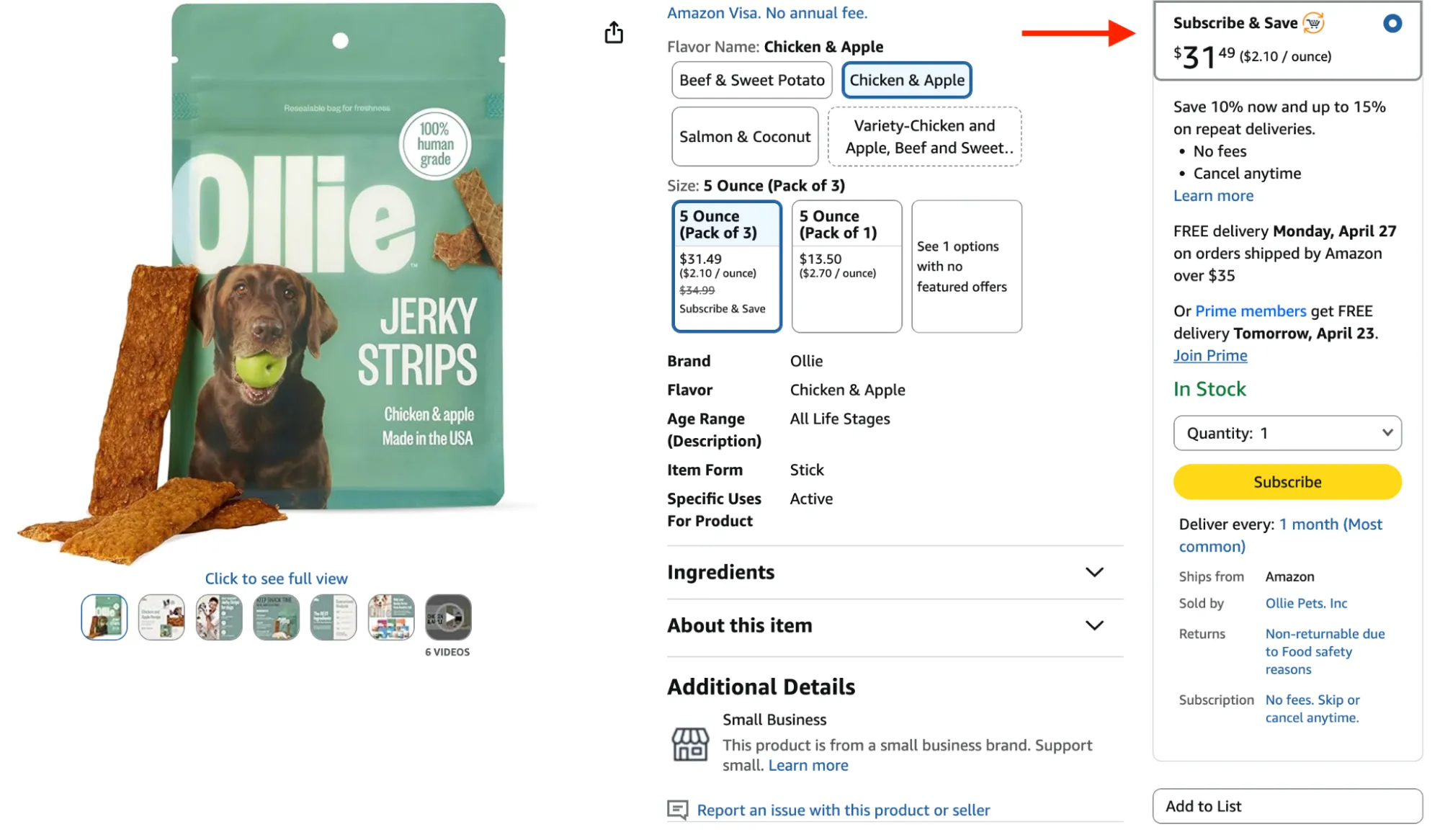
So, if the S&S price is the price customers pay on more than 50% of days in the 90-day window — and it almost certainly is for subscription-first brands — and if other discounting behavior (coupons, price reductions) is also in play, the S&S price risks becoming the “Typical Price” baseline.
The “regular” price stops anchoring value, and the subscription no longer feels like a privilege.
This matters at the category level. Brands that have built their Amazon flywheel around S&S must protect their pricing structure.
Profile B: The Supplement Brand with a Phantom MSRP
The US pet supplement category is flooded with Amazon-first brands: Zesty Paws, PetHonesty, Nutramax Laboratories, Vetri-Science, and NaturVet.
These brands sell joint chews, calming treats, probiotic powders, and omega blends — products with no standardized commodity price and a premium positioning.
It lives almost entirely in the MSRP-to-sale-price spread.
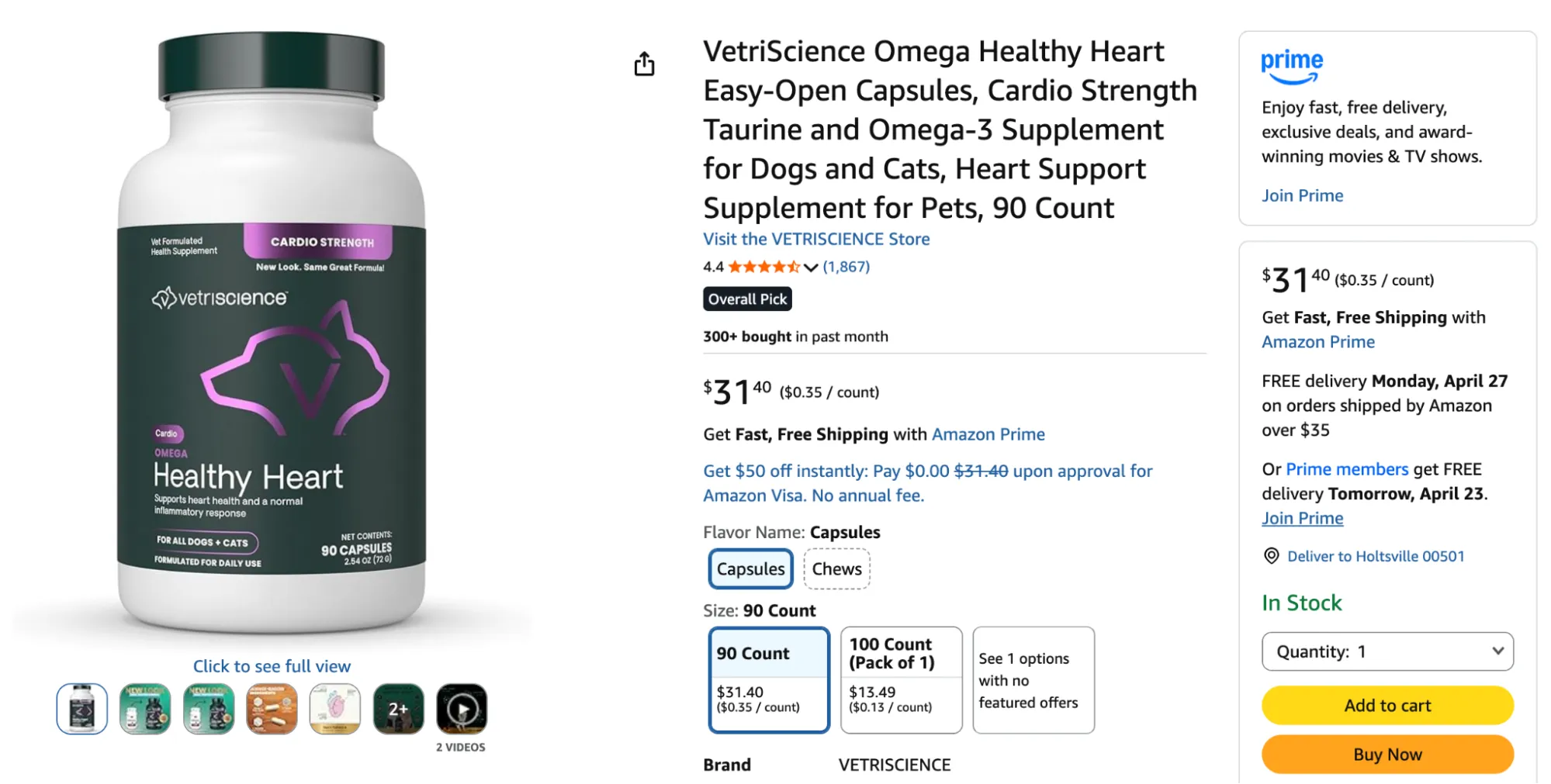
For example, a brand selling a 90-count hip & joint soft chew at $34.99 while displaying a $59.99 MSRP is signaling clinical-grade quality at a 42% discount.
If that $59.99 MSRP has never been the actual “Featured Offer” price on Amazon, and the brand sells primarily through Amazon with limited Chewy or PetSmart distribution at that price, it will not pass validation after April 23.
The strikethrough disappears — and with it, your value anchor. In a category where conversion relies on balancing “vet-grade” quality with an accessible price, that’s a meaningful hit to how your listing performs.
Profile C: The OTC Flea, Tick & Dental Brand Running Perpetual Coupons
Bayer Animal Health (Seresto, Advantage), Boehringer Ingelheim (Frontline), Central Garden & Pet (Adams), and Virbac all sell over-the-counter flea and tick prevention on Amazon with coupons that are rarely, if ever, turned off.
The same applies to dental care brands like Greenies (Mars Petcare) and Vetri-Science dental chews. A 20% coupon on a 6-pack of Frontline Plus that is clipped on nearly every order is not a promotional event. It is the price.
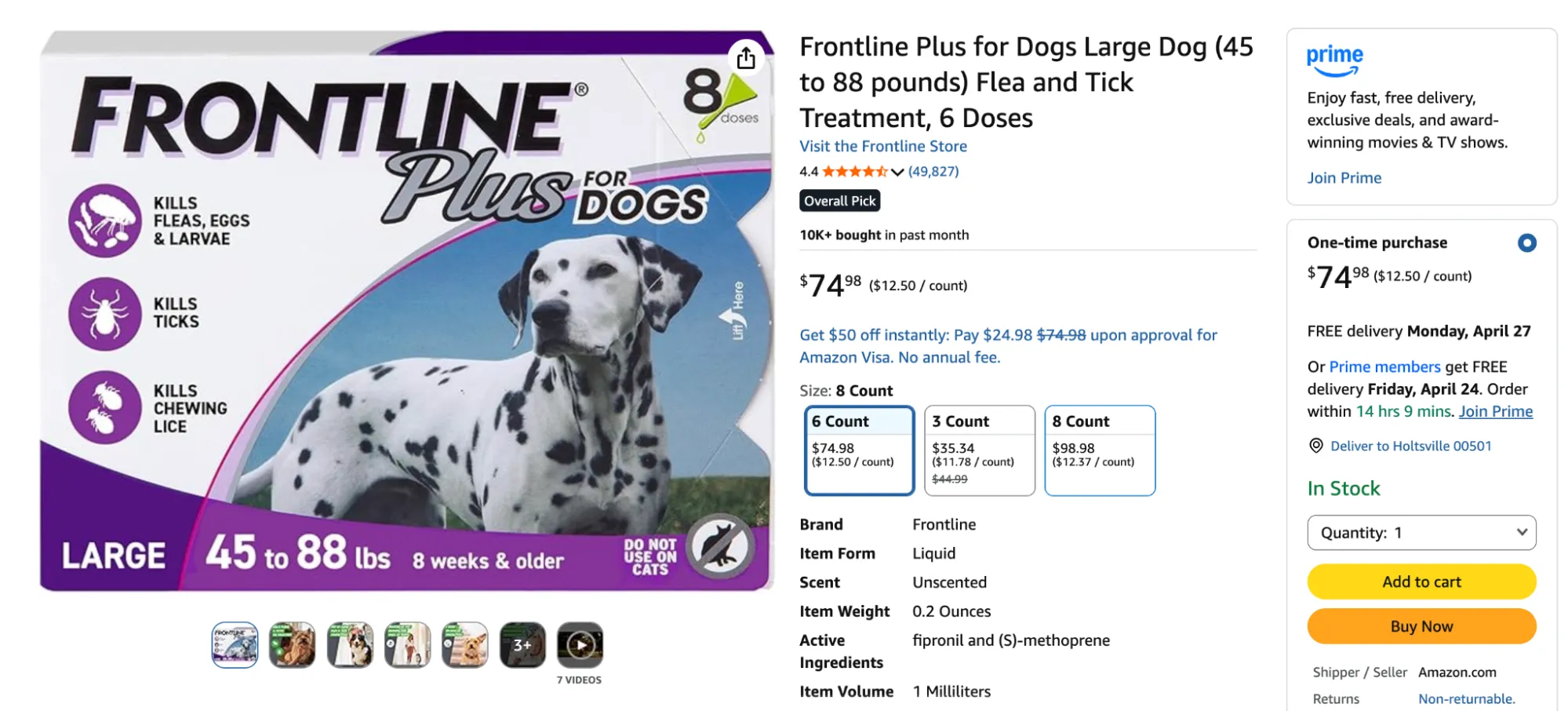
Starting May 18, price discounts not advertised to customers as promotions — which include certain always-on discounts — are treated as non-promotional sales and included in “Typical Price”.
A year-round discount that most buyers use will eventually reset your “Typical Price” to that lower, discounted level.
The strikethrough disappears — and with it, the “sale” signal that creates urgency in the “Buy Box”.
Your Pre-May 18 Price Audit: 5 Things to Check Now
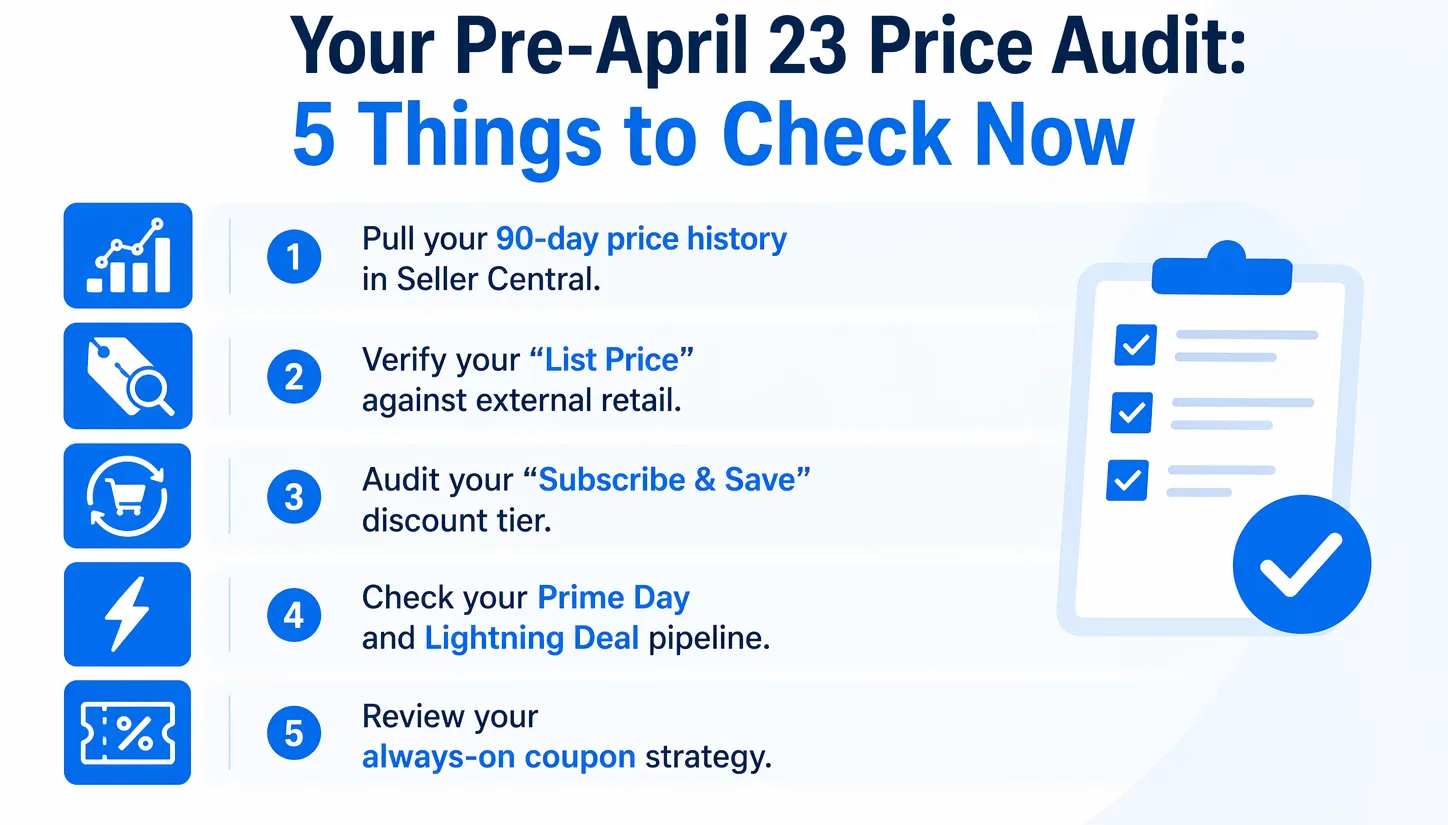
Block 30 minutes before May 18. Here is what to verify for every pet ASIN that uses reference pricing or runs promotions.
-
Pull your 90-day price history in Seller Central. Go to “Pricing > Price History” for each ASIN. If your selling price has been at or below your “Typical Price” for more than half of those days — through S&S, coupons, or price reductions — you are in the “Typical Price” risk zone for May 18. Deal with it now, don’t wait for actions from Amazon.
-
Verify your “List Price” against external retail. If you’re submitting an MSRP, make sure it’s actually listed at that price on at least one major U.S. retailer — like Chewy, PetSmart, Petco, etc. If it doesn’t, your “List Price” may be removed after April 23. It’s better to update it to a verifiable price — or remove it — than let it disappear without notice.
-
Audit your “Subscribe & Save” discount tier. The typical Subscribe & Save discount sits around 5-15%. If you’re at the top end (15%) and most of your sales come from S&S, your everyday selling price is already close to a promo price. Test a small reduction — even 3–5% — to keep stronger price anchoring without significantly impacting retention.
-
Check your “Prime Day” and “Lightning Deal” pipeline. Promotions during peak events don’t count toward your “Typical Price,” which is good news for Prime Day. But your “Maximum Deal Price” in “Manage Deals” still depends on your reference prices, recent promos, and sales history. If your reference prices are suppressed — or your “Typical Price” has dropped — your deal might not qualify or will come with a tighter price ceiling. So, set your pricing structure now.
-
Review your always-on coupon strategy. If you’re running a 20% coupon on a dog supplement or cat food SKU, ask yourself if it's acting like a permanent price cut. Under the new rule, these kinds of discounts count as regular sales. So if most buyers use that coupon, your “Typical Price” will start to drop.
Read our articles to get more Amazon deep dives:
- Sephora Just Plugged into ChatGPT — find out what this means for your brand
- Five Questions That Will Help You Identify an Amazon Agency That Can’t Handle Pet Brands
- Amazon Sharing Reviews Across Variations Update
- How Small Pet Brands Can Compete on Amazon Without a Big Budget?
- Why Your Amazon Pet Ads Are Getting More Expensive Every Quarter and How to Manage It
- Your US Pet Parcel to the EU Now Costs 3€ More. What Next?
- Amazon's 2026 Fee Changes: What Every Pet Brand Should Recalculate Before Q4
Your Discounts Are Only as Strong as Your Reference Price
Deals, coupons, and peak-event discounts all need a minimum % off a reference price. If that reference price is suppressed — or your “Typical Price” drops — your promos may no longer hit the threshold and won’t run.
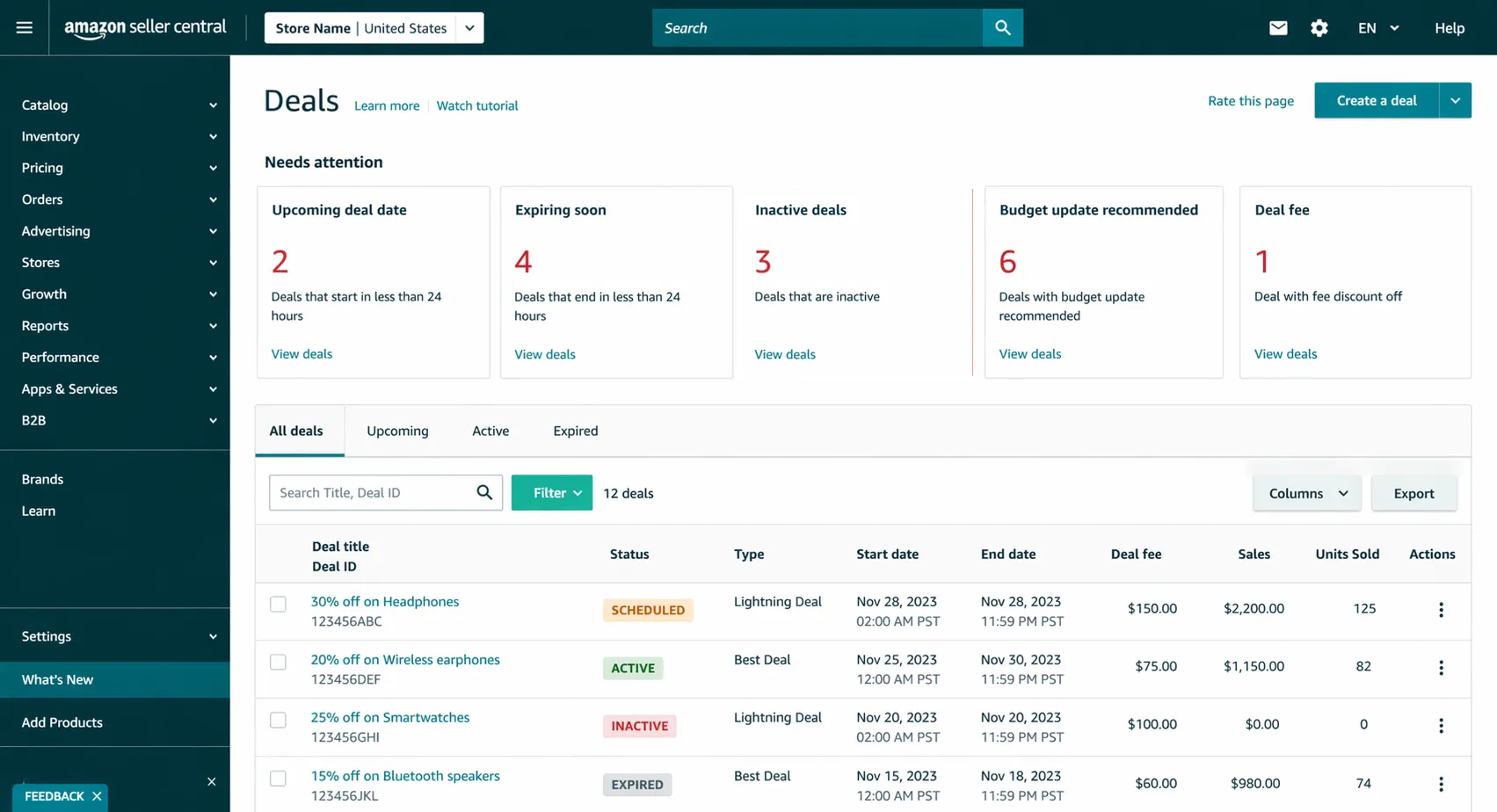
The “Maximum Deal Price” you see in “Manage Deals” is based on your reference prices, recent promos, sales history, and even the lowest competitor price in “New” condition.
If your reference price drops, your deal ceiling drops with it. For pet brands planning “Lightning Deals” or “Prime Day”, that creates a constraint that’s much harder to fix the closer you get to launch.
Best practice from Amazon guidance: Two weeks before a deal starts and while it is running, check for “Needs Attention” alerts in your “Deals” dashboard. Resolve them immediately to prevent suppression.
Bonne chance — and may your “Subscribe & Save” conversion rate be ever in your favor!
Frequently Asked Questions
What is Amazon's “List Price” (RRP) validation change effective April 23, 2026?
Starting April 23, 2026, Amazon is tightening its “List Price” rules. To show it, the price needs to be real — either recently used by another retailer or actually paid by customers on Amazon (as the “Featured Offer”). If it can’t be verified, Amazon may remove it without notice.
Does a Vine order count as purchased by customers as the “Featured Offer” at the “List Price”?
No, Vine units don’t count. They’re given to reviewers for free, so Amazon doesn’t treat them as real customer purchases.
That means Vine orders won’t validate a “List Price” as a “Featured Offer” sale. If your only history at a certain price comes from Vine, it won’t be considered a verified price under the new rule.
The Amazon “pet” search results look normal — until you analyze who is actually taking the revenue. Read our article to uncover the surprising pattern.
What is the “Typical Price” recalculation change effective May 18, 2026?
“Typical Price” is the median price customers paid over the last 90 days, usually excluding promos.
Starting May 18, 2026, that changes: if your “Featured Offer” price stays below the regular (non-promo) price for more than half of that period, Amazon will recalculate “Typical Price” using all sales, including discounted ones.
One exception: sales during peak events like Prime Day are always excluded.
What qualifies as a “price discount not advertised to customers as a promotion”?
The only confirmed non-promotional sale included in “Typical Price” is the “Sale Price” set through SKU attributes (not surfaced to customers as a promotion).
Here is a list of unconfirmed ones, waiting for further Amazon clarification:
-
Price Discounts created through the Seller Central “Price Discounts” tool
-
Broadly available (non-tailored) coupons. Tailored coupons are explicitly excluded; whether standard public coupons receive the same treatment is not yet confirmed.
-
Brand-tailored promotions.
Note: Netpeak USA is actively seeking official Amazon clarification on these items. This FAQ will be updated as confirmed guidance becomes available.
Do not adjust pricing strategy based on unconfirmed items without verifying directly with your Amazon account team or Selling Partner Support.

 0
0
 0
0
 0
0
 0
0
Related Articles
What Vibe Coding Means for Business: No Coding Skills, One Weekend, One SaaS
Vibecoding is changing the rules for front-end development and opening up new opportunities for businesses, but there are some nuances to consider.
Business Apps in the US: iOS vs. Android, September 2026
We searched for US App Store and Google Play data to see what business apps professionals, shoppers, and investors actually installed in September.
Pet Food Product Patent: How to Protect Your Innovation
Patenting pet products requires careful consideration and proper application filing. With the 8 steps below, you will be able to submit your patent application and protect your invention.