
Amazon's 2026 Fee Changes: What Every Pet Brand Should Recalculate Before Q4
Before Q4, every pet brand selling on Amazon should rebuild its per-unit margin model around three stacked 2026 changes: the January fulfillment-fee increase, the 3.5% fuel surcharge added in April, and Q4 storage rates that climb two to three times from October.
Referral fees stayed frozen, so the entire squeeze lands on fulfillment and storage — precisely the costs that heavy, bulky pet products carry more of than anyone else.
Bottom line: Referral fees are frozen, but fulfillment, prep, storage, and a new 3.5% surcharge are not. Rebuild your per-unit margin model before Q4 pricing locks.
What Changed in Amazon's 2026 Fees (and What Didn't)
Amazon rolled out its 2026 fee changes in three waves, not one. Each wave is small on its own. Stacked together, they reshape the unit economics of a pet catalog.
-
FBA fulfillment fees rose an average of $0.08 per unit on January 15, 2026, and standard-size items now sit in three price bands. Amazon discontinued its own FBA prep services on January 1, 2026, moving all prep work to sellers or third-party providers (Amazon Seller Central, 2026).
-
A 3.5% fuel and logistics surcharge hit every FBA fulfillment fee on April 17, 2026, adding roughly $0.17 per unit on a standard item. Although Amazon described the surcharge as temporary, it did not specify when it would end (Amazon, 2026).
-
Aged-inventory surcharges start at 181 days, with new 2026 tiers of $0.30 per unit at 12 to 15 months and $0.35 per unit at 15 months and beyond (Amazon Seller Central, 2026).
-
Referral fees stayed frozen for a second year: 15% on most pet supplies and 22% on veterinary diets (Amazon Fee Schedule, 2026).
APPA projects US pet industry spending will reach $165 billion in 2026 (APPA, 2026), so the demand side is healthy, but revenue growth means little if fee creep outpaces it.
Here is the shift in one line:
Amazon stopped selling you a set menu and switched to à la carte.
Fulfillment, prep, surcharge, and storage each arrive as a separate charge with its own quiet markup. For a brand shipping 30-pound bags of kibble, that carte adds up faster than a Labrador clears a food bowl.
Want to stay up to date on all the latest Amazon updates, like this one? Check out our other articles below!
Why Pet Brands Feel the 2026 Fees More Than Most
Pet products are heavy, bulky, and often bought on subscription. All three traits amplify the 2026 changes.
-
Weight and size drive fulfillment tiers. Kibble, litter, crates, and beds land in the higher standard and oversize brackets, where per-unit fees are steepest.
-
The surcharge is a percentage of the fulfillment fee, so the higher your base fee, the larger the absolute hit per unit.
-
Subscribe & Save staples run on thin margins and high volume, so a $0.17 increase compounds across thousands of monthly units.
Amazon Fee Changes 2025 vs 2026 — Pet Brand Impact
|
Fee line |
2025 |
2026 |
Pet brand impact |
|
FBA fulfillment (standard) |
Single rate per size tier |
+$0.08/unit avg; three price bands (Amazon Seller Central, 2026) |
Reprice around band thresholds |
|
Fuel & logistics surcharge |
None |
3.5% of fulfillment fee, ~$0.17/unit (Amazon FBA Fee Changes, 2026) |
Direct hit on every unit shipped |
|
FBA prep services |
Amazon-provided |
Discontinued; seller-handled |
New prep or 3PL cost line |
|
Aged-inventory surcharge |
From 181 days |
+$0.30–$0.35/unit at 12–15+ months (Amazon Agind Inventory Action Plan, 2026) |
Q4 overstock risk on slow ASINs |
|
Referral fee (pet supplies) |
15% |
15% (Amazon Fee Schedule, 2026) |
The one predictable line |
What Pet Brands Should Recalculate Before Q4
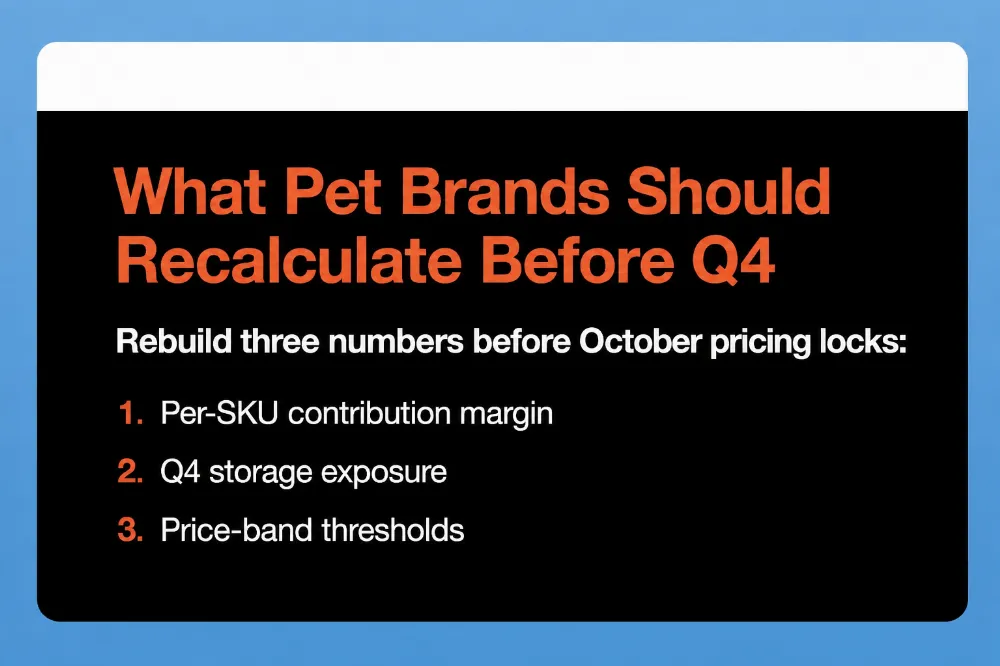
Rebuild three numbers before October pricing locks. None of them takes long, and each one protects margin at exactly the moment volume peaks.
1. Per-ASIN contribution margin
Recalculate margin for every ASIN with the new fulfillment tier and the 3.5% surcharge baked in. A product that cleared 18% margin in December 2025 may sit closer to 14% today. Products under 15% margin need repricing or removal before peak season, not after.
2. Q4 storage exposure
Inventory sitting in Amazon warehouses from October through December pays two to three times the standard monthly storage rate. Trim slow movers now, so you are not paying premium rent on kibble that will not sell until spring.
3. Price-band thresholds
Standard-size fulfillment now splits by price. A $49.99 item and a $50.01 item can fall into different fee brackets, so check where each ASIN lands before you set holiday pricing.
A Worked Example: What the 2026 Stack Does to One Pet ASIN
Numbers make the compounding real. Below is an illustrative large-standard pet ASIN, a $34.99 bag of dog food, run through both fee stacks. The figures are representative, not a quote for your catalog.
Per-unit economics, $34.99 large-standard pet ASIN (illustrative)
|
Per-unit line |
2025 |
2026 |
|
Sale price |
$34.99 |
$34.99 |
|
Referral fee (15%) |
$5.25 |
$5.25 |
|
FBA fulfillment (large standard) |
$5.34 |
$5.42 |
|
Fuel surcharge (3.5%) |
— |
$0.19 |
|
Prep (now seller-side) |
included |
$0.35 |
|
Total Amazon fees |
$10.59 |
$11.21 |
|
Fees as % of sale price |
30.3% |
32.0% |
Referral fees did not move, yet total Amazon fees still climbed from 30.3% to 32.0% of the sale price. On $9 of product cost, per-unit contribution slips from $15.40 to $14.78 — about $0.62.
That looks harmless until you scale it: at 5,000 units a month, the same ASIN gives back roughly $37,000 a year. Multiply that across a catalog and the average $0.08 headline stops telling the whole story.
Read more Amazon pet category deep dives here:
Four Levers to Claw Back Pet Margin in 2026
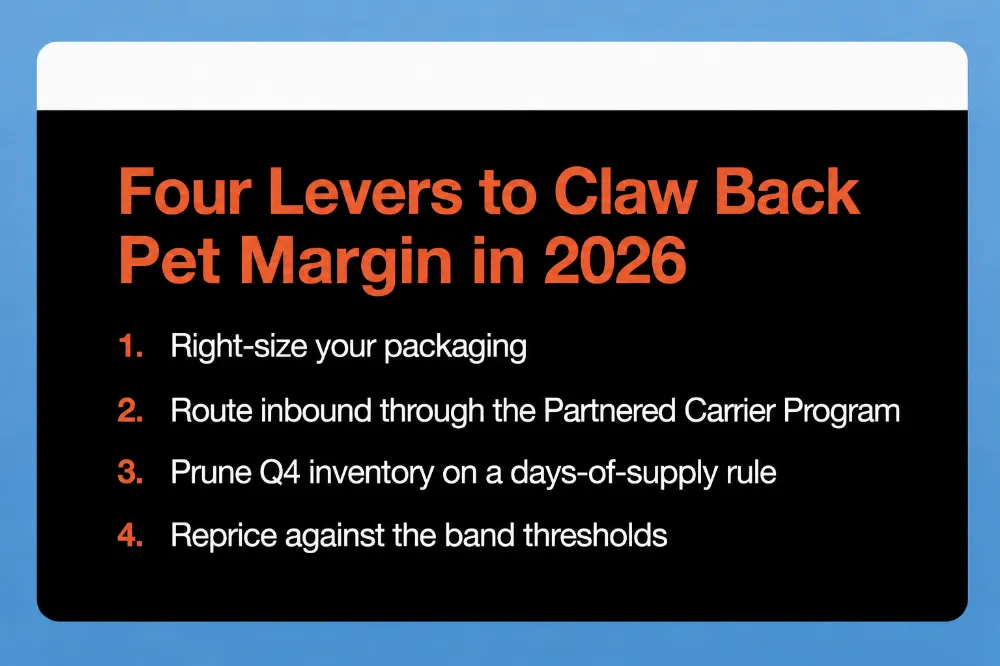
You cannot vote the fees away, but you can engineer around them. Four levers do most of the work for a pet catalog.
1. Right-size your packaging
Fulfillment fees step up by size tier, so trimming a fraction of an inch off a box can drop an ASIN into a cheaper bracket. Audit your bulkiest movers first — beds, crates, litter — where the tier gaps are widest.
Watch out: re-measure after any packaging change. Amazon charges on the unit it receives, not the spec sheet you designed.
2. Route inbound through the Partnered Carrier Program
Inbound placement fees apply when Amazon has to spread your stock across several fulfillment centers. Routing shipments through the Partnered Carrier Program, or splitting to the locations Amazon recommends, avoids that surcharge. Confirm every Q3 inbound follows the low-fee path before peak volume lands.
Watch out: minimal-split shipments look cheaper on freight, but often cost more once placement fees are added back.
3. Prune Q4 inventory on a days-of-supply rule
Storage rates multiply from October, and aged-inventory surcharges start at 181 days. Set a days-of-supply ceiling per ASIN and clear the slow tail before the Q4 clock starts. A slow-selling cat tree in a fourth-quarter warehouse is the most expensive nap in retail.
Watch out: removals sit in longer queues during Q4, so start the process in September, not November.
4. Reprice against the band thresholds
Standard-size fulfillment now splits into three price bands, so a single dollar of list price can cost you a whole tier. Map each ASIN against its nearest threshold, then decide whether a small price move protects more margin than it surrenders in conversion.
Watch out: test price changes on a few ASINs before rolling them across the catalog, since pet buyers are price-sensitive on everyday staples.
Working with a Marketplace Partner on Fee Planning
Netpeak USA models per-ASIN marketplace economics for pet brands, so fee changes show up in your plan before they show up in your settlement report. The French Kiss blog team can rebuild your Q4 margin model on request.
Bonne chance — and may your Subscribe & Save conversion rate be ever in your favor!
Frequently Asked Questions
When did Amazon's 2026 fee changes take effect?
The main FBA fulfillment increase took effect January 15, 2026; Amazon's own prep services ended January 1, 2026, and the 3.5% fuel surcharge began April 17, 2026 (Amazon FBA Fee Changes).
How much did Amazon's 2026 fuel surcharge add per unit?
The 3.5% fuel and logistics surcharge adds roughly $0.17 per unit on a standard-size item. It is calculated on the fulfillment fee, not the sale price, and has no stated end date (Amazon, 2026).
Did Amazon raise referral fees for pet products in 2026?
No. Referral fees stayed frozen at 15% for most pet supplies and 22% for veterinary diet food (Amazon Fee Schedule, 2026).
Why do pet brands pay higher Amazon fulfillment fees than other categories?
Fulfillment fees scale with product size and weight. Pet staples such as food, litter, and crates fall into heavier size tiers, so their per-unit fees run higher than lightweight categories.
What should pet brands recalculate before Q4 2026?
Recalculate per-ASIN contribution margin with the new fees included, review Q4 storage exposure on slow-moving inventory, and confirm which price band each ASIN falls into.

 0
0
 0
0
 0
0
 0
0
Related Articles
Business Apps in the US: iOS vs. Android, September 2026
We searched for US App Store and Google Play data to see what business apps professionals, shoppers, and investors actually installed in September.
Pet Food Product Patent: How to Protect Your Innovation
Patenting pet products requires careful consideration and proper application filing. With the 8 steps below, you will be able to submit your patent application and protect your invention.
Business Apps in the US: iOS vs. Android, August 2026
We’ve fetched data from the US App Store and Google Play to see what professionals, shoppers, and businesses are actually installing, and why the market leaders are winning right now.