
Going Global? What Expanding Your Business Internationally Really Takes
Find out how to tell if your business is ready to grow, and get to know the main ways to enter new markets and when to use them. You’ll also see how marketing changes when you move into new countries, with specific tips for Europe and the US.
Global expansion business planning really boils down to one question: will people in a new market actually buy from you once you arrive?
The demand is certainly there: 59% of global shoppers already buy from retailers outside their home country, and 35% do this at least once a month (DHL's 2025 research).
But having access to international customers and convincing them to choose you are two very different things. Legal setup, shipping, and hiring can usually be solved with enough money and time. Earning trust in a culture where nobody knows your brand is trickier.
This guide focuses on that part. You'll learn how to tell whether your business is ready, choose a global expansion strategy, and adapt your marketing instead of copying and pasting whatever worked at home.
Why Should Your Company Go Global?
There is a limit to how many customers you can reach in your home market. By expanding your business internationally, you can connect with people who might not know your brand yet.
Because of globalization, cross-border shopping has become normal consumer behavior, and small businesses are already leaning into this:
-
51% of cross-border shoppers buy from other countries to get lower prices. Another 47% do so because they can't find a product or brand locally, and 44% want more choice options (DHL).
-
Over 1.3 million small businesses in the US are now involved in global trade. In a recent Forbes Business Council survey, 40% of small-business owners said expanding into new international markets is a key growth opportunity for the next year.
What Are the Benefits of Expanding Your Business Internationally?
-
A bigger, less saturated customer base. You stop competing for the same shrinking slice of attention at home and start reaching people who've never seen a pitch from you.
-
Revenue diversification. If one market slows down because of a regulatory shift or a competitor, you're not fully exposed.
-
Access to new talent and suppliers. Local hires and vendors bring market knowledge you can't buy any other way.
-
Brand credibility. Operating internationally often makes a company look more established, which can help even in its home market.
-
Riding the growth of global commerce itself. Cross-border B2C e-commerce was worth about $719 billion in 2021 and is expected to reach $5,576.73 billion by 2030, with a compound annual growth rate of 25.8% (Grand View Research).
International expansion isn't a niche marketing strategy anymore. But that doesn't mean every company should immediately start planting flags on a map. You need proper market research.
What Are the Risks of International Expansion?
None of this is a straight line up and to the right. The honest risks include:
-
Cultural missteps that damage trust faster than any ad campaign can rebuild it.
-
Legal and regulatory complexity — different tax codes, global payroll, consumer protection laws, data privacy rules, and import restrictions in every market. About 25% of small businesses surveyed by Forbes Business Council said that regulatory change was already slowing their growth plans for 2025 (Forbes).
-
Currency and pricing risk, since exchange-rate swings can quietly erode margins.
-
Operational strain, from customer service across time zones to returns, sales funnel, and shipping logistics.
-
Underestimating localization costs. Businesses often budget for translation but not for the deeper work of adapting an offer to fit local expectations.
Also, buyers often feel unsure about buying from international sellers instead of local ones. DHL research shows what they worry about most.
|
What can stop a cross-border sale? |
What businesses need to do |
|
Fear of fraud |
Build recognizable trust signals, reviews, buyer protection, and local credibility |
|
Delivery concerns |
Give realistic delivery dates and tracking |
|
Customs charges |
Explain duties and fees before checkout |
|
Difficult or expensive returns |
Create clear local return policies |
|
Unfamiliar checkout |
Support local currency and payment methods |
|
Language barriers |
Localize the buying experience, not just ads |
See our breakdown of seven real-world market expansion failures and what caused each one.
How Can You Know That Your Business Is Ready for Expansion?
There's no universal green light, but a few signals tend to show up together when a business is genuinely ready:
-
Your domestic revenue is stable and predictable.
-
You're already fielding organic interest from international customers — website traffic, social followers, or inbound orders from abroad.
-
Your unit economics still work after international shipping, taxes, marketing, and returns.
-
You can finance several months of testing without depending on immediate new-market revenue.
-
You have access to local expertise in language, culture, regulation, or customer behavior.
-
Your existing operations don't collapse the moment management gets distracted by a new market.
The second signal is especially valuable. If you're a US company and 8% of your website traffic is mysteriously coming from Germany without you doing anything to attract it, investigate that.
What Financial Benchmarks Should You Hit Before Expanding Internationally?
There isn't a magic revenue number that allows international expansion. You need to look for a bunch of markers:
-
consistent profitability at home;
-
a dedicated expansion budget separate from essential operating cash;
-
enough runway to tolerate a slow launch;
-
market-specific CAC and LTV estimates;
-
a financial buffer for unexpected compliance, customs, localization, and logistics costs.
If those numbers don't work yet, it’s okay. Maybe you just need a lower-commitment strategy.
How to Grow Your Business: Global Expansion Strategies
International expansion runs on a spectrum from low commitment and limited control to high commitment and high control.
Exporting vs. Licensing vs. Franchising: Which Strategy Fits Your Business?
|
How It Works |
Commitment & Risk |
Control |
Best For |
|
|
Exporting |
Sell existing products in a new country directly or through local distributors |
Low |
Low–Medium |
Product businesses testing international demand |
|
Licensing |
Allow a local company to produce or sell under your brand for fees or royalties |
Low–Medium |
Low |
IP-heavy or manufacturing-light businesses |
|
Franchising |
Let local operators run your full business model using your brand and playbook |
Medium |
Medium |
Food, retail, and service businesses with a repeatable model |
|
Joint venture |
Build the local business with a partner |
Medium–High |
Shared |
Complex or relationship-heavy markets |
|
Subsidiary |
Establish and operate your own local company |
High |
High |
Proven, strategically important markets |
How Does Exporting Help You Test Demand Before Committing?
Exporting lets you sell products you already make in a new country without setting up a local entity — you either ship directly to customers or partner with a distributor who already has retail relationships and market knowledge. It's the lowest-commitment entry point, which makes it a natural first move before investing in anything more permanent.
Celsius Holdings is a good example. They partnered with Suntory Beverage & Food Benelux to bring its products into Belgium and Luxembourg, building on earlier launches in France, Ireland, and the UK.
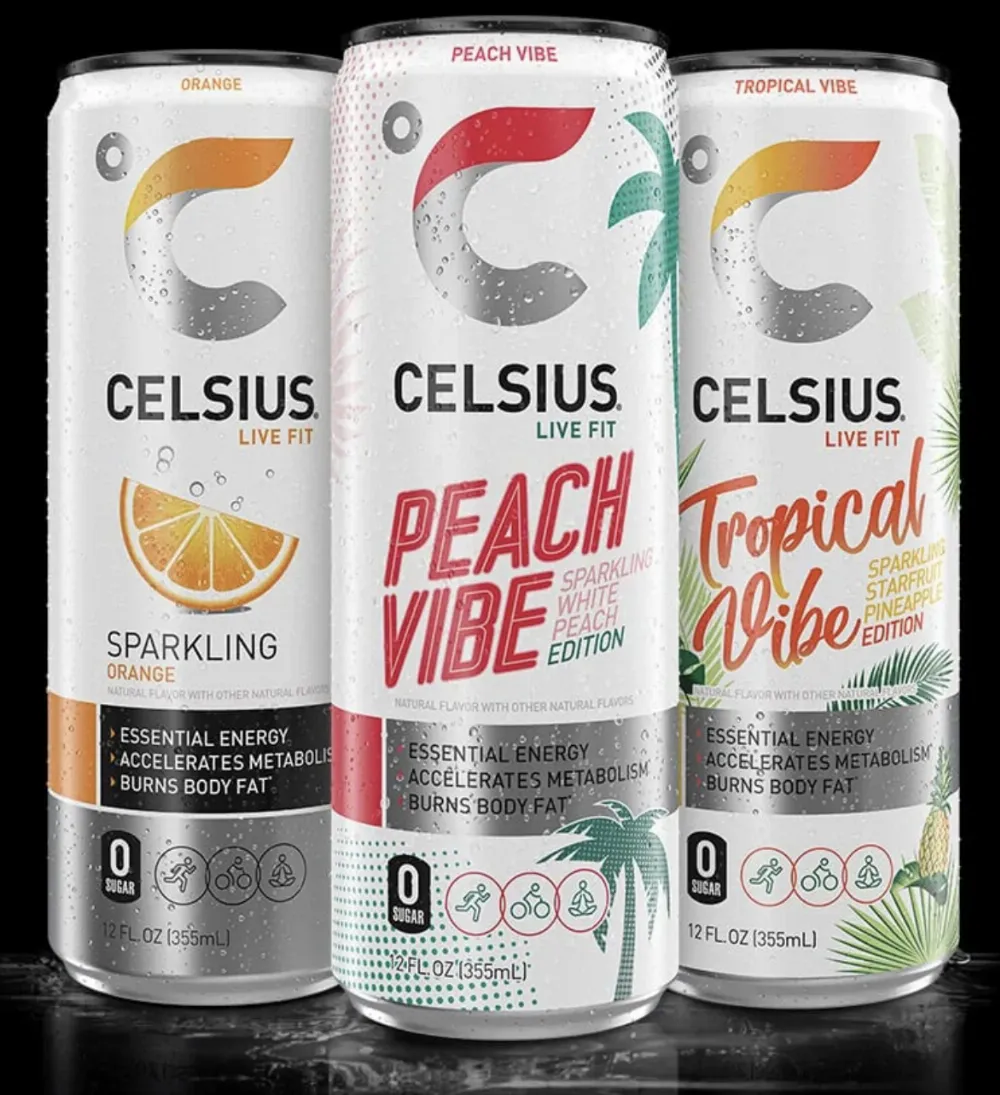
By Q1 of the following year, international revenue had grown 55% year over year — evidence that the country-by-country, distributor-led approach was working before Celsius put any more capital on the line (Food Navigator, 2026).
That's the appeal of exporting: you get real sales data from a new market while someone who already knows that market handles the on-the-ground work.
How Does Franchising Let You Scale a Repeatable Business Model Abroad?
Franchising works best when you've already turned your business into a system with a documented playbook for operations, training, and branding that a local operator can run with your support.
Subway’s international expansion mostly relies on this approach. Since 2021, the company has signed 15 master franchise or country development agreements in regions including Europe, the Middle East and Africa, Asia Pacific, and Latin America and the Caribbean.
These deals together promise more than 9,000 new restaurants over the next 20 years (Subway Newsroom).

That division of labor is what makes franchising scale so fast: Subway didn't have to open a single one of those thousands of future locations itself.
How Does Licensing Let You Expand Without Owning Local Operations?
Licensing hands your brand, but not your operations, to a local company, which manufactures or sells under your name in exchange for fees or royalties. It suits businesses where the value sits in the brand or the recipe rather than in owning factories or storefronts everywhere the product is sold.
Brooklyn Brewery's partnership with Carlsberg shows how far this can go:
-
The two companies started working together in 2004, when Carlsberg took over distribution of Brooklyn's beers in Scandinavia, and the relationship deepened from there.
-
In 2020, Carlsberg acquired Brooklyn's brand rights across Europe and Asia for $130 million (Brewbound, 2026). That means that Carlsberg now brews, markets, and sells beer there under Brooklyn Brewery's license.

That trade-off is the core case for licensing: you extend your brand into markets your own manufacturing or sales footprint could never reach on its own.
How Do Joint Ventures and Partnerships Support Global Growth?
A joint venture lets you enter or scale in a foreign market with a local company that already understands the business environment. You share ownership and control, but you also share the investment and risk.
Starbucks' 2026 China deal is a good example. In April 2026, Starbucks finalized a joint venture with Chinese investment firm Boyu Capital to support its next stage of growth in China. It oversees around 8,000 coffeehouses and has a long-term ambition to reach 20,000 locations.
Boyu took a 60% stake in Starbucks China's retail operations, while Starbucks retained 40% and continued to own and license the Starbucks brand.

Starbucks China CEO Molly Liu says Boyu's local expertise will help the company expand into more cities. She also shared plans for “hyper-localization,” which will include drinks, food, merchandise, digital experiences, and stores tailored to local tastes.
That's the main advantage of a joint venture: you don't have to learn a complex market entirely from scratch. A strong local partner can help you adapt faster. If a company with Starbucks' brand recognition still decided it needed a local partner, it's worth asking whether your business might benefit from the same approach.
A joint venture tends to make sense when:
-
The market has real regulatory or cultural complexity.
-
You lack local relationships that matter. Suppliers, landlords, regulators, or distribution networks are typically built over years.
-
You're entering a market where wholly foreign-owned businesses face restrictions. Some countries limit or complicate full foreign ownership, making a local partner a practical requirement rather than just a preference.
-
You value speed over full control. A partner with existing infrastructure and relationships can get you to market faster than building everything yourself.
When Should You Open a Local Office or Subsidiary Abroad?
A subsidiary gives you the most control — and the biggest pile of responsibilities. That control comes at a cost. A subsidiary means navigating a new country's tax code, employment law, and compliance requirements largely on your own. You're also fully exposed to local market risk, with no partner to share the loss.
It usually makes sense when:
-
demand has already been validated;
-
the market is large enough to justify permanent overhead;
-
local hiring or enterprise sales require an entity;
-
local customer service is strategically important;
-
or regulation makes a local presence necessary.
Olive Young's US expansion is a good example of this step-by-step approach. The Korean beauty retailer already had evidence that American consumers wanted what it sold: by 2024, more than 67% of sales on its international Global Mall came from North America (Olive Young 2025 Impact Report).
Olive Young set up CJ Olive Young USA in Los Angeles in 2025. The new branch was formed to help with local product sourcing, marketing, logistics, and getting ready for physical retail (CJ Newsroom).
Want to know how the K-beauty business expanded? Read our article to learn how they did it.

What Steps Should You Take Before Expanding a Business?
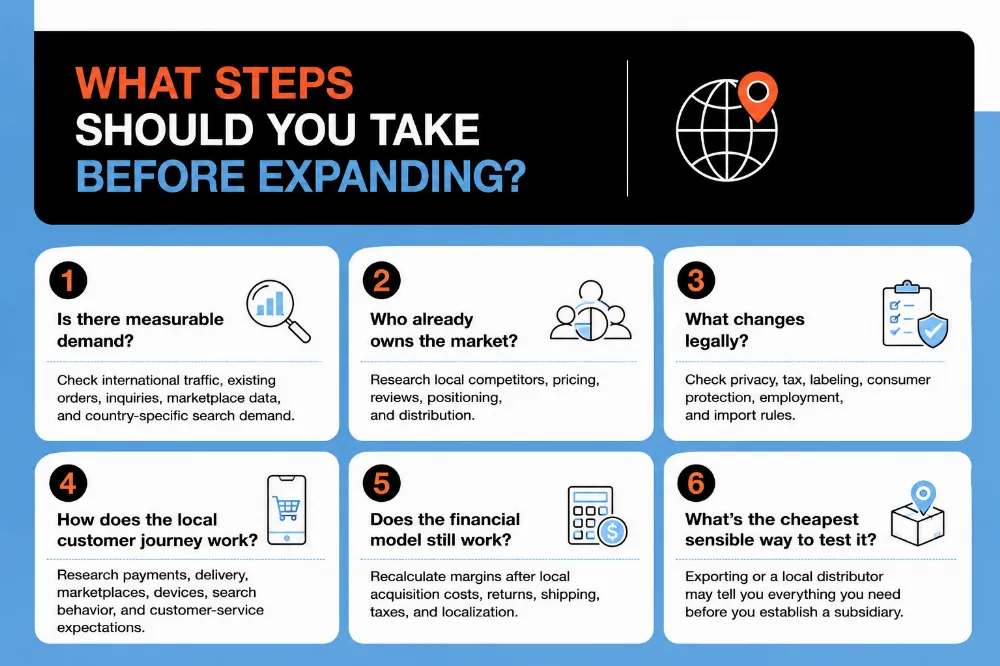
Before spending on marketing or logistics, a short pre-expansion checklist saves a lot of expensive backtracking:
Adapting Your Marketing Strategies for Global Expansion
This is where most international launches actually succeed or fail. A product can be right for a market and still flop if the marketing around it feels foreign, careless, or tone-deaf.
Localize Your Brand Messaging
CSA Research surveyed 8,709 consumers across 29 countries and found that 76% prefer buying products with information in their own language, while 40% won't buy from websites in other languages.
But localization goes well beyond swapping words. It means adjusting tone, humor, imagery, colors, and even the value proposition itself to match local expectations.
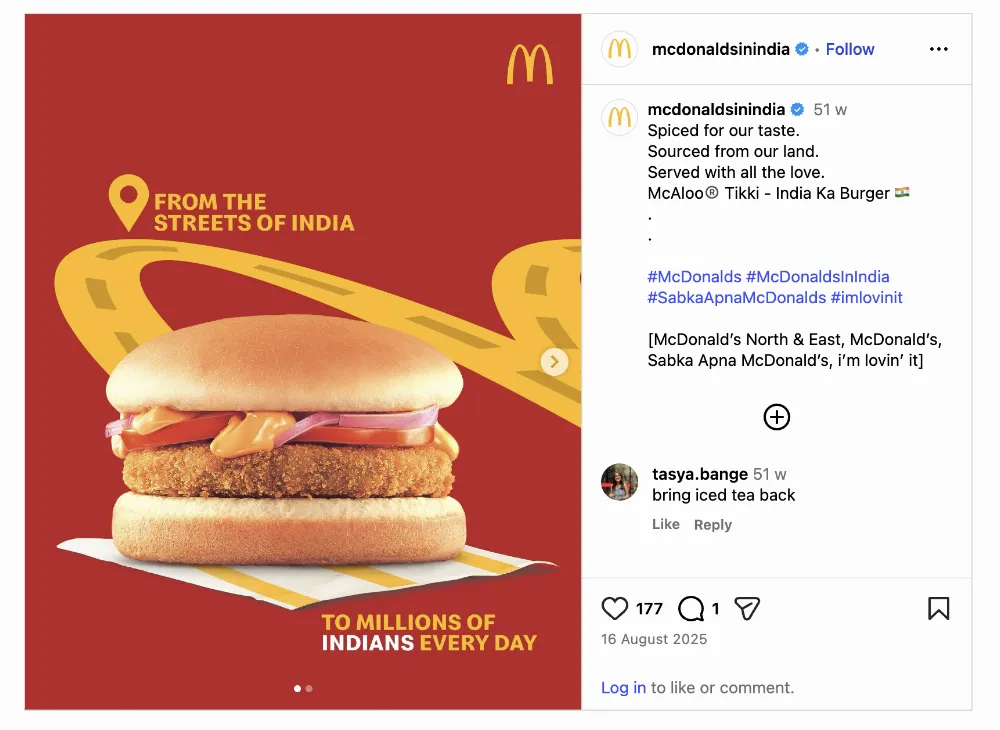
McDonald's is a clear example of great product localization. In India, the menu features a vegetarian burger called McAloo Tikki. In Australia, there is a Cheddar BBQ Bacon Burger, while in France, customers can order Deluxe Potatoes (McDonald's).
That's the balance you're looking for: keep the brand recognizable, but give customers something that makes sense locally.
Localization can increase demand by making a product or service as easy to use as possible. This allows products or services that weren't popular in the local market to find a new audience abroad.
Money Heist (La Casa de Papel) is a clean example of this. The show premiered on Spain's Antena 3 in 2017, and critics praised its thrilling pilot, but by the second half, the series was effectively a domestic flop. Netflix acquired the global streaming rights a month later, then re-cut and dubbed the episodes for international distribution under the new title (The Washington Post).
The localization worked: Netflix reported over 34 million households had watched it, a record at the time for a non-English title, and the following year it drew 65 million viewers (The Day).
Today, almost a third of what people watch on Netflix is non-English content, and the platform now offers shows and movies in over 30 languages (Netflix).

Choose Appropriate Digital Marketing Channels
The channel mix that works at home rarely transfers as-is. In some markets, local platforms are almost impossible to ignore.
KakaoTalk is used by 97.1% of internet users in South Korea. In Japan, 92.6% use LINE, and in Thailand, the figure is 82.6%. In contrast, people in the US and Brazil tend to use more globally recognized platforms (Data Reportal).
|
Market |
Channels Worth Knowing |
What the Data Says |
|
🇨🇳 China |
WeChat, Douyin, Xiaohongshu |
China had 1.28B social media user identities in late 2025 (Data Reportal China). |
|
🇯🇵 Japan |
LINE, YouTube, X, Instagram |
LINE: 99M MAUs / 92.6% of internet users; YouTube: 78.5M ad audience; X: 71.2M; Facebook: 16.5M (Data Reportal Japan). |
|
🇰🇷 South Korea |
KakaoTalk, YouTube, Instagram |
KakaoTalk: 49.1M MAUs / 97.1% of internet users (Data Reportal South Korea). |
|
🇹🇭 Thailand |
LINE, Facebook, TikTok |
LINE: 56M MAUs / 82.6% of internet users; Facebook had 51M users, and TikTok's adult ad audience was 34M in early 2025 (Data Reportal Thailand). |
|
🇺🇸 US |
YouTube, Facebook, Instagram, TikTok |
84% of adults use YouTube, 71% Facebook, 50% Instagram, and 37% TikTok (Pew Research). |
|
🇧🇷 Brazil |
Instagram, TikTok, YouTube, Facebook |
Instagram's ad audience reached 147M; TikTok's adult ad audience reached 131M; Facebook reached 109M (Data Reportal Brazil). |
One important caveat: LINE and KakaoTalk publish monthly active users, while Meta, Google, TikTok, and X often publish potential advertising reach.
Japan is a great example of why you should choose appropriate channels. LINE is used by 92.6% of Japanese internet users, but Facebook’s ad audience there is only 16.5 million. This clearly shows that using a Western channel strategy can miss a large part of the market.
Build an International SEO Strategy
International SEO requires more actions than just translating your keywords. People in different countries may think differently and describe the same problem in another way.
They use different search engines (Baidu in China, Yandex in parts of Eastern Europe), expect different content, and search for locally familiar brands or product categories. A query with huge US search volume may barely exist in France — and vice versa.
What to do:
-
run keyword research for every new market;
-
create country- and language-specific URL structures;
-
implement hreflang;
-
localize helpful content; mass machine-translating pages don’t work;
-
earn links and mentions from local websites;
-
study local SERPs before the decision-making process to determine what type of content to produce.
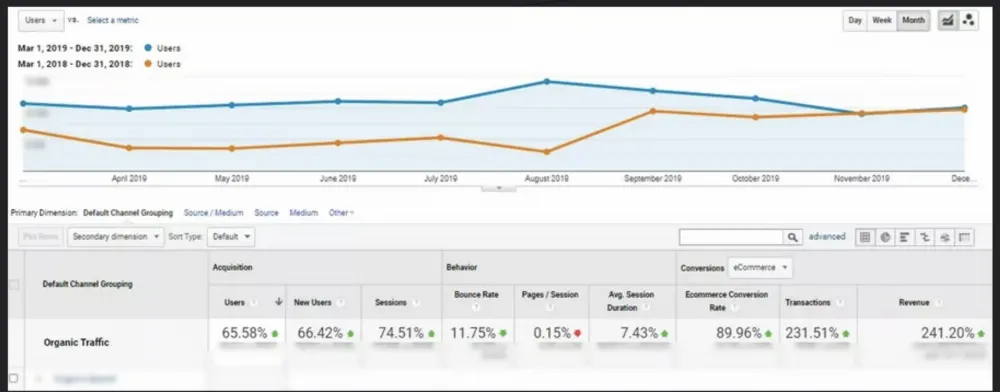
Netpeak x Domino's Pizza collaboration shows what this looks like in practice. The chain wanted to enter an already crowded Ukrainian delivery market. Our goal was to help Domino's compete for people searching for pizza and food delivery — not just customers already searching for the Domino's name.
We analyzed local competitors and their backlinks, optimized landing pages and website structure, improved technical SEO, built links and local mentions, optimized regional analytics, and added reviews to category pages. We also tested usability and made recommendations for stronger USPs and review generation.
The result: organic traffic increased by 34.14% in Kyiv and 65.58% in Odesa, while unique visitors from organic search increased by 74.51% overall.
Choose Local Influencers and Partners
Local creators solve one of a foreign brand's biggest problems: "Why should I trust you?"
Don’t pay for the country's largest celebrity. Micro-influencers in specific niches are often even more effective. Find smaller creators whose audiences match your customers and give them enough creative freedom to make the content feel native to their feed.
Sephora used this method when growing its stores in the UK. The “Meet Me at Sephora” campaign worked with local influencers to tailor each launch to the unique beauty culture of each city. This local focus brought in over 150,000 customers (Sephora UK Launch Case Study).
@llilmaz A Sephora in Sheffield??? 👀👀 @Sephora UK #SephoraUk #MeetMeAtSheffield ♬ original sound - maz 🐾
How to Expand Your Business in Europe: Main Marketing Insights
Europe is roughly markets, each with its own language, consumer habits, and regulatory quirks, tied together loosely by the EU's single market and GDPR. A few things to business plan around:
-
GDPR compliance is non-negotiable for any business collecting customer data, and it shapes how you can run email campaigns for customer retention, retargeting, and analytics.
-
Language fragmentation is real even within single countries (Belgium, Switzerland), so a "one European campaign" approach rarely performs as well as country-by-country adaptation.
-
Sustainability messaging means corporate social responsibility and carries more weight with European consumers than in many other regions.
-
Local marketplaces matter — Amazon dominates in several countries, but platforms like Allegro (Poland), Zalando (fashion, DACH region), and Cdiscount (France) often out-convert generic international listings.
-
Cross-border trade within the EU's single market continues to be a structural growth driver for e-commerce sellers who get logistics and VAT registration right (Grand View Research).
The EU has replaced the old €150 duty-free limit with a fixed fee on low-value parcels. Read our article to find out how cross-border e-commerce works for US businesses now.
How to Expand Your Business in the US: Key Marketing Tips
The US looks like a single market from the outside, but it behaves like several — regionally, culturally, and even legally, since sales tax and business regulations vary by state.
-
Plan for state-level tax and regulatory differences early; what's compliant in one state may need adjustment in another.
-
Hispanic marketing deserves its own strategy. In Nielsen's Latinx research, 71% of Hispanic consumers reported speaking Spanish at home, either primarily or alongside English.
-
Reviews and social proof carry outsized weight with US consumers, so investing early in review generation (and responding to them) pays off disproportionately.
-
Regional targeting beats "national" campaigns for most mid-sized budgets — a message tuned for the Northeast rarely performs the same way in the South or the Mountain West.
-
Expect a crowded paid-media landscape. US customer acquisition costs are typically higher than in emerging markets, which makes organic channels — SEO, content, and community — worth investing in from day one rather than treating them as a later-stage nice-to-have.
|
Europe |
United States |
|
|
Localization |
Often country + language specific |
Often regional/audience specific |
|
Privacy |
GDPR provides a major EU-wide framework |
Federal + increasingly important state-level rules |
|
Language |
Highly fragmented |
English dominant, but multilingual audiences matter |
|
Vary substantially by country |
More nationally consolidated |
|
|
Campaign structure |
Often country-by-country |
Often state/region/audience-by-audience |
|
Pricing |
Currency and VAT presentation matter |
Sales tax varies by jurisdiction |
Do you have a pet care brand? Read on for more insights about the differences between the US and European markets in your niche.
Final Thoughts
International expansion isn't really a logistics project with a marketing footnote.
Understand your risks before scaling. You need to validate demand, choose an entry strategy, adapt your offer, and make buying feel familiar through local language, delivery, and support.
Start with the market where you're already seeing signs of demand. Test it using the lowest sensible level of commitment. Learn what customers actually need.
Then spend the serious money.
FAQ
How to grow your business online?
Focus on the channels your specific audience already uses, invest in SEO and content that answers real customer questions, and treat your website as a conversion tool — fast, mobile-friendly, and built around clear calls to action — rather than just a digital transformation brochure.
What is the cost of global expansion for my business?
It varies enormously by market and entry strategy, but plan for legal and registration fees, localization and translation, marketing spend to build local awareness, logistics or fulfillment costs, and a cash buffer for at least six months of below-breakeven operation in the new market.
Should small businesses sell internationally too?
Yes — it's increasingly common. More than 1.3 million US small businesses are already engaged in global trade, and 40% of small-business owners recently surveyed by Forbes Business Council see new-market entry as a major growth opportunity (Forbes). Starting with a low-commitment strategy like exporting makes it accessible even without a large budget.
What is the easiest country to expand a business into?
"Easiest" depends on your industry, but factors that consistently make expansion smoother include a shared language, similar legal and regulatory frameworks, existing trade agreements with your home country, and established e-commerce infrastructure.
For English-speaking businesses, markets like the UK, Ireland, Canada, or Australia often present a lower initial barrier than markets with major language or regulatory differences.
How long does international business expansion take?
A straightforward exporting or e-commerce entry can launch in a few months. Licensing or partnership deals typically take six months to a year to negotiate and set up properly. Opening a full local subsidiary — with entity registration, hiring, accounting, tax compliance — usually takes 12–18 months before it's fully operational.

 0
0
 0
0
 0
0
 0
0
Related Articles
Business Apps in the US: iOS vs. Android, September 2026
We searched for US App Store and Google Play data to see what business apps professionals, shoppers, and investors actually installed in September.
What Happens When Amazon Suppresses Your Listing? The New 2026 Rules
Under the new 2026 rules, Amazon warns you first and gives you a grace period to fix the issue.
Amazon’s New “Sourced from Brand” Buy Box Label: Who Gets It and Who Doesn’t
Amazon is rolling out a provenance line in the Buy Box. A short label under the Brand row now reads “Sourced from [Brand]” on amazon.com and “[Brand] approved” on amazon.de. It tells the shopper that the unit on offer came through the brand’s own supply c