
What Are Ad Regulations for Movers This Year (2026)?
In 2026, ad regulations for movers strictly require companies to prominently display their US DOT or state-issued permit numbers, explicitly disclose broker status, and ensure absolute truth in pricing across all moving advertising. Understanding these rules — which differ for intrastate and interstate moves — is vital, as a single violation can lead to heavy fines, shipment delays, and severe reputational damage.
State-Level Regulations
While federal laws apply to moves crossing state borders, local moves — often called intrastate moves — fall under state-level jurisdictions. Many states enforce rigorous requirements when it comes to local marketing.
-
Permit Visibility: Moving companies must include their state-issued permit number in all forms of advertising and solicitation. For example, in California, the Bureau of Household Goods and Services requires the permit number to be prominently displayed on vehicles and in all marketing materials, and it must be no less than 1.5 inches in height on trucks.
-
Specific Jurisdictions: Depending on the state, a moving company might be regulated by the Public Utilities Commission (PUC), the Department of Motor Vehicles (DMV), or the Department of Transportation.
-
Written Estimates: In states like Massachusetts, a price over the phone is about as solid as a handshake in a hurricane. To keep things fair (and legal), your estimator needs to see the stuff in person and put the numbers in writing.
If you are expanding your local presence, working with a moving company SEO agency can help you ensure that your local citations, Google Business Profiles, and website footers accurately display these required state licenses.
FMCSA Advertising Regulations
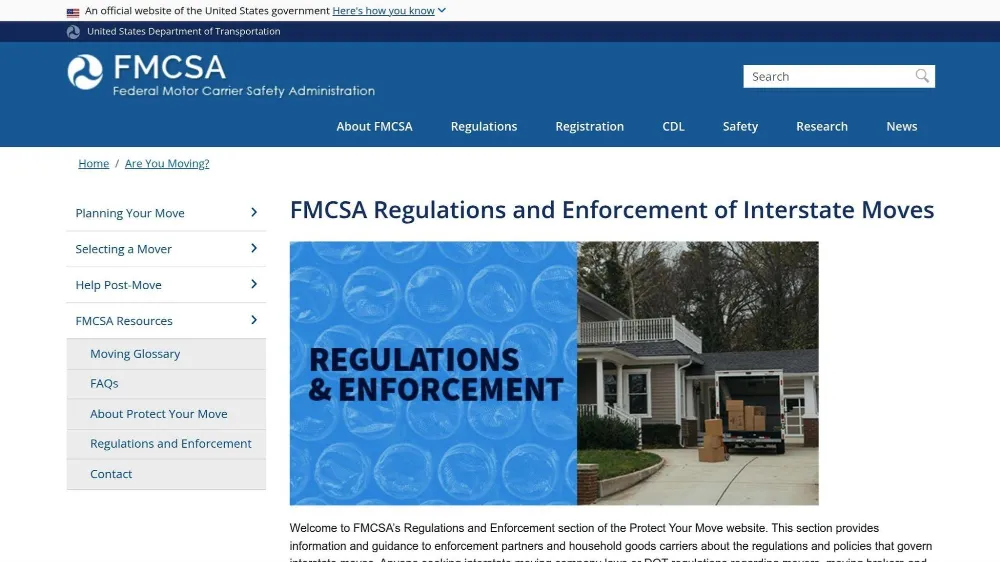
For interstate moving companies, the Federal Motor Carrier Safety Administration (FMCSA) lays down the law. A moving business transporting goods across state lines must comply with FMCSA rules under 49 CFR Part 375.
-
Mandatory Identifiers: Your mover must publish only truthful, straightforward, and honest advertisements. Every ad must display the company's exact name or trade name and its assigned US DOT number.
-
Broker Disclosures: If you’re a broker, you can’t play dress-up as a carrier. FMCSA says you have to spell it out in your ads: you’re not the one hauling the boxes, just connecting the dots.
-
Consumer Rights Documentation: While not an ad in the traditional sense, movers are required by the FMCSA to provide customers with specific documentation — such as the "Your Rights and Responsibilities When You Move" booklet and the "Ready to Move" brochure — before shipping household goods interstate.
Federal vs. State
|
Jurisdiction |
Regulatory Body |
Required License/Number in Ads |
Scope of Move |
|
Federal |
FMCSA |
U.S. DOT Number, MC Number |
Interstate (Across state lines) |
|
California |
CPUC / Bureau of Household Goods |
T-number permit |
Intrastate (Within CA) |
|
Texas |
TxDMV |
Household Goods Mover Certificate |
Intrastate (Within TX) |
|
Florida |
Dept. of Agriculture (DACS) |
State Registration |
Intrastate (Within FL) |
General Best Practices
To maintain a pristine reputation and avoid legal pitfalls in 2026, implementing these general best practices across all campaigns is critical:
-
Audit Your Campaigns: Double-check every corner of your digital world to make sure your real trade name and license numbers are front and center. If you’re running paid ads, a moving company PPC agency can help you squeeze those legal must-haves into tight character limits without breaking a sweat.
-
Avoid Bait-and-Switch Tactics: Tempting folks with too-good-to-be-true prices and then springing a surprise bill is a fast track to angry customers and nosy regulators. Stick to written, itemized estimates — your future self will thank you.
-
Highlight Protection: Spell out your insurance and valuation options right in your contracts and pre-move info. No one likes surprises, especially when it comes to coverage.
If you are looking for inspiration on how to market safely and effectively, analyze the top moving marketing campaigns this year and learn how to accurately calculate your acquisition numbers by reviewing the internal metrics behind the cost of a moving lead.
FAQ
Is a license a must for movers?
Yes. For local moves, companies must adhere to specific state-level licensing requirements. For interstate moves, a U.S. DOT number from the FMCSA is mandatory.
Do these regulations apply to digital ads and offline ads?
Yes, regulations apply to all forms of advertising and solicitation, whether it is a billboard, a truck decal, a website footer, or a digital Google Ad.
What are the dos and don’ts when advertising movers?
Do: Display your correct U.S. DOT and state permit numbers, use your registered trade name, and clearly state if you are a broker.
Don't: Make false claims, use a name that isn't on your official registration, or refuse to provide a written estimate.
Where can I find more resources on scaling my moving business in 2026?
You’ll find all the data-driven strategies and growth hacks you need right on our blog. Break down your options with our breakdown of the best platforms to get moving leads from in 2026 — it’ll show you how to boost your online presence without running afoul of the rules.
Let's Keep Your Business Growing Legally
Navigating the legalities of moving advertising doesn't mean your marketing has to be boring or overly clinical. With a deep understanding of digital marketing for moving companies, you can create high-converting, fully compliant campaigns. Reach out to our experts today to ensure your ads are both safe and highly profitable!

 0
0
 0
0
 0
0
 0
0
Related Articles
Business Apps in the US: iOS vs. Android, September 2026
We searched for US App Store and Google Play data to see what business apps professionals, shoppers, and investors actually installed in September.
What Happens When Amazon Suppresses Your Listing? The New 2026 Rules
Under the new 2026 rules, Amazon warns you first and gives you a grace period to fix the issue.
Business Apps in the US: iOS vs. Android, August 2026
We’ve fetched data from the US App Store and Google Play to see what professionals, shoppers, and businesses are actually installing, and why the market leaders are winning right now.