
Amazon’s New “Sourced from Brand” Buy Box Label: Who Gets It and Who Doesn’t
Amazon is rolling out a provenance line in the Buy Box. A short label under the Brand row now reads “Sourced from [Brand]” on amazon.com and “[Brand] approved” on amazon.de. It tells the shopper that the unit on offer came through the brand’s own supply chain.
So far, the line only appears on offers where Amazon is both the seller and the shipper. For pet brands, this makes the vendor relationship a visible trust signal on the product detail page (PDP).
The French call this montrer patte blanche: showing a white paw. In La Fontaine’s fable, a kid goat keeps the door shut until the visitor proves he is not the wolf. Amazon just built that door into the Buy Box. Your shopper is the goat, and she has a senior Labrador to protect.
What Is Amazon’s “Sourced from Brand” Label?
The label sits in the Buy Box, directly under the brand name, between the Shipper / Seller row and the Returns row. Amazon highlights it with an orange bar, so shoppers see it before they click Add to cart.
The wording changes by marketplace. On amazon.com, a Nike offer reads “Sourced from Nike.” On amazon.de, HUGO BOSS and La Roche-Posay offers read “HUGO BOSS approved” and “La Roche-Posay approved.” In each case, Amazon is the shipper and seller.
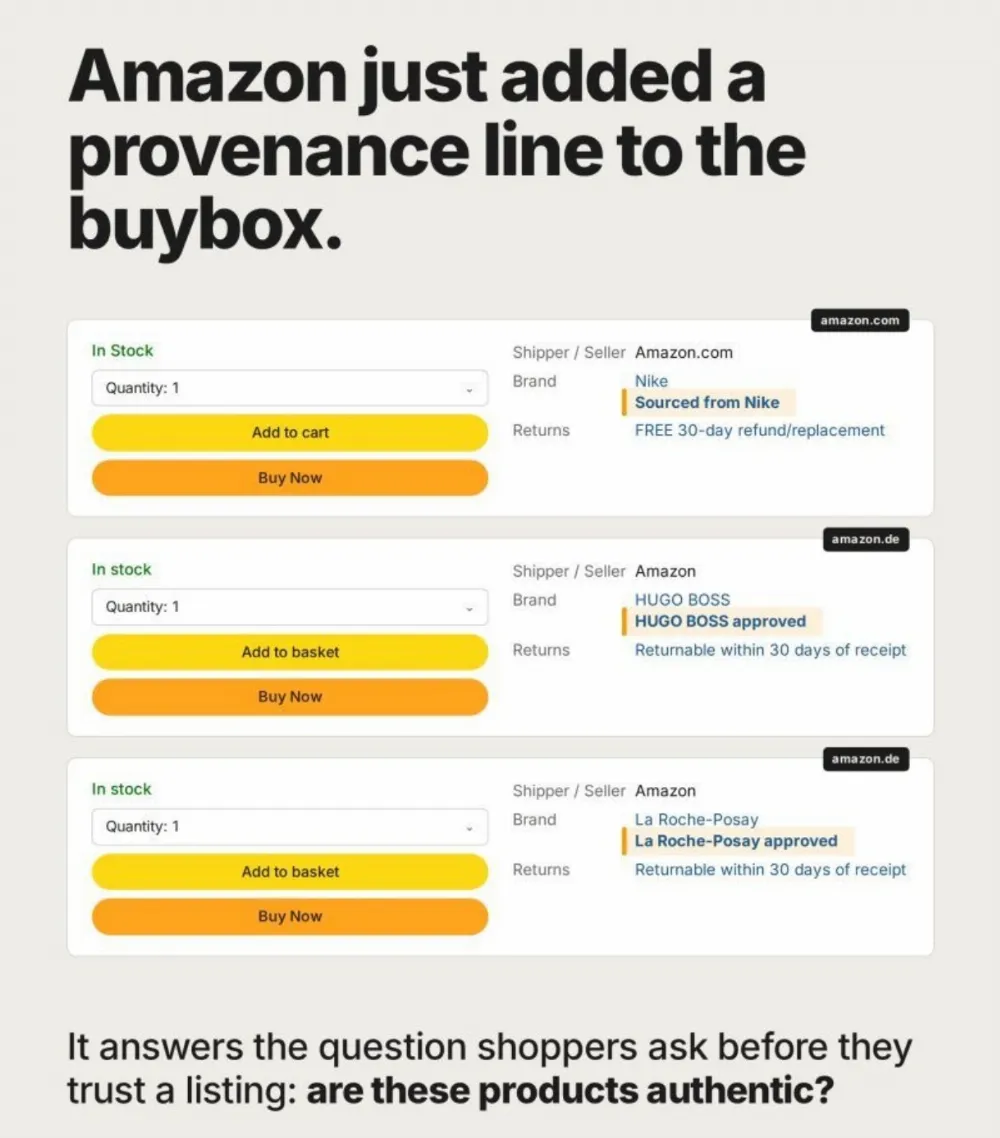
The provenance line on amazon.com (Nike) and amazon.de (HUGO BOSS, La Roche-Posay), September 2026.
Amazon introduced the Frequently Returned Item badge the same way. The badge appeared on a limited set of US listings in March 2023. Amazon then confirmed it was showing return rate information on some product detail pages (Android Police, 2023).
The badge has since expanded across categories. Expect the provenance line to follow that path: a few flagship brands first, then category by category.
Before you plan around it: Amazon has not published eligibility rules or a category timeline for the provenance line. Ask your vendor manager or Amazon account team whether your ASINs qualify, and under which wording.
Why Does Product Provenance Matter So Much in the Pet Category?
US pet industry expenditures reached $158 billion in 2025, and APPA projects $165 billion for 2026 (APPA, 2026). The global pet supplements market reached $2.8 billion in 2025, growing to $4.6 billion by 2033 at a 6.9% CAGR from 2026 to 2033 (Grand View Research, 2026).
Much of that spend goes to products an animal eats, chews, or wears against its skin. Supplements, food, and flea and tick treatments carry a real safety cost when the unit is fake or expired. Counterfeiters and gray-market resellers follow demand, so they follow these categories.
A provenance line answers the authenticity question at the exact point of purchase. Until now, a shopper had to read the seller name and guess. Now Amazon states the origin in a single line.
More deep dives into the pet category on Amazon here:
Which Amazon offers get the provenance line?
The line depends on who sells the unit and where that seller bought it. The table maps the five offer types a pet brand usually finds on one ASIN.
|
Offer type |
Provenance line today |
What the shopper sees |
What the CMO should do |
|
Amazon Retail, stock bought from the brand (1P) |
Yes, on live listings |
“Sourced from [Brand]” or “[Brand] approved” |
Confirm eligibility with your vendor manager |
|
Amazon Retail, stock bought from a distributor |
Not confirmed |
Amazon as seller, origin line uncertain |
Map which distributors sell to Amazon |
|
Brand’s own seller account (3P) |
Not observed yet |
Brand name as seller, no origin line |
Keep Brand Registry and Transparency active |
|
Authorized reseller (3P) |
Not observed yet |
Reseller name as seller |
Tighten reseller agreements |
|
Unauthorized reseller (3P) |
No |
Unfamiliar seller name, no origin line |
Enforce, and let the contrast work for you |
The strategic reading is simple. When Amazon Retail holds the Buy Box with a provenance line, every competing offer on that ASIN looks less certain by comparison.
What Should a Pet Brand CMO Do Before Q4?
Four steps, none of which require waiting for Amazon. Counterfeiters do not care that your salmon oil is wild-caught. They care that it sells.
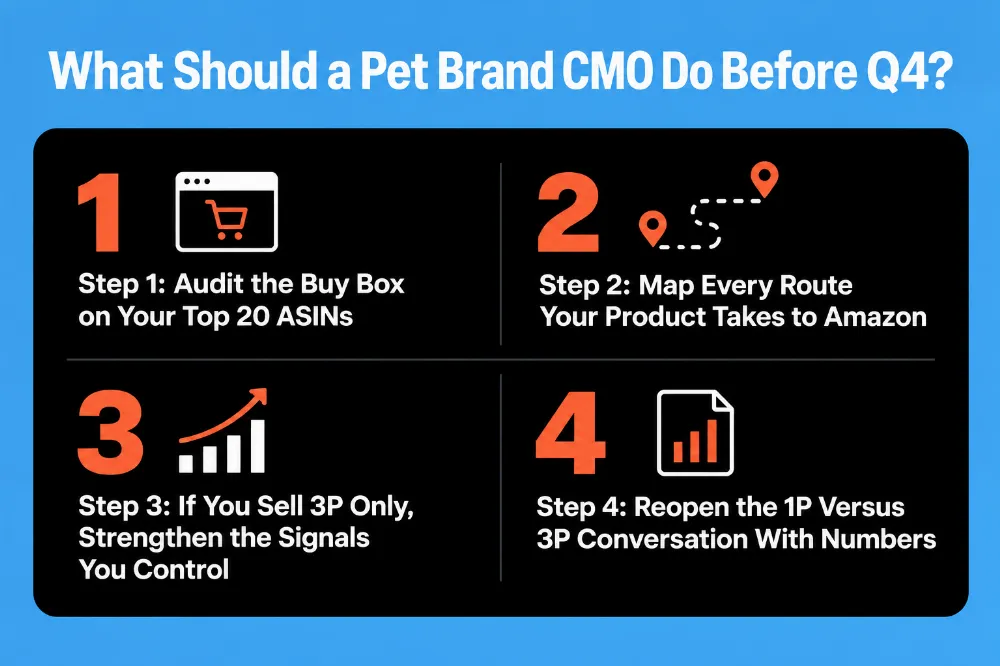
Step 1: Audit the Buy Box on your top 20 ASINs
Open each PDP and record the Shipper / Seller row, the Brand row, and any line beneath it. Do it on amazon.com and on every EU marketplace where you sell.
Watchout: Check while logged in. Early Amazon labels do not always show to signed-out shoppers.
Step 2: Map every route your product takes to Amazon
List who sells your product to Amazon Retail: you, a distributor, or both. A brand cannot claim a provenance it cannot document.
Watchout: Distributor contracts often allow resale to Amazon by default. Read the clause before you need it.
Step 3: If you sell 3P only, strengthen the signals you control
The Brand Registry, Transparency codes and the brand store link under the title all inform shoppers who is behind the product. As none of them are located inside the Buy Box, it is best to use them together.
Watchout: Transparency adds a per-unit code and a labeling step at the factory. Budget for both.
Step 4: Reopen the 1P versus 3P conversation with numbers
A visible origin line adds a conversion argument to the vendor side of the ledger. Weigh it against vendor terms, chargebacks, and the pricing control you give up. Many pet brands will land on a hybrid: 1P for hero ASINs, 3P for the long tail.
Watchout: Do not move to 1P for a label alone. A badge will not fix a margin problem, however handsome the badge.
Netpeak USA audits Buy Box ownership and channel structure for pet brands on Amazon US and EU. If you want a second pair of eyes on your top ASINs, the French Kiss blog team is one email away.
Bonne chance, and may your Subscribe & Save conversion rate be ever in your favor!

 0
0
 0
0
 0
0
 0
0
Related Articles
Pet Food Product Patent: How to Protect Your Innovation
Patenting pet products requires careful consideration and proper application filing. With the 8 steps below, you will be able to submit your patent application and protect your invention.
How UGC and Algorithms Turn Content Into Viral Trends
Let’s break down how UGC, audience behavior, and recommendation algorithms work together to make something go viral. And how you can use this information to help your business grow.
Failed Market Expansion Examples: 7 Mistakes Your Business Should Avoid
Explore seven common failed market expansion examples, real-world lessons from global brands, and a practical checklist for entering new markets successfully.