
How to Market a Pet Brand: Why Performance Marketing Might Be Killing Your Growth
The pet industry grows by leaps and bounds: the US one is worth $158B, and the European pet market is worth more than $81B. The pet product category is one of the most competitive in e-commerce today, especially on Amazon. The marketplace accounts for 59% of all US online pet product sales.
You feel like you’re doing everything the same way as the top players: spending a ton of effort and money on advertising. But for some reason, the results aren’t making you a market leader. Eventually, it becomes a burden: you either keep pouring endless resources into performance marketing, or you fail.
So what are the top brands in the niche doing differently?
Performance marketing helps you get customers quickly, but it needs ongoing effort and high spending. On its own, it is not a long-term solution. You should use it alongside methods that work for you, even if you don't invest any money.
We at Netpeak decided to rack our brains too to answer this question, and asked industry experts with hands-on experience to speak at our “Marketing Pet Brands: Strategy, Marketplaces, Ads — What Scales Profit?” expert panel.
-
Cyril Kuznetsov, Head of Marketplace Promotion, Netpeak (ex-Amazon)
-
Daria Markova, Lead Brand Strategist, Netpeak
-
Yevheniia Kuzmina, Senior Paid Media Specialist, Netpeak
-
And myself, Alyona Grytsuk, Startup Mentor & CEO, Netpeak International
We discussed (and didn’t always agree!) why performance marketing for pet brands alone doesn’t scale; what’s missing when brands hit that ceiling; the real role of Amazon; and how to move from isolated tactics to a smart system that brings you predictable revenue.
Missed the expert panel? I’ve put together some bite-sized insights to help you avoid the pitfalls of performance marketing.
Why Trust Our Advice
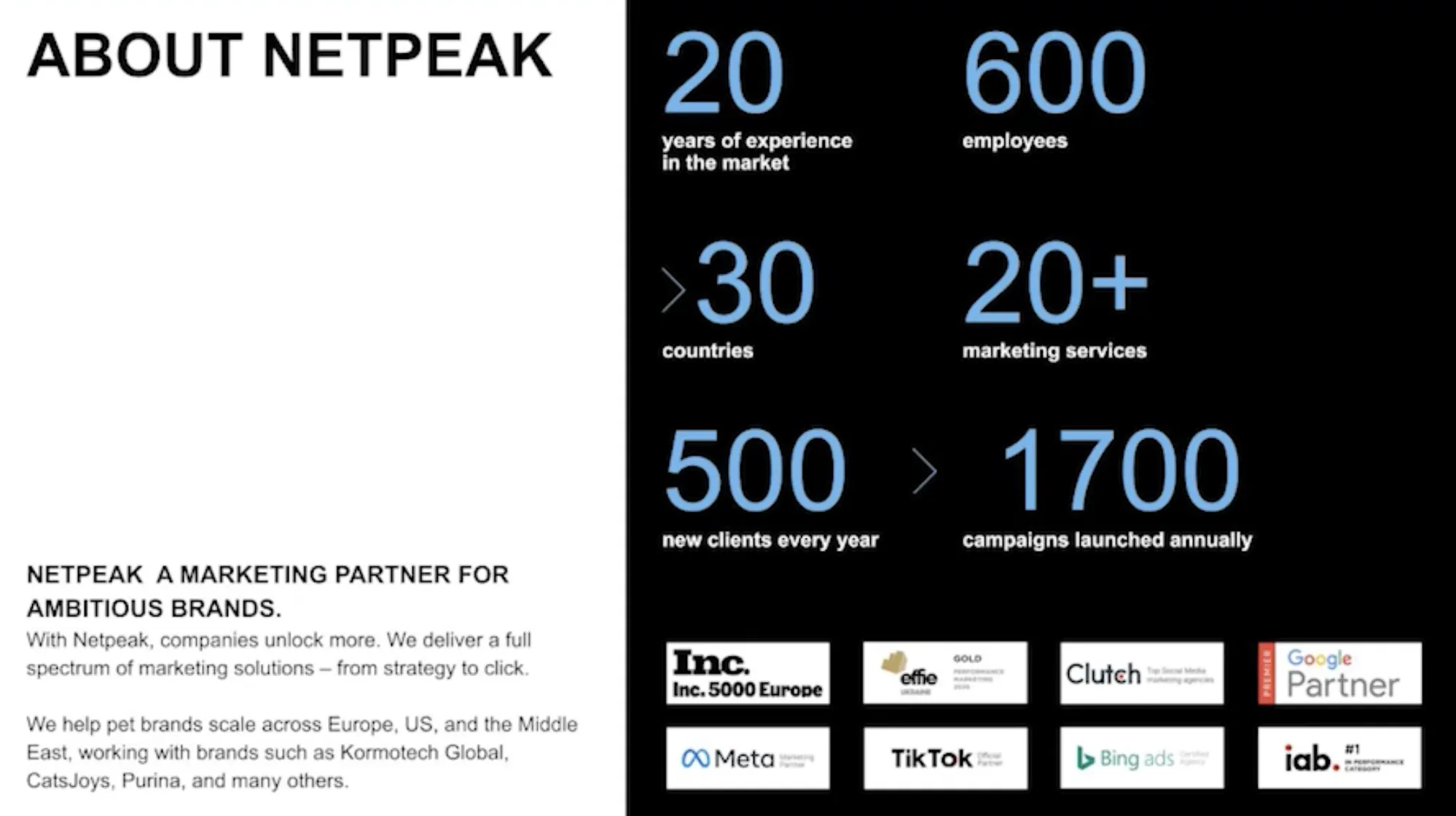
Netpeak has spent over 20 years working on more than 8,500 projects for all types of companies, including Purina (a pet food giant), CatsJoys (cat accessories), Petlock8 (pet GPS trackers), and Kormothech Global (pet food).
So, our experts know a little about the pet industry marketing firsthand.
Here are a few of the latest examples. Netpeak helped:
-
Petloc8 to stand out in a crowded GPS category by speaking to pet-owner emotions, not just features
-
New dogs and cats' premium treats, Delickcious, to fight for their place in the market and get 547M impressions
-
Handmade furniture and accessories for cats, CatsJoys, to get +29% organic revenue and +13% orders! on Etsy
Our experts are good at talking about marketing, sure. But what we love even more is helping companies to get real-life results. Call Netpeak to leverage our expertise to drive your company's growth.
Competing in an Overcrowded Pet Market
The pet category looks easier from the outside because the pet market is huge. The US one is worth $158B, and the European pet market is worth more than $81B.
This can create a feeling that if you have a decent product, you will naturally find your place in this category. In practice, unfortunately, the size of the market often works against you: 73% of pet brands fail on Amazon before year two.
There are almost no unique new audiences in the pet market. To improve their reach, brands are fighting for the customers who are already buying from their competitors.
You need to make them feel ready to switch to something better (your product!) because of your unique selling proposition and/or brand image.
|
What Makes Pet Owners Switch Brands? |
Why It Matters |
What Your Brand Should Do |
|
Ingredient Transparency |
76% pet parents say transparent product information is important (Nielsen, 2024) |
Show sources of ingredients, certifications, and manufacturing details |
|
Health & Functional Benefits |
Pet owners want to buy products not only to feed their pets but to support their digestion, joints, immunity, and wellness (APPA, 2025) |
Build messaging around specific health outcomes, e.g., “more energy,” or“shiny fur.” |
|
Fresh & Human-Grade Positioning |
Pet parents want only the best for their pets. Fresh pet food sales grew 18.2% YoY, while human-grade one grew nearly 20% (Petfood Processing, 2025) |
Show real-food visuals, minimal-processing messaging, and premium positioning |
|
Sustainability & Ethical Sourcing |
62% of pet owners bought environmentally friendly products recently (Faunalytics Sustainability Report, 2026) |
Talk about recyclable packaging, ethical sourcing, and sustainability |

“The hardest part of standing out is not launching the product, but building something people actually love, choose, remember, and trust. And I think this is exactly where a lot of pet companies get it wrong because they move into marketing too early.
They have a product, a few ASINs, even some paid traffic, but they still haven't done the deeper work: research what emotional need the product closes. And if you don't do that before the start, performance gets expensive very fast. Because then you're using the media budget to learn what you should have understood before launch.
We saw this clearly in our work with PetLock8, a GPS tracker brand. It’s a tech product, but when we looked deeper, the real driver of purchase wasn't technical.
Fear. Fear of losing the pet, not being able to protect them, of one small mistake turning into something very harmful for their family.
So the tracker was doing much more than a functional job. It was helping people feel more secure, safer, more in control, and more responsible as pet parents.”
Daria Markova, Lead Brand Strategist, Netpeak
What Works Best for Pet Brands Today
Here is a situation: pet owners are overwhelmed with choices. At the same time, advertising costs keep rising, and marketplaces are becoming more competitive.
So what actually works best for pet brands today? The brands growing fastest are usually the ones that combine three things at once:
-
Strong emotional branding
-
Smart performance marketing for pet brands (running PPC ads)
Let’s dive into each one and learn something for your pet brand!
Pet Brand Strategy as a Profit Driver
A lot of pet companies think that strategy is something you do later: when the business grows bigger, sales are more stable, and the product is already loved.
You can work and have sales without a strategy, sure, but sooner or later comes a moment when the lack of it becomes impossible to ignore. Often, it happens when a company wants to grow.
A pet brand strategy is the plan that helps people understand:
-
Who your brand is
-
Why your products matter
-
The way you speak to your customers
-
Why should someone trust you instead of 500 other pet brands
-
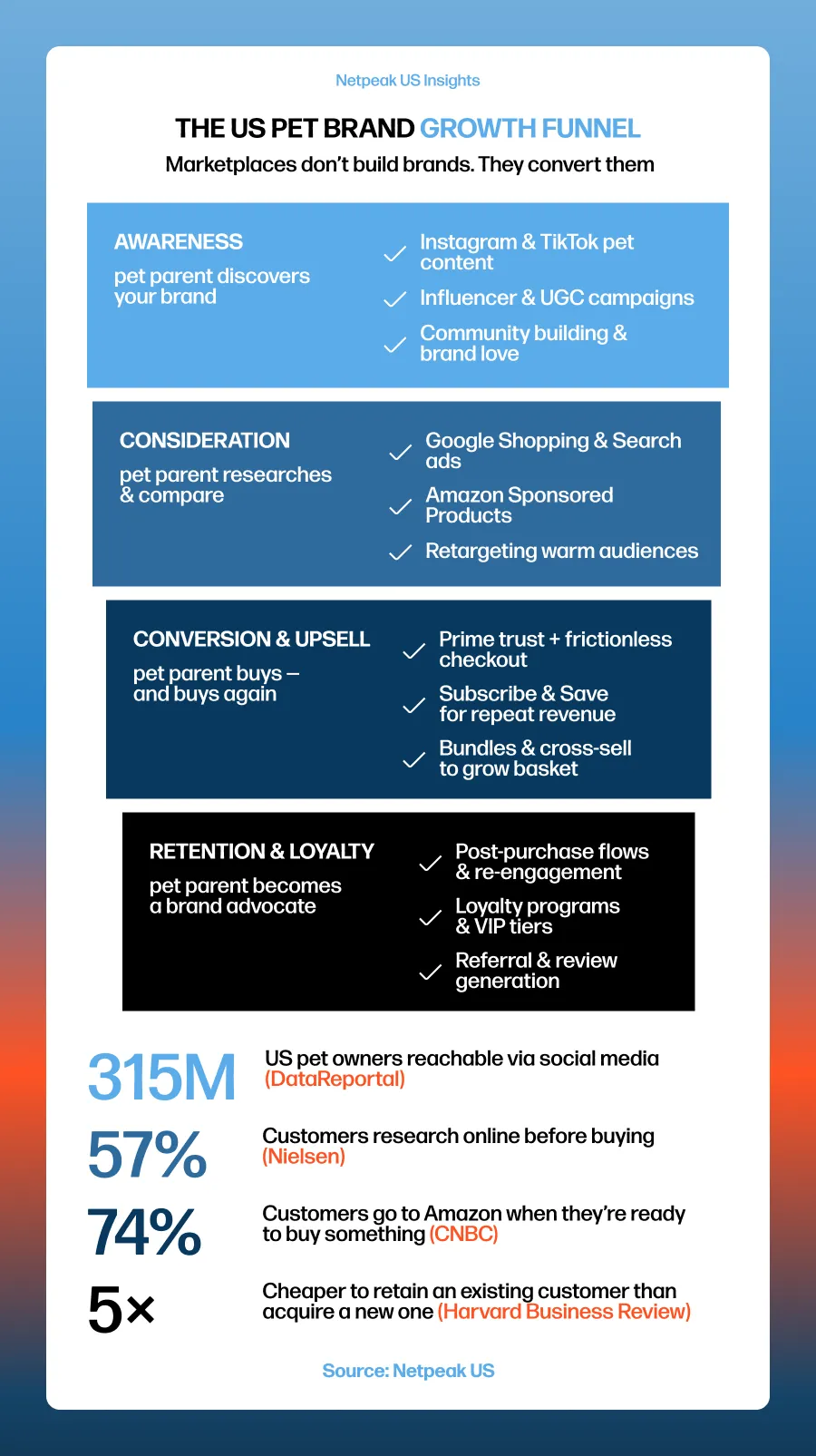
What is your pet brand growth funnel based on the customer journey
“Growth is not just one thing. One of the biggest mistakes that we see in our department is companies trying to solve all problems at once. As if there were some magic button they could press, and suddenly everything would start working exactly the way they wanted.
This sounds ambitious, yes. But very quickly it turns into a wasted budget and teams pushing in different directions. Brand strategy helps to define the priority: how do you talk with your audience, and what should your brand mean to people.
Only after that, move into strategic work like building a communication platform, clarifying messages, and defining the role of channels. Strong communication is not just creative, it's aligned, and it knows what kind of growth is there to support.”
Daria Markova, Lead Brand Strategist, Netpeak
Having a brand and communication strategy is a long-term investment that also helps with reducing ad costs in the future. The bigger your pet brand is, the lower the cost per result you will see in your ad account, and the more stable your income will be.

“Strong brand image with strong positioning is a game changer. It helps customers understand why they should switch to your service.
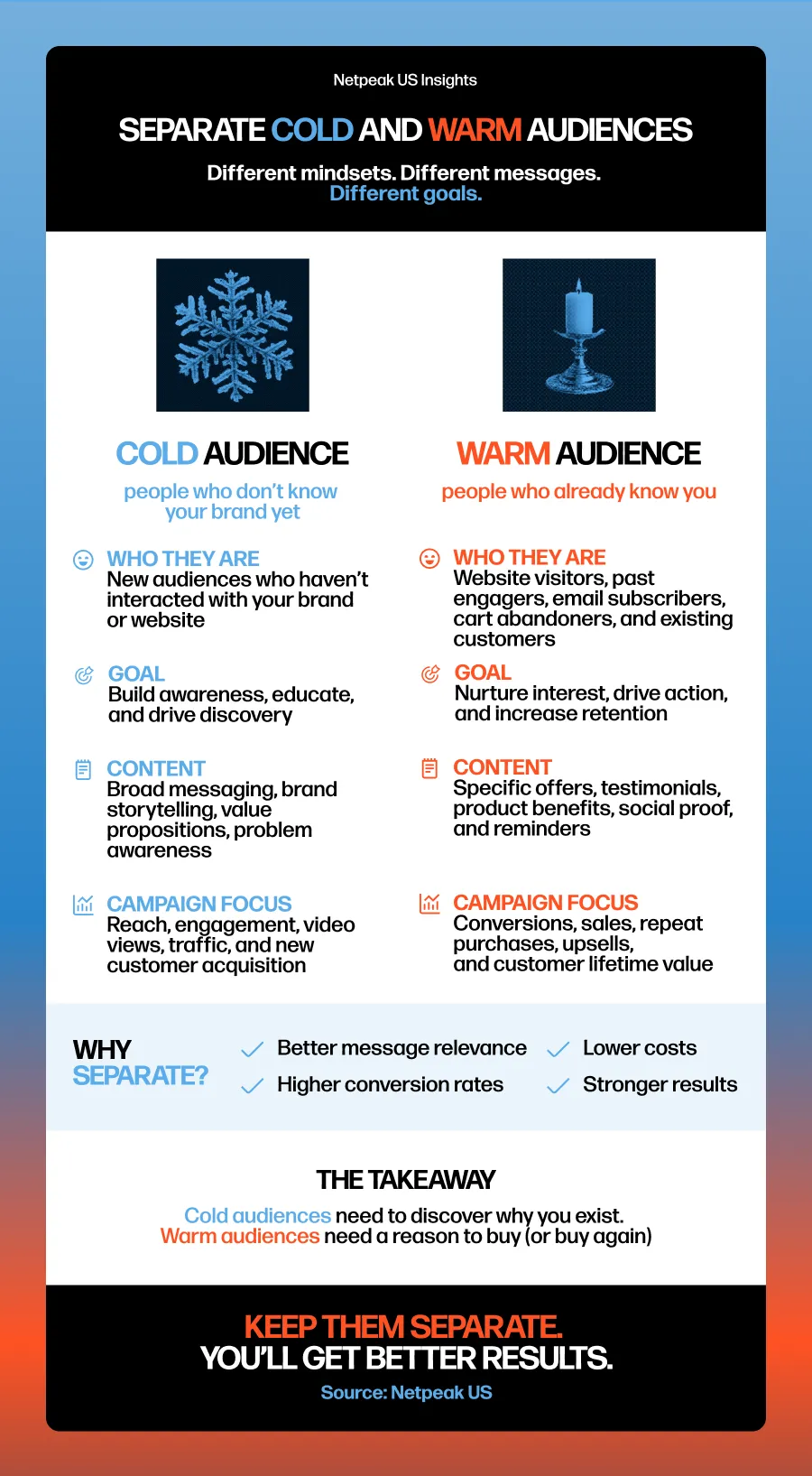
Once you have a base of loyal customers, you can create different campaigns, budgets, and KPIs for new "cold" audiences and for remarketing to "warm" ones. "Warm" audiences, keeping together by your brand, produce better and cheaper results. This may sound obvious, but I rarely see businesses doing this.”
Yevheniia Kuzmina, Senior Paid Media Specialist, Netpeak
It’s not about a nice brand name or logo (but these are important too!). You need a brand strategy for stronger long-term results. Here are a few main brand strategy factors and their business impact:
|
What It Actually Means |
Example in the Pet Industry |
How It Becomes a Profit Driver |
|
|
Clear Positioning |
You need to clearly explain who the product is for and what problem it solves. Without it, brands look generic, compete mostly on price, and struggle to explain why customers should choose them. |
Instead of “premium dog food,” your brand should say: “Fresh food for small dogs with sensitive digestion.” |
Customers understand the value faster, which reduces wasted ad spend (ResearchGate, 2024) If you position your brand clearly, it helps products stand out on crowded shelves and marketplaces. |
|
Emotional Connection |
Your brand should connect with how pet owners feel, not just what they buy. Without it, customers may buy once but rarely form loyalty. The business constantly needs new customers to survive. |
Don’t promote ingredients, but “helping anxious rescue dogs feel safe at home.” It creates a stronger emotional reaction. |
Emotional brands increase sales, build loyalty, and repeat purchases (Nielsen, 2022). Pet owners are more likely to stay with brands that make them feel like good, caring pet parents. |
|
Trust & Credibility |
Give your customers confidence that they made the right choice. Without it, customers hesitate, compare endlessly, or choose cheaper alternatives because the brand feels risky or unknown. |
Show ingredient sourcing and veterinarian input, write feeding guides, and share real customer stories. |
80% of consumers say they must trust a brand before buying from it (Edelman Trust Barometer, 2025) Trust increases conversion rates and allows you to charge higher prices. |
|
Marketplace Differentiation |
Your brand needs to stand out visually and emotionally on platforms like Amazon and Chewy. Without it, products disappear into crowded search results and enter constant price wars. |
Use recognizable packaging, consistent messaging, and value propositions across listings and ads. |
Strong differentiation reduces dependence on discounts. Customers search for the brand directly. Trust and emotional resonance are central competitive advantages now (Amazon, 2025) |

“Brand strategy is important for Amazon, but Amazon is not the place where you create your brand. It’s the place where you convert, upsell, and show customers that they made the right choice.
Pet brands should use Amazon like an upsell machine. For example, I buy food for my cat, and I will never switch to another brand because of a promo or a fancy image; I will stick to the brand I know and my pet already approved. However, when I go to the brand I know, and I see a different flavor, it’s another story. I already trust the brand, so I can experiment.
That's what you need to boost when you're a pet brand: play with bundles.”
Cyril Kuznetsov, Head of Marketplace Promotion, Netpeak (ex-Amazon)
Beauty brands are often the first to adapt to changes in marketplaces and social commerce. See what their latest moves can teach pet brands.
Marketing Strategies for a Pet Brand
Running pet ads is easy. Running profitable pet ads in a crowded market is where things become complicated.
Let’s review your marketing strategy! I wrote down some tips to help you optimize your pet campaigns.
Where Should Optimization Start
If you already have pet campaigns running, start optimization from the foundation. A lot of businesses try to scale campaigns before checking whether the system underneath works properly.
#1: Start With Tracking and Analytics
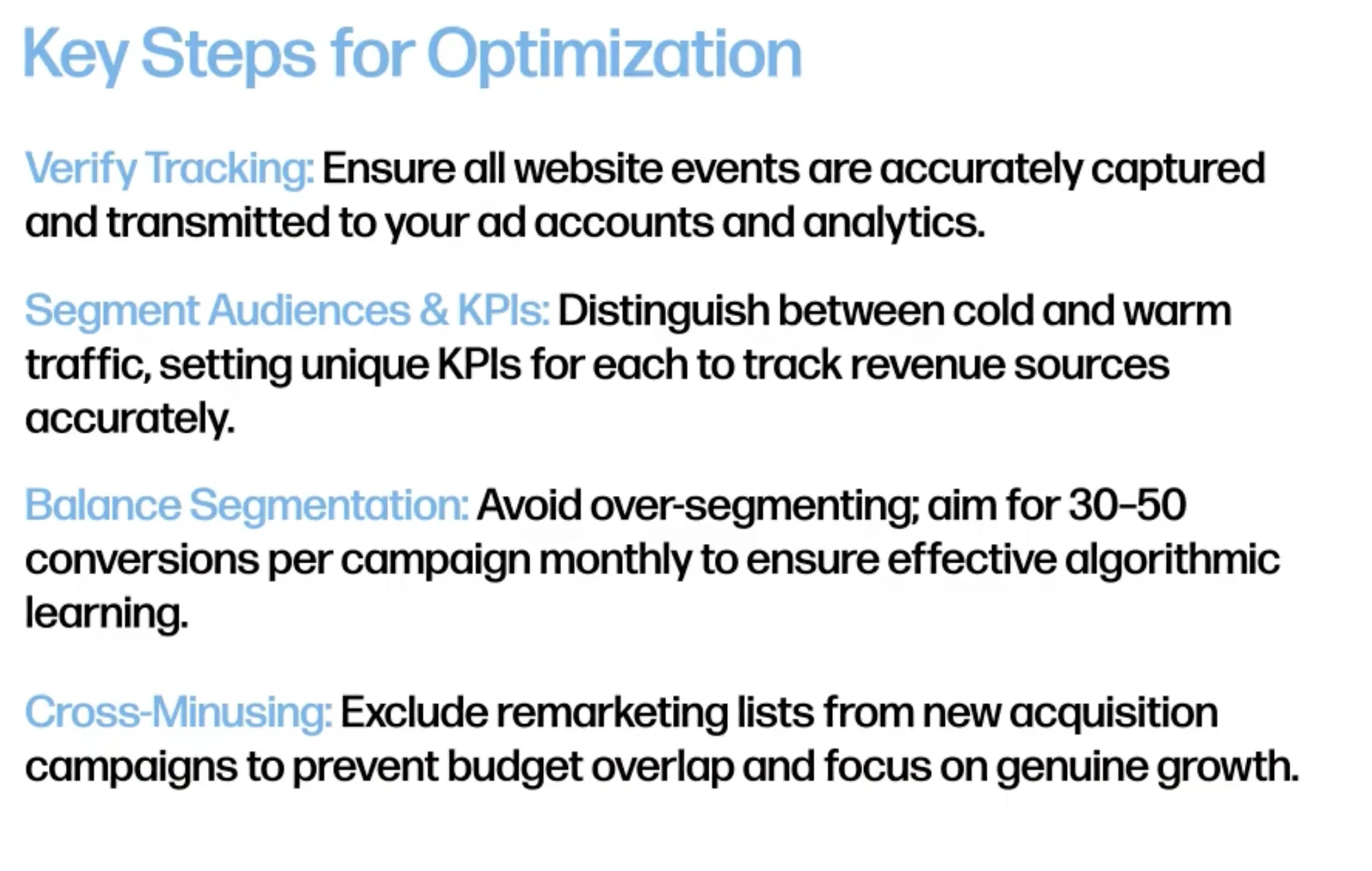
Before optimizing anything, check your tracking. Make sure:
-
Website events work correctly
-
Conversions are properly transmitted to ad accounts and analytics systems
-
E-commerce tracking works normally
-
Product feeds update regularly
-
Segmentation is clean
-
No critical errors in reporting
“This may sound obvious, but even large brands that have been on the market for 10+ years sometimes have major analytics problems. When we audit accounts, we regularly find broken tracking, duplicate events, incorrect attribution, or missing conversions.
And if the data is wrong, every decision afterward becomes unreliable. You cannot scale campaigns properly without a strong foundation.”
Yevheniia Kuzmina, Senior Paid Media Specialist, Netpeak
Don't rely on data from only one platform. Compare CRM data, GA4, Meta Ads reports, and Google Ads reports. It helps to find tracking problems faster.
#2: Separate Cold and Warm Audiences
Cold audiences and remarketing audiences should have different campaigns and different KPIs because these audiences behave differently.
But don’t oversegment them. Sometimes ad accounts have 100 small campaigns, some of which generate only one or two conversions per month.
Modern ad systems do not work well like this. Platforms like Meta, Google, and TikTok rely heavily on data; their algorithms need enough conversions to learn.
“Use a rule of thumb: try to have at least 30-50 conversions per campaign per month. That is usually the minimum level where campaigns can start learning efficiently. If your account is oversegmented — simplify it.
More campaigns do not always mean better optimization.”
Yevheniia Kuzmina, Senior Paid Media Specialist, Netpeak
And use cross-exclusions properly. If Campaign A targets remarketing audiences and Campaign B targets new audiences, don’t forget to exclude remarketing users from Campaign B. You don’t want them to compete against each other.
#3: Audit Your Creatives
Strong creative work is usually the main factor behind campaign success, especially on Meta, TikTok, and Display ads.
So, check your banners, videos, hooks, thumbnails, and ad copy often. If something is not working well, turn it off. If your cost per action gets too high, swap in a new creative.
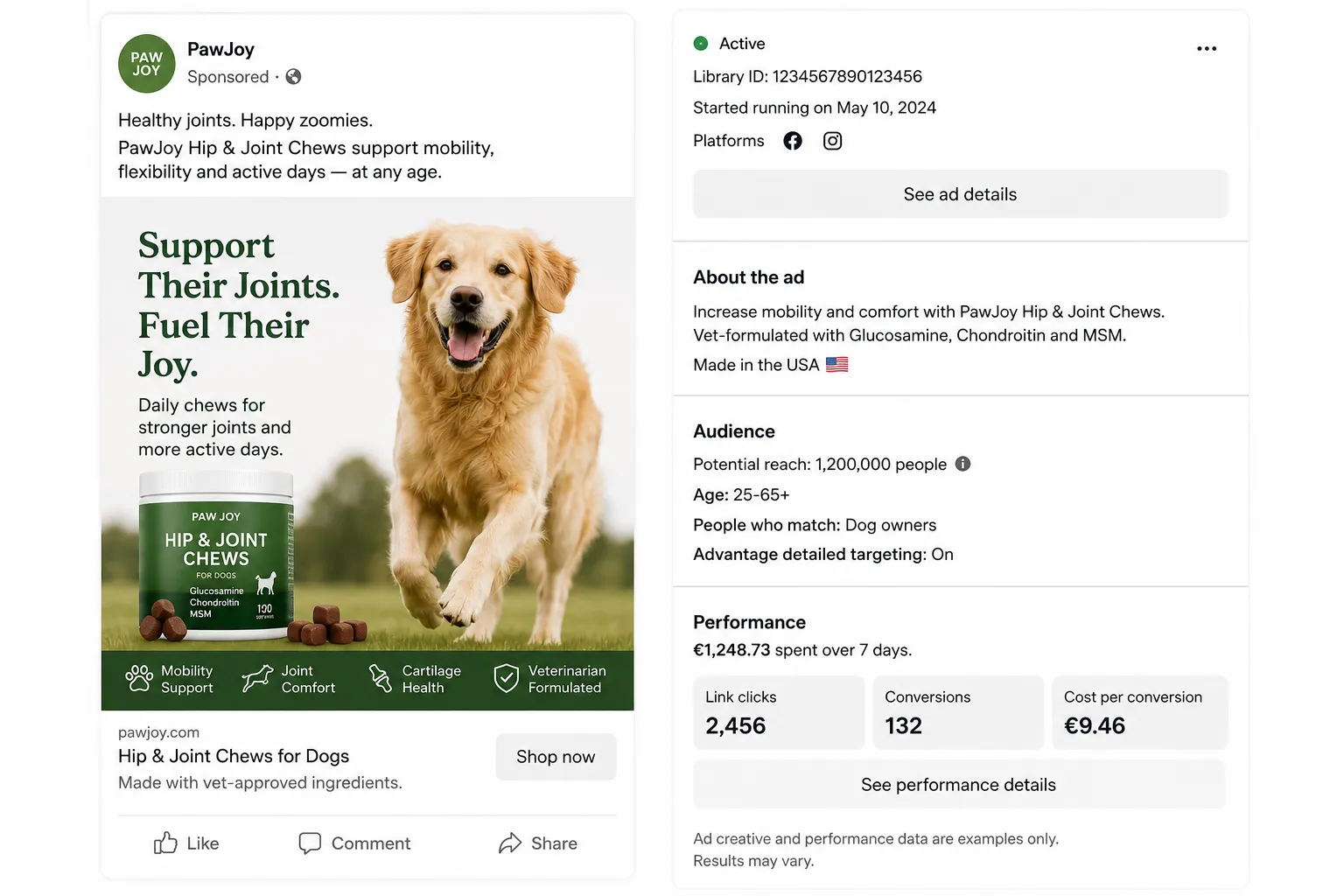
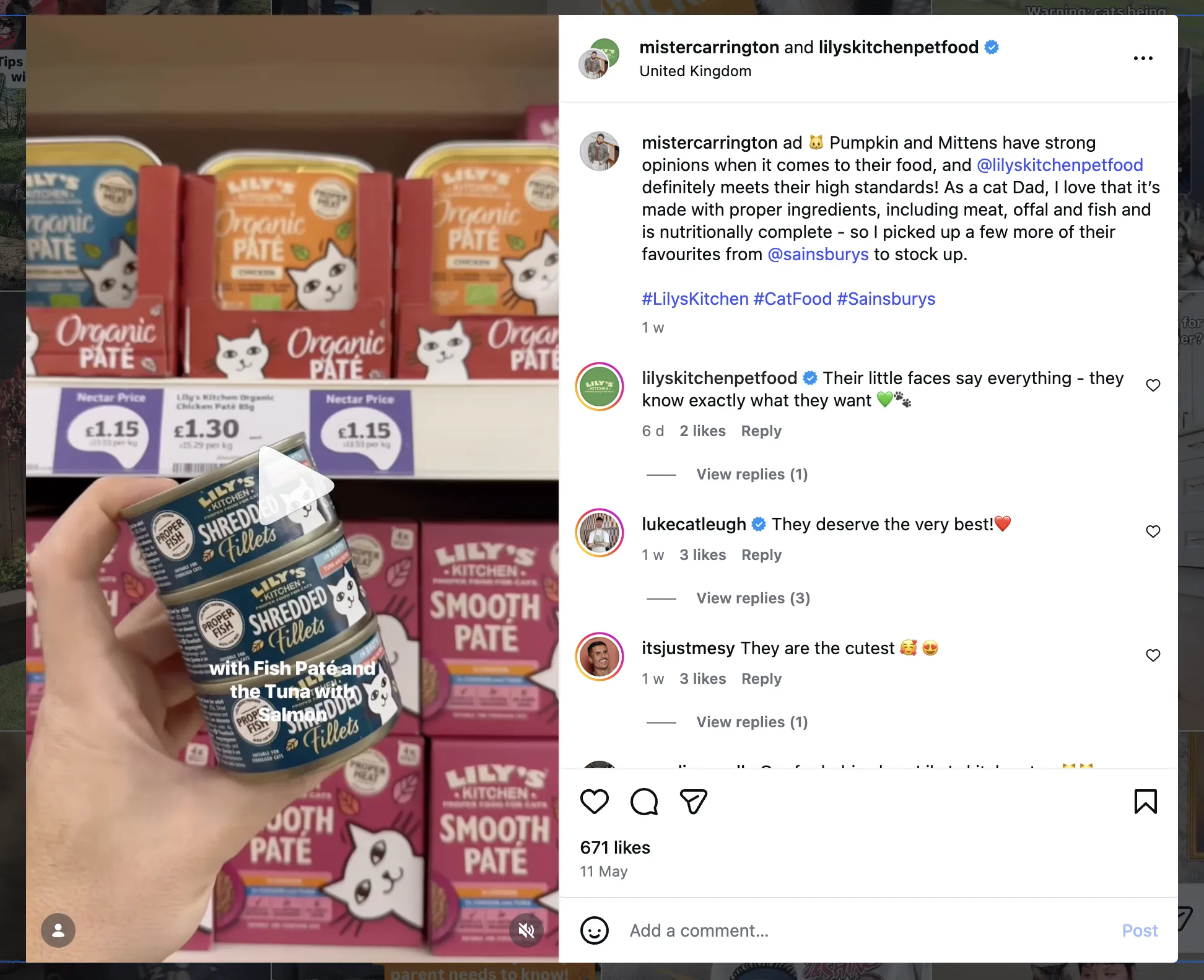
If you don’t have a designer, hire one. You’ll need:
-
Multiple banners
-
Videos
-
Hooks
-
Emotional visuals

-
UGC-style content
-
Product demonstrations
Pet marketing relies a lot on emotion and visuals. If your creative work is weak, it can hold back your growth.
#4: Do the “Boring” Optimization Work Consistently
This step might not be exciting, but it’s important. Make it a habit to check your search query reports, placements, audience quality, device performance, gender and age breakdowns, geographic results, and website behavior metrics.
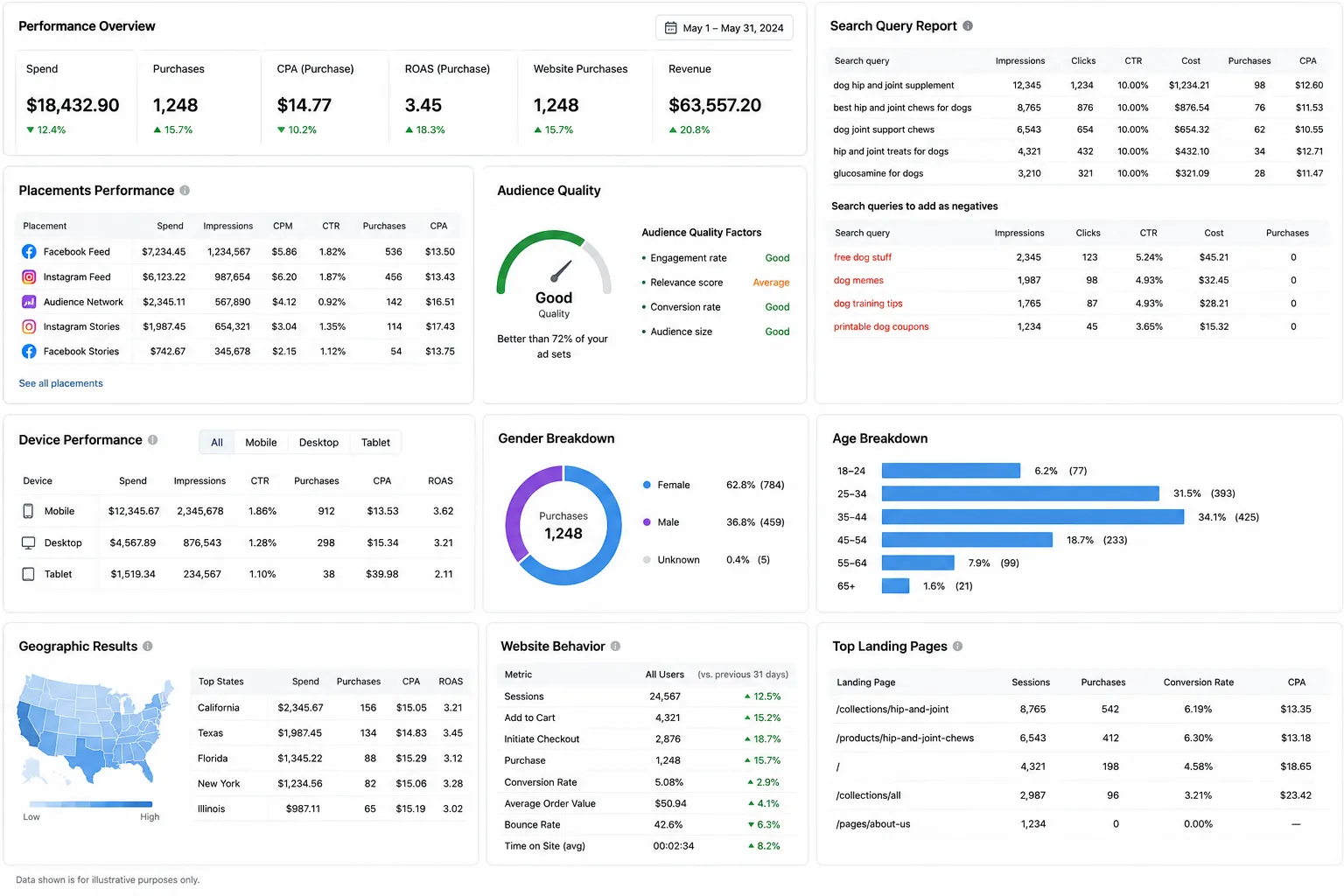
With Google and Bing in particular, keep reviewing your search terms, spot irrelevant traffic, and update your negative keyword lists.
If you skip this, you’ll end up spending money on searches that won’t bring in valuable customers.
Pet Advertising Tactics You Need to Know
“Dedicate your time to learning how to work with intellectual automated bidding strategies, Target CPA, and Target ROAS. Classic maximum clicks strategy doesn’t work well in the modern market and in the modern ad auction.”
Yevheniia Kuzmina, Senior Paid Media Specialist, Netpeak
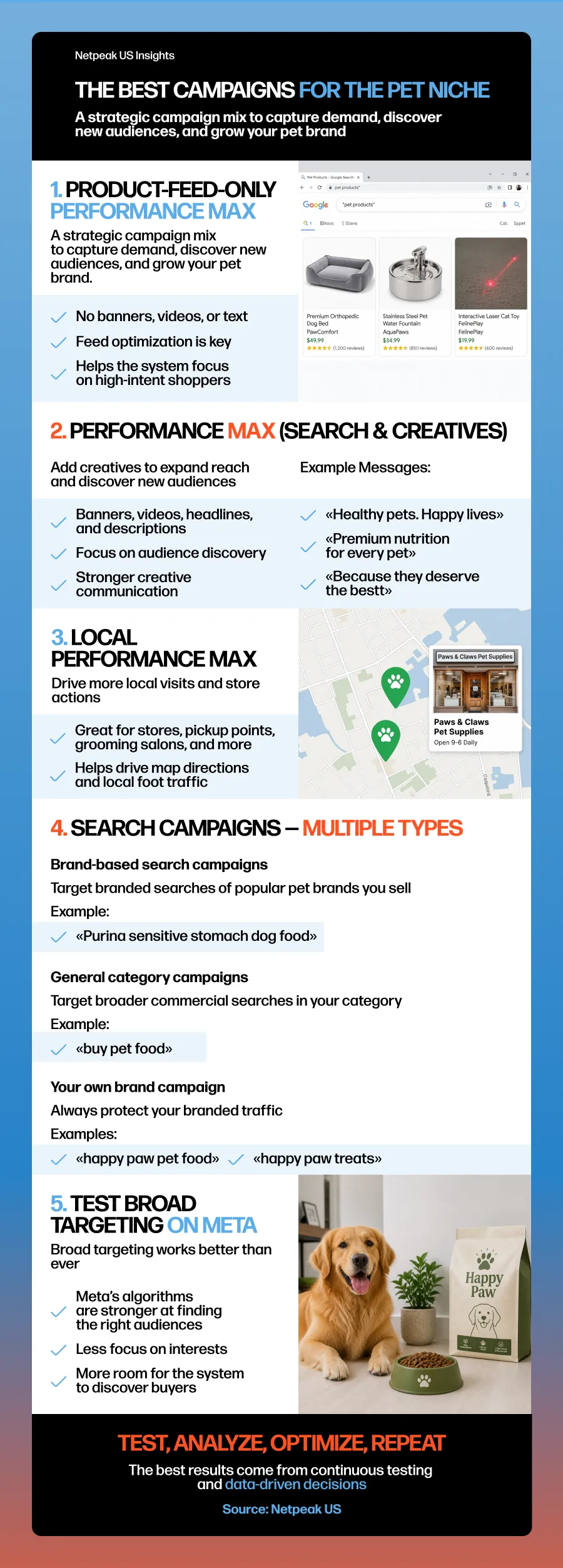
Here are the campaigns that work best for the pet niche:
-
Start with a product-feed-only Performance Max campaign without banners, videos, or text. This helps the system focus on product intent, shopping behavior, and feed optimization.
-
Create a second Performance Max campaign focused on search & creatives: with banners, videos, headlines, and descriptions. This creates a second layer focused more on audience discovery, search intent, and creative communication.
-
Use local Performance Max campaigns if you have physical locations. If your pet brand has stores, pickup points, grooming salons, etc., local Performance Max campaigns can help drive map directions and local visits.
-
Build multiple types of search campaigns:
-
Brand-based search campaigns if you sell popular pet brands and want to target those branded searches directly (e.g., “Purina sensitive stomach dog food”). This allows you to capture existing demand.
-
General category campaigns, if you want to target broader commercial searches like “buy pet food” or “cat supplements.” But avoid relying only on ultra-competitive keywords. Look for more niche queries.
-
Your own brand campaign. Always protect your own branded traffic. If your brand is called “Happy Paw,” run campaigns targeting: “Happy Paw”, “Happy Paw pet food,” “Happy Paw treats,” etc.
This protects you from competitors bidding on your name and helps track brand growth directly inside ad platforms.
-
Test broad targeting on Meta. Use broad targeting without focusing on specific interests; it is more effective now than it was in the past. Facebook and Instagram are now so much better at finding the right audiences through their algorithms.
Trying out broad targeting and Advantage+ can sometimes give better results than using very detailed targeting setups.
The Role of Amazon and Marketplaces for the Pet Businesses
Amazon and Chewy are now key places where customers discover products, check reviews and testimonials, build trust, and often decide what to buy. And they have their own rules.
Pet humanization is the baseline for Amazon. It's not just a must-have; it's the entry condition for playing in the pet market. This is even true when considering that Amazon is more of a cash register than a relationship booster.
The corporate America playbook doesn't work anymore — buyers see through overpolished generic benefit claims and stock photos. But the trick is that the opposite extreme doesn't scale either. For example, the local store's strategy of making food from scratch will have huge trust issues.
Pet brands need to find the sweet spot. They need to be real and operate like a machine.
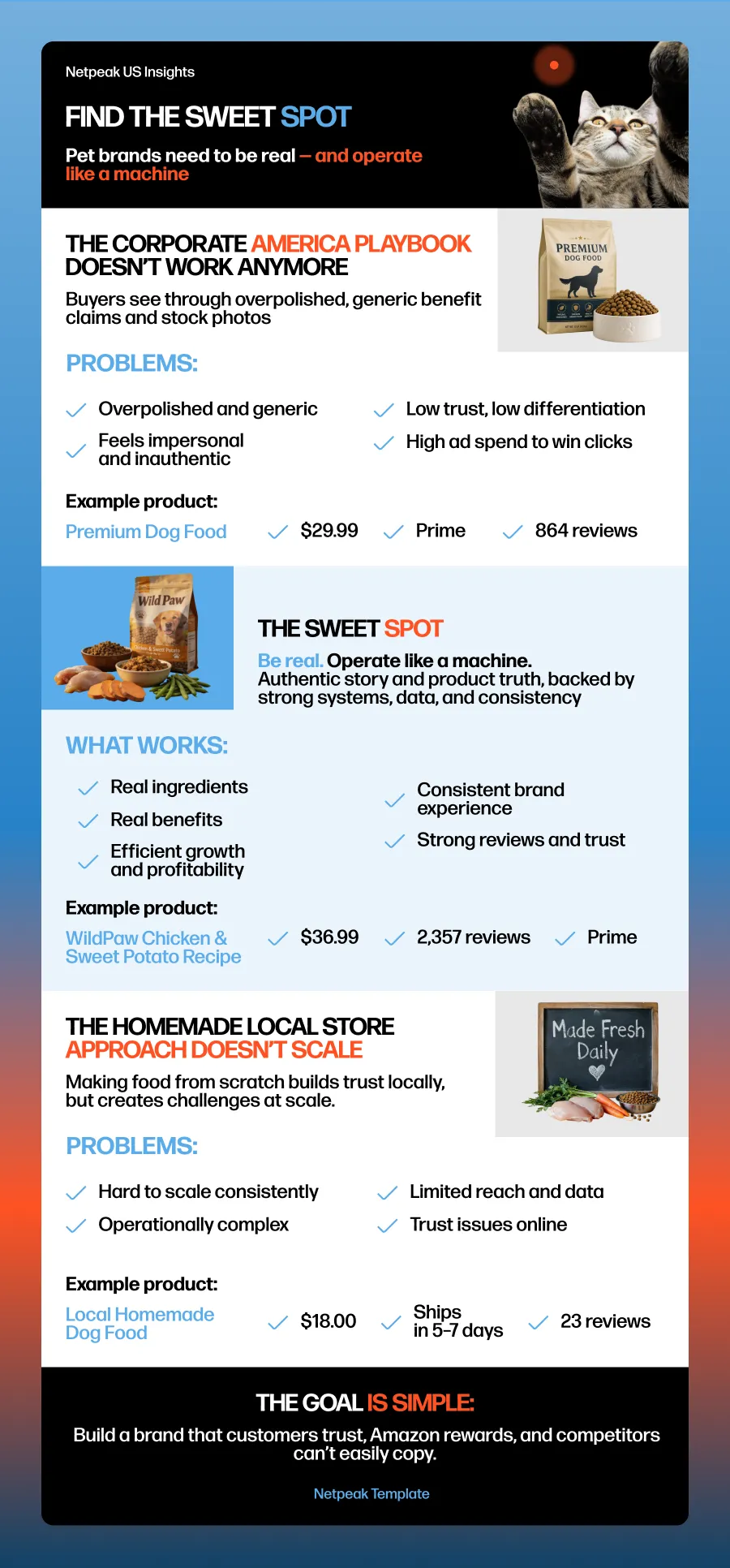
"Operational excellence is non-negotiable. You need Prime agility, never be out of stock, have fast fulfillment, and 'Subscribe and Save,' as well as relevant Amazon rewards.
It's all about reliability. Amazon doesn't tolerate unstable brands or accounts.”
Cyril Kuznetsov, Head of Marketplace Promotion, Netpeak (ex-Amazon)
How Can a Pet Brand Stand Out on Amazon?
Pet categories are oversaturated, that’s why more spending doesn't mean more growth. Otherwise, big guys would just pour an infinite amount of money and get every customer on the market, but it doesn't work that way.
Growth comes from changing your structural position in the marketplace and not just turning up the volume. You need to improve the keywords you rank for, the competitors you are placed next to, placements you own, and how you show up in new-to-brand searches. If none of that changes, you're just cannibalizing organic.
“We at Netpeak never just play on keywords like “pet food” or “dog collar”. Everybody's targeting those. You need to be smart.
One example: in February, Amazon changed its share review policy. Before, e.g., all dog food (chicken, duck, tuna) shared the same 4,000 reviews, but in one day, Amazon separated them, so chicken got their 3,100 reviews, duck got 844, and tuna got 56 overnight.
We took one of our clients and started to pour marketing budget into their reviews. When previously they had 300 reviews compared to 4,000, it was nothing. But 300 reviews compared to 56, it's everything.
That was an open window that closed because the competitor is big, so they figured it out pretty fast. But we had an opportunity of one and a half weeks, and we used it.”
Cyril Kuznetsov, Head of Marketplace Promotion, Netpeak (ex-Amazon)
It's really how you should operate — don't just go all in on typical. Call Netpeak to find those little openings on Amazon when you can snatch.
Temu is getting bigger, louder, and harder to ignore. But should pet brands actually be worried? We break down the numbers and the implications.
Key Metrics Every Pet Brand Should Track in 2026
You need to track the right metrics to make better growth decisions.
There are two main ways to manage a pet brand’s ad accounts: using long-term value (LTV) as a guide, or not.
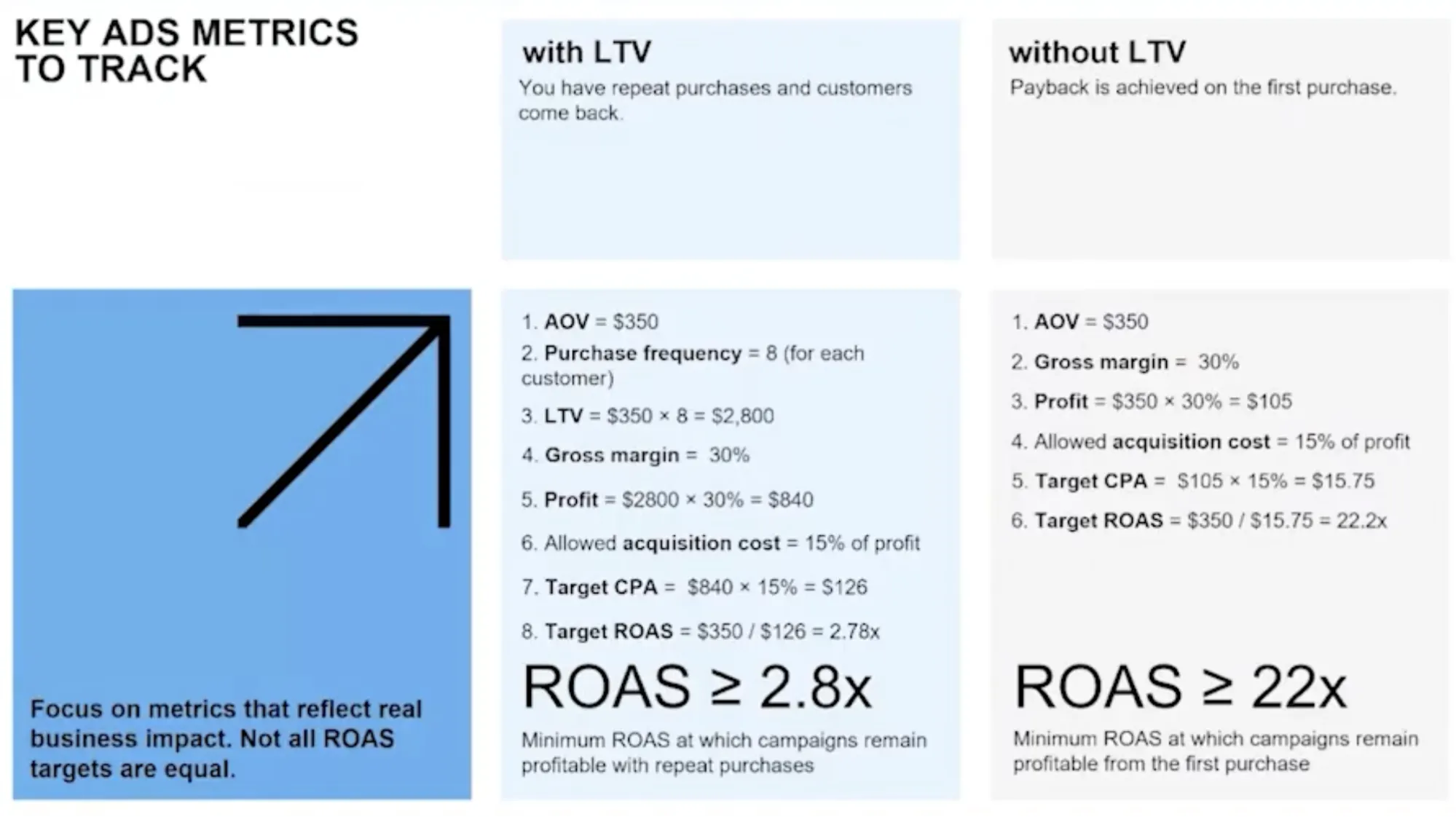
It’s a lot of numbers, I’ll try to explain.
Option 1: Evaluating Ads WITH LTV (Recommended for Scaling)
This is the model where you calculate not revenue from the one purchase, but how much money the customer brings over time, how often they reorder, and how profitable they become in the long term.
How to do it:
-
Calculate your average order value (AOV), for example, $350, and purchase frequency — how many times the average customer buys per year, e.g., 8 times per year.
-
Now it’s time to calculate LTV (Lifetime Value). Use formula: Average Order Value ($350) × Purchase Frequency (8 purchases). LTV = $2,800.
This means one average customer generates nearly $2,800 in revenue over time.
-
Calculate profit. For example, your gross margin = 30%. This means, from $2,800 revenue, approximately 30% becomes gross profit. Your profit = LTV ($2,800) × Gross Margin (30%) = $840.
-
Define acceptable acquisition cost (CPA). Decide how much of that profit you are comfortable spending to acquire a customer. For example, 15%. Now, use the formula: Target CPA = Gross Profit ($840) × Allowed Acquisition (15%) = $126.
This means: you can afford to spend up to $126 to acquire one customer. And still remain profitable long term.
-
Calculate Target ROAS. Use formula: ROAS = Revenue ÷ Ad Spend. For example, a $350 first order and a $126 acquisition cost. 350 ÷ 126 = 2.78 ROAS or approximately 280% ROAS.
And this is important: 2.8 ROAS is usually realistic and achievable for ad systems.
“When using LTV, you accept that the first purchase may not be extremely profitable, because repeat purchases recover the acquisition cost later.
This gives ad systems more flexibility, more room for learning, and better scaling potential. And this is especially powerful for pet brands because many customers naturally reorder products for months or years.”
Yevheniia Kuzmina, Senior Paid Media Specialist, Netpeak
Option 2: Evaluating Ads WITHOUT LTV
Some businesses want the very first purchase to already generate strong profit. In this case:
-
The allowable CPA becomes much lower
-
The required ROAS becomes much higher
In the example, the required ROAS could become 22 or 2,200%.
However, not all speakers agreed that it’s the main metric the pet business should measure.
“This CPA, ROAS, and LTV explanation is far beyond the bare minimum — it is princess treatment. From the brand strategy side, real brand impact starts showing up when growth becomes easier, not just bigger. You begin seeing more:
-
direct traffic
-
recommendations
-
organic mentions
-
UGC (user-generated content)
And usually lower customer acquisition costs over time.
You may also notice stronger conversion rates even without dramatically increasing media spend. That is often a sign the brand itself is starting to do part of the work. And I think one of the most important signals is when people begin choosing your brand more naturally — over entirely different alternatives they could have gone with.
For example, if you sell a pet tracker, you are not competing only with other pet tracker brands, but with Apple AirTag-style Bluetooth trackers, better training, and different owner routines, or simply the belief that “my dog is well-behaved, nothing will happen.
That is when you know branding is working on a deeper level. You are becoming a brand people think about naturally at the right moment.”
Daria Markova, Lead Brand Strategist, Netpeak
Final Thoughts
In 2026, successful pet marketing is about combining strong performance marketing with long-term brand building, clear positioning, creative consistency, and a deep understanding of customer behavior.
Metrics still matter — ROAS, CPA, LTV, retention, and conversion rates are all critical. But behind those numbers, something bigger is happening. Strong brands gradually make growth easier: customers trust them faster, return more often, recommend them naturally, and search for them directly instead of comparing endless alternatives.
You are not competing only against other pet companies anymore. You are competing against every alternative solution, every customer habit, and sometimes even the decision to do nothing at all.
The brands that win are usually the ones that stay memorable, emotionally relevant, and consistently visible across every place pet owners discover, compare, and purchase products.
FAQ
What are the biggest challenges when launching a DTC pet supplement brand?
The first challenge is trust. Pet supplements may seem easy to launch because the category has strong repeat purchase potential, but customers are buying products for animals they love and care about. That means the brand needs to feel credible, safe, and trustworthy from the very beginning.
Another challenge is clarity. If the messaging becomes overloaded with claims, customer acquisition costs can rise very quickly. And finally, retention is critical — pet supplements become truly profitable only when customers come back.
Does conscious spending reduce emotional impulse buying in the pet industry?
Not really. Emotional buying still exists very strongly in the pet industry, but it has become more selective and more rationalized. Customers still buy emotionally, but now they often need a stronger justification behind the purchase.
Instead of “This is cute, I want it,” the thinking becomes “This is cute, but it also helps my pet.” Brands that connect emotion with function usually convert better.
When should brands start using retargeting and lookalike audiences?
Retargeting campaigns can usually start immediately because even new websites already have organic visitors, website traffic, and initial audience signals.
Lookalike audiences are different because they require a strong source audience first. Ideally, brands should already have:
-
customer lists
-
email databases
-
at least around 1,000 purchasers
Budget also matters heavily. Campaigns need enough data and enough conversions — usually around 30–50 conversions per month — for algorithms to learn.
How should pet brands approach bundles and subscriptions?
Bundles and subscriptions should not be treated only as discount tools. They are one of the closest things marketplaces like Amazon offer to long-term customer relationship building.
When building bundles: keep segmentation logical, avoid mixing too many unrelated variations, and create combinations that naturally fit together.
For subscriptions, common discount ranges are:
-
5% = minimum baseline
-
10-15% = usually the strongest conversion range
-
above 15% = can start training price sensitivity instead of loyalty

 0
0
 0
0
 0
0
 0
0
Related Articles
Business Apps in the US: iOS vs. Android, September 2026
We searched for US App Store and Google Play data to see what business apps professionals, shoppers, and investors actually installed in September.
What Happens When Amazon Suppresses Your Listing? The New 2026 Rules
Under the new 2026 rules, Amazon warns you first and gives you a grace period to fix the issue.
Amazon’s New “Sourced from Brand” Buy Box Label: Who Gets It and Who Doesn’t
Amazon is rolling out a provenance line in the Buy Box. A short label under the Brand row now reads “Sourced from [Brand]” on amazon.com and “[Brand] approved” on amazon.de. It tells the shopper that the unit on offer came through the brand’s own supply c