
Pet Food Product Patent: How to Protect Your Innovation
How to patent a pet food product? First, figure out what you want to protect and whether it can be patented. It CAN be patented in most cases. From there, research similar products and possible patents, write down your formula and process, choose the right patent type that fits your business goals, and prepare your application process. And, most importantly, keep the details safe.
You've spent months perfecting a treat recipe that dogs or cats go crazy for. One question is probably nagging at you: can I actually protect this if another company wanted to copy it? This question matters just as much for small businesses as it does for pet food giants.
Pet food is a crowded, fast-moving industry: total US pet industry spending reached $158B in 2025, and pet food and treats are one of the largest categories, driven by steady consumer demand (APPA, 2026). So, "I had the idea first" means nothing legally unless you can prove it.
The good news is that pet food innovations can often be protected, and the process is more approachable than it looks once it's broken into steps.
In this guide, you'll learn exactly what intellectual property can be patented, how to check if your idea qualifies, and how to move from a kitchen-counter formula to a filed application.
1. Define What Exactly You Want to Patent
You need to be sure your improvement is worth patenting. Patent offices grant rights only to novel betterments. Ask yourself: what does your product do better or differently than other products on the market?
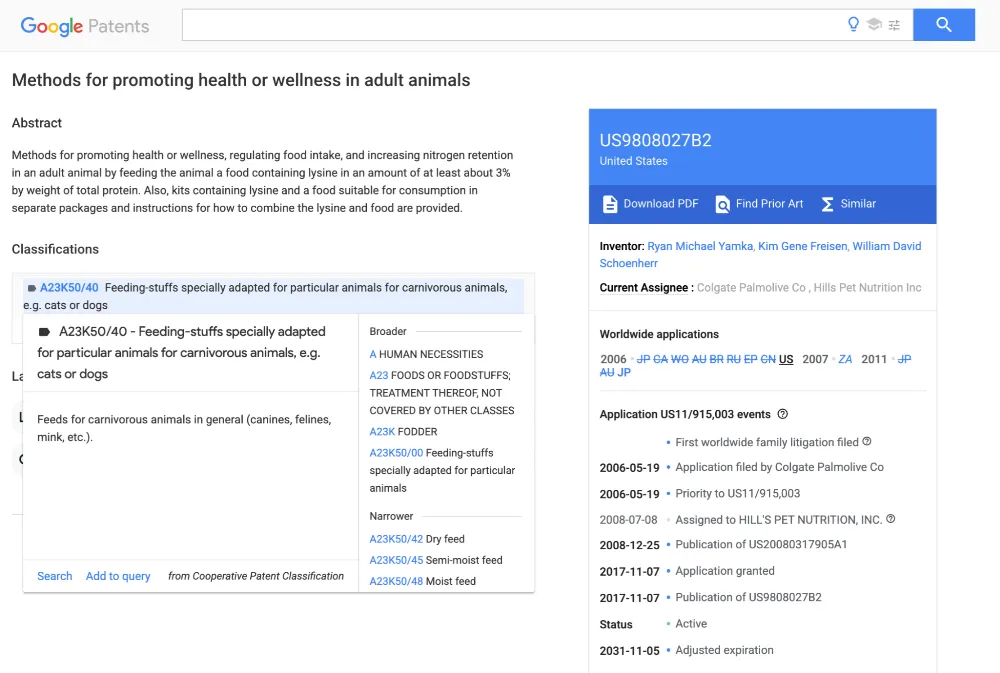
For example, Colgate-Palmolive (owner of Hill's Pet Nutrition) was granted US Patent No. 9,808,027 for a method combining pet food and a lysine supplement to help manage weight in senior and overweight cats and dogs. The improvement was a specific nutritional method.
If you've invented both a new recipe and a new packaging design tied to your brand identity, treat them as two separate inventions from this point forward. They'll likely need separate patent filings.
2. Check If It Can Be Patented
Not every good idea is patentable, and pet food sits at an interesting intersection of food science, chemistry, and manufacturing. All of them are patentable categories, but with some nuances described in USPTO rules.
-
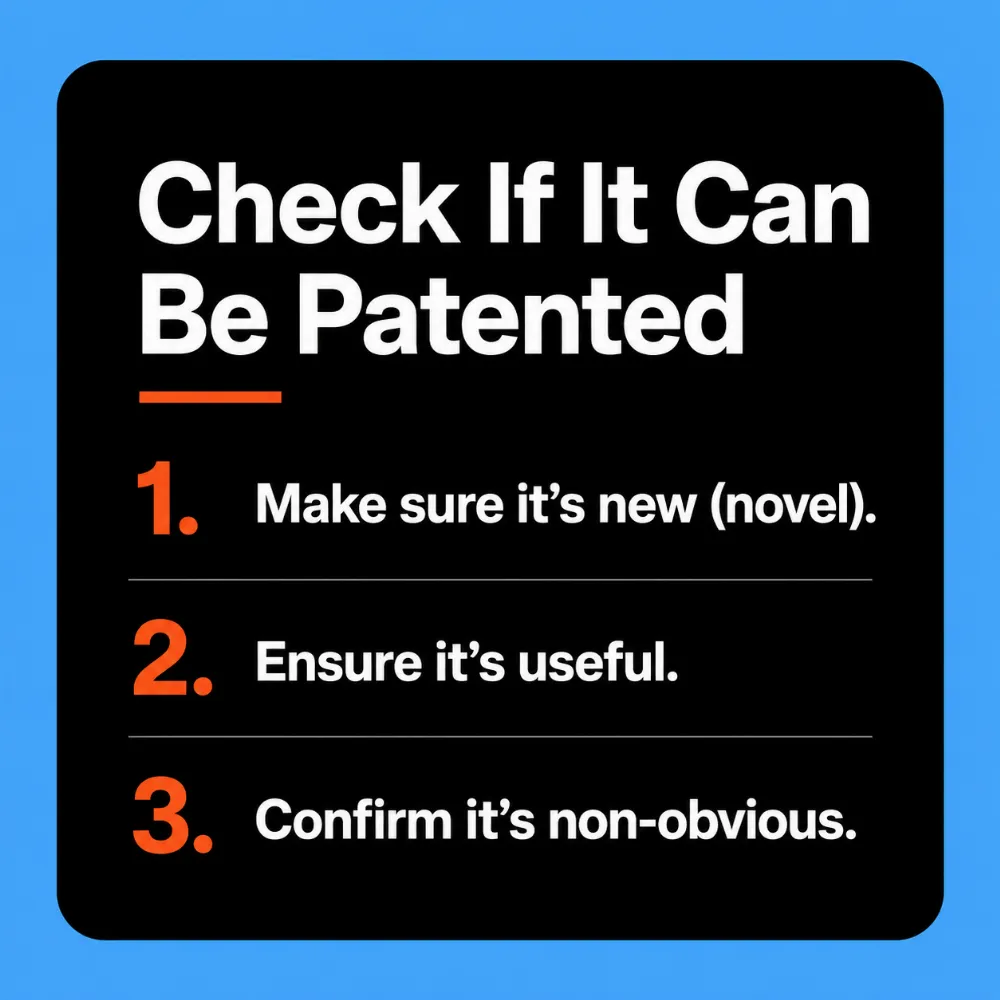
Make sure it's new (novel). Your invention must be something that hasn't been publicly disclosed, sold, or patented before your filing date.
-
Ensure it's useful. The invention needs a practical application — improved nutrition, better shelf life, easier digestion, and so on. This is rarely the hard part for food products, since almost any food innovation has an obvious use.
-
Confirm it's non-obvious. Even if no one has done exactly what you're doing, if the improvement would be "obvious" to someone else skilled in pet food formulation, it may not qualify.
Before investing in the legal process, gather customer feedback from real pets and pet owners. This won't affect patentability directly, but it helps confirm the product market fit; that your invention actually delivers the improvement you're claiming. This matters when you draft your application later and need test data to back up your claims.
Interested in digital marketing for your pet food brand? Read our articles to learn more:
3. Look for Similar Products
This is the "prior art search" step, and skipping it is expensive. You might spend thousands on an application process only to have it rejected over something you could have found in an afternoon.
Your main helper for this task is the USPTO's free Patent Public Search tool, a web-based patent search application that provides public access to search US patents and published applications. You can find them by keyword, inventor, or company, with both a basic keyword interface and an advanced search mode.
You can also browse Google Patents for a friendlier interface.
For example, you can compare your invention with what big brands already hold. A quick search shows that in 2017 alone:
-
Mars, Incorporated was awarded a patent for a blossom-shaped pet treat design with divots for texture
-
Nestlé Purina was awarded a patent for a multi-textured pet treat combining a soft and hard component in a twisted stick shape (Pet Food Processing).
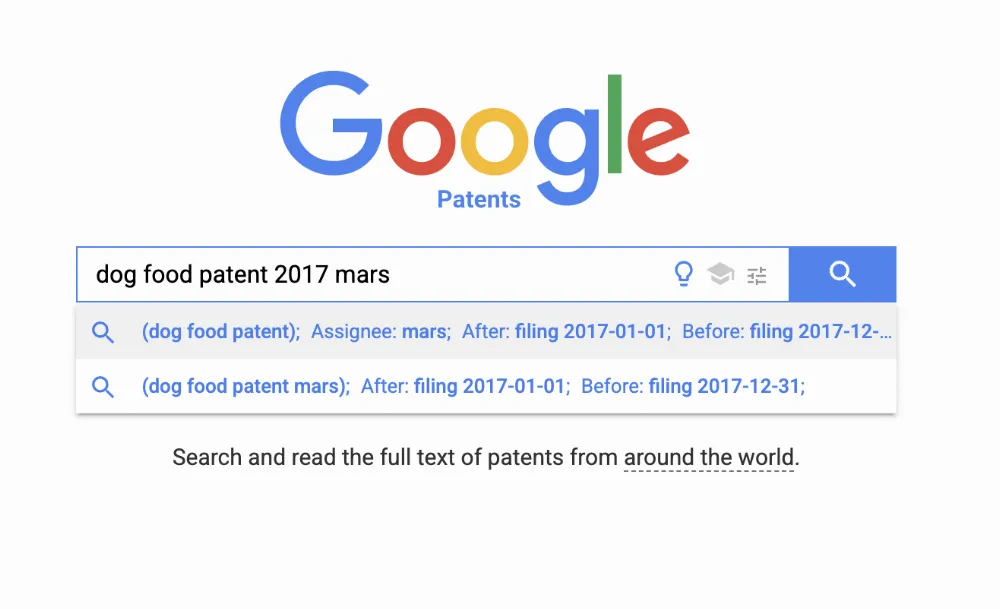
Also, you can search by ingredient, processing method, and function (e.g., "extruded pet food," "hypoallergenic pet food," "customized pet food formula").
If you find something very close to your idea, don't panic. You may still be able to patent a meaningful variation, but you'll need to clearly document how yours differs and still appeals to your target audience.
4. Document Your Formula (Texture, Ingredients, etc.)
Once you know your idea is likely novel, start building a paper trail. This documentation becomes the backbone of your eventual application process.
-
List all ingredients and exact ratios. Record the exact percentages or weights, where the ingredients come from, and any substitutions you tested. Include enough detail for a food scientist to recreate the product from your description alone.
-
Explain and record every processing step: temperature, mixing time, extrusion pressure, drying method, cooling process (anything that affects the final texture, shelf life, or nutritional profile).
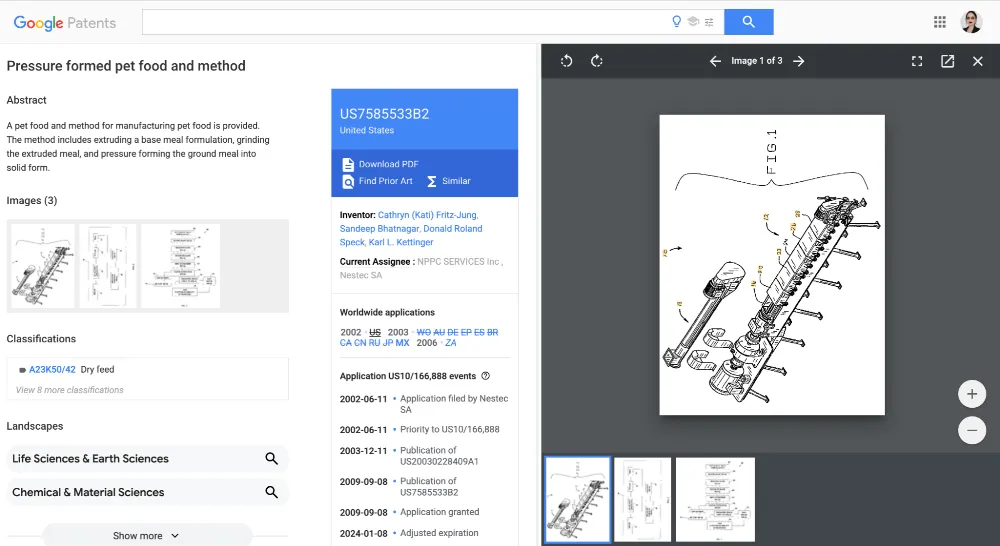
This matters because pet food product patent often protects methods, not just ingredient lists — like the Nestlé Purina patent for a pressure-formed pet food process that relies on specific extrusion and pressure-release steps to create a porous texture.
-
Jot down the results. Keep records of texture tests, palatability trials, shelf-life data, and any lab analysis (protein content, moisture level, etc.). This test data will strengthen your eventual patent claims, and a formula that stays consistent, batch after batch, is exactly what supports sustainable growth as your customer base expands.
-
Date and sign everything. Keep dated lab notes, timestamped files, or a signed witness document. They won’t replace an official filing date, but they help show when and how you developed the product.
5. Decide on the Patent Type
This is where many beginners get stuck, because "patent" isn't one single thing. Pet food inventions can actually touch on a few main types.
Utility Patent for the Formula or Process
This is the most common route for pet food and covers a new and useful invention: a machine, process, composition of matter, or an article of manufacture (USPTO). A novel food recipe, a unique nutrient-delivery method, or a new manufacturing process would fall here.
Utility patents last 20 years from the filing date but require the highest level of detail and typically the most expense.
Design Patent if There's a Unique Shape or Packaging
If your treat has a distinctive shape, or your packaging has an ornamental feature that catches the eye of potential customers on the shelf, a design patent might be the right (and cheaper) fit. Utility patents cover function, while design patents cover form.
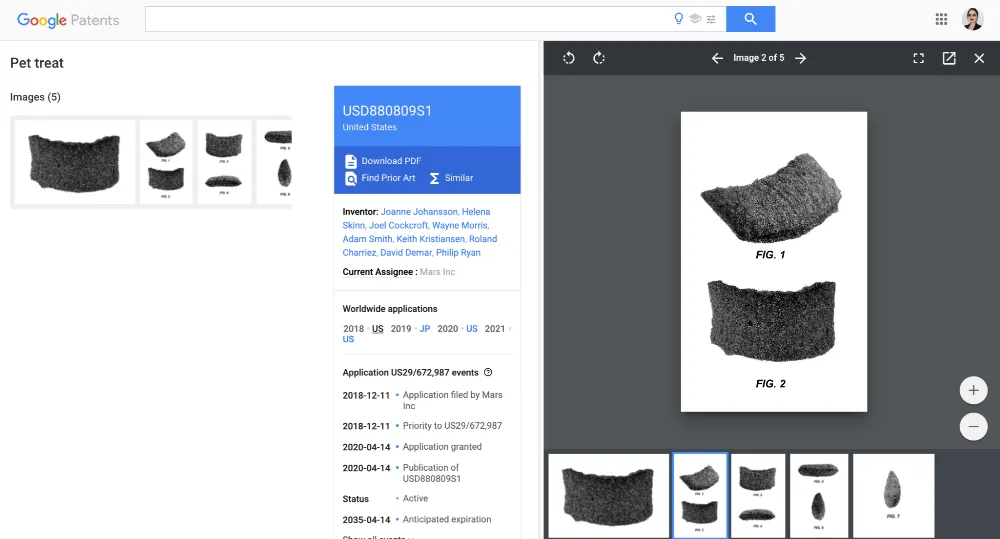
Design patents now last 15 years from issuance, with no maintenance fees required (USPTO). Mars' curved pillow pet treat is a textbook example of a design-patent candidate. A recognizable shape like that is also how products build brand loyalty over time.
6. Write the Application
This is the most technical step, and it's where working with a registered patent attorney or agent genuinely pays off. But understanding the components helps you prepare and evaluate their work.
-
Draft the specification. The specification is the heart of the application process. It should describe the structure, function, and advantages, and explain how the invention differs from existing solutions.
-
Add examples and test data. Write in your application formula ratios, processing conditions, and test results. For treat shapes, packaging designs, or process diagrams (like extrusion equipment layouts), you'll need drawings that meet USPTO standards.
Vague, generic descriptions are a common reason applications get rejected. A well-documented, clearly protected formula also gives your marketing strategies more room later to highlight what makes your product genuinely unique, without fear of copycats.
-
Draft the claims. Claims define the legal boundaries of what you're protecting. The USPTO's own filing guide notes that each claim should be a single sentence, and where a claim lists multiple elements or steps, each one should be separated by a line indentation (USPTO Nonprovisional Utility Patent Filing Guide).
Claims are notoriously easy to write too broadly (get rejected) or too narrowly (get approved but offer weak protection), which is the main reason most inventors bring in professional help at this stage.
Decide: Provisional or Nonprovisional First?
A provisional application is cheaper, faster to file, and gives you 12 months of "patent pending" status while you refine the invention. It’s useful if you're still finalizing your food recipe or raising funds.
A nonprovisional application is the one that actually undergoes full examination and can result in a granted patent.
|
Provisional Application |
Nonprovisional Application |
|
|
What it is |
A placeholder filing that establishes an early filing date |
The formal application that's actually examined by the USPTO |
|
Cost |
Lower filing fees |
Higher filing, search, and examination fees |
|
Speed to file |
Faster, less formal documentation required |
Slower, requires complete claims, specification, and drawings |
|
"Patent pending" status |
Yes, for 12 months |
Yes, until the application is granted or abandoned |
|
Undergoes examination |
No |
Yes, reviewed by a USPTO examiner |
|
Can result in a granted patent |
No, must be followed by a nonprovisional within 12 months |
Yes |
|
Best for |
Still finalizing your food recipe, testing the market, or raising funds before committing to full costs |
You're ready to lock in your claims and pursue actual patent protection |
7. Submit the Patent Application to the Relevant Office
Once your application is drafted, it's time to file. This step is more procedural than creative.
-
Choose the office in your jurisdiction. In the US, that's the USPTO. If you want protection in other countries too, you'll eventually need to file through those countries' offices or use the Patent Cooperation Treaty (PCT) system to streamline multi-country filing.
-
Pay the fees. Costs vary, but, for example, the filing fee for a design patent application is $650 for small entities and $325 for micro entities (Thompson Patent Law, 2025).
Utility patents typically cost more once attorney fees, drawing fees, and examination fees are factored in, and filing electronically through the USPTO's Patent Center avoids an extra non-electronic filing surcharge.
Securing protection early is usually far cheaper than absorbing the customer acquisition costs you'd face later if a copycat undercuts your pricing and positioning first.
-
File the application and monitor deadlines. After you file, a patent examiner will compare your application with other inventions. A decision usually takes 18 to 36 months (UpCounsel, 2025). During that time, the examiner may raise questions or reject parts of the application, and you or your attorney may need to respond several times.
-
Track your maintenance obligations. If your utility patent is granted, you'll owe periodic maintenance fees to keep it in force. Missing these deadlines can cause your patent to lapse.
8. Keep It Secret
Use NDAs with manufacturers and partners. Even within your own team, limit access to confidential details. The fewer people who have the full formula, the smaller your risk of leaks.
In 2006, MGP Ingredients sued Mars and S&M NuTec over Greenies dog chews. MGP claimed that confidential research shared under confidentiality agreements had been used to develop a replacement formula and leave it out of the supply chain (ECF.KSD.USCOURTS.GOV).
The dispute ended in 2007 with an $8 million settlement paid to MGP. MGP also let the companies use its patented technology under a non-exclusive license (SEC filing).
Also, avoid early digital marketing for ecommerce that shows too much. It's tempting to tease your new product on social media, but describing your invention publicly before filing can put your patent at risk.
Once your application is safely filed, that's the moment to turn your marketing efforts toward building brand awareness and reaching your ideal buyers with confidence.
Contact us at Netpeak International for more advice about your pet care marketing. We can help you create the right digital strategy, choose effective channels (SEO, PPC, email) and more.
When Patenting Isn’t the Best Business Move
Not every valuable formula needs a patent. Sometimes secrecy is smarter.
-
Your formula is difficult to reverse-engineer. Keeping it confidential may make more business sense than revealing it in a patent application. The classic example is the Coca-Cola formula, which has remained a trade secret for decades (GovFacts: Trade Secret vs. Patent).
-
You’re still changing the product. If the recipe is evolving, you could spend money protecting a version you’ll soon replace.
-
The costs outweigh the business benefit. Filing, legal support, and ongoing fees may be hard to justify if the innovation has limited sales or licensing potential.
A trade secret can last as long as the information stays confidential. It needs no formal filing and protects immediately once secrecy is established. But if a competitor reverse-engineers your formula, you’re on your own.
The common practice is to patent the parts of a product that are easy to reverse-engineer while keeping harder-to-copy details (temperatures, pressures, speeds, material ratios) as trade secrets.
Expert Insights
Here are a few practical takeaways worth keeping in mind:
-
Research other companies' patents before you fall in love with your idea. It's far cheaper to pivot early than to redesign a formula after a rejected application.
-
Document as you go, not after the fact. Patent offices favor applicants who can show a clear, dated development trail, retroactively reconstructing your process is far weaker evidence.
-
Don't assume "food" means "not patentable." As the Mars and Colgate-Palmolive examples show, both nutritional methods and manufacturing processes for food products are patented regularly.
-
Match the protection type to the risk. If competitors could reverse-engineer your product just by buying it off the shelf, patenting process makes more sense than a trade secret. Since if competitors can buy your product, disassemble it, and figure out how it works, a patent is your only real legal protection against copying. It’s a way to protect your marketing strategy, too — a genuinely unique, protected product is what turns first-time buyers into positive reviews and the kind of customer stories that sell your brand for you.
-
Budget for the long game. Between attorney fees, drawings, filing fees, and possible office action responses, utility patents are a multi-thousand-dollar, multi-year investment.
Here are more pet food marketing articles to grow your business:
Final Thoughts
Patenting a pet food product isn't reserved for giant corporations with in-house legal teams, but it does reward careful preparation. The inventors who succeed are clearly defining their invention, searching thoroughly for prior art, documenting their formula and process in detail, and choosing the right mix of utility patents, design patents, and trade secrets for what they're actually trying to protect.
If there's one thing to take away, it's this: don't rush to file, and don't rush to disclose. Get your documentation solid, get your prior art search done, and loop in a registered patent attorney before you submit anything to the USPTO.
From there, it's a matter of patience. Most applications take well over a year to resolve, but a granted patent can protect your innovation and your market position for two decades.

 0
0
 0
0
 0
0
 0
0
Related Articles
Amazon's AI Now Builds Complete Looks on Product Pages. How Do Brands Make Sure the Bundle Is Theirs?
Amazon now uses AI to assemble complete, shoppable looks around a single product, and it fills those looks with whichever brands its model picks.
What Happens When Amazon Suppresses Your Listing? The New 2026 Rules
Under the new 2026 rules, Amazon warns you first and gives you a grace period to fix the issue.
Business Apps in the US: iOS vs. Android, August 2026
We’ve fetched data from the US App Store and Google Play to see what professionals, shoppers, and businesses are actually installing, and why the market leaders are winning right now.