
Word-of-Mouth Won’t Save Your Moving Company. Here’s How to Actually Streamline Leads [Research & Industry Insider Tips]
Word-of-mouth has always been the secret sauce for moving companies — there’s nothing like a happy customer telling a pal about your reliable trucks and careful crews. It works… until it doesn’t. One month, your phone is ringing off the hook, the next, crickets. Referrals alone can’t guarantee steady growth, no matter how many five-star reviews you rack up.
Maybe it’s time to face it: relying on luck (or friendly neighbors) isn’t a growth strategy. So, what if there’s a smarter way to predictably fill your lead pipeline — without crossing your fingers and hoping someone mentions your company at the right barbecue?
As always, diversification is key, and marketing is how you make it happen. We’ve collected real client experiences and service expert insights, so you know exactly how to expand your lead sources with flying colors.
TL; DR: No plug-and-play solution, just clear steps you can follow.
- Why We Can Talk About Moving Company Marketing
- Lead Generation in the Moving Industry Feels Like Chasing the Oasis
- The Cost of Marketing Your Moving Company the Old Way
- Movers Need More Than One Channel to Win Leads
- What the Top Moving Companies Do Differently in Marketing
- Moving Company Marketing Playbook: Netpeak US Insights
- Case Studies: How Our Clients Beat Market Odds
- Final Takeaway: There Is No One-Size-Fits-All Approach
- FAQ: Marketing Myths That Keep Movers Stuck
Why We Can Talk About Moving Company Marketing?
At Netpeak US, we help service‑oriented businesses scale predictably with digital marketing — not just get traffic spikes. We’re a full‑cycle, data‑driven marketing agency with 20+ years of real‑world experience, having completed over 8,500 projects across industries and business sizes. From small local teams to global brands, we’ve built strategies that actually drive leads and revenue rather than boost vanity metrics. To talk numbers:
- Our Chicago-based client H2H Movers saw a 135% rise in paid conversions and a 136% boost in site visits from Instagram thanks to a multichannel marketing strategy.
- We helped Meest US boost their market share 0.5% to 1% in non-branded traffic.
Lead Generation in the Moving Industry Feels Like Chasing the Oasis
Finding leads in the moving industry is a bit like fishing in the ocean — some days the net comes up full, other days you’re staring at empty water wondering where all the fish went. One thing both you and I know: the moving business is a rat race like no other, where hands-on experience is key to avoiding rookie mistakes.
Moving Is Not Like Other Home Services At All
Movers aren’t solving a daily inconvenience; they’re entrusted with someone’s entire household. Unlike HVAC repairs or plumbing jobs, a relocation is a high‑stakes, infrequent, life‑event decision that usually involves multiple quotes, deep research, and emotionally charged planning.
About 95% of consumers research multiple moving companies before hiring, and 70% request at least three quotes. Hence, it’s a comparison‑driven purchase journey that requires a tailored marketing approach to win attention
Word-of-Mouth Gets the Ball to Roll
For movers, word-of-mouth is gold. Relocating is stressful, and clients want proof you’re reliable. That’s why 20-40% of leads for service businesses still come from referrals.
A happy customer isn’t just a completed job — they’re a walking billboard for your business. Every positive review, every casual mention to a friend, and every social media shout-out can bring in a new lead without you spending a dime. That’s the magic of word-of-mouth: it’s authentic, trust-driven, and often converts better than any ad campaign.
But here’s the catch: it’s also unpredictable. You can’t control when or how referrals happen, and relying on them alone means your growth will always be at the mercy of chance. That’s why even the best word-of-mouth strategy needs a backbone of systematic marketing.
Clients Don’t Move Often
Unlike plumbers, roofers, or cleaners, your typical moving client only hires a moving company a few times in their life — if that. According to the US Census Bureau, the average American moves about 11.7 times over their lifetime. That may sound like a lot at first glance, but spread across decades, it means relocations are infrequent, high-stakes events, not routine service calls.
That changes everything about lead generation. Every inquiry carries higher value. Every missed call is a bigger loss. And every marketing touchpoint has to work harder.
All Depends on Seasonal Dynamics
Moving isn’t a year-round grind but rather a summer sport. Nearly half of all US relocations happen between May and August, with June consistently ranking as the busiest month of the year. To win, you need campaigns that ramp up when prospects are active, scale back during the slow months, and nurture leads long before they’re ready to book.
User Intent Types Are Varied & Mixed
Not all leads are created equal, especially in moving. Some are all-in, Googling “full-service movers near me” with a credit card in hand, while others are just window-shopping, comparing prices, reading reviews, or daydreaming about that perfect move… six months from now.
The trick? You’ve got to catch the ready-to-book folks fast while also keeping the browsers warm with follow-ups, content, and smart remarketing.
Treating every lead the same is like packing boxes without labels — good luck finding what you need when it counts.
The Cost of Marketing Your Moving Company the Old Way
The hard truth? Most small businesses don’t just sit around and grow — they fight to stay alive. Without a systematic way to attract and convert leads, companies risk fading out as soon as they hit their first slow season or a bump in competition. Numbers speak for themselves:
-
20% of small businesses don’t survive their first year.
-
About 45% of small businesses fail within their first 5 years.
-
A formal marketing strategy increases your chance of success by about 30%.
-
Up to 14% of small businesses fail specifically because of poor marketing or ignoring customers.
We all know it’s a dog-eat-dog industry. Missing out on any lead channel that could keep you booked and busy is a luxury small businesses can’t afford. Every marketing opportunity you skip is a chance to get booked or rebooked that you’ve just handed to a competitor.
“This isn’t an oligopoly — it’s not a market with just 2‑3 companies where you simply choose between them. Competition is fierce, there are lots of players, and standing out is hard because there’s no striking product-market fit or anything like that. The industry itself is solid, and the service is actually quite simple.
There are a few stages when you work with a client: during the initial call, when explaining the quote, and during the service itself. The difference comes from how quickly and effectively you handle each of these stages.
Being visible online and differentiating yourself also helps. For example, we have over three thousand reviews, and not many companies can say the same. That gives you an advantage when a client is searching. From there, it’s straightforward: did the client get through during peak times, how fast and well did sales handle the call, was the price acceptable, how smooth was the service itself, and finally, is the client ready to recommend and return,”
Vitalii Kovalenko, COO of H2H Movers, a flourishing Chicago-based moving company with 13+ years of experience in the market.
Movers Need More Than One Channel to Win Leads
Good news: there’s no need to panic — you can build a strategy that helps you thrive against the odds.
Most moving companies lean too heavily on word-of-mouth and seriously underestimate marketing as a way to build a stable, predictable flow of leads. Sure, referrals are great — but they’re sporadic, unpredictable, and not enough to keep your trucks full year-round.
Marketing, on the other hand, can move the needle, but only when it works as a system. Paid search, social campaigns, SEO, email nurturing, and even reviews all play together in different combinations depending on the unique circumstances of your business. Alone, each channel can help a little; together, they create a steady, scalable engine that keeps your pipeline humming no matter the season.
Is Netpeak US a PPC agency for a moving company or an SEO agency for a moving company? Actually, we are both and so much more. We believe in a multichannel approach and know how to do it right.
What the Top Moving Companies Do Differently in Marketing
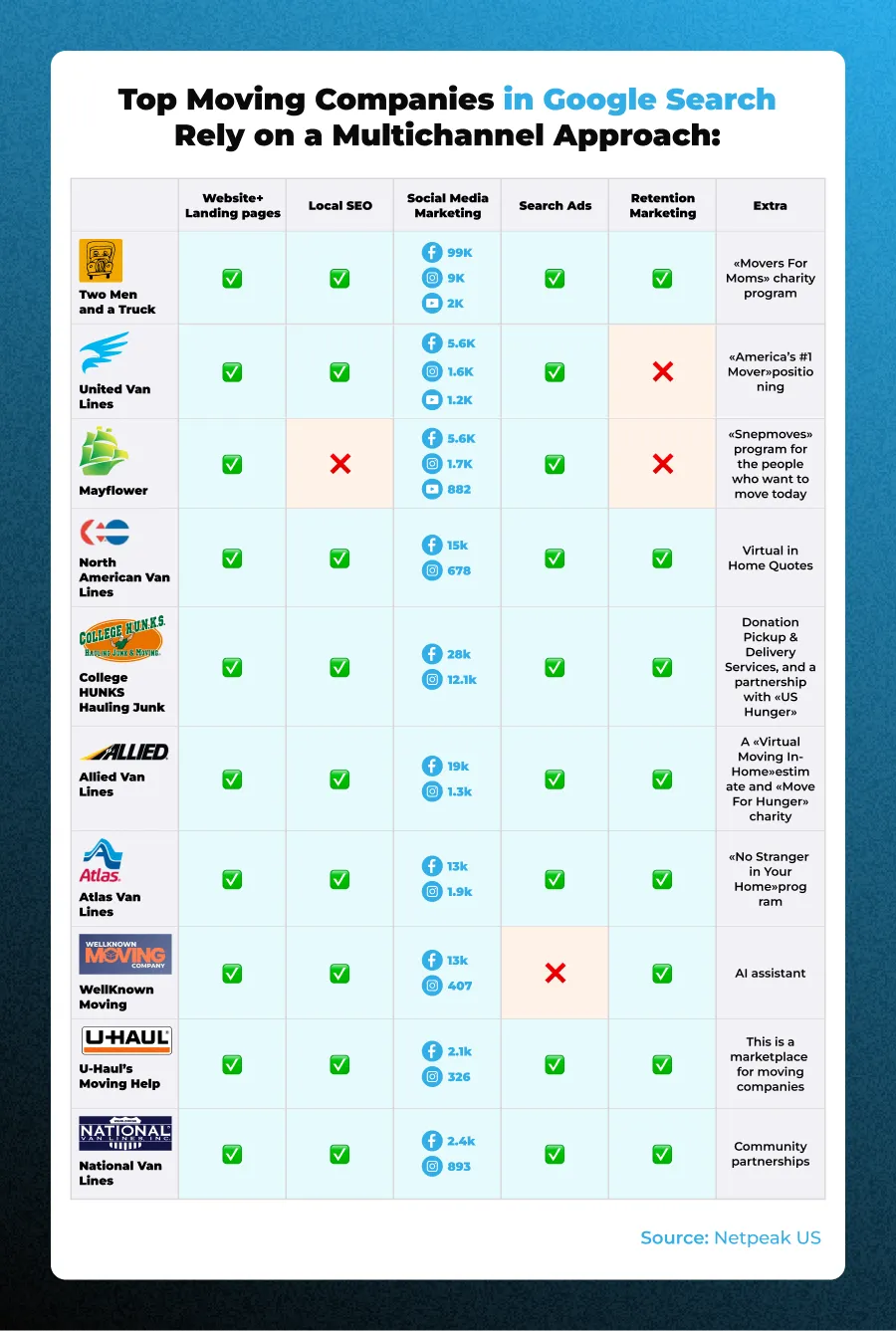
The first step to beating the competition? Figure out how the top players secure their positions.
No stress — we did the heavy lifting for you. Netpeak US used Ahrefs to identify 10 competitors capturing the largest traffic share of high-volume moving industry keywords (analyzing data from October 2025 to January 2026). Then we audited their websites, dissected their social presence, reviewed their paid ads, and broke down their retention marketing tactics.
Turns out, every moving business uses its own mix of digital channels based on its audience, budget, and goals. However, one rule remains constant: effective advertising is always multi-channel.
Our research shows that most companies' strategies are similar: a website, landing pages, local SEO, and social media marketing. In addition, companies choose other custom channels that work for them to stand out.
Of course, every company has its own strong suit that helps to stand out in a crowded market:
-
Two Men and a Truck and College HUNKS Hauling Junk dominate a Google Local Pack and have successful social media strategies
-
United Van Lines is often at the top of the Google search first page
-
Atlas Van Lines has a powerful Google Ads campaign and shows up for a bunch of queries
-
College HUNKS Hauling Junk and U-Haul’s Moving Help have affiliate programs, and WellKnow Moving has an influencer partnership program
Why Can't All Moving Strategies Be Built The Same?
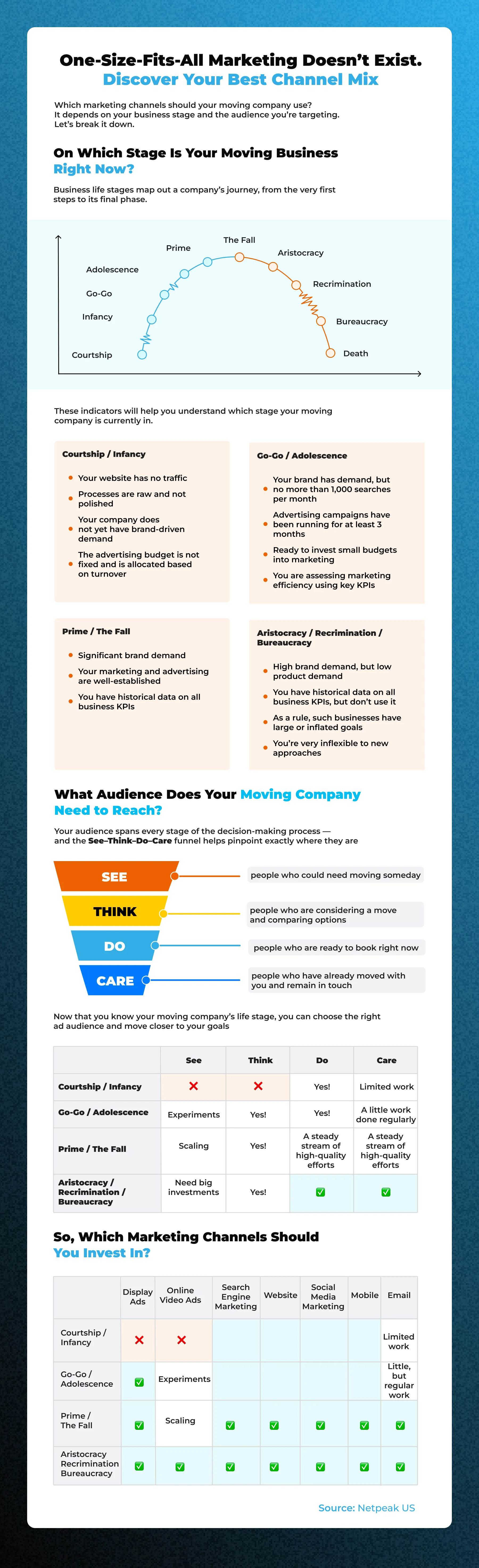
While there are some common patterns, you won’t find a single formula shared by all the top players in the US moving industry. Why? Because different stages of business maturity demand different solutions.
First, when a business is just starting out and budgets are tight, most companies naturally go to the channels where they can capture “hot” demand. Usually, that’s search advertising. PPC is a great entry point into digital marketing — you launch search campaigns, capture high-intent users, convert them, and start generating orders.
There are clear pros and cons here. The upside? It gives you an initial boost and those first steady bookings. But there’s a cost ceiling. High-intent audiences are more expensive by default, and competition is fierce because everyone wants the same “ready-to-buy” customers. In the long run, if you rely only on hot leads, you have to be prepared to continuously invest more and more.
“Sooner or later, every company hits a spending limit and realizes the unit economics stop working as efficiently. To keep growing, you need additional sources of more affordable demand channels. That often means working with audiences you’ve already acquired — retention channels, repeat customers, remarketing. It’s cheaper to re-engage someone who knows you than to acquire a brand-new lead.
Even word-of-mouth isn’t just one magical source. It’s the result of multiple marketing efforts working together — different channels reinforcing your brand until recommendations start happening naturally.
There’s also another limitation of search: it’s capped by existing demand. If 100 people search for a specific keyword each month, you can’t show up to more than those 100. Search is limited by organic demand volume.
So when a company outgrows its early stage and starts scaling, it has to plug in additional channels. Many businesses follow the classic Google framework — See, Think, Do, Care,”
Anton Lypskyi, Head of PPC Department at Netpeak US.
A company fighting for visibility won’t use the same mix as one protecting a dominant position. Early-stage movers often lean heavily on paid acquisition to generate quick demand. Mid-sized players start investing in SEO and brand-building to lower dependency on ads. Market leaders? They double down on retention, reputation, and omnichannel presence to defend their turf.
That’s the real takeaway: growth isn’t random. It’s structured. And the smartest companies adjust their marketing mix as they scale—shifting from chasing leads to owning the market.
Naturally, you first need to understand your company’s stage of growth to choose the marketing activities that will truly support your moving business. To make it easier, we’ve prepared a quick cheatsheet below to help you identify your stage in just five minutes:
Moving Company Marketing Playbook: Netpeak US Insights
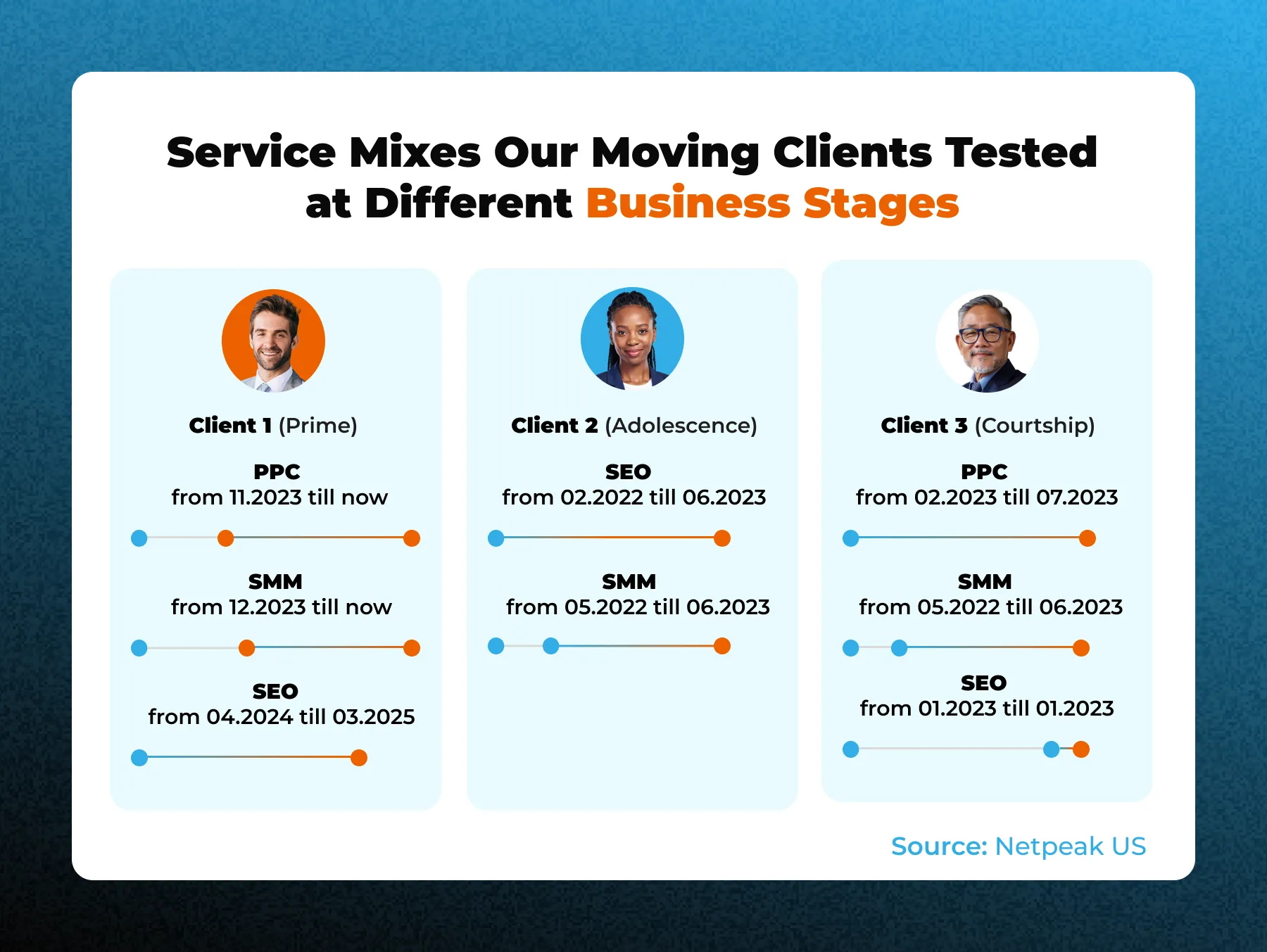
Theory is all good, but what about practice? We’ve worked with moving companies at different stages of maturity, each facing its own growth challenges. Let’s overview three of them:
|
Growth Stage |
Focus Channels |
Goal |
Strategy |
|
Prime Stage = Full-Funnel Confidence |
Long-term PPC + ongoing SMM + a sustained SEO run. |
This client isn’t experimenting — they’re optimizing. |
Short-term demand (PPC) + brand visibility (SMM) + organic scalability (SEO). Mature businesses think in systems, not single channels. |
|
Adolescence Stage = Visibility First |
Heavy focus on SEO and SMM. No PPC. |
Building presence before aggressively buying demand. |
Investing in foundation: traffic, awareness, credibility. Still shaping predictable acquisition mechanics. |
|
Courtship Stage = Testing Mode |
Short bursts across PPC, SMM, and minimal SEO. |
Trying everything. Committing to nothing (yet). |
Budget-sensitive. Learning what sticks. Searching for traction and repeatability. |
AI Is An Elephant in the Room
Multichannel marketing just got a whole lot more critical since AI rewrote the rules. Our clients — and everyone in the moving market — are feeling the squeeze: sustaining lead generation in the zero-click era is no walk in the park.
Recent shifts with AI-powered answers and search have flipped the game. Based on the observations of our service experts, content strategies that used to drive leads for moving companies are seeing traffic drops of 30–80%.
Blog articles that once generated high CTRs and motivated inquiries now deliver fewer clicks because users increasingly get answers directly in the search results.
The takeaway? Best practice is no longer just “Google-first.” Movers need to optimize for LLMs, adapt existing strategies to the new reality, retire what’s no longer working, and rethink how content is created — focusing on formats and approaches that actually drive engagement and lead capture in the AI era.
“Multichannel naturally strengthens performance because it creates more entry points into your funnel. The very fact that SEO “takes time” already introduces single-channel risk — if you rely only on it, growth slows while you wait.
On top of that, declining CTRs driven by AI Overviews make diversification even more logical. Organic clicks are becoming harder to capture, even when rankings stay strong.
At the same time, SEO remains one of the most cost-effective channels in the long run. Yes, AI is increasing competition and raising the bar — which indirectly raises costs — but compared to constantly buying high-intent traffic through paid ads, organic still delivers stronger unit economics over time,”
Elena Voskoboinik, Head of Product & SEO Specialist at Netpeak US.
For moving companies, AI has turned brand visibility into a make-or-break factor. When potential clients check for movers, AI-powered overviews, snippets, and review aggregators often appear before your website even does. If you’re not showing up there, all your PPC, SEO, and social efforts risk being invisible. That’s why savvy movers layer their funnels, combining ads, organic content, reviews, and retargeting, so that no matter how someone searches or browses, your brand stays front and center.

Case Studies: How Our Clients Beat Market Odds
H2H Movers
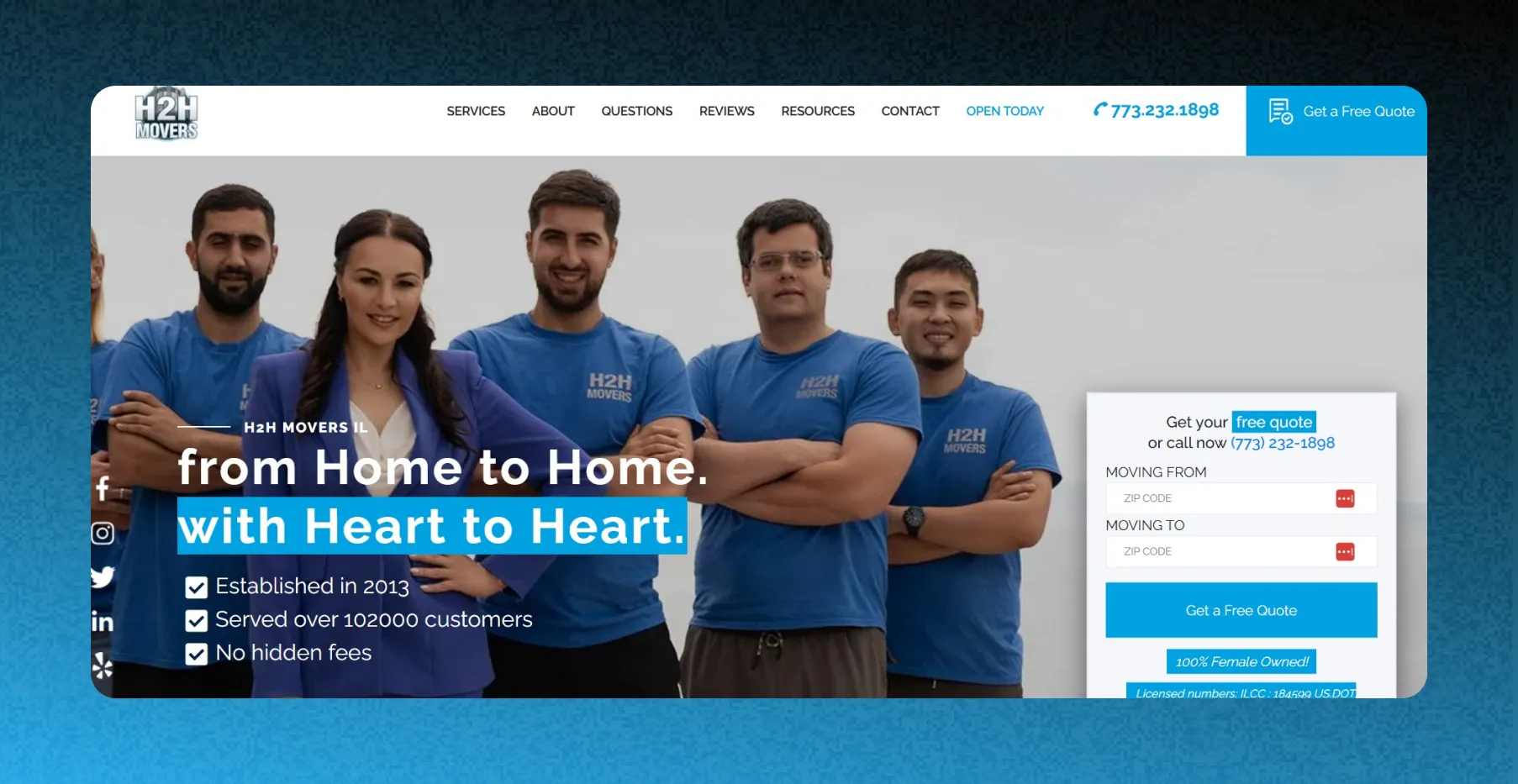
A Brief Description: A US-based moving company specializing in residential and commercial relocations, offering end-to-end moving solutions, packing services, and storage options.
PPC — from 11.2023 till now
SMM — from 12.2023 till now
SEO — from 04.2024 till 03.2025
Marketing Overhaul in Action
In spite of 13 years of experience on the market, H2H Movers' marketing was minimal till 2023. The budget was being poured into all sorts of lead sources — AngelList, Yelp, and a variety of US lead providers, and every day, one of them was pitching leads of questionable quality. You could buy a lead, but whether it converted depended entirely on chance. SEO, SMM, and Google campaigns existed, but nothing was systematic. Referral programs were small-scale and inconsistent.
-
Analysis changed everything. Channel budgets were misallocated: underperforming sources drained funds while high-converting channels were underfunded. A full marketing overhaul became necessary.
-
Growth came from service quality. Excellent execution turned clients into repeat customers and referrals. Today, H2H Movers maintains a 4.9 Google Review rating, with roughly 40% of clients returning or referring others — above the industry benchmark.
Systematic Marketing, Backed by Netpeak US
Working with Netpeak US, H2H Movers began running multiple channels more systematically and intensively. That brought its own challenges.
Find a Sweet Spot
H2H Movers had to identify which channels actually delivered the highest revenue and conversions. They have tested different combinations, adjusting budgets based on performance correlations: when a channel showed positive ROI, we scaled it; when the correlation disappeared, we reallocated resources elsewhere.
Keep a Safety Net
The goal was always a diversified, multi-channel approach. Putting all your eggs in one basket — like relying solely on PPC — is risky. If that channel underperforms or fails, your lead pipeline collapses. Diversification is what keeps it stable.
It’s not just Google Ads. In the US moving market, a typical mix looks like 60–80% from Google (Ads, SEO, and Google Warranty), with the rest coming from Meta, Instagram, TikTok, and sometimes Reddit. Different channels perform differently depending on state, audience, or market segment, so continuous testing and adjustment are crucial. Even underperforming channels aren’t abandoned — a minimal budget (around $500) keeps them alive as a safety net for when they might rebound.
The Secret Sauce: Max Out Your Potential With Different Channels
Before brand storytelling can drive growth, performance marketing has to carry the load. For most movers, this means focusing on the channels that actually generate leads and consistently adapt.
“At this stage, the story is simple: we still have untapped potential in performance marketing. Big-brand campaigns come later — once you’ve hit a certain revenue threshold and can justify larger investments. Right now, the focus is purely on marketing channels that drive leads. You can’t rely on people trying your service and organically recommending it; the brand story alone won’t carry you yet.
That’s why there’s no one-size-fits-all marketing playbook for movers. Some companies lean heavily on Google Ads, others experiment across multiple channels, seeing what works and cutting what doesn’t. Success varies: what burns money for one company might generate profit for another. The key is adapting your strategy to your business stage — some are ready to scale brand-driven campaigns, others are still building lead-generation muscle,”
Vitalii Kovalenko, COO of H2H Movers.
Meest US
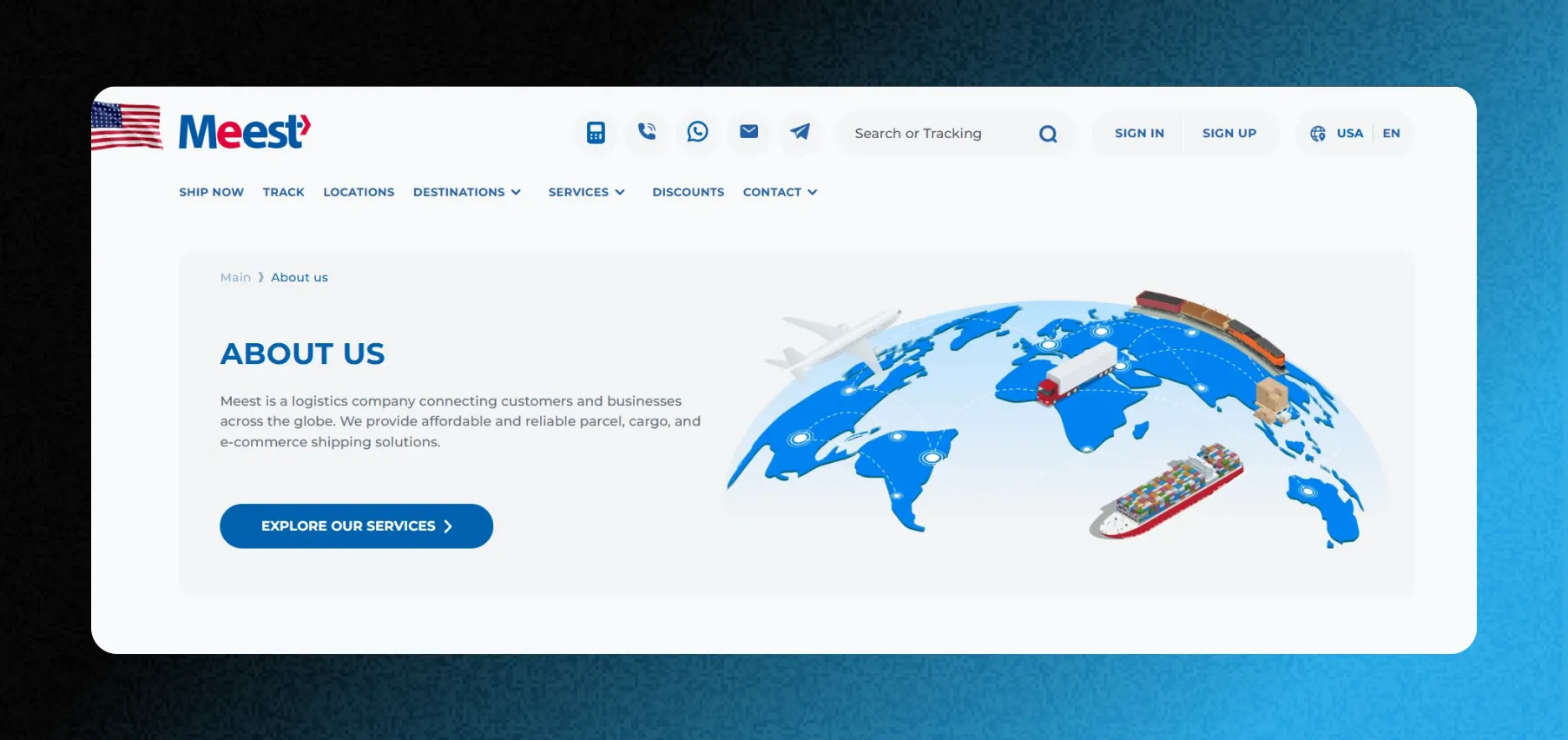
A Brief Description: The US wing of the Ukrainian logistics enterprise. Specializes in international parcel delivery, cross-border fulfillment, and tailored shipping solutions for both individuals and businesses.
ASO — from February 2025 till October 2025
SEO — from January 2025 till now
SERM — from January 2025 till now
A Peculiar Word-of-Mouth Approach
Our client, Meest US, came to Netpeak US with a unique challenge: help a behemoth of Ukrainian delivery services to expand into the US market as a relatively small player.
Meest US is part of one of Ukraine’s Global Logistics Group/Meest Logistics Group, with decades of experience delivering parcels across Europe and beyond. While the brand is a household name both back home and within the Ukrainian diaspora in the US, it started from scratch with mainstream American customers — no recognition, no local reputation, and a fraction of the resources of established competitors. Their goal was ambitious: build visibility, attract new customers, and compete with entrenched players in a highly competitive market, all while scaling smartly and efficiently.
-
Meest US have started building recognition on the ground with good ol’ word-of-mouth. A big part of the community they tapped into 30 years ago was the network of Ukrainian churches in the US. When the company launched, the founder and his partners went door-to-door — or rather, pew-to-pew — explaining their mission: “If you want to help your family or friends back home, we can deliver your packages.”
-
These churches became collection hubs. People would drop off boxes, used clothing, food, and other supplies, which Meest US then picked up and shipped directly to Ukraine. It was a grassroots approach that built trust, awareness, and early traction in the community — long before any paid marketing campaigns were even launched.
Market Differences Crash Course
Once Meest USA decided to expand their services, the real marketing challenges began. Launching a Ukrainian enterprise into a completely unfamiliar and massive market brought several unique hurdles.
-
Sheer Geography. The US is enormous, and reaching your audience across such vast territories takes serious resources. With budgets far smaller than global players like DHL or FedEx, Meest US had to get hyper-targeted — drilling down by ZIP code, state, and even specific neighborhoods — to reach the exact audience most likely to use their services.
-
Competition Is Intense. For the same logistics routes, there are 5 major global brands, 10 other Ukrainian carriers, and dozens of ethnically focused delivery companies. And when they expand beyond the US–Ukraine corridor to over 170 countries, that pool multiplies: dozens of local carriers in Poland, Romania, and other European countries are already serving those clients.
-
Audience Diversity. The immigrant population is large and segmented, with distinct languages, cultural norms, and preferences. Messaging had to be precise, localized, and culturally relevant to capture attention and convert leads.
-
Trust Is a Barrier. Smaller or newer companies face skepticism, especially in a market flooded with scams. Unlike Ukraine, where a stable 30-year company naturally earns credibility, Meest US had to prove reliability from scratch.
Pivoting With Digital Marketing
Launching a Mobile App
Meest US went beyond traditional channels like social media, Google Ads, and YouTube Ads by launching a mobile application. Netpeak US helped the team set it up from scratch, optimize it, and promote it, turning the app into a lead-generation and engagement tool right from day one.
Engaging the Ukrainian Diaspora
Meest USA has also implemented various initiatives targeting the Ukrainian diaspora in the US, which have proven highly effective:
-
Meta Ads reached local audiences with precision.
-
Facebook groups acted as grassroots marketing hubs — active communities where posts spread like word-of-mouth.
-
Local bloggers helped build credibility and reach.
Reaching New Audiences
For Americans unfamiliar with Meest US, SEO, Google Ads, and Meta Ads were crucial to build brand awareness and drive first-time conversions. These channels allowed Meest US to expand beyond its niche diaspora audience and reach broader US markets.
B2B Lead Generation
For their fulfillment services, lead-gen platforms acted as catalog-style directories, providing a steady stream of qualified leads. This approach supplemented traditional marketing and ensured consistent visibility in highly competitive segments.
The Secret Sauce: Tactical Scheduling
For logistics marketing in the US, Meest US shows it all comes down to one thing: understanding your customers’ seasonal patterns and preparing your campaigns accordingly.
“The key is smart planning and understanding your audience. For example, if we know that Ukrainians send packages before Christmas, we need to focus on that timing. Then, pick the channels we know work best and concentrate our campaigns ahead of the season. That’s how you get maximum results,”
Yuliia Bilozir, Sr. Marketing Manager at Meest USA.
Final Takeaway: There Is No One-Size-Fits-All Approach
In the moving industry, chasing a single magic channel is a dead end. Sustainable lead generation works as a system — a mix of performance marketing, retention tactics, brand visibility, and seasonal timing. The companies that thrive aren’t the ones hoping for a lucky break; they’re the ones building a repeatable, adaptable engine for leads that keeps them busy year-round.
FAQ: Marketing Myths That Keep Movers Stuck
Marketing is too expensive for small movers
Smart, targeted campaigns can fit any budget and pay for themselves if executed correctly.
Google Ads is all you need
Using a single channel is risky; diversification keeps your lead pipeline stable.
Aggregators will solve our lead problem
They can help, but relying solely on them leaves you vulnerable to rising costs and limited control.
Don’t invest in SEO, it’s too slow
SEO builds a cost-effective, long-term traffic engine that pays off for years.
All leads are built the same
Different customers behave differently; your approach must match their intent.
A one-time marketing investment is enough
Lead generation is ongoing — a single push won’t keep your calendar full.

 0
0
 0
0
 0
0
 0
0
Related Articles
Local SEO for Construction Companies Explained
If clients can’t find you online, they hire someone else. Learn how local SEO puts your construction business in front of ready buyers.
How to Market a Security Company in 2026?
Most security companies are invisible online. Here's how to fix that and turn your digital presence into a steady stream of qualified leads.
Sustainability Marketing: 7 Smart Ways to Earn Trust (and Customers)
Learn how to grow your brand efficiently while using eco-friendly marketing practices to build trust and long-term revenue.