
Digital Marketing for Pest Control Companies: Full Guide With Cases & Stats
A panicked homeowner just discovered a family of trash pandas has set up what can only be described as a luxury vacation home under their porch. They grab their phone, frantically searching “emergency pest control near me” — and your competitor’s website shows up first because they invested in digital marketing for pest control while you were still relying on local radio ads.
Welcome to 2026, where the battle for pest control customers happens online long before any technician shows up with a treatment plan. If you’re running a pest control business and still think a truck wrap will promote your services through another year, we need to talk. Marketing for pest control has evolved from “spray and pray” to strategic, data-driven campaigns that actually track ROI.
In this guide, we’re breaking down how digital marketing strategies work for pest control companies — with real stats and proven tactics from successful marketing for pest control companies. Because you deal with enough nonsense in crawl spaces; you don’t need it in your marketing advice too.
Why Traditional Marketing Is No Longer Enough
Let's pour one out for newspaper ads and radio spots. These tactics aren't completely dead, but they're about as effective as using a flyswatter against a termite infestation.
The reality is that 98% of homeowners search online for local businesses before making an appointment. When someone discovers mice in the attic or roaches treating the kitchen like an all-you-can-eat buffet, they’re searching on their phones when panic (and the ick) sets in.
Traditional marketing is also nearly impossible to measure. You drop $2,000 on direct mail and have no idea if those calls came from the mailer or a neighbor’s recommendation. Digital marketing for pest control flips that script — you track every click, every call, and know exactly which ad brought in which customer.
The Perks of Investing in Digital Marketing for Pest Control Businesses
Your market is out there: 73% of homeowners try to DIY pest control before calling professionals.
You Show Up When It Matters Most
Someone discovers bed bugs while tucking in at night? Your Google Ads show up immediately. A homeowner notices carpenter ant damage Sunday morning? Your optimized website appears first. You’re there exactly when they need you — usually right after they’ve screamed and realized they’re in over their head.
You Build Trust and Track Results
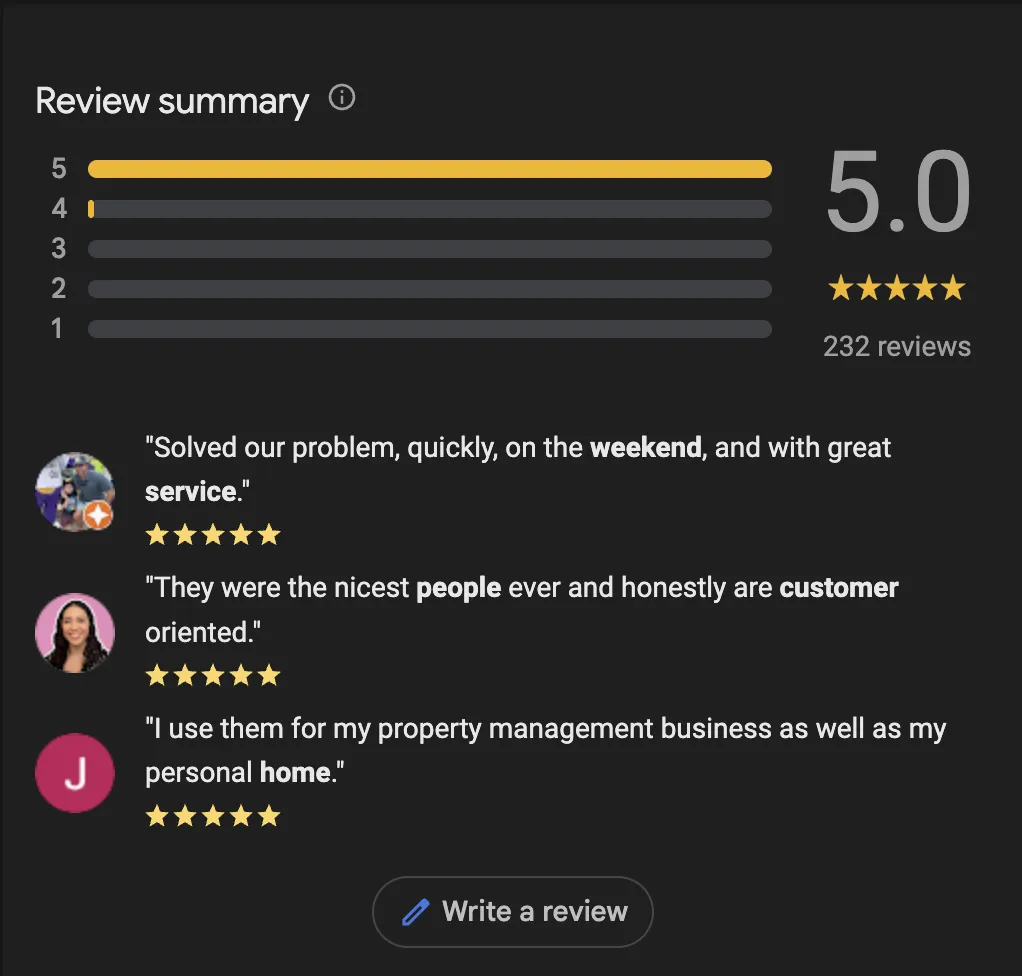
The reality is that 93% of consumers say online reviews impact their purchasing decisions. Your Google Business Profile with five-star reviews, professional website and social media build trust before the first conversation.
Unlike traditional marketing’s guessing game, digital tells you exactly what’s working. You can see which ads drive calls, which pages convert and calculate ROI. That’s real business intelligence.
You Compete With (and Beat) Bigger Companies
Digital marketing levels the playing field. A small pest control company with smart local search engine optimization (SEO) and well-managed pay-per-click (PPC) campaigns can absolutely outrank national franchises phoning it in with generic content. It’s David versus Goliath, except David has really good Google rankings.
Best Digital Marketing Strategies to Consider
Here’s your tool kit. You don’t have to use everything at once, but be aware of your options.
Local SEO
If you only invest in one channel, make it this, because 46% of all Google searches are seeking local information. Your potential customers are looking for companies near them who can show up TODAY.
Local SEO involves optimizing your website for location-based keywords, creating location-specific pages, building local citations, and ensuring your site is mobile-friendly and fast. The goal is to be at the top when someone in your service area has a pest problem.
If you're serious about dominating local search, consider working with professionals who offer SEO services for home service businesses. Generic SEO approaches waste money — strategies that work for an e-commerce company selling products don’t translate to local service businesses. For more on local service marketing, check out our digital marketing strategies for HVAC companies.
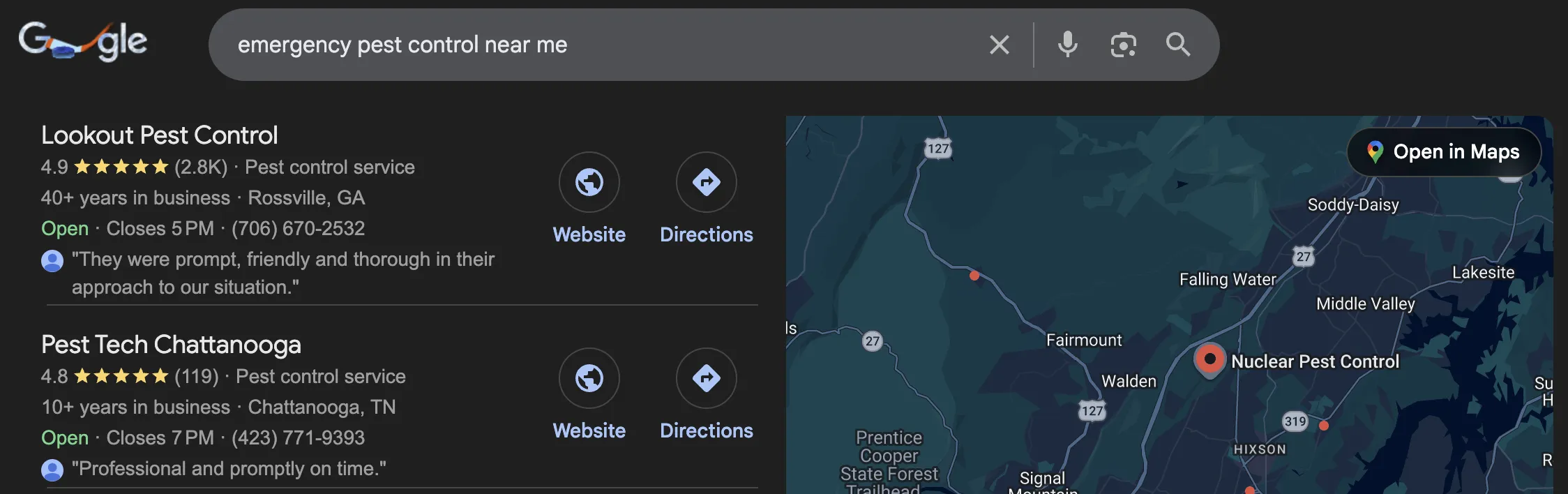
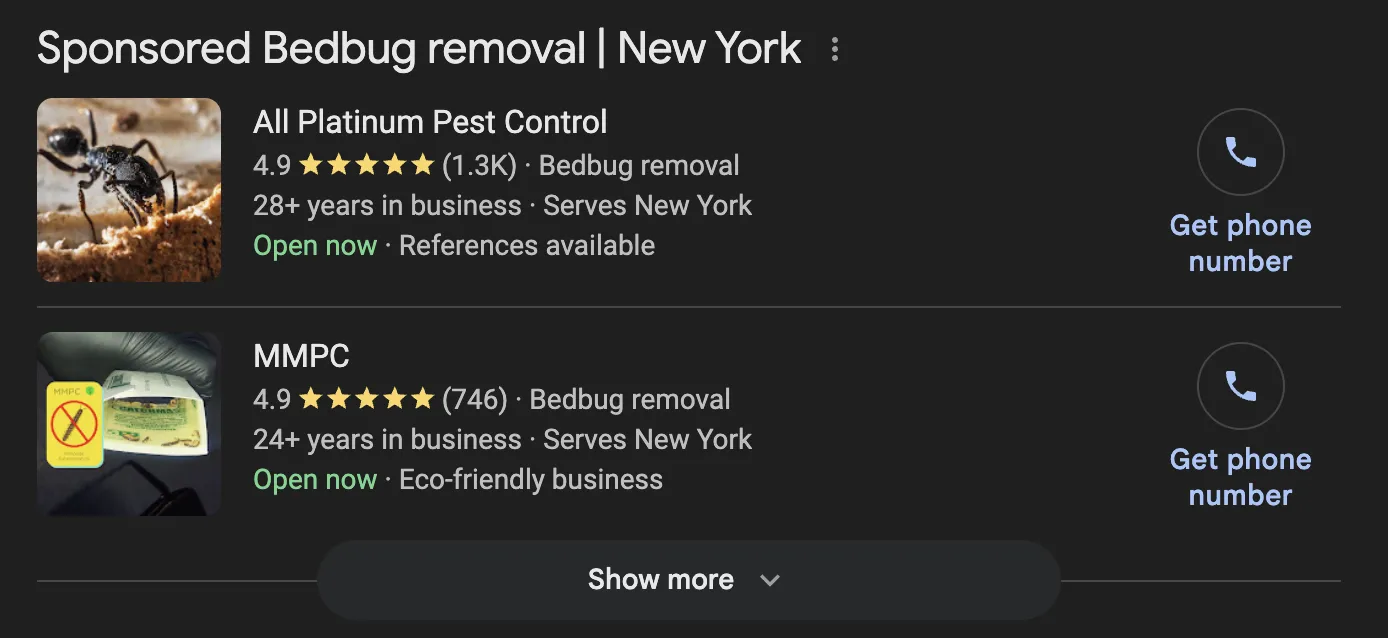
PPC + Retargeting
Pay-per-click puts you at the top of search results immediately. While SEO is the long game, PPC is like ordering pizza — shows up fast, costs money, solves your immediate problem.
The average cost per click for pest control keywords can be as high as $35, but average customer value is typically $300–$1,500. That’s powerful ROI when managed correctly. Target high-intent keywords like “emergency pest control” or “bed bug treatment” — searches from people ready to book right now.
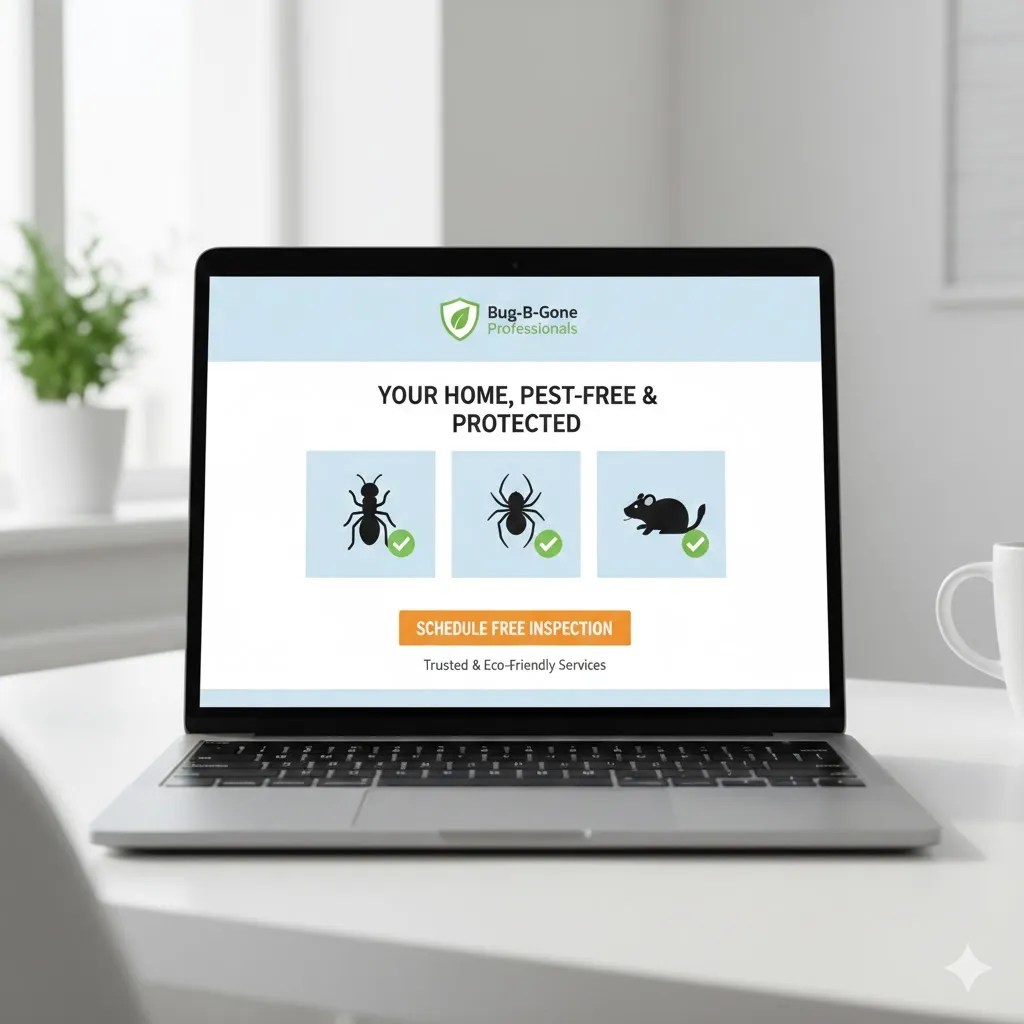
Most businesses screw up by sending clicks to their homepage. You need dedicated landing pages with clear calls-to-action, transparent pricing information, trust signals and easy booking.
Retargeting campaigns have 10x higher click-through rates than standard display ads. For more on retargeting strategies, see Netpeak’s marketing tactics for roofing companies.
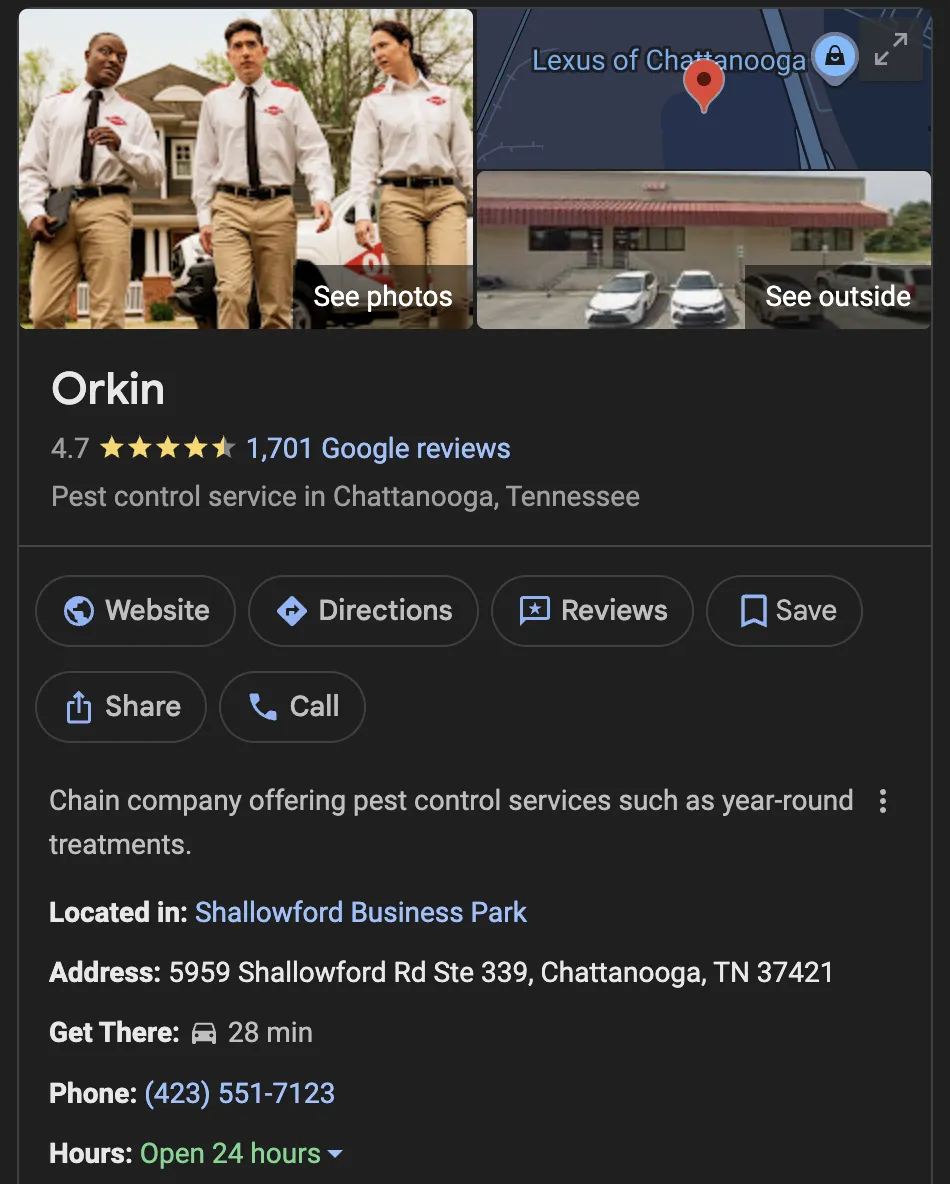
Google Business Profile
Your Google Business Profile is free, takes 20 minutes to set up and can drive significant leads. If you’re not using it, you’re losing money. Not like “oops, I accidentally washed a $10 bill,” but serious business money.
Those map listings get 33% of all clicks from local searches. That’s a THIRD of everyone searching clicking those map results.
Complete every section, upload photos of your team and trucks (bonus points if you catch your technician heroically facing down a hornet’s nest), post regular updates and respond to every review. 87% of consumers read online reviews for local businesses, and 79% trust online reviews as much as personal recommendations.
Make review collection systematic. After every successful job, ask for a review and send a direct link. Make it easier than ordering takeout.
Retention & Email Marketing
Acquiring a new customer costs 5-25x more than keeping an existing one. That’s basic math telling you to stop ignoring the customers who already trust you.
Build an email list for seasonal reminders (“Hey, remember mosquitoes? They remember you.”), preventive tips and special offers.
A whopping 92% of consumers trust recommendations from friends and family above all advertising. A simple “Refer a friend, get $50 off” program generates consistent leads at a fraction of paid advertising costs. Plus, referred customers stick around longer because they come pre-vetted by someone who already likes you.
Reviews & Referrals
Another crazy stat? 94% of consumers say a bad review has convinced them to avoid a business. Your reputation is scattered across Google, Facebook, Yelp, Angi, Nextdoor and the BBB like breadcrumbs, except these breadcrumbs can make or break your business.
Ask for reviews immediately after a successful service when customers are most satisfied and still remember your name. Respond to everything — positive reviews get thanks, negative reviews get acknowledged professionally. Never argue. That’s how you turn a one-star review into a viral story about “that insane pest control guy who lost it in the comments section.”
Additional Strategies
- Geofencing: Target competitor locations (nothing says business competition like poaching customers from their parking lot), high-value neighborhoods and new construction with location-based ads.
- Partnerships & PR: Partner with real estate agents (nothing kills a home sale faster than evidence of termites), property management companies and home inspectors. Local PR builds reputation and generates SEO backlinks.
- Seasonal Offers: Use seasonality to your advantage — spring termite inspections, summer mosquito control (because nobody wants their BBQ ruined by tiny vampires), fall rodent control.
- Visual Content: Post before-and-after photos, pest removal videos and educational content on social media. There’s an entire subculture who watch pest removal videos for FUN. Those are your people. Find them. For more on visual content, see our tips for cleaning business marketing.
- Green & Pet-Safe Solutions: Market eco-friendly and pet-safe treatments prominently. Dog owners panic about their fur babies eating treated grass (dogs are gonna dog). These customers actively seek safe solutions and will pay premium prices. Make it explicit: “We’ll kill your pests AND keep Fluffy safe” beats “we kill pests” every time.
Why Multichannel Marketing Is the Best Approach
No single marketing channel will carry your entire business. Businesses that dominate use multiple channels working together. Your Google Ads get better click-through when people recognize you from social media. Your SEO improves with PR backlinks. Your email works better when recipients have seen your brand elsewhere.
How to choose your channel mix:
Start with basics: functional website, Google Business Profile, basic local SEO, review management.
-
Need leads immediately? Focus on PPC and retargeting (results in days/weeks).
-
Building long-term dominance? Invest in SEO and content marketing (results in 6–12 months).
-
Small budget? Prioritize local SEO and Google Business Profile (time over money).
-
More money than time? Use PPC management services while building organic channels.
Start with 2–3 channels, track results, optimize, then expand. Better to do three things well than 10 things badly.
Rookie Mistakes to Avoid
Even smart business owners stumble when they’re new to digital marketing. Here are the most common mistakes — and why each one can seriously set you back.
Don’t Expect Instant Results: PPC delivers in days or weeks. SEO takes 3–6 months for local keywords. Businesses that quit SEO after two months abandon it just as it was gaining traction. The problem? You’ve already spent the money — you just didn’t stick around long enough to see the return. That’s like planting a garden, watering it for six weeks, then paving over it the day before harvest.
Don’t Invest in Just One Channel: What happens when a Google algorithm update tanks your rankings or a competitor outbids you on PPC? If all your leads come from one source, a single disruption can flatline your revenue overnight. Diversified marketing survives disruptions — single-channel strategies don’t.
Don’t Invest in All Channels at Once: Trying everything simultaneously spreads your budget thin and causes burnout. When you’re everywhere at once, you’re doing well — and you can’t tell what's actually working. Start focused, master 2 to 3 channels, then expand.
Test Strategically: A/B test ad copy, try different landing pages, experiment with new platforms — but change one variable at a time and analyze results. Without structured testing, you’re just guessing. And guessing with ad spend gets expensive fast.
Don’t Ignore Mobile Users: 60%–70% of web traffic is mobile. If your website looks terrible on phones or loads slowly, you’re actively driving customers to competitors who got the memo. If your web design isn’t mobile-first in 2026, you’re an endangered species.
Don’t Forget Existing Customers: Retention is way cheaper and more profitable than acquisition. Ignoring your current customers while chasing new ones is like filling a leaky bucket — expensive and pointless. Keep customers engaged through email, social media and excellent service.
Mistake |
Why It Hurts |
What to Do Instead |
|
Expecting instant results |
You burn budget and quit before ROI kicks in |
Give SEO 3–6 months; evaluate PPC weekly |
|
Investing in one channel only |
One algorithm change or competitor move wipes out your leads |
Diversify across 2–3 channels minimum |
|
Investing in all channels at once |
Budget spreads too thin, results are unmeasurable |
Start with 2–3 channels, master them, then expand |
|
Not testing strategically |
You waste spend on underperforming ads and pages |
A/B test one variable at a time |
|
Ignoring mobile users |
You lose 60%–70% of potential visitors |
Prioritize mobile-first design and speed |
|
Forgetting existing customers |
Acquisition costs 5–7x more than retention |
Nurture current customers with email and engagement |
The Bug Stops Here
Back to those trash pandas under the porch, living their best life on someone else’s property like kinda cute, could be rabid squatters.
When that homeowner frantically searches for help in their pajamas with one eye closed, are they finding your pest control company or your competitors’? When someone asks their neighborhood Facebook group for recommendations (because apparently that’s how we make decisions now), does your business come up? For context on similar urgency-based marketing, check out digital marketing for moving companies.
Want proof this actually works for home services businesses? Take a look at how H2H Movers used PPC and Google Ads to drive growth. While moving companies and pest control companies serve different needs, the digital marketing principles are the same: Show up when people are searching, target local customers with urgency-based needs and optimize campaigns for maximum ROI. The same strategies that helped them dominate their local market can work for pest control businesses facing similar challenges — emergency service requests, seasonal demand fluctuations and competition from national franchises. Check out more of our case studies and customer stories to see how we’ve helped businesses like yours.
Marketing pest control is about being visible where your customers are looking, building trust before they contact you and delivering enough value that they choose you over every other option.
Start with the basics: Optimize your Google Business Profile, manage your online reputation, get your website in order (make it load fast and not look like it’s from the MySpace era). Layer in paid advertising for quick wins while building SEO for long-term dominance. Test, measure, optimize and scale what works.
If you need help navigating the digital marketing rat race, consider partnering with professionals who specialize in digital marketing for pest control businesses. Because while you’re the expert at keeping ants from ruining the picnic and not freaking out when you find a wasp nest the size of a basketball, we’re the experts at making sure customers can find you. Now go deal with your business. Those trash pandas aren’t going to evict themselves.
Need help getting started? Netpeak is a full-cycle agency offering complete digital marketing services.
FAQ
How is marketing for pest control services unique compared to other home services?
Marketing pest control requires balancing emergency response with preventive messaging, since many customers need help immediately when they discover pests, but the most valuable contracts are recurring preventive services. Additionally, pest control faces unique trust barriers because customers are inviting strangers into their homes while dealing with an embarrassing problem, making reviews and empathetic messaging crucial.
How do I measure success for my pest control marketing campaign?
Focus on metrics that directly impact revenue: cost per lead, lead-to-customer conversion rate, customer lifetime value and return on ad spend for each marketing channel. Use call tracking to attribute phone leads to specific campaigns, implement conversion tracking on your website and use CRM software to track the entire customer journey from first contact to final invoice.
Why should I choose an agency for handling marketing for pest control?
Choose an agency if you lack the time or expertise to manage campaigns effectively, your market is highly competitive or you’ve tried DIY marketing without seeing results. Many successful pest control companies use a hybrid approach, hiring agencies for specialized tasks like SEO and PPC management while handling simpler tasks like social media marketing and review management in-house.
Should I combine traditional and digital marketing for my pest control business?
Yes, when it makes strategic sense. Digital marketing should be your foundation because it’s measurable and targetable, but traditional tactics like vehicle wraps, yard signs and local sponsorships still work when integrated with your digital strategy. The key is using traditional marketing to drive people to your digital properties where you can track conversions and nurture leads.

 0
0
 0
0
 0
0
 0
0
Related Articles
Sustainability Marketing: 7 Smart Ways to Earn Trust (and Customers)
Learn how to grow your brand efficiently while using eco-friendly marketing practices to build trust and long-term revenue.
Why Your Amazon Pet Ads Are Getting More Expensive Every Quarter Since 2025 (and How Smart Brands Manage It)
What happened to the auction prices? Where is the margin going, and what should be done next quarter?
How to Track Brand Mentions in AI Search? Find Out Whether You Are in the Answer
Being mentioned in an AI search boosts visibility. Discover how to monitor your brand mentions in ChatGPT, Perplexity, or Gemini and follow our approach to higher mention frequency.