
What Vibe Coding Means for Business: No Coding Skills, One Weekend, One SaaS
In The Matrix, Neo starts out as an ordinary programmer before discovering he can be an unexpected hero. A marketing executive with no coding experience might also seem an unlikely SaaS developer. Yet Andriy Chumachenko managed to build a working product in a single weekend with the help of AI.
Vibecoding is changing the rules for front-end development and opening up new opportunities for businesses, but there are some nuances to consider.
Andriy Chumachenko, co-founder and managing partner of FRACTAL and founder of BASE, in a few days built BASE AUDITOR, a tool that automatically audits a website’s marketing.
He’s not a developer or a designer, and the total cost of the project was about the price of a gift shop trinket. So, if it’s this cheap and easy, what opportunities does vibe coding create for business and where’s the catch?
What Vibe Coding Is and Why It Is Not Quite “Programming”
Vibe coding means creating websites and apps with the help of AI, no coding knowledge required. In a nutshell, anyone can do it if they learn how to harness an LLM chatbot to meet their needs.
Unlike no-code, where you assemble a product from ready-made blocks, vibe coding is a dialogue with the model: you describe the result you want, and the AI generates the code, structure, and interface and helps with revisions. The user’s role shifts to defining the task, reviewing the result, and managing iterations.
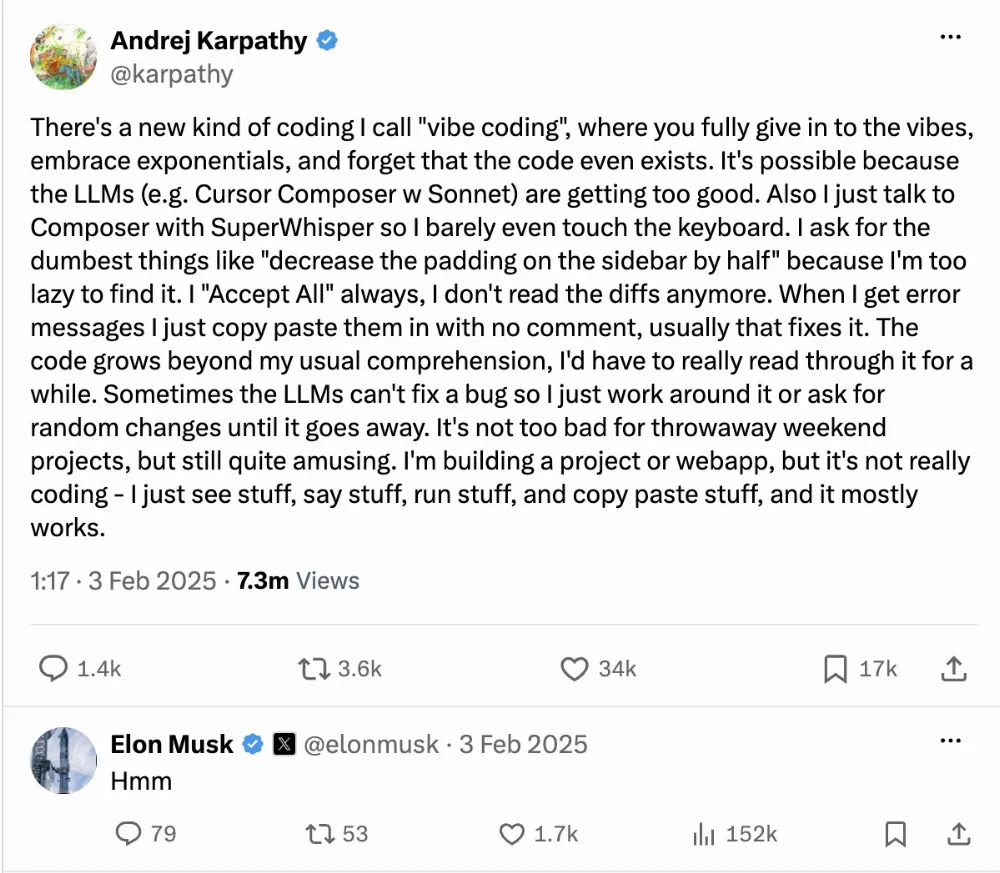
According to Andrej Karpathy, co-founder and former head of AI research at OpenAI, this isn’t quite coding:
Vibe Сoding vs. Сlassic Development
In traditional development, a programmer or team designs the product logic, writes the code, chooses the architecture, and tests and maintains the system. In vibe coding, the user describes what they want, and the LLM handles much of the implementation: it generates code, sets up the project structure, proposes solutions, makes revisions, and explains the next steps.
So LLMs built by IT specialists are now available to everyone else, who can use them to create simple websites and apps:
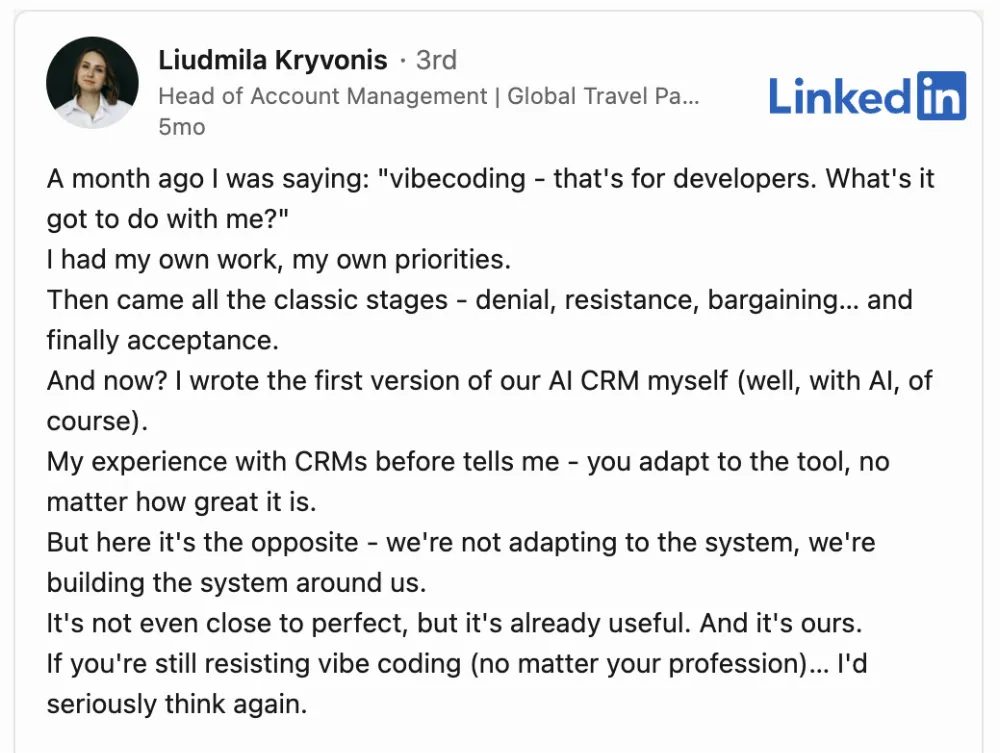
How Vibecoding Is Changing the Market
If code used to be one of the biggest barriers to entry for business, vibe coding is steadily making it cheaper. Website platform Wix, for example, is cutting 20% of its staff as it streamlines its operations with AI.
A simple service, MVP, calculator, internal tool, or prototype no longer takes months of work and thousands of dollars.
|
Who it’s useful for |
Main needs |
|
Founders and non-technical teams |
Build an MVP, internal tool, or landing page fast without hiring a dev team |
|
Beginners and less experienced developers |
A head start on projects without deep coding skills |
|
Teams that need to review risk before shipping |
Prototype quickly, then verify code before it touches customers |
|
Enterprises |
Faster internal tools and prototypes |
Will the Market Turn Into an “App Store Junkyard” of Thousands of Identical AI Products with No Real Value?
“There is nothing fundamentally new here: the internet already works this way. Anyone can create a website, record a video for YouTube or TikTok, or launch a social media page. That does not mean there will be attention: not everyone gets watched, not everyone gets followers, and not every website gets traffic.
The situation will be similar with AI-powered apps: there will be many more products, and it will become harder to find the ones that are truly useful. Curated lists, recommendations, ratings, reputation, and new quality filters will be the main sources of help. So I wouldn’t overreact. Let people create.”
Andriy Chumachenko, co-founder and managing partner of FRACTAL and founder of BASE
Reality Сheck
Although, once a product starts handling real users, data, payments, or complex logic, a business still needs technical review and support from specialists to ensure security and proper functioning. Veracode tested more than 100 LLMs on 80 coding tasks and found vulnerabilities in 45% of cases.
Programmers add a fly in the ointment. Vibe coding may reduce demand for junior and, in some cases, even mid-level developers. But AI-generated code still leaves a lot to be desired, says Oleh Bohuslavskyi, CTO and co-owner of Data Science UA:
“It often suggests outdated or unsuitable solutions and ignores project specifics and context. A person who deeply understands the task, constraints, and goals will almost always write better code, though more slowly.”
For developers, vibe coding suffices when they need to work fast: prototypes, personal tools, MVPs, hackathons, learning experiments, and algorithm checks.
It’s a way to test an idea quickly, not a replacement for full-scale development. Especially where complex architecture, security, and scaling are involved, so companies can’t yet cut programming costs entirely.
That makes the new scarce resources a strong idea, clear positioning, access to an audience, brand, trust, expertise, and distribution. The question is no longer how to build it, but who needs it, why now, and how people will find out about it.
This is where agencies, strategists, and marketers may play a bigger role, helping a product stand out from hundreds of lookalikes and showing consumers its value.
SaaS by the Weekend: The BASE AUDITOR Case
Andriy Chumachenko, co-founder and managing partner of FRACTAL and founder of a B2B marketing agency BASE, in a few days built BASE AUDITOR, a tool that automatically audits a website’s marketing.
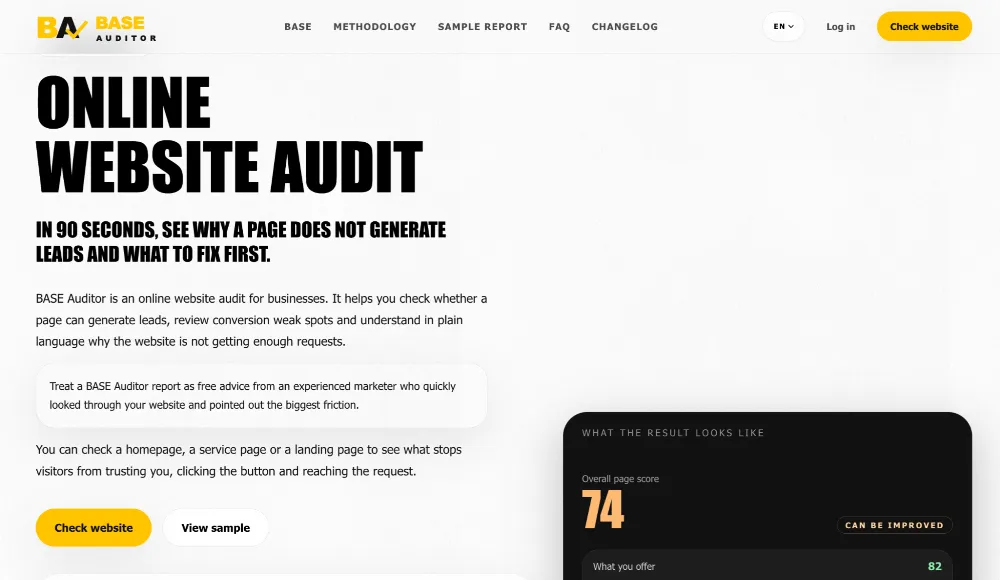
Audit surface problems teams hadn’t considered, and if the findings are numerous or critical, a tool promotes a full audit from BASE as a logical next step.

Andriy says he ran the experiment out of curiosity and because he had some free time on a Friday evening. He had never vibe coded before, but he was inspired by a post from his FRACTAL colleague Serhii Sauta, who used the approach to build FRACTAL+, a self-development app.
What follows is Andriy’s own account, step by step.
Step 1. Finding the Idea in Gemini
I usually use Gemini through a corporate subscription, plus my own OpenAI subscription (that’s ChatGPT and Codex) and the free version of Claude. I started with Gemini. Why?
Corporate Gemini works like a blank slate for me: every new chat starts with no memory of previous conversations.
I wanted a fresh perspective on the problem, not a continuation of old context, as if I were explaining to an outside consultant, for the first time, what BASE is and what product I wanted to build. It’s also the Pro version of the model, so it’s powerful enough for that kind of conversation.
I gave Gemini the basics about BASE: what we do, who our audience is, and what problem we want to solve.
From the ideas it suggested, I picked an automatic website audit: users could analyze a page for free and find problems. If there are many issues, they’d be advised to contact BASE for a deeper professional audit and fixes.
Step 2. Choosing the Format in Claude
I first considered an iOS app and took that idea to the free version of Claude. But the model talked me out of it: for a supporting product for an agency, an app is too complex a starting point, and the value to the user isn’t obvious. Instead, Claude suggested a web service, which is easier to launch and test, and makes it simpler to see whether there’s demand.
Step 3. Technical Specification and Building with Codex
Next, I needed to turn the idea into a technical specification. I asked the model to write a spec for a coding agent: what the web service should do, which pages it needs, how the audit logic should work, and what the form, results, and recommendations should look like.
The spec came out huge, and to keep the experiment pure, I didn’t even read all of it. I just copied it into OpenAI’s Codex with a short command:
“Build it.”
Codex started building the service. Along the way, it asked me to sign up for several free infrastructure services. I set one condition right away: no budget. In the end, I used Supabase and Vercel, whose free plans were enough for an MVP.
By Friday evening, I had a more-or-less working site.
I wanted to run the AI audit while sticking to free tools, but around then I ran out of ChatGPT tokens, so I had to pause the work. Later I found out that NVIDIA offers access to language models via API, and I suggested that Codex use it for the AI feature.
After that, we finished the service: added the audit, polished the UX/UI, moved it to my domain, and started expanding the content.
Step 4. Blog and SEO
Separately, I asked Codex to automate the blog. The logic was simple: every new iteration we introduce into the product becomes a separate blog post.
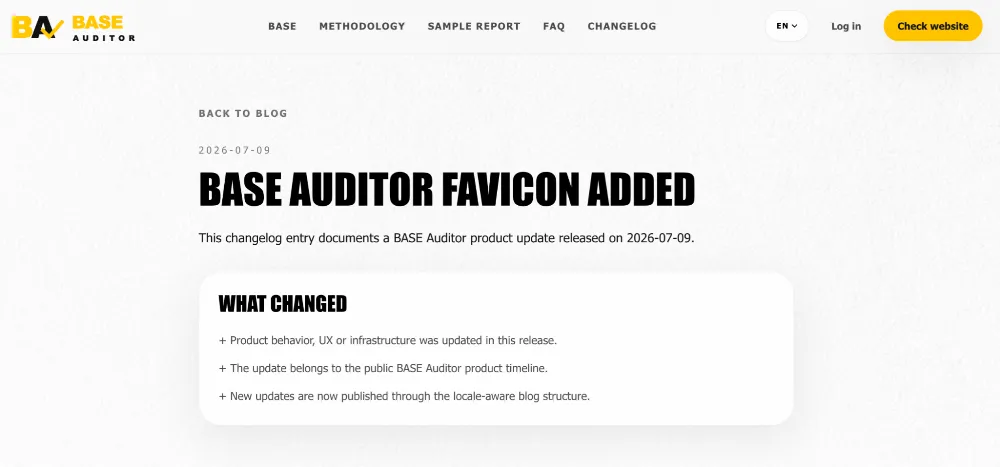
Then I asked Codex to create a semantic core and suggest article topics to attract search traffic. That’s how the service ended up with a blog featuring a basic SEO structure: topics, keyword clusters, and content tailored to the needs of potential users.
The Result
All in all, from Friday to Monday, I had an MVP for a service that analyzes websites, generates leads, and can serve as a starting point for learning about the agency’s services. And I didn’t write a single line of code myself. I simply described what I wanted, set some constraints, and suggested improvements. So, I did what the model couldn’t do for me.
It helped that I’ve seen a lot of similar sites and know a bit about marketing, so I made some changes to the design, copy, and a few structural elements. But honestly, the service would have been great even without them.
In total, the actual time I spent building a fully functional SaaS was no more than two hours.
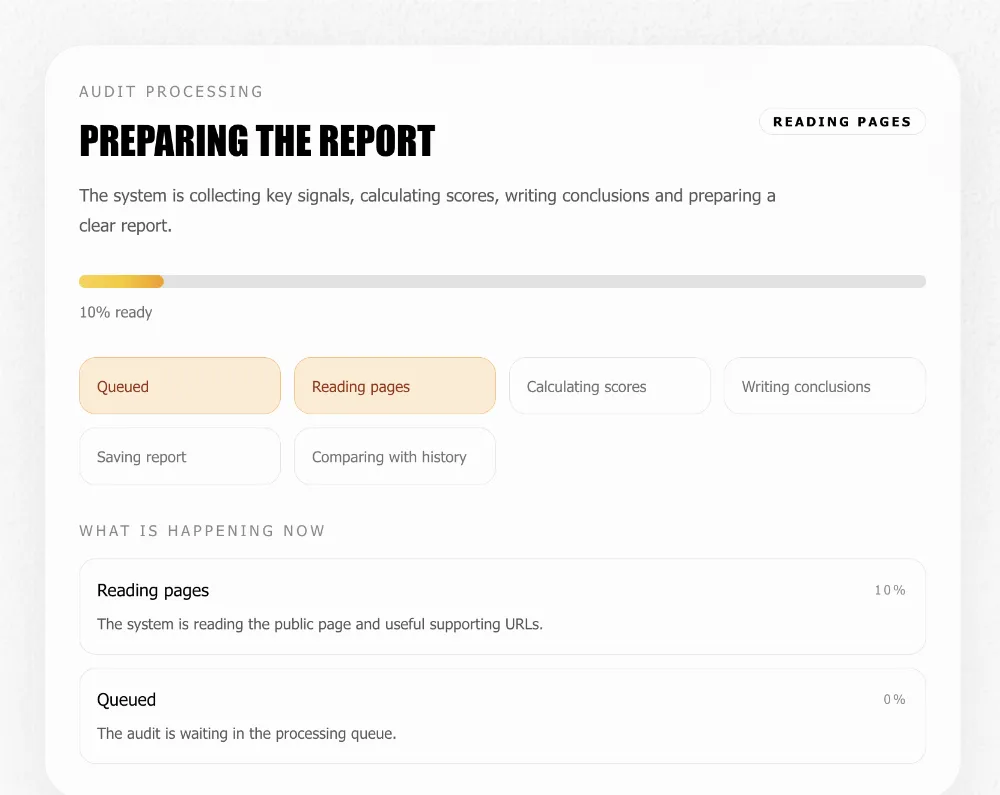
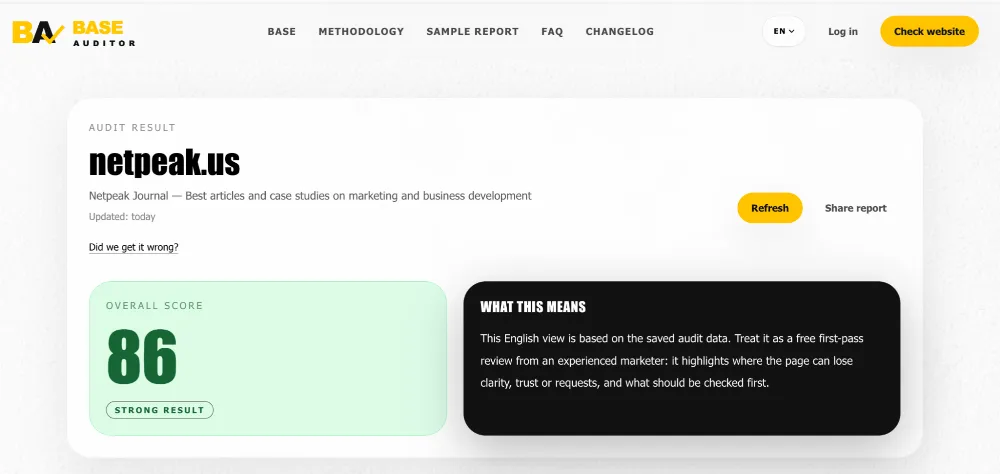
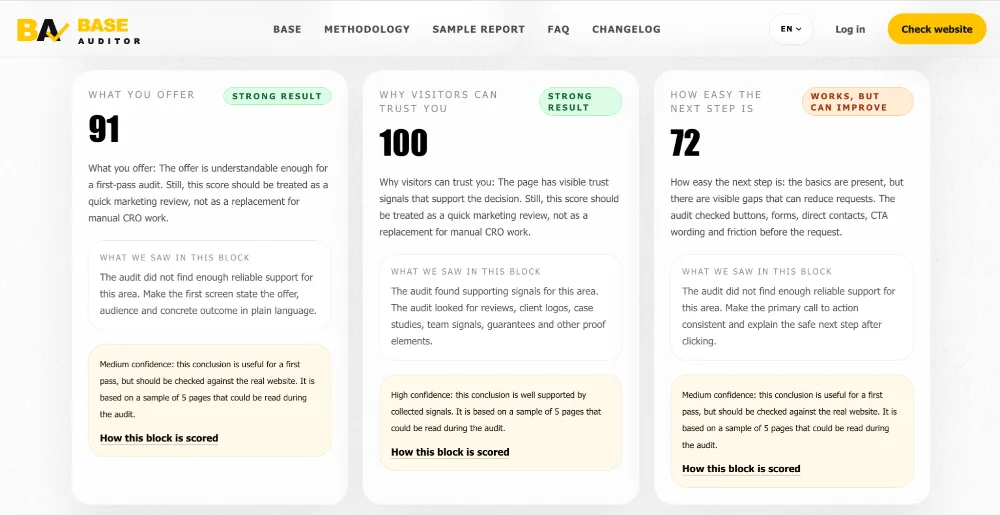
Here is what the report results look like:
I think most internet users, including my parents, could do the same. The LLM explains everything, answers follow-up questions, and walks you through technical steps that used to require a developer.
As the case shows, a business can now build an MVP over a weekend for the price of a $20 subscription, saving not just money but also time and nerves.
Conclusions
The key takeaway from the BASE AUDITOR case is that even non-programmers can use vibe coding to quickly build a simple website or app with AI’s help, something a bit more complex than a calculator.
But this clearly doesn’t extend to sites with a complex structure, payments, stored personal information, or other data whose loss would be critical. Vibe coding doesn’t remove responsibility, and you’ll still need IT specialists.
For a business, some working hypotheses no longer need months of approvals and budget. They can be implemented quickly and shown to users, demand can be tested, and only then do you decide whether to invest in full development, design, and security, and scale the product.

 0
 0
 0
 0
Related Articles
Amazon's AI Now Builds Complete Looks on Product Pages. How Do Brands Make Sure the Bundle Is Theirs?
Amazon now uses AI to assemble complete, shoppable looks around a single product, and it fills those looks with whichever brands its model picks.
Business Apps in the US: iOS vs. Android, September 2026
We searched for US App Store and Google Play data to see what business apps professionals, shoppers, and investors actually installed in September.
What Happens When Amazon Suppresses Your Listing? The New 2026 Rules
Under the new 2026 rules, Amazon warns you first and gives you a grace period to fix the issue.