
Selling on Amazon Europe in 2027: How to Choose Your First EU Market and Build a Successful Business
Amazon Europe selling might look simpler on paper: one seller account, ten European stores and a continent of shoppers. In practice, the stores differ sharply in size, competition, and cost.
For example, Amazon's 2025 annual report attributes about $45.9 billion of net sales to Germany and $43.2 billion to the UK. Newer stores such as Poland or Sweden are far smaller. The challenge is choosing where to start and making the numbers work before you send stock.
This guide helps you sell on Amazon Europe without spreading yourself thin. It gives you a marketplace comparison, a weighted scorecard, a fulfillment decision table, and a 90-day launch plan.
Key Takeaways
-
Test demand on a marketplace before committing to a full market entry.
-
Germany is the default anchor market: it is Amazon's biggest in Europe by sales.
-
France, Italy, and Spain are the natural second wave.
-
The safest option is to start with FBA (Fulfillment by Amazon) in one country plus EFN (European Fulfillment Network)
-
You need to budget VAT, EPR, product-safety compliance, and translation first; ad spend comes later.
Is Selling on Amazon Europe Worth It in 2026-2027?
Yes, if your margin is big enough to absorb VAT, compliance, and localization costs. Amazon Europe has a list of advantages:
-
One account, multiple stores. A European Unified Account lets you manage product offers across Amazon’s European stores from one place. You can start with one country and expand your business once you know what works. One account makes management easier, although each country still has its own requirements.
-
A large market. The EU had 451 million residents in January 2025 ( Eurostat’s 2026 demographic report). That is the EU’s population, rather than Amazon’s customer count, but it shows the region’s scale. The UK offers another market outside the EU.
-
Ecommerce is growing. In 2025, 78% of EU internet users bought online, compared with 62% in 2015 (Eurostat). Your customers are already comfortable shopping through websites and apps.
-
Small businesses are making sales. EU-based small and medium-sized businesses generated over €40 billion in Amazon sales in 2025 (Amazon reports). That shows real demand.
-
Amazon lowered fees by an average of €0.17 per unit sold across its European stores from 5 January 2026 (European pricing page).
Although that reach comes with work behind the scenes. These are nuances for your first feasibility check:
-
Local Amazon EU VAT obligations once stock sits in a country. Keep in mind that Amazon's account covers the UK store, but the UK sits outside the EU VAT and customs system. The overseas seller must charge UK VAT and register for VAT unless the supply is exempt (HMRC's guidance for Overseas Sellers).
-
Extended Producer Responsibility (EPR) and new packaging rules.
-
Product-safety rules that require an EU-based responsible person.
-
Potential language and especially cultural barriers, customer service and returns.
Who should wait: Brands with thin margins, no stock buffer, or no budget for compliance and a few months of learning.
Why Use a Marketplace to Enter a New Market?
A marketplace can give you real market data before you commit to a wider market entry. You see actual prices, reviews, conversion, and ad costs in a country before you spend on a local entity, warehouse, or distributor.
The question is whether your product passes a simple marketplace-fit test.
Before comparing countries, check whether the product itself suits this route. A large market cannot fix a product that has no comparable demand, no workable margin, or missing approvals.
The Marketplace-Fit Test
-
Your product has a shelf: comparable products already sell in your format.
-
The economics survive fees, fulfillment, and ads.
-
You can legally sell the product in that country (certifications, EPR, GPSR).
Passing those checks makes Amazon worth exploring. The next decision is your role in the sale: will you sell directly to shoppers, or supply Amazon as a wholesale customer? That choice shapes the operation you need to build.
The rule that can overturn the ranking: The market with the best conditions — growth, low concentration, and cheap clicks — is often not the best business opportunity. Your first Amazon marketplace needs to generate enough money in year one to finance entry into the second. A small market with excellent metrics may not deliver that.
Two Main Ways to Sell on Amazon Europe
-
Third-party (3P) seller: you sell to consumers, and Amazon provides traffic and logistics.
-
Vendor (1P): Amazon buys from you and resells, so it works like a distributor.
You can also combine channels: a distributor for offline retail, your own account for online. If you do this, register your trademark and enroll in Brand Registry first. A distributor can otherwise create listings for your products before you do.
European distributors and retail buyers (your potential partners) check a brand’s Amazon presence and reviews before signing a contract. A listing with over 50 reviews and 10k of monthly sales provides evidence of demand, and that can be more persuasive than a presentation.
Amazon Europe Marketplaces at a Glance
When you have checked product fit and considered a way to sell, it’s time to map the available countries before narrowing the choice. Amazon's European stores share an account but differ in language, currency, demand, and tax treatment.
The table below compares the nine EU stores + UK, which needs separate VAT and customs planning.
|
Marketplace |
Launched |
Language |
Currency |
Std. VAT (Jan 2026) |
Size signal |
Typical role |
|
Amazon.de |
1998 |
German |
EUR |
19% |
Largest; ~7.9B visits (2023) |
Anchor market |
|
Amazon.fr |
2000 |
French |
EUR |
20% |
~3.6B visits |
Second wave |
|
Amazon.it |
2010 |
Italian |
EUR |
22% |
~3.2B visits |
Second wave |
|
Amazon.es |
2011 |
Spanish |
EUR |
21% |
~3.1B visits |
Second wave |
|
Amazon.nl |
2020 |
Dutch |
EUR |
21% |
Smaller, newer |
Low-cost test |
|
Amazon.se |
2020 |
Swedish |
SEK |
25% |
Smaller, newer |
Niche test |
|
Amazon.pl |
2021 |
Polish |
PLN |
23% |
Smaller, growing |
Test market |
|
Amazon.com.be |
2022 |
French/Dutch |
EUR |
21% |
Smaller |
Add-on to FR/NL |
|
Amazon.ie |
2025 |
English |
EUR |
23% |
Newest |
English-language test |
|
Amazon.co.uk (non-EU) |
1998 |
English |
GBP |
20% |
~6.9B visits |
Biggest market, but difficult logistics |
Sources: launch dates from Marketplace Pulse and VATai (UK); VAT rates from VAT Update, which tracks the European Commission's TEDB, and HMRC (UK); 2023 visit estimates from IFA Magazine
Market size gives you a starting shortlist, but it cannot tell you whether your particular product will sell profitably. That requires a category-level comparison.
How to Choose Your First Amazon Marketplace?
Work through four questions: are people buying your kind of product often, can you compete, will each sale leave a 15–20% margin, and can your team support the market?
Step 1: Know Everything About Category Demand
Start by checking whether customers already buy your category products. Judge each market on the same data:
-
Addressable revenue: the part of the category that sells in your format, not the whole category.
-
Growth: year-on-year demand change.
-
Concentration: if five brands hold 80% of the shelf, market size no longer matters.
-
Amazon's own share: how much of the category Amazon sells itself (1P).
-
Newcomer earnings: how much listings launched in the last 12–18 months actually make.
-
Traffic cost: CPC and the share of branded search.
-
Legal fit: whether you can sell the product there at all (certifications, EPR, GPSR).
Don't exclude any market in advance. Let the data do it:
-
Run your keywords through Amazon Brand Analytics (Search Query Performance), if you have Brand Registry, and through a keyword tool set to each locale.
-
Check the Best Sellers Rank of the top 10 products in your category in each store.
-
Compare domain traffic with a third-party tool.
Hypothetical example: You sell a stainless-steel pet bowl. First, check how many times people search for “pet bowl” each month in German, French, and Italian. Then look at the fifth bestselling pet bowl in each Amazon store and note how many reviews it has.
Suppose Germany gets five times more searches, but its fifth bestselling bowl has 4,000 reviews. That suggests a bigger market, but strong competition too: your new listing will need to win buyers’ trust.
“Always keep in mind that marketplaces are not about TOFU and vanity; it's about profit. The viability of your product and unit economics are your main KPIs. It's better to enter a smaller market with higher profits than vice versa.”
Kyrylo Kuznetsov, Head of Marketplace Promotion at Netpeak
Your research should now show where customers are buying. Next, ask what would make them choose you over the listings already on the page.
Step 2: Check Whether Competition Is Not Too Strong
Compare these signals, because they are as important as the revenue estimates above:
-
Review counts and ratings across the top 10 results.
-
Brands versus resellers, and local brands.
-
Suggested bid and CPC for your core keywords, from your Amazon Ads console.
-
Whether Amazon itself sells your product category.
A gap in the competition is useful only if you can serve it profitably. Take the prices and ad costs you just researched and compare them with country-specific expenses. Learn how to stay competitive without underselling your brand, and avoid low-profit niches.
Step 3: Calculate What Each Market Will Cost
A promising category still needs to leave enough margin after costs. Amazon's selling plans are consistent across stores.
Per its EU pricing page, the Professional plan is €39 per month excluding VAT, and most referral fees fall between 8% and 15%. Amazon's French and Italian fee schedules quote referral fees including digital services tax. For a full breakdown, see our guide to Amazon seller fees.
Use market differences to estimate your margin in each country.
|
Market |
Std. VAT |
Packaging/EPR enforcement |
Language need |
Return risk |
|
Germany |
19% |
LUCID (packaging) and Stiftung ear (electronics) |
German |
Highest (about 1 in 4 parcels returned overall) |
|
France |
20% |
19 EPR categories; unique IDs required |
French |
Category-dependent |
|
Italy |
22% |
Packaging register (CONAI); verify |
Italian |
Category-dependent |
|
Spain |
21% |
Packaging register (Ecoembes); verify |
Spanish |
Category-dependent |
|
Netherlands |
21% |
Verify by category |
Dutch |
Category-dependent |
|
Poland |
23% |
Verify by category |
Polish |
Category-dependent |
Sources: VAT from VAT Update; German and French EPR from Amazon's EPR page; Italy and Spain from AVASK's EPR guide; German returns from dpa via MarketScreener
On returns, University of Bamberg research found that 88.7% of German ecommerce retailers offer free returns, versus 52.4% elsewhere in the EU (Study Summary). Clothing is the most frequently returned category (MarketScreener).
The returns figures also raise a practical question: who will deal with those returns, and in which language? Check whether you can actually deliver the service your assumptions depend on.
Step 4: Can You Support the Market?
The final check is whether your team can run the market day to day:
-
Ask whether you can support the language in customer service.
-
Ship from your current warehouse.
-
Handle returns in that country.
-
Check whether your payment and currency setup works.
Fulfillment for Your First Market: FBM, EFN, MCI or Pan-European FBA?
FBA handles last-mile delivery and returns. Your responsibility is to get pallets to Amazon’s warehouse. But for bulky products, Amazon FBA can be expensive or unavailable. Alternatives include Fulfillment by Merchant (FBM) through a local third-party logistics provider (3PL), or using the marketplace solely for lead generation.
|
Option |
How it works |
VAT registrations |
Cost profile |
Best for |
|
FBM (Fulfillment by Merchant ) |
You ship from your warehouse |
Depends on where stock sits |
Your own logistics cost |
Bulky or low-volume items |
|
FBA (Fulfillment by Amazon) + EFN (European Fulfillment Network) |
Stock in one country; Amazon ships cross-border |
Stock country |
Higher cross-border fulfillment fees |
First 1–3 markets |
|
Multi-Country Inventory (MCI) |
You choose storage countries |
Each storage country |
Lower local fees |
Proven bestsellers |
|
Pan-European FBA |
Amazon distributes stock across countries |
Per Amazon's VAT options |
Replaces EFN fees |
Scaled brands with stable demand |
Sources: Amazon, Eurofiscalis. Confirm current eligibility in Seller Central. New Professional sellers also get a one-year exemption from the Pan-EU low-inventory cost coverage fee (Amazon). Compare approaches in our FBA vs FBM guide
Your fulfillment choice is also a compliance decision: inventory in another country means legal obligations. Take care of those before choosing a warehouse and sending stock.
Compliance Checklist Before Launch
It’s the most difficult part of your Amazon Europe expansion. Before shipping, check both the legal requirements for your product and the documents Amazon expects. Common listing-blocking triggers include:
-
VAT: If your business qualifies for the EU’s €10,000 annual threshold, it covers your cross-border sales across the EU combined. Above that amount, you generally charge VAT at the customer’s local rate.
The One Stop Shop (OSS) makes reporting these sales easier by putting them in one system. But if Amazon stores your stock in several countries through Pan-European FBA or MCI, you may still need local VAT registrations and returns.
-
EORI: Needed if you import goods into the EU.
-
EU responsible person (GPSR): Products need an EU-established responsible person, whose details appear on the product, packaging, or accompanying document. Online product pages must include warnings, safety information, and manufacturer and responsible-person details.
-
EPR (for packaging, electronics, batteries, etc.): In Germany, Amazon suspends non-compliant listings: packaging since July 1, 2022, and electronics since January 1, 2023. Amazon says German packaging compliance is proven with a 13-digit LUCID number, and electronics need registration with Stiftung ear. France covers 19 categories (Amazon).
-
Product conformity: Use CE marking, local-language labels and instructions.
-
Data protection: Know everything about GDPR for customer data you handle outside Amazon.
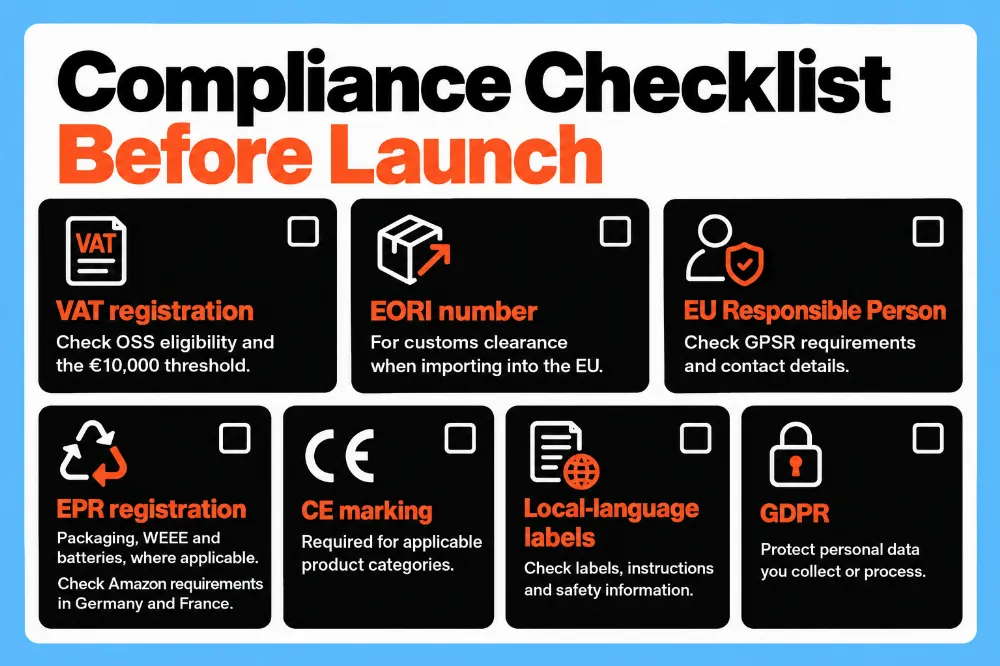
Completing this checklist should leave you with a concrete list of registrations, documents, and services to arrange. Add their setup and ongoing costs to the fulfillment figures you already gathered. Together, they form the budget you need to judge whether the launch is affordable.
Build a Launch Budget Before Sending Stock
Your budget is about Amazon Ads too, for sure, but it's also about the specific market ongoing costs, fulfillment model, and compliance requirements. Plus setup expenses. It all can eat your margin if you did your math wrong.
Use the 3× rule: Try to sell your products for at least three times what it costs to get them into your European warehouse. It seems a lot, but you need this budget room to cover all the fees and ads.
|
Cost item |
Notes |
|
EORI |
Needed to import goods into the EU |
|
VAT registration |
With Pan-EU FBA you may need registrations in each storage country; OSS doesn't cover these (Eurofiscalis) |
|
EPR |
LUCID in Germany; France's EPR categories; WEEE and batteries for electronics (Amazon) |
|
Amazon Europe fees |
Referral fees mostly 8–15% plus the €39 monthly Professional plan (Amazon); FBA fulfillment and storage on top |
|
Advertising |
Practitioners often plan 10–20% of first-year revenue |
|
Photos and content |
Practitioners often budget €2,000–3,000 |
|
Seller verification |
Identity checks can take weeks, so start before your stock ships |
If the budget still supports your target margin, you can move from preparation to launch. Keep enough working capital for replenishment and the learning period, rather than spending it all on the first shipment.
Building an Amazon Europe Business: 90-Day Launch Plan
Focus the first 90 days on one market. The goal is to find out whether the market can become profitable before adding another.
|
Phase |
Key actions |
KPIs |
|
Days 0–30 |
Localized keyword research (not machine translation); listing optimization and A+ content; Brand Registry; Vine if eligible |
Listing quality, indexed keywords, in-stock rate |
|
Days 31–60 |
Launch Amazon PPC (Sponsored Products and Brands); test pricing; collect reviews |
Sessions, conversion rate |
|
Days 61–90 |
Cut waste; add off-Amazon traffic; plan stock |
Organic rank on top-10 keywords, contribution margin |
Check the KPIs in this order: Can shoppers find and buy your product? Do they visit the listing and place an order? Then check how much each sale leaves after variable costs to see whether those orders are profitable.
The launch plan sets out the work and the measures to watch.
Real-Life Success Stories: How To Win European Market
Netpeak and Biosphere Case Study
Netpeak’s Biosphere case puts all previous theory into practice. The household and hygiene goods brand wanted to enter Europe through Amazon. Netpeak chose Germany as the entry point for logistics reasons, then expanded into Spain and Italy.
Services included Amazon advertising, Amazon SEO, and account management.

Results? Over the July 2022 to May 2023 engagement, a +300% month-over-month sales increase.
Netpeak and Coffeein Clean Case Study
Coffeein Clean was already reaching European coffee lovers through Allegro in Poland. Amazon Germany was the next step, but documentation and verification issues stalled their first attempt to open a store.
Netpeak helped get things moving: the team prepared and submitted the verification documents, opened and verified an Amazon US account, enrolled the brand in Amazon Brand Registry, and developed an Amazon Ads strategy.

The result: a wider European presence, more sales, and a stronger position against competitors.
For more lessons from the field, read about what going global really takes.
Beyond Amazon: Other European Marketplaces Worth Knowing
Expansion is also about adding a sales channel in a country where you already have a presence. Compare local marketplaces before assuming that another Amazon store is your best next move.
|
Marketplace |
Where it matters |
Source note |
|
Allegro |
Poland |
Over 30% market share and 20.4M users (Lengow) |
|
Kaufland |
Germany, France, Italy, Poland, Austria, Czechia, Slovakia, Netherlands (Spain planned) |
One registration reaches these sites (ESM Magazine) |
|
eBay |
UK; also DE, FR, IT, ES |
Second most visited marketplace in Germany (Lengow) |
|
Etsy |
Handmade and design products |
Best for craft and design niches |
If you want to start Poland expansion, check Allegro before Amazon.pl. If you want German-speaking shoppers beyond Amazon, Kaufland is a natural second channel.
Common Mistakes When Entering Amazon Europe
Most launch problems come from blindly assuming you’ll be okay without learning the market. Use this final check before committing stock:
-
Launching on five marketplaces at once instead of reaching profit in one market.
-
Pricing without a fee calculation.
-
Delaying your trademark and Brand Registry setup makes brand protection and content management harder.
-
Starting seller verification late, when stock is already in the warehouse.
-
Launching in Q4 without stock.
-
Ignoring EPR and VAT until Amazon blocks a listing.
-
Letting a distributor manage the first listing without an agreed channel strategy can create conflicts over content and competing offers.
-
Copying your US PPC structure and underestimating returns in Germany.
-
Machine-translating listings without local keyword research.
The main path is clear: do the basics to protect your European investments.
To learn more, read about Starbucks, Walmart, Target, and Facebook failed market expansions.
Ready to Start Selling on Amazon Europe?
Selling on Amazon Europe pays off when you choose one market, prove it, then expand. Our team can help you choose the right Amazon marketplace, including a marketplace-fit assessment before you spend on stock, and run Amazon marketing from day one. Book a market-entry consultation.

 0
 0
 0
 0
Related Articles
Business Apps in the US: iOS vs. Android, August 2026
We’ve fetched data from the US App Store and Google Play to see what professionals, shoppers, and businesses are actually installing, and why the market leaders are winning right now.
Amazon’s New “Sourced from Brand” Buy Box Label: Who Gets It and Who Doesn’t
Amazon is rolling out a provenance line in the Buy Box. A short label under the Brand row now reads “Sourced from [Brand]” on amazon.com and “[Brand] approved” on amazon.de. It tells the shopper that the unit on offer came through the brand’s own supply c
Failed Market Expansion Examples: 7 Mistakes Your Business Should Avoid
Explore seven common failed market expansion examples, real-world lessons from global brands, and a practical checklist for entering new markets successfully.