
Why Does My Under-$10 Product Lose Money on Amazon FBA?
Your under-$10 product loses money because Amazon charges an almost fixed fulfillment fee per order, and on a $3.99 item, that fee takes two-thirds of the price. Put 10 units in one multipack, and the fee falls to about a fifth of the price, which turns a loss into a margin close to 25%.
On November 5, Amazon announced its 2027 US fees, and the cheapest products took the hardest hit. If your catalog still sells a lone bamboo toothbrush at $3.99, this article is for you. The toothbrush cleans teeth beautifully. It cleans out your margin even better.
What Did Amazon Change in Its 2027 FBA Fees?
Amazon announced its 2027 US referral and FBA fee updates on November 5, 2026, and most changes take effect on January 15, 2027. Fulfillment fees rise by an average of $0.19 per unit. Storage moves to one unified monthly fee on February 1, 2027 (Amazon, 2026).
The average hides who pays. Low-price items under $10 face increases of up to 9.2%, while large standard items priced from $10 to $50 rise by about 1.5%. The 3.5% fuel and logistics surcharge introduced in April 2026 stays on top of every fulfillment fee (Amazon, 2026).
|
Size Tier and Shipping Weight |
2026 Fee |
2027 Fee |
Change |
|
Low-price small standard, 2 oz or less |
$2.43 |
$2.64 |
+8.6% |
|
Low-price small standard, 2+ to 4 oz |
$2.49 |
$2.72 |
+9.2% |
|
Large standard ($10 to $50), 4+ to 8 oz |
$3.95 |
$4.01 |
+1.5% |
|
Large standard ($10 to $50), 8+ to 12 oz |
$4.20 |
$4.26 |
+1.4% |
Non-peak, non-apparel fulfillment fees before the 3.5% surcharge. Source: Amazon 2027 US FBA fulfillment fee changes, published November 5, 2026.
Interested in how Amazon uses AI? Read our articles:
How Much Does One Toothbrush Lose Compared with a 10-Pack?
Say you sell a bamboo toothbrush for $3.99. It weighs less than 2 oz when packed for shipping and costs you $0.45 to buy and get into inventory. The breakdown below uses Amazon’s 2027 fees outside peak season, including the 3.5% surcharge.
It also assumes you spend 15 cents on ads for every $1 in total sales. That's 15% TACoS (total advertising cost of sales).
The referral fee is 8% on the single and 15% on the pack, because Amazon charges the lower rate on many personal care items priced at $10 or less.
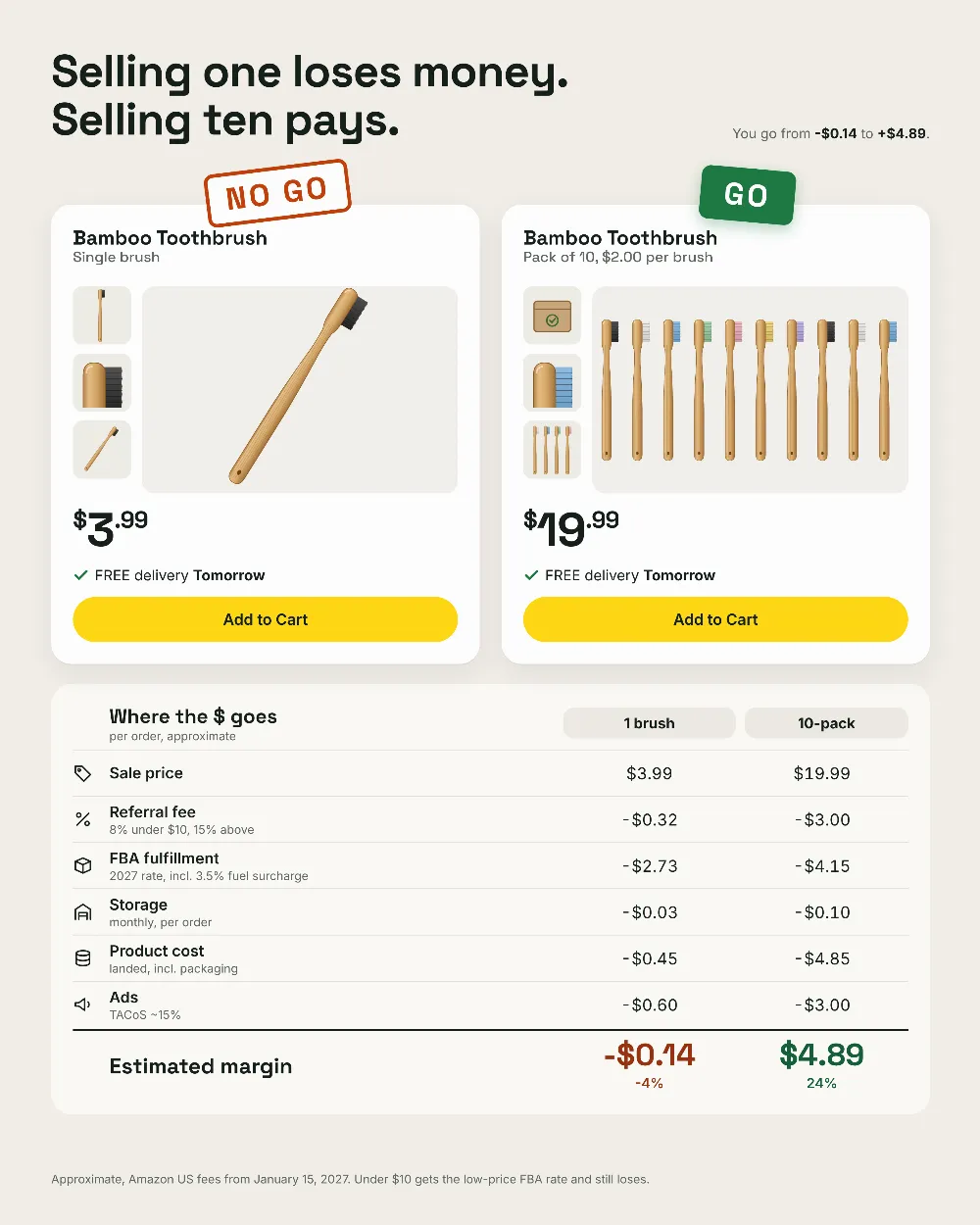
Netpeak USA model based on Amazon 2027 US rate cards: 8% referral fee on the single (personal care, $10 or less), 15% on the pack, ads at 15% of sales (TACoS). Your category, landed cost, weight band, and ad efficiency will change the result.
The shopper pays $2.00 per brush instead of $3.99. You move from a 14-cent loss to $4.89 of margin on every order. At 2026 fees, the single brush made about $0.07 per order, so the 2027 increase alone pushes it below zero.
The Belgians put the answer on their coat of arms: l'union fait la force. Unity makes strength. Ten toothbrushes in one box carry a fee that would crush any one of them alone.
The fee-to-price test
You need to divide the FBA fulfillment fee by the sale price for every ASIN in your catalog.
Above 40%: the ASIN rarely earns margin once you add product cost and ads. Test a multipack.
Between 25% and 40%: the ASIN works only with efficient ads. Watch it closely.
Below 25%: you have room to invest in growth.
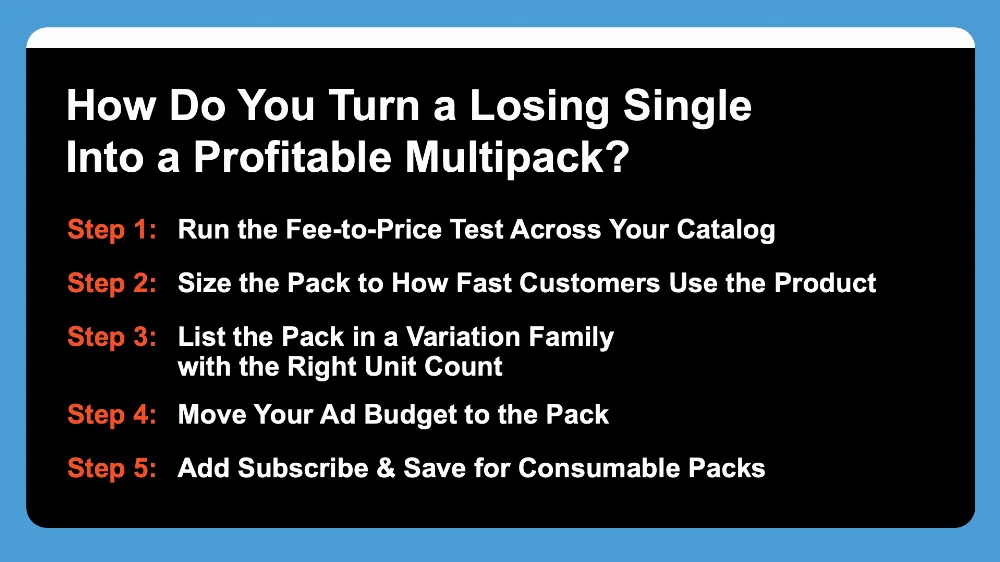
How Do You Turn a Losing Single Into a Profitable Multipack?
Step 1: Run the Fee-to-Price Test Across Your Catalog
Export every ASIN under $10 with its weight band, referral rate, and fulfillment fee. Sort by fee share from highest to lowest. The top of that list is your multipack shortlist, and it usually holds small consumables, accessories, and refills.
Watchout: Model peak and non-peak fees separately. Amazon applies holiday peak fees from October 15 to January 14, which pushes the ratio even higher on cheap items.
Step 2: Size the Pack to How Fast Customers Use the Product
Choose a pack size based on how quickly customers use up or replace the product. The American Dental Association recommends replacing toothbrushes every three to four months. At that rate, a 10-pack can last a family of four about 7 to 10 months. Think about how often customers replace sponges, cables, batteries, or hair ties, and offer a larger pack for people who go through them faster.
Watchout: Check the weight before you settle on a pack size. Even one extra item can push the pack into a higher weight range and increase the fulfillment fee on every order.
Step 3: List the Pack in a Variation Family with the Right Unit Count
Create the multipack as its own ASIN inside the same variation family as the single, using a number-of-items theme. Amazon then shows a price per count on the listing, and the pack wins that comparison every time.
Watchout: Enter the correct number of items in each pack in Amazon’s Unit Count field. If the count is wrong, Amazon can show the wrong price per item, making it harder for shoppers to compare the single item and the multipack. That can cost you sales on both listings.
Step 4: Move Your Ad Budget to the Pack
A $3.99 order cannot pay back a click in most competitive categories. Point Sponsored Products at the multipack, and let the single live on organic traffic inside the variation family. Shoppers who search for one unit still land on the family and see the better deal.
Watchout: Keep the single-item listing active so you retain its sales history and any reviews Amazon shares across the product options. You need to start by spending less on ads for the single item, then see if more shoppers buy the multipack.
Step 5: Add Subscribe & Save for Consumable Packs
Customers regularly replace toothbrushes, sponges, and refills. With Subscribe & Save, they can sign up to get your multipack on a schedule. So, if the pack leaves you with more profit per order, that means that you have more room to cover the discount you offer subscribers.
Watchout: Before you enroll in Subscribe & Save, subtract the discount from what you earn on each pack and check whether you’ll still make a profit. You can also try a “Buy X, Get Y” promotion. Starting in 2027, Amazon charges $5 upfront plus 2% of the sales made through that promotion (Amazon, 2026).
Want more Amazon deep dives? Read them here:
-
What Happens When Amazon Suppresses Your Listing? The New 2026 Rules
-
Amazon’s New “Sourced from Brand” Buy Box Label: Who Gets It and Who Doesn’t
-
What Does the EU Green Claims Ban Mean for My Pet Brand's Amazon EU Listings?
When Does a Single Unit Still Make Sense on Amazon?
It’s no surprise to anyone that low prices still sell. During Prime Day 2026, items under $15 gained share and average order value fell to $57.50 from $63.50 (NielsenIQ, 2026). In a separate survey, 45% of Amazon shoppers said they compare prices more than a year ago (Feedvisor, 2026).
Keep selling a single item when it gives shoppers a good reason to buy one. They might want to try a premium product, buy a small gift, or test the product before ordering a multipack.
If you lose money on the single, treat that loss as part of the cost of winning a new customer. For example, if you lose $1 on a trial order, check whether enough of those shoppers come back to buy a profitable multipack to cover that cost.
Shoppers may want a low-priced item. Whether you make money depends on how much you charge and what it costs to package and ship one item versus a pack.
Netpeak USA runs this fee-to-price audit for brands before every Amazon fee change. If your catalog hides a few lone toothbrushes, we can find them before January 15.
Bonne chance — and may your Subscribe & Save conversion rate be ever in your favor!
FAQ
Why do cheap products lose money on Amazon FBA?
Does the Amazon low-price FBA rate fix the problem for items under $10?
How many units should an Amazon multipack contain?
Will a multipack cannibalize my single-unit sales on Amazon?
When do the 2027 Amazon FBA fee changes take effect?

 0
 0
 0
 0
Related Articles
Business Apps in the US: iOS vs. Android, October 2026
Which business apps did Americans actually download in October 2026? We pulled US data from the App Store and Google Play to find out what professionals, gig workers, shoppers, and investors installed.
Black Friday Marketing 2026 in Europe: How to Win the Season Before It Starts
Google surveyed thousands of European shoppers about Black Friday 2026: when they buy, which discounts work, and where they find deals. Plus an 8-week Black Friday marketing plan to win the season.
Shoppable YouTube: How to Make Every Screen Shoppable
Shoppable YouTube turns your video ads into mini storefronts by adding clickable products from your Merchant Center catalog.