
Amazon's AI Now Builds Complete Looks on Product Pages. How Do Brands Make Sure the Bundle Is Theirs?
Amazon now uses AI to assemble complete, shoppable looks around a single product, and it fills those looks with whichever brands its model picks.
Brands make sure the bundle is theirs by building complementary ASINs, giving Amazon clean visual and attribute data, creating virtual bundles, and defending their own product pages with ads.
I spotted the new module on amazon.fr on a quiet Monday morning, scrolling a black streetwear hoodie page. The hoodie brand sold one item on that page. Amazon dressed it with four other brands, and the full look cost more than a weekend in Deauville. Then it asked me, very politely, "Vous aimez cette tenue ?" (Do you like this outfit?)
Your hero product could be next, and Amazon will not ask your permission before it accessorizes it.
What Is Amazon's AI-Generated Look Module?
In June 2026, Amazon announced Shop by Style, an AI feature in its iOS and Android apps that displays collages of complete outfits (Amazon via The Verge, 2026). The AI composes each collage, but every item inside it is a real product that shoppers can buy. Amazon launched it alongside AI-generated search images for clothing and home goods.
In October 2026, I observed a related module on an Amazon.fr product page, titled “Style Ideas” in the French interface. Unlike “Frequently Bought Together”, it does not list items that shoppers bought together. It builds a full outfit around the product, then asks the shopper to rate the look with a yes or no button.
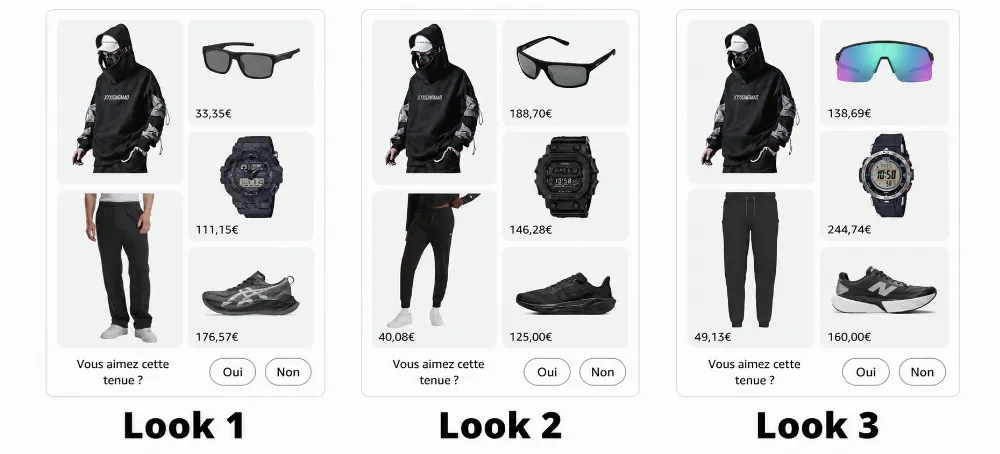
Three “Style Ideas” looks for the same hoodie on an Amazon.fr product page, observed by Netpeak USA in October 2026
What the Module Showed: One Product, Four Other Brands Per Look
I reviewed three looks the module generated for one hoodie listing on Amazon.fr in October 2026. Each look kept the hoodie as the anchor and added four complementary items: sunglasses, a watch, sneakers, and pants. Established sportswear and watch brands filled those slots, not the hoodie brand.
Individual complementary items ranged from €33.35 to €244.74. In the two looks with every price visible, the four add-ons totaled €500.06 and €592.56. Every look matched the hoodie’s black palette, which points to visual coherence as a selection signal.
|
Look |
Sunglasses |
Watch |
Sneakers |
Pants |
Add-on total |
|
Look 1 |
€188.70 |
€146.28 |
€125.00 |
€40.08 |
€500.06 |
|
Look 2 |
€33.35 |
€111.15 |
€176.57 |
Not shown |
€320.97 (3 items) |
|
Look 3 |
€138.69 |
€244.74 |
€160.00 |
€49.13 |
€592.56 |
Prices of complementary items in three “Style Ideas” looks, Amazon.fr, October 2026. Source: Netpeak USA observation
Which Brands Are Most Exposed to AI-Generated Looks?
Any brand whose product gets used alongside other products is exposed. Amazon started with fashion, where an outfit is the natural unit of purchase. The same logic extends to categories where shoppers buy a set: home decor, kitchen, outdoor gear, beauty routines, and pet supplies.
Pet supplies show how large these set-based categories can get. Supplies, medications, and live animals reached $34.4 billion in US spending in 2025, up 4.4% year over year (Global Pet Industry, 2025). The global pet accessories market reached $7.2 billion in 2025 and should grow to $12.3 billion by 2033 (Grand View Research, 2026).
A dog harness, a leash, a waste bag dispenser, and a treat pouch already form a look. So do a duvet, two pillows, and a throw, or a tent, a sleeping bag, and a lantern. Whatever you sell, Amazon’s AI will happily staff the empty slots with your competitors.
Status Сheck
As of October 12, 2026, Amazon has announced Shop by Style for clothing in its mobile apps. It has not confirmed when AI-generated looks will reach other categories or marketplaces. Confirm availability for your category with your Amazon account team before you move budget.
The steps below also strengthen “Frequently Bought Together,” and the other cross-sell placements that already run on every product page.
More deep dives into the pet category on Amazon here:
-
Sephora Just Plugged Into ChatGPT: Here Is What That Means for Pet Brands on Amazon
-
What Does Amazon Joining YouTube Shopping Mean for My Pet Brand's Black Friday?
-
Amazon’s New “Sourced from Brand” Buy Box Label: Who Gets It and Who Doesn’t
How to Make Sure Amazon's AI Bundles Your Products, Not Your Competitors'
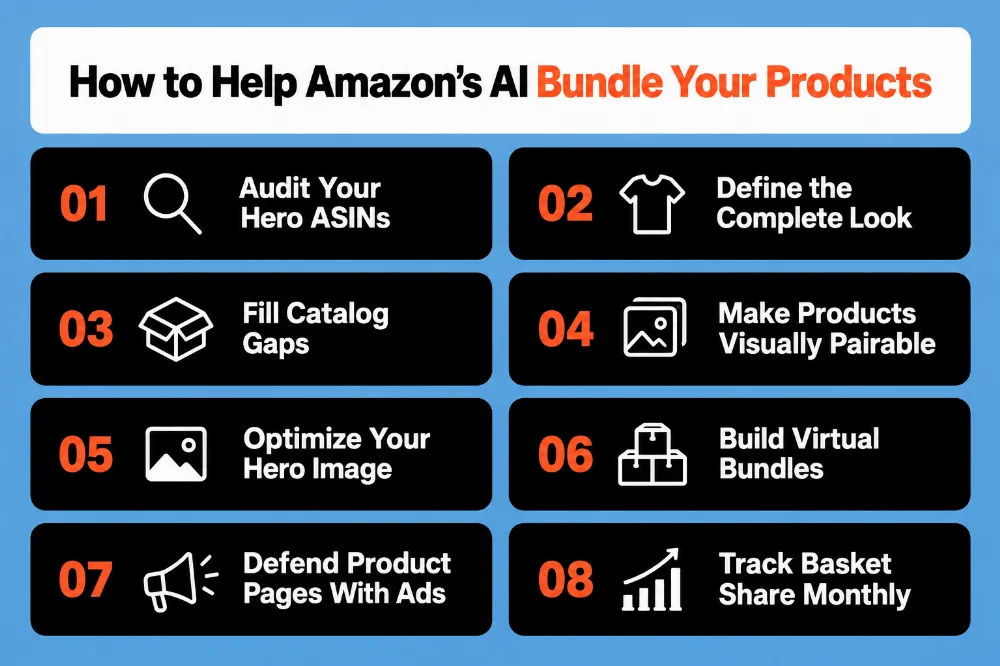
Amazon does not publish how its look module picks products, and brands cannot buy or claim the slots directly. You can, however, control the inputs the model sees. Here is the eight-step playbook Netpeak USA recommends.
Step 1: Audit What Amazon Already Pairs With Your Hero ASINs
Open the five most popular pages for your products in the Amazon mobile app and take a screenshot of each cross-sell module. Amazon initially rolls out its AI-powered shopping features in the app, so you can skip them during an audit on desktop computers. Make a note of every competing brand that appears next to your product.
Why it matters: This audit shows who already rents space on your page, rent-free. Most brand teams check their listing on desktop once a quarter and never see the mobile layout their shoppers actually scroll.
Watchout: Amazon personalizes these modules. Run the audit from two or three accounts, or you will mistake your own browsing history for a market pattern.
Step 2: Define the Complete Look for Each Hero Product
Next to each main product, list three to five items that a customer might need. For example, for a hoodie, these would be pants, sneakers, and a cap. For a dog harness, these would be a leash, an ID tag, a poop bag dispenser, and a treat bag.
Why it matters: This map will serve as your service package, a list of your target audience for advertising, and a roadmap for product development. Imagine how the product is used in practice from the moment it’s taken out of the box to the moment the customer shows it off.
Watchout: Build the look from the customer’s routine, not your warehouse. A look built around overstocked ASINs reads like a clearance bin, and shoppers notice.
Step 3: Fill the Gaps in Your Catalog
Compare your product assortment map with the current catalog and make a list of all the items you cannot stock. Prioritize high-selling, easy-to-manufacture products, such as basic items, replacement parts, and small accessories. List these ASINs under the same registered trademark.
Why it matters: An AI cannot pick a product you do not sell. Every empty slot in your look hands a competitor a guaranteed seat on your page, and you paid for the traffic.
Watchout: Do not launch a weak ASIN just to fill a slot. A two-star accessory next to your four-star hero product drags down both listings.
Step 4: Make Your Products Visually Pairable
Products that go together should match in color and have the same color names in every listing. Also, fill in all product attributes: color, material, size, style, etc. Keep main photos consistent on a white background, then add a lifestyle shot of the full set in use.
Why it matters: Every look we observed matched the anchor product’s color palette. A navy hoodie with navy joggers and a navy cap gives the model an obvious match. A navy hoodie with "midnight" joggers and a "deep ocean" cap gives it a riddle.
Watchout: Amazon has not confirmed which signals drive look selection. Treat attribute hygiene as a low-cost bet that also helps search and Rufus answers, not as a guaranteed ranking lever.
Step 5: Adapt Your Hero Image
Review your main image as one tile in a five-tile collage. In every look we observed, Amazon reused the hoodie’s main image as the anchor tile, next to clean packshots of the add-ons. You need to keep your product large, centered, and readable at thumbnail size.
Why it matters: Your hero image now sells inside outfits you did not design. The hoodie’s main image showed a model in black pants and a cap, and Amazon filled the pants slot with other brands every time. Show only what you sell, or style the shot with your own complements.
Watchout: Amazon’s main image rules still apply: a pure white background, the product filling about 85% of the frame, and no added text. Test any new hero image with Manage Your Experiments before you roll it out across the catalog.
Step 6: Build Virtual Bundles Around Each Look
It’s a good idea to create virtual bundles in Seller Central for your most popular products: combine two to five ASINs into one offer. To do this, you need to be enrolled in Brand Registry, have FBA inventory, and ensure that the bundle price is below the sum of its parts.
Why it matters: A virtual bundle is the one look on your page that Amazon cannot hand to another brand. It also gives value-seeking shoppers a clear reason to buy the full set from you today.
Watchout: New bundle ASINs start with zero reviews. Feature each bundle in your A+ content and Brand Store, so it borrows trust from your established listings.
Step 7: Defend Your Product Pages With Product Targeting Ads
Run Sponsored Display and Sponsored Products campaigns that target your own hero ASINs with your complementary products. Add the competitor ASINs from your Step 1 audit as targets for your complements too.
Why it matters: Organic modules and ad placements share the same page. When you hold the ad slots on your own listings, competitors pay more to reach your shoppers, and your complements stay visible even when the AI picks someone else.
Watchout: Keep defensive campaigns on a tight budget and watch incremental sales. You do not want to pay for clicks from shoppers who would have bought your accessory anyway.
Step 8: Track Basket Share Every Month
Pull the Market Basket Analysis report in Amazon Brand Analytics every month. It shows which products customers buy together with your ASINs. Track the share of those pairings that belong to your own brand.
Why it matters: Basket share is the scoreboard for every step above. If your hero buyers still leave with a competitor’s accessory, your look strategy has a leak.
Watchout: Market Basket Analysis shows purchases and doesn’t show impressions. Pair it with your monthly mobile screenshots from Step 1 to see both what Amazon shows and what shoppers buy.
Amazon Cross-Sell Placements Compared
|
Placement |
What it shows |
Who picks the products |
Brand lever |
|
Frequently Bought Together |
Items shoppers bought together |
Amazon, from purchase data |
Catalog breadth, virtual bundles |
|
AI look modules (Shop by Style, Style Ideas) |
AI-composed sets of real products |
Amazon's AI model |
Visual consistency, attributes, catalog breadth |
|
Virtual bundles |
A brand-built set at one price |
The brand |
Bundle design and pricing |
|
Sponsored Display and Sponsored Products targeting |
Ads on product pages |
The advertiser |
Bids, targets, creative |
|
A+ content and Brand Store |
Brand-controlled cross-sell content |
The brand |
Content and page layout |
The Bottom Line for CMOs
Amazon’s AI stylist works for the shopper, not for your brand. It picks the best-looking set from whatever the catalog offers. Your job is to make sure your brand offers that set.
Treat your product page as your chasse gardée, the private hunting ground where only your own products get to roam. Build the full look, make it visually obvious, and defend the slots you cannot win organically.
Otherwise, Amazon will keep styling your hero product with someone else’s catalog. Even the dog harness deserves a leash from the same family.
Netpeak USA helps brands build catalog, content, and advertising strategies for Amazon. Talk to our team to audit what Amazon shows on your product pages today.
Bonne chance - and may your Subscribe & Save conversion rate be ever in your favor!
FAQ
What is Amazon Shop by Style?
Which product categories does Amazon's AI look module cover?
Can a brand choose which products appear in Amazon's AI-generated looks?
Do I need to change my main image for Amazon's AI-generated looks?
How many products can an Amazon virtual bundle include?
How do I see which products customers buy together with mine on Amazon?

 0
0
 0
0
 0
0
 0
0
Related Articles
Pet Food Product Patent: How to Protect Your Innovation
Patenting pet products requires careful consideration and proper application filing. With the 8 steps below, you will be able to submit your patent application and protect your invention.
Digital Marketing for SMBs: How to Grow a Small Business Online
Small or mid-sized businesses compete for the same customers as brands with marketing departments ten times their size, on a fraction of the budget. You can't outspend them, so you have to outsmart them and grow your business deliberately.
Business Apps in the US: iOS vs. Android, August 2026
We’ve fetched data from the US App Store and Google Play to see what professionals, shoppers, and businesses are actually installing, and why the market leaders are winning right now.