
How Does Amazon Feed Rufus Data Your Listing Never Shows (And You Didn’t Even Know It)?
Amazon feeds Rufus with data your listing never shows by asking buyers structured questions after checkout. A toy buyer now gets asked the child’s age and whether the toy suited it. Those answers join reviews, Q&A, and purchase patterns to tell Rufus who a product actually fits. If your pet listing stays vague on size, age, or chew strength, your customers write that part of the answer for you.
And most brands never even know it happened.
I learned this the honest way: I bought a toy for my nephew. Before I could even wrap it, Amazon wanted his age and a verdict on the fit. My nephew did not get a vote. Neither, it turns out, does the brand.
What Data Does Amazon Collect After a Purchase?
Amazon now shows some buyers a short suitability survey after they order. The prompt below appeared on Amazon.fr minutes after a toy purchase. It asks for the user’s age, then a simple yes or no: was the toy suitable for that age?
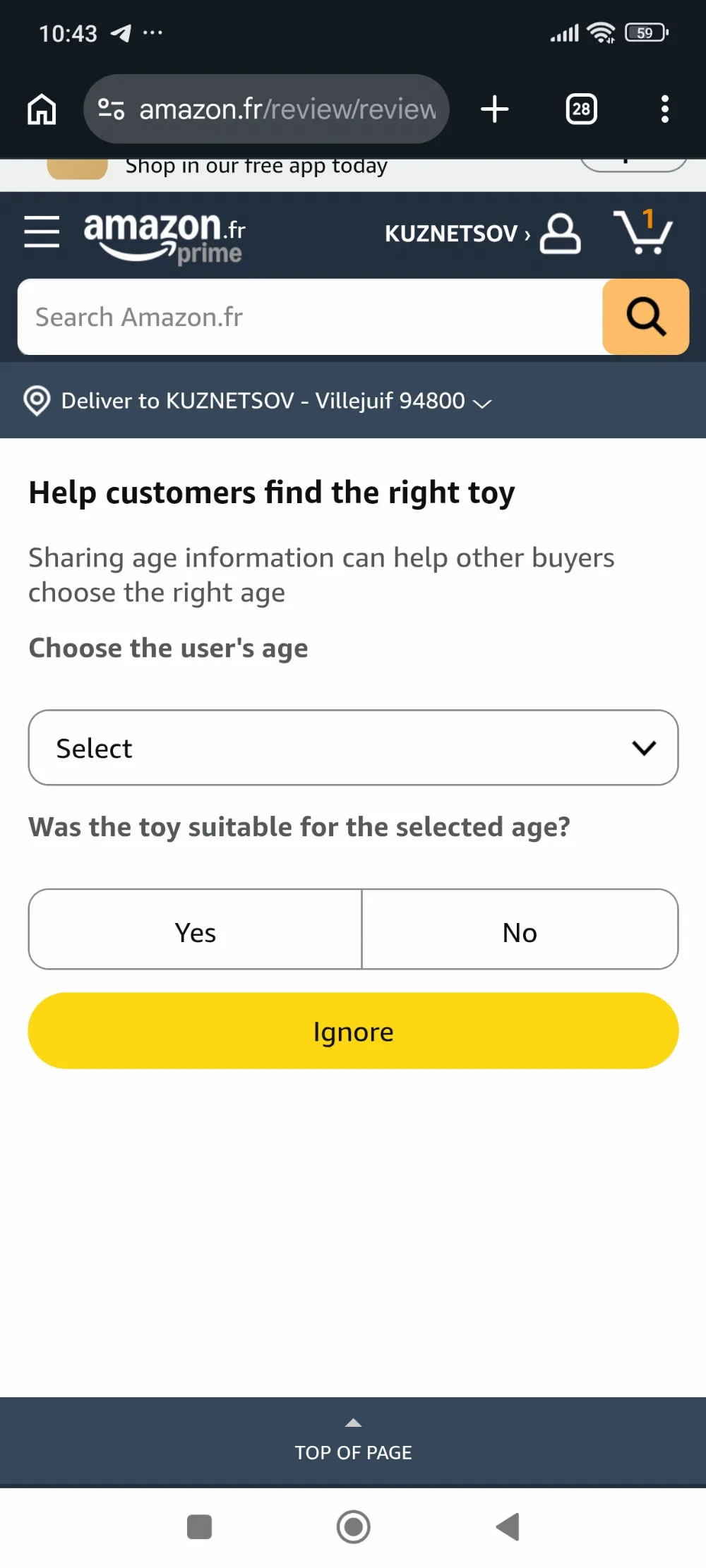
Amazon’s post-purchase suitability prompt, captured by the French Kiss blog team in October 2026. Account details anonymized.
It looks like a tiny form. In practice, it turns a free-text opinion into a structured record: product, user age, fit, yes or no. Amazon already runs this logic in apparel. Since January 2024, Fit Review Highlights summarize what reviewers say about sizing, and a Fit Insights tool shows brands where their size charts fail (Amazon, 2024).
In the toy prompt, this template expands from “does this fit your body” to “does this fit your life.” When it comes to pet products, the following questions come naturally. How much does your dog weigh? How hard does he chew? How old is your cat, and does she like it?
Which Data Sources Does Amazon Rufus Read?
Rufus answers shopper questions by retrieving data from four sources Amazon has disclosed: the product catalog, customer reviews, community Q&A, and curated web content. A query planner first classifies the shopper’s intent, then Rufus pulls the matching evidence before it writes an answer (Amazon Science, 2024).
The catalog is powered by COSMO — Amazon’s common-sense knowledge graph. COSMO analyzes the relationships between products and buyer intent based on “search-purchase” pairs and “related purchases” pairs. In a test conducted on 10% of U.S. traffic, COSMO increased user navigation activity by 8% and product sales by 0.7% (ACM, SIGMOD 2024).
The pattern matters more than any single source. Your listing is one input among several, and it is the only one you write. Everything else comes from what buyers search, buy together, and report after delivery.
What Amazon has confirmed, and what it has not
Amazon confirms that Rufus draws on catalog data, customer reviews, community Q&A, and web content. Amazon has not published how it uses post-purchase suitability answers such as the age prompt. Treat the link to Rufus as the logical pipeline, not a documented one, and confirm details with your Amazon account team.
How Amazon Started Talking Directly to Your Customers
Here’s what most brands miss: you didn’t even know it happened. Amazon asked your customer a question about your product, and you never saw either the question or the answer. No email, no notification, not a single line in a report. It’s a bit like finding out that your dog has been talking to the neighbor over the fence for several months straight.
Amazon now talks to your customers on both sides of the sale. Before the purchase, shoppers ask Rufus about your product, and Rufus answers for you. After delivery, Amazon asks buyers who used the product and whether it suited them. The brand sits outside both conversations.
That gives Amazon product knowledge the brand often lacks. You know what you sold. Amazon learns the age of the child who played with it, the size of the dog that wore it, and whether it worked. Amazon’s communication guidelines restrict proactive seller messages to order-related topics, so brands cannot run the same survey themselves.
The answer is not to fight Amazon for the conversation. It is to answer those questions in your own listing before Amazon asks your customers for you.
Why Rufus Data Gaps Cost Pet Brands Sales
Rufus generated nearly $12 billion in incremental annualized sales in 2025, and more than 300 million customers used it that year (Amazon, 2026). Rufus users are 60% more likely to complete a purchase than non-users (Amazon, 2025). In Q1 2026, Amazon reported Rufus monthly active users up 115% year over year and engagement up 400% (Amazon, 2026).
Rufus also shortens the shelf. An Amalytix study of more than 1,300 Rufus recommendations found none rated below 4.0 stars and a median of 2,991 reviews.
The pet category raises the stakes. US pet industry spending reached $158 billion in 2025, and APPA projects $165 billion for 2026. About 71 million US households own a dog and 53 million own a cat (APPA, 2026). North America held about 40% of the global pet care e-commerce market in 2024 (Grand View Research, 2024).
Which Pet Product Attributes Do Buyers Report That Listings Miss?
Most pet listings describe the product. Buyers describe the pet. The table maps that gap for five common categories.
|
Category |
What the listing usually says |
What buyers tell Amazon |
Rufus question it can answer |
|
Dog chew toys |
“Durable,” “tough” |
Dog weight, breed, chew style, days until destroyed |
“Best toy for a 70 lb power chewer?” |
|
Harnesses and collars |
Size chart in inches |
Breed, real fit, escape incidents |
“Which harness fits a deep-chested greyhound?” |
|
Dog and cat food |
“All life stages” |
Pet age, acceptance by picky eaters |
“Will my 12-year-old cat eat this?” |
|
Cat litter |
“Low dust,” “odor control” |
Number of cats, odor after several days |
“Best litter for a three-cat apartment?” |
|
Puppy and kitten toys |
“For puppies” |
Age in weeks, teething use |
“Safe chew toy for a 10-week-old puppy?” |
The gap follows an old French rule: qui ne dit mot consent, or silence gives consent. When your listing says nothing about weight range or chew strength, the buyer’s answer becomes the official one. And a buyer whose beagle shredded your “indestructible” toy before lunch will not phrase it kindly.
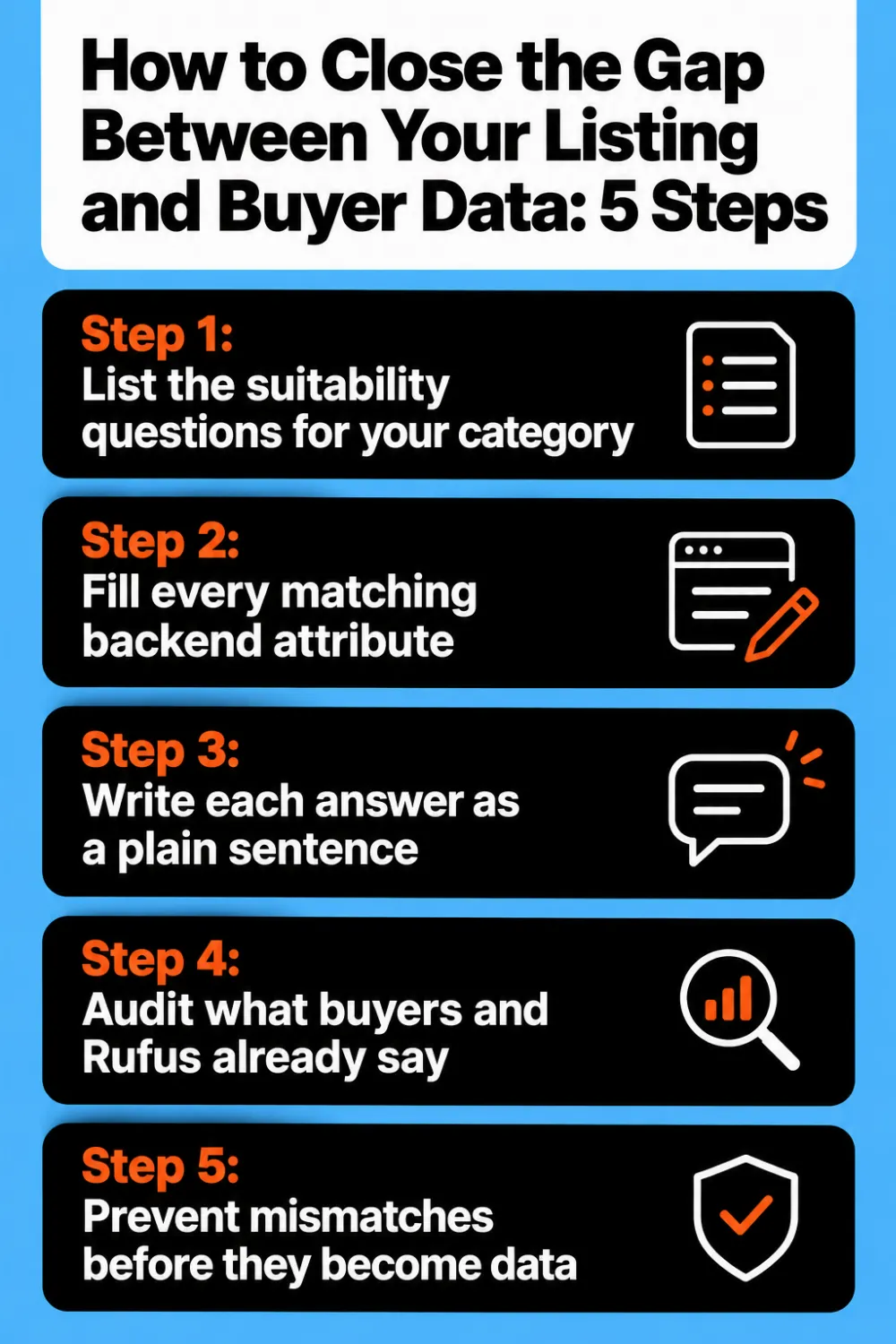
How to Close the Gap Between Your Listing and Buyer Data: 5 Steps
Step 1: List the suitability questions for your category
Write down the three to five questions a buyer would answer after delivery: weight, breed size, age, chew strength, number of pets. Shoppers ask Rufus those same questions before they buy. This list becomes your content brief for every ASIN in the category.
Watchout: Do not copy a competitor’s question list. A cat tree and a cat food answer very different questions, even when the same cat judges both.
Step 2: Fill every matching backend attribute
Complete target species, life stage, breed size, dimensions and weight capacity in your catalog data. These structured fields help Amazon classify the product before a single review exists. Check the category template, because pet attribute fields change more often than most brands notice.
Watchout: An empty attribute does not stay empty for Rufus. Review data you do not control fills the gap instead.
Step 3: Write each answer as a plain sentence
Rufus extracts evidence from the text, so describe features using complete sentences in list form and create “A+” content. “Suitable for dogs weighing 25 to 60 pounds with a chest circumference of 22 to 32 inches” is better than “Suitable for most medium-sized dogs.” A single sentence with specific numbers answers a dozen of Rufus’s questions at once.
Watchout: Overclaiming backfires. “For all chewers” invites a wave of “No” answers from owners of very determined terriers.
Step 4: Audit what buyers and Rufus already say
Every month, read your last 50 reviews and Q&A posts and tag each attribute buyers mention. Then ask Rufus your five category questions and log whether your ASIN appears and how Rufus describes it. Feed every new finding back into steps 2 and 3.
Watchout: Rufus answers vary by session and by shopper. Log several runs before you change a listing.
Step 5: Prevent mismatches before they become data
Include life-size photos showing the product being worn by real pets of various sizes. Include a size chart in the box so buyers can check if the product fits before taking their pet on its first walk. The fewer mismatches, the fewer “No” answers to Amazon’s questions.
Watchout: Amazon prohibits requests for positive reviews and any review incentive. Inserts may explain sizing, but they must not steer ratings. Use only neutral tools such as the Request a Review button.
The Takeaway for Pet Brand CMOs
Amazon will keep asking your customers questions, and Rufus will keep repeating the answers. The brands that win answer those questions first, in their own listing and in their own words.
Netpeak US audits pet listings for Rufus readiness, from backend attributes to review and Q&A gaps. Talk to our marketplace team before your customers write your size chart for you.
Bonne chance - and may your Subscribe & Save conversion rate be ever in your favor!
FAQ
How does Amazon Rufus decide which pet products to recommend?
Does Amazon use post-purchase survey answers in Rufus?
Which product attributes matter most for pet brands on Rufus?
Can brands see the answers buyers give to Amazon’s post-purchase questions?
Can a brand influence what buyers report to Amazon after a purchase?
How big is Rufus as a sales channel in 2026?

 0
 0
 0
 0
Related Articles
What Vibe Coding Means for Business: No Coding Skills, One Weekend, One SaaS
Vibecoding is changing the rules for front-end development and opening up new opportunities for businesses, but there are some nuances to consider.
Business Apps in the US: iOS vs. Android, September 2026
We searched for US App Store and Google Play data to see what business apps professionals, shoppers, and investors actually installed in September.
Pet Food Product Patent: How to Protect Your Innovation
Patenting pet products requires careful consideration and proper application filing. With the 8 steps below, you will be able to submit your patent application and protect your invention.