
Review of Pet Care Ad Rules This Year (2026)
In 2026, the FDA allowed more flexibility with color labeling for pet food, Google relaxed its pharma-ad certification, and some states made pet-sale laws stricter.
|
Change |
What happened |
In plain terms |
Who's affected |
Source |
|
|
1. |
FDA color-labeling leniency extended to pet food |
Feb 2026: enforcement discretion on "no certified colors" claims |
Already given for human food, now they apply to animal food using the same additives |
Pet food labeling/marketing |
|
|
2. |
Google loosened pharma-ad certification, kept animal-drug keyword limits |
Jan 2026: removed certification requirement for programmatic pharma ad buyers |
Animal prescription-drug keywords still restricted to certified advertisers in US/Canada |
Pet pharmacy & animal-medicine advertisers |
Google – Healthcare and Medicines policy, Google Merchant Center – Healthcare & Medicines |
|
3. |
State pet-sale laws tightening |
Jan 2026: California’s AB 519 bans online brokers reselling animals bred by others for profit; April 2026: Colorado's HB 1011 bans pet-store sales of dogs/cats (adoption listings still allowed) |
Both laws are trying to cut off the pipeline between mass breeders and stores/websites, pushing more pet sales towards adoption |
Pet retailers, online brokers, breeders |
1. The FDA Loosened One Small Labeling Rule for Pet Food
In February 2026, the FDA let human food companies say "no artificial colors" on a label even if the product still has some added color — as long as that color comes from a plant or mineral source instead of a lab-made petroleum dye.
They confirmed the same leniency applies to pet food too (FDA). Before, companies could only claim "no artificial colors" if the product had zero added color of any kind, not even natural ones like beet juice or turmeric.
It’s a small regulatory change, but it gives brands a little more room to turn product formulation into a marketing message — something we’ve also seen in some of the best pet care marketing campaigns of 2026.
2. Google Eased One Pharma Ad Rule — But Animal-Drug Restrictions Still Apply
Starting in January 2026, Google updated its pharmaceutical policy for Authorized Buyers.
They allowed eligible advertisers to promote prescription drugs and prescription drug services in certain countries without needing Google’s healthcare certification (Google Support — Pharmaceutical Products and Services Policy).
But this change does NOT apply everywhere. Rules vary by platform and market, which is another reason pet brands expanding internationally can't simply copy and paste the same strategy from one country to another. We've seen similar differences in pet care marketing behavior in the US vs. Europe.
Regular Google Ads (the search and YouTube ads most people are familiar with) still require certification for anyone advertising prescription drugs. The same certification logic applies to human medical services, not just animal drugs — see our breakdown of the ad rules Google Ads has for medical services.
Separately, Google still has a specific rule for animal medicine: if you're targeting the US or Canada, you can't use certain prescription-animal-drug keywords in your ads unless you're certified to do so (Google Support — Restricted Drug Terms).
3. Some US States Passed Laws That Limit How Pet Sellers Can Market Animals
These aren't "advertising laws" exactly, but they restrict what sellers are legally allowed to claim or do — which changes what can go into an ad.
For example, California's new AB 519 law stops online brokers from reselling puppies, kittens, and rabbits bred by someone else for profit. This is a rule aimed at stopping puppy-mill animals from being marketed as coming from small, ethical breeders.
And Colorado's HB 1011, signed in April 2026, will stop pet stores from selling or leasing dogs and cats starting in 2027. Though stores can still advertise animals that are up for adoption (CasevetsGlobalPETS).
This is a real change, but scattered across a few agencies and companies rather than one unified update.
That makes channel selection and messaging more important, especially for brands running campaigns across several platforms. Our Petloc8 multi-channel case study, for example, shows why pet marketing works better when each channel has a clear role rather than simply repeating the same message everywhere.
What Pet Brands Should Do About These Changes
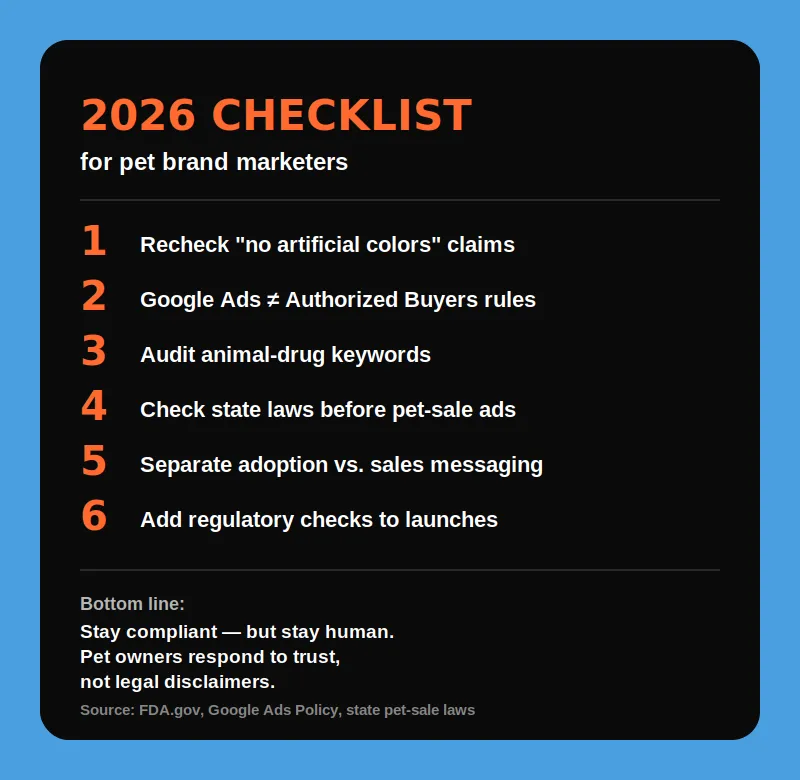
These updates don’t require you to rebuild your pet brand marketing. They just give you a few things to check in 2026:
-
Revisit your "no artificial colors" claims. If your pet food uses colors derived from plant or mineral sources, check whether the FDA's updated interpretation gives you more flexibility in how you describe the product.
-
Don't assume Google's pharma update applies to Google Ads. The relaxed certification rule is specific to Authorized Buyers. If you're advertising veterinary drugs or related services through regular Google Ads, check the applicable certification requirements before launching a campaign.
-
Audit animal-drug keywords separately. Campaigns targeting the US or Canada may face restrictions on certain prescription animal-drug terms, so review keyword lists as well as the claims in your ad copy.
-
Check state laws before running pet-sale campaigns. If you sell, broker, or advertise live animals, requirements can differ substantially by state. A campaign that's acceptable in one state may promote a transaction that's restricted in another.
-
Separate adoption messaging from sales messaging. As more states restrict retail pet sales while allowing stores to promote animals available for adoption, make sure your ads clearly distinguish between the two.
-
Add regulatory checks to campaign launches. Make FDA + platform-policy + state-law reviews part of your pre-launch checklist, but don't let compliant copy turn into legalese. Pet owners still respond to emotion, trust, and relatable messaging — which is why empathy can beat technical specs in pet care marketing.
FAQ
What changed in pet care ad rules this year?
A few things shifted in 2026, though nothing huge and unified. The FDA gave pet food a little more breathing room on "no certified colors" labeling. Google tweaked its pharma ad policy for programmatic buyers. And a couple of states — California and Colorado — passed laws that quietly limit how pet sellers can market animals.
What platforms have the most stringent ad rules for pet care?
Google Ads is the strictest ad platform hands down — especially if you're anywhere near pet medicine. You'll need outside accreditation from LegitScript or NABP plus Google's own certification, and campaigns are locked to the US and Canada. Meta's a bit more relaxed on the paperwork but still strict on medical-sounding claims.
What's the easiest way to stay compliant in 2026?
Three simple habits go a long way:
-
Have your evidence ready before the ad goes live — not scrambling to find it after someone flags it (that's the whole point of the FTC substantiation rule).
-
If you're selling pet meds or supplements, get accredited before you even think about running paid ads.
-
Keep half an eye on your state's pet-sale laws — they're moving faster than federal rules right now.
Do pet food ads need FDA sign-off before they go live?
No pre-approval needed. But specific claims like "supports urinary tract health" need real backup under FDA guidance. Cross the line into "treats or cures a disease," though, and suddenly your kibble is being regulated like a drug — not a fun place to end up.
Can small pet brands actually get in trouble, or is it just the big brands?
Everyone's fair game. These updates don't care how many followers you have — it applies to any business making claims in commerce. Enforcement tends to focus on bigger names, sure, but a platform can still yank your ad or suspend your account regardless of your brand's size.

 0
0
 0
0
 0
0
 0
0
Related Articles
What Vibe Coding Means for Business: No Coding Skills, One Weekend, One SaaS
Vibecoding is changing the rules for front-end development and opening up new opportunities for businesses, but there are some nuances to consider.
Amazon's AI Now Builds Complete Looks on Product Pages. How Do Brands Make Sure the Bundle Is Theirs?
Amazon now uses AI to assemble complete, shoppable looks around a single product, and it fills those looks with whichever brands its model picks.
Pet Food Product Patent: How to Protect Your Innovation
Patenting pet products requires careful consideration and proper application filing. With the 8 steps below, you will be able to submit your patent application and protect your invention.